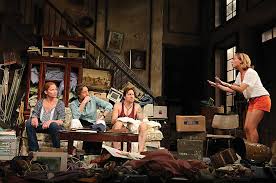
Tanya Barfield’s Bright Half Life, produced by the Women’s Project Theatre, is beautifully cast with actors who sparkle through their roles as a long-term lesbian couple who come together and move apart and return to one another over 25-odd years.
Played with comic verve and deep feeling by Rachael Holmes and Rebecca Henderson, Vicky and Erica meet cute at work in the early 80s and get together despite Erica’s uneasiness about the aimlessness of her own career. They have children at a time when lesbians could barely imagine creating their own families. They eventually get married in Massachusetts, divorce, and suffer deaths and health crises before and after they break up. In other words, the play charts a relationship similar to many others over its long and various life.
But Barfield’s conceit is that time collapses on the couple, so that we see the relationship’s beginning, middle, and end all at once, in short scenes that rocket backwards and forwards, hither and yon, across time. It’s a fun and often funny concept, which director Leigh Silverman handles with her typical economy and precision. The stage (suggestively designed with clarity and nearly Scandinavian modernism by Rachel Hauck) is bare except for two gray, long, flat benches and the occasional metal bar that drops from the flies to represent, for instance, the safety latch on the gondola of a Ferris wheel the couple rides. Jennifer Schriever’s lighting demarcates the play’s ever-changing moments and moods, as Vicky and Erica cycle through significant life events and their attendant light, dark, or grey emotional tones.
Sitting together on the Ferris wheel (Holmes, r., and Henderson)
Holmes and Henderson call up the couple’s ever-morphing emotions in rapid rotation. But what the production doesn’t quite convey (at least not in a late preview performance I saw) is the impression that this relationship is, in its longer-toothed moments, lived in and comfortable. Vicky and Erica should evince a persuasive physical and emotional intimacy, despite what become the chafing moments of long-lasting coupledom.
Barfield’s dialogue establishes appropriately knowing rhythms, as the couple talk over one another and finish each other’s sentences. But it’s challenging for actors to find their way so quickly to very different places along a continuum of feeling and time, and to move so sharply in and out of the emotional and physical challenges of representing 25 years of intimacy. As a result, all the play’s events seem, strangely, to happen right now, which compresses what I”m sure Barfield and Silverman mean to be a more expansive and complicated sense of past and future.
The play’s time scheme is represented in allusive shorthand. Vicky and Erica meet in the early 1980s, when word-processing and temping were popular ways for under-employed intellectuals to make a living in New York. Erica volunteers for a helpline perhaps connected to ACT-UP or HIV/AIDS activism; Vicky’s apartment boasts a land-line with a long, tangled cord, rather than wireless handheld receivers. Later, Erica becomes despondent when the Challenger flight explodes; Massachusetts legalizes marriage. But these events and references remain signposts to the story, ways to situate us in history rather than to deeply effect how Vicky and Erica produce and live in their on-going relationship.
Holmes and Henderson are game and determined, and their charm goes a long way toward making the production a vivid, warming 75 minutes. But that deeper layer, which would let the pair explore the costs and deep mutual effects of what it means to be together for so long, wasn’t quite reached in the preview I saw. Instead, despite its clever premise, pleasing theatrical style, and winsome performances, the play felt familiar. That their relationship forms, sediments, and breaks apart doesn’t feel as surprising or revelatory as it might.
Vicky (Holmes) and Erica (Henderson) motoring through their lives
On the other hand. Holmes is African American and Henderson is white, as are their characters, Vicky and Erica. Their biracial relationship makes the uniqueness of this square-on theatrical attention to a long-term lesbian couple that much more worthy of our time and consideration. And although the events of the relationship don’t surprise, the fact of it still seems to me notable and important. As Barfield remarks in a Huffington Post story on the play, “As a biracial gay woman, the politics of simply being alive has been part of my life since birth . . . Existence within a larger social construct grace notes all of my work.” Likewise, Vicky and Erica’s relationship in the play is also gilded with the politics of history, whether the play engages it directly or not.
I admired this production of Bright Half Life, as I’m a fan of Barfield’s and Silverman’s work, in my roles as spectator, critic, and feminist.Although I might have wanted the play’s memory to cut a bit deeper and to last a bit longer, I was glad for the ride, one I urge you to take, too, as there’s a lot to like and enjoy in Bright Half Life.
The Feminist Spectator
Bright Half Life, produced by the Women’s Project Theatre, New York City Center Stage II. Through March 22, 2015.
I recently finished binge-watching the second season of The Fall, a BBC series I highly recommend. Gillian Anderson is riveting as Stella Gibson, a British detective superintendent brought in from England to help oversee the investigation of a serial murderer named Paul Spector in Belfast. The show is essentially a procedural, a genre distinguished by how its examples address character, mood, and plot. The Fall excels on each count.
Told from both Stella and Spector’s perspectives, the suspense comes not from wondering about the murderer’s identity but rather from how the series draws the tension tautly between the two, who are, of course, more alike than they are different, and by how it shows their characters without telling us much of anything about their back-stories. Although Spector has a sick fascination with dark-haired professional women, whom he stalks and learns enough about that his crimes feel personal, he’s also a competent grief counselor (of all things) and a loving father (if a rather remote husband). Stella, likewise, revels in her own sexual agency and her sharp intelligence; she’s very, very good at her job and doesn’t suffer fools. Her precision and emotional acuteness, overridden by her public need to be controlled and authoritative, mirrors Spector’s.
Stella Gibson (Gillian Anderson), always on the look-out
Both the detective and the murderer are supremely intelligent and wily; both use their complex desires toward different but ultimately complementary ends. The closer they get to their climatic meeting, the more their similarities clarify, which makes their showdown a marvel of acting, writing, and editing (by Steve Singleton). As Spector insists Stella join him in the interview room when he’s finally captured, the camera frames their faces in close-up, almost like portraiture, prowling back and forth between them as though it’s the referee in their boxing match, waiting for one of them to break. That neither ultimately gives up testifies to depth of the series producer Allan Cubitt’s writing and to the impeccable skill of the actors who play these characters.
Anderson offers a beautifully disciplined performance as a professional woman who doesn’t let her job get in the way of her desires, but who is burdened with emotional damage that’s never completely revealed. The Fall parcels out information that explains bits and pieces of back story and motivation without satiating the spectator’s curiosity about these characters and their actions. We come to learn a bit about the deprivations of Paul’s early life. He was adopted, his mother committed suicide, he moved around foster care, and he was nearly abused by a pedophilic priest. But nothing really explains his predilection for stalking and strangling professional young women, or his narcissistic god-complex.
God-like Paul Spector (Jamie Dornan)
Likewise, Gibson prefers one-night stands with men of her own choosing instead of emotional entanglements. We learn that she has a troubled emotional past in which her unresolved relationship with her father figures heavily. But The Fall knows that the details only matter for what they compel the characters to do in the present. Human nature, Gibson suggests, can’t be explained. It can only be controlled as much as possible through laws that enforce the ever-more tenuous social contract.
Both characters’ contradictions fascinate. Gibson is on the side of morality and truth, but her one-night stands make her seem corrupt, though she feels no compunction for her actions. Spector is a serial murderer and sexual predator, but he’s a sought-after grief counselor, an occupation that demonstrates his ability to empathize even as we see him show no mercy for his victims or remorse for their deaths.
Burns (John Lynch), Stella, and a CSI guy at a scene
Unpredictable human behavior preoccupies The Fall’s creators, and they grace Stella Gibson’s character with insight. When her superior, Jim Burns (John Lynch)—a married man with whom she has some sexual history—appears one night in her hotel room distraught and drunk and tries to force Stella to have sex with him, she refuses but forgives him the next day, remarking that everyone has complicated desires and needs. The trick, she says, is knowing how to manage them appropriately. In fact, the very same evening, Stella has made a pass at Reed Smith, the local medical examiner, played with her typical sexually ambiguous magnetism by The Good Wife’s Archie Panjabi. Their easy gender camaraderie, intensified by alcohol that evening, magnifies into sexual attraction. But when Smith balks on her way to Stella’s hotel room, Stella understands how easy it is to be lead into beds that might not, after all, be appropriate.
Reed Smith (Archie Panjabi) and Gibson (Anderson) in an intimate moment
Stella Gibson’s implicit, often unarticulated empathy is part of how she navigates a world filled with sexual, ethical, and gendered double standards. When Burns insists that Spector is a monster, Stella retorts that in fact, Spector’s only human. She can finally prevail over the villain because her more capacious view of human folly makes her better understand how her nemesis thinks and feels. Although she appears “cold,” her empathy makes her passionate and keenly observant.
Jamie Dornan, the Belfast-born actor soon to rocket to fame as the lead in the film adaptation of 50 Shades of Grey, is terrific as the taciturn, mysterious, and brutal Paul Spector. Part of the character’s power comes from Dornan’s ability to communicate his psychic complications. When he’s counseling his clients, Spector is calm and empathetic, his manner physically remote but intellectually acute. Often, Spector says little, but Dornan uses his deep, dark eyes and a twitch of his jaw to communicate the character’s interior machinations. Spector is a ruined but powerful man; Dornan does justice to his skill and his intelligence and, on some level, his madness. He makes Spector a fearsome presence by underlining the character’s unpredictability. He always seems one step ahead of the police and everyone else.
But The Fall’s feminism comes from its nuanced characterization of the woman in charge and from how smartly it addresses Spector’s violence against women. Her colleagues think Stella Gibson is icy and dispassionate, one of those imperious, piranha-like professional woman. But the series dismantles that stereotype without undermining the character’s power or dignity. Watching video of Rose Stagg (Valerie Kane), a young woman who’s been abducted by Spector, and feeling responsible for what will surely be Rose’s death, tears roll from Stella’s eyes, even as her face barely changes and she makes no sound. Her eyes fill often, mostly in private, frequently when she’s gazing into a screen across which evidence of some new depravity plays, just out of her reach. Stella’s feelings—of loneliness, grief, ambivalence, desire—are in fact, enormous. But she’s trained herself to manage them so that they don’t get in the way of her job.
And she’s excellent at what she does. Other women work with Stella, detectives who bristle when their male partners appear to be condescending, or uniformed officers whose fierce demeanor radiates a “don’t fuck with me” strength. These professional women counterbalance the female victims on whom Spector preys, although The Fall carefully avoids judging them. They suffer from bad luck. They all try to fight Spector off and do their best to save themselves. They’re not to blame for their own ends. Melissa Maerz, in her Entertainment Weekly review, notes that the writers show the aftermath of Spector’s crimes, as we see the victims’ families in shock and learn more about the victims after their deaths. This careful rendering of the murdered women gives them lives to be mourned, filling in the outlines of what are usually two-dimensional, conveniently dispatched and apparently disposable people. (Sonia Saraiya, in Salon, also wrote a nice piece about the series’ feminist analysis of violence against women.)
FS2 was disappointed that second season capitulated to the conventions of the genre by psychologizing Stella, making sure we know she is damaged to explained why she’s so good at her job and suggesting that her own family narrative makes her prey to Spectator’s mental manipulations. In procedural suspense stories like these, the formula requires two damaged souls, one on the side of right and the other on the side of wrong, who battle to see who’s more capable of functioning in the world they’ve inherited. Without some trauma fueling her single-mindedness, Stella Gibson wouldn’t be worthy enough as Spector’s opponent.
Katie (Aisling Franciosi) and Spector
The series is filmed stylishly by cinematographer Ruairi O’Brien, who finds surprising angles on each scene and photographs Belfast in often jarringly beautiful ways. The cinematography’s lush look seems at odds with such a dark and violent story, but it underlines the series’ thematic ambivalences. Likewise, though Spector’s perverted sexuality is the root of his violence, The Fall doesn’t eschew sex but admits to its inevitable complications. Spector manipulates Katie (Aisling Franciosi), his family’s 15-year-old babysitter, to fall in love with him. Katie’s precocious understanding of the intimate link between desire and power offers another character’s perspective through which the distortions of sexuality and desire play out with tragic consequences.
In a post-coital mood of reflection after one of her one-night stands, Stella tells her male sex partner that men are afraid of women because they’re terrified women will laugh at them. Women, on the other hand, she says, are afraid of men because they fear men will kill them. (This quote apparently originates with Margaret Atwood.) All the The Fall’s characters carefully tread that fault-line of fear.
Anderson, sublime as Gibson
Anderson is sublime as Stella Gibson. Like many independent, thoughtful, singular women crime-solvers in film and television, Gibson swims alone in an eerily empty pool (think Kerry Washington’s Olivia Pope, in Scandal). She wears her beautifully cut clothes with a careless disregard that only heightens her beauty. Gibson speaks so quietly—in a gorgeously upper-class but somehow languid English accent—that people have to lean towards her to hear. And she tosses back her whiskey, neat. Anderson gets Gibson’s edges and soft spots perfectly right. No Botox is evident on the actor’s face, just a beautiful and somewhat lined, weary and wise platform for emotions that flicker and pass, and thinking that leads a squad to the side of righteousness.
Watching the Golden Globes isn’t even a guilty pleasure. It’s more along the lines of eating something I know will disagree with me, but for some unfathomable reason, being unable to resist and utterly regretting it afterwards. Jokes about who exactly comprise the “Hollywood Foreign Press” abound (most pointedly last night by Wes Anderson, when he won Best Movie comedy or musical for The Grand Budapest Hotel, surprisingly, given that his film ran against Birdman, which had taken so many awards in its category).
But the awards are still taken more seriously than they deserve to be—this year, NBC’s Matt Lauer appeared on the red carpet to ask the arriving stars stupid questions. The awards bestowed seem capricious (Fargo for best mini-series or televised film event? Really? Against Olive Kitteridge, The Normal Heart, or even True Detective, which I liked less than most?). And rather than a jury of their peers, the artists gathered are judged by critics whose names they gleefully (if rather xenophobically) can’t pronounce.
Sometimes, I think I watch awards shows like the Globes because it’s live TV, which always provides a frisson of possibility and pleasure. What might go wrong? Not just John Travolta mispronouncing Idina Menzel’s name or, last night, Kevin Spacey’s incredulous cursing bleeped out of the feed when he said I can’t “fucking believe I finally won.” I watch hoping that the actors will take the opportunity of their very visible, live, potentially unedited public moment to say something of import. That’s because I want to continue to believe that artists can be smart and politically engaged, as well as talented.
Political gesture of the evening on the red carpet
Some rose to the occasion: George Clooney received the year’s humanitarian award. The sublime hosts Tina Fey and Amy Poehler, of whom we didn’t see enough all evening, joked about the irony of his being recognized, given his wife Amal’s more obvious humanitarian accomplishments. Clooney ended his speech by referring to the marches staged across the world that day that decried the attack against the Charlie Hebdo editors and artists in Paris. He insisted we should refuse to live in fear and ended with “Je suis Charlie.” I believed it more from him than from Jared Leto or the few other performers who made obligatory reference to world events.
But so few presenters even did refer to anything outside of the self-congratulatory moment. The amazing, important, beautifully rendered Selma received only one award, for Best Song for “Glory,” which gave Common and John Legend a chance to mount the dais and talk earnestly about how much they learned about history from working on director Ava DuVernay’s remarkable film. They connected the voter registration actions in Selma in ‘65 to the events of Ferguson and to the #BlackLivesMatter movement, and seemed obviously moved not just by being honored but by their involvement with a film so meaningful to them both.
Common and John Legend, accepting Best Song award for “Glory” in SELMA
Common said that DuVernay’s film “elevates us all and brings us all together,” remarking that the film “awakened my humanity.” Legend said they wrote the song as inspiration for those fighting for their civil rights now. But the film apparently didn’t inspire enough of the Hollywood Foreign Press to make it award-worthy, as Selma lost in all its other categories. The impressive David Oyelowo was overlooked for his spectacular performance as Martin Luther King; DuVernay’s rightful Best Director trophy went to Richard Linklater instead, as did the Best Film award, a sad signal that Boyhood will most likely trump Selma at the Oscars, too.
Boyhood is actually a terrific, moving film (though FS2 remarked that the first third of the film is as much about the little girl as it is about the boy). Patricia Arquette’s Globe win for her nuanced, authentic, and very personal role as the boy’s mother was well deserved. Her speech made common cause with the hardships of all single mothers, and honored the grit and determination it takes to make your way alone with young children.
Boyhood turned out to be about a marriage and what it means to age into adulthood and beyond as much as it was about a little boy’s journey toward becoming an interesting young man. In his acceptance speech, Linklater honored his own parents as he reminded the audience that families are important and parents are always flawed. Sure, fine. But is Linklater’s domestic drama with a circumscribed world view really more important than Selma? We’re a nation that likes to forget its history as soon as it happens. Shouldn’t Selma’s timely reminder be worth recognizing? The choice of Boyhood over Selma, and DuVernay’s film’s invisibility through much of the evening, just seemed blatantly wrong. I was disturbed all evening by how this snub seemed to close history back over on itself again, conveniently out of sight, out of mind.
Gina Rodriguez, JANE THE VIRGINViola Davis on the carpet
Racial justice seemed off the table for the Hollywood Foreign Press. Happily, Gina Rodriguez won for her role in the new television series Jane the Virgin, and breathlessly referred to her pride in representing a culture “who want to see themselves as heroes.” But Viola Davis lost for her incisive performance in How to Get Away With Murder to the Ruth Wilson in The Affair. (Wilson’s acceptance speech sounded only smug.) Every time one of these white people or projects won against a person of color or a film or television show about race, the glaring slights seemed brushed away like so much lint on a fancy tux.
In the Best Actor in a film competition among men playing great men, Eddie Redmayne won for his performance as Stephen Hawking over Oyelowo as Martin Luther King. Of course the strapping heterosexual guy (Redmayne referred to his new wife and their honeymoon numerous times in his speech) who had to twist his body, silence his voice, and perform from a wheelchair would win against the British African man playing the well-spoken, inspiring, burdened African American icon of the civil rights movement. We could have predicted that.
Frances McDormand, unadorned and unimpressed
And perky young Maggie Gyllenhaal won for The Honorable Woman over Frances McDormand’s remarkable performance as a middle-aged curmudgeon in director Lisa Cholodenko’s adaptation of Olive Kitteridge, because really, who wants to watch a woman age across 25 years in a mini-series? McDormand sat in the crowd at the Golden Globes peering intently at the proceedings, with her hair wild and her face unadorned and her dress covering her chest. Her demeanor and her costume marked her as an outlier in a gathering where 90% of the women wore gowns with plunging necklines that left all but their nipples exposed, their cleavages oiled and their breasts puffed out like ornaments. Good for McDormand, whose presence and postured raised the middle finger at all that retrograde gender display. Her acceptance speech would have been terrific.
Lily Tomlin and Jane Fonda presenting
Some of the women who won did try to insert a little gender commentary into the proceedings. Gyllenhaal described how much more complicated women in film and television are becoming as characters, and Amy Adams, when she won for Big Eyes, thanked her co-nominees for challenging her young daughter to think about gender in more complex ways. Jane Fonda and Lily Tomlin, the evening’s matriarchs, looked resplendent and affectionate with one another. They joked as they gave the award for Best Actor in a musical or comedy that they were pleased to be dispelling the stereotype that men just aren’t funny. Fonda ended the bit by proclaiming, “You’ve come a long way, baby!”
Fey switched to a Dean Martin-esque tux later in the evening . . . a nice choice
This sly gender reversal comedy began early in the evening, with the always sharp and funny co-hosts Fey and Poehler noting that people might have been impressed with Steve Carell’s two-hour-long make-up session for his transformation into his Foxcatcher character, but the two of them spent three hours that evening preparing for their roles as “human woman.” Fey and Poehler also joked that Arquette’s role indicates what good parts there are for women over 40, as long as they’re cast before they’re 40. And for the last bit in their opening, they played “Who would you rather?” a game in which they named pairs of male stars to illustrate that they have opposite sexual tastes in men.
Julianne Moore
Julianne Moore, accepting an award for Still Alice, said that early feelers about the movie indicated fear that no one would be interested in the physical deterioration of a middle-aged woman. Moore made her speech with her own beautiful face proudly displaying the lines on her forehead and around her mouth. Such obvious lack of surgical intervention was unusual in an evening where more women boasted immobile faces and frozen smiles.
Matt Bomer won for THE NORMAL HEART
The gays did okay, better, in any case, than the people of color nominated. Although The Normal Heart took very few awards, Matt Bomer represented the film well when he won for his moving performance. Humble and sweet, Bomer thanked his husband and their three kids. He invoked the memory and spirit of those lost to HIV/AIDS and who continue to die from the virus, and thanked HBO for making films that people need to see and hear.
Jill Soloway and Jeffrey Tambor win for TRANSPARENT
Likewise, Jill Soloway, winning for her Amazon-produced series, Transparent, and accepting the award in a men’s-style suit in a geometric blue and purple pattern, dedicated the award to the memory of Leelah Alcorn, the transgender teenager in Ohio who recently committed suicide. Soloway also referred to her own trans-parent, and thanked her for “teaching the world something about authenticity, truth, and love.” When Jeffrey Tambor won for his marvelous turn as Mort/Maura, the trans-parent on Soloway’s series, he said, “This is much bigger than me. . . . Thank you for the gift and the responsibility of Maura Pfefferman.” Tambor dedicated his performance and the award to the transgender community, saying “Thank you for your courage, your inspiration, your patience, and for letting us be a part of the change.”
Cho as the North Korean movie critic didn’t work; not her fault, though
Fey and Poehler announced that this would be their last time hosting the Globes, which is a shame, since their pointed, feminist humor makes at least the beginning of the evening seem worthwhile. Using Margaret Cho, however, to play a dour North Korean movie critic who popped up to comment occasionally, and whose presence let the hosts point out the absurdity of The Interview fiasco, only wasted time.
So what to make of all this? Does it ultimately matter, the day after France and other countries mobilized to support global citizens against terrorism and for free speech? Does it matter when you read the news and see what else is happening in the world, events so much more important and relevant than what stars are wearing and what a group of unknown international critics thinks about Hollywood’s work? No, it doesn’t matter at all.
But then again. As Amy Adams said when she talked about her four-year-old daughter, the stories these films and television shows tell do matter. Clooney was right when he said you remember the work, not who got the awards. Because it’s the work that tells us something about ourselves, as people, as a nation, as a global community. It’s the work that tells us that gender is, in fact, being reimagined and that desire is various, on shows like Transparent and Orange is the New Black and in films like The Normal Heart and Olive Kitteridge.
David Oyelowo, center, in SELMA
Films like Selma, and even the other great-men films like The Imitation Game and The Theory of Everything, teach us something we might not have known or remembered about history, and why its effects are so lasting and relevant. Our popular entertainments matter quite a lot to how we might stretch our imaginations and revise our dreams about who we are and might become, and in the process, encourage us to fight for social justice and real equality.
At Jonathan Mandell’s invitation, I’ve taken up the challenge of creating a “best of” list for 2014. My list isn’t scientific, but more intuitive and off-the-cuff. The exercise gave me a chance to remind myself of and recommend to you some of the many (nearly 80) wonderful productions I saw this year. I’ve included 20, because a feminist spectator who subscribes to critical generosity shouldn’t stop at 10 . . .!
I describe them here in the order of my viewing through the year, rather than in a ranked hierarchy. I don’t think I could single out any one of these as the very “best.” Unless otherwise noted, I saw all of these productions in New York.
***
STOP HITTING YOURSELF
Stop Hitting Yourself, by the Rude Mechs at Lincoln Center Three. This Austin-based theatre collaborative continues to innovate its form and content, always surprising me with its delightful, theatrical irreverence but sincere humanism. In a story about the contemporary gods and goddesses of the money that rules us all, they engaged the audience (literally, participation as well as direct address) in a fluid, hopeful, fantastical narrative about, among many other things, theatre and performance itself (enhanced by Mimi Lien’s brassy, Las Vegas-inspired set). Lana Lesley remains a great gift to the American theatre, a performer with so much intelligence and warm charisma that it’s difficult to tear your eyes from her any time she’s on stage. And Thomas Graves balances her zany humor with a precise, more sober, powerful physical presence that always feels thoughtful and interesting. I’ll travel great distances to see anything the Rude Mechs produce. You should, too (here’s a production montage video).
The irresistible, talented Peggy Shaw in RUFF
Ruff, written by Peggy Shaw, directed by Lois Weaver, at LaMama ETC. The redoubtable Peggy Shaw suffered a stroke a few years ago, which left her with some memory loss and a deep perspective on what it means to be alive. Ruff partly narrates her health crisis, and partly continues Shaw’s tradition of gender performativity and charismatic solo performance. She’s irresistible, moving, and wise, a long-time treasure of the feminist-lesbian-queer performance scene. Don’t miss her solo shows, as they offer a chance to absorb Shaw’s life lessons as a 60-something butch lesbian, and her talent as a lounge act-stand-up-comic-storyteller. (Full Feminist Spectator post here.)
Mimi Lien’s terrific set for CHEROKEE at the Wilma Theatre
Cherokee, written by Lisa D’Amour and directed by Anne Kauffman, the Wilma Theatre, Philadelphia. I’m looking forward to seeing D’Amour’s new play, Airline Highway, which recently opened at the Steppenwolf Theatre in Chicago. Cherokee excites with its insights into race and gender privilege, through a play that stretches the envelope of realism to consider how we can or can’t escape conventional lives. D’Amour is deeply humanist in her ethical inquiry into how we choose to live our lives and interact with one another. Her theatrical metaphor, illuminated by Mimi Lien’s inventive scenic design of a camping site, uses getting lost in the woods to ponder whether we can choose to escape the grids that confine us, practically and ideologically. D’Amour is also a talented collaborative artist, working with her art partner, director Katie Pearl (they go by PearlDamour), on a community-based project called Milton that I hope to see sometime in the new year.
ROW AFTER ROW
Row after Row, written by Jessica Dickey, directed by Daniella Topol, for the Women’s Project at City Center. I was surprised by how affecting I found this three-hander about Civil War reenactors, and the new woman who insinuates herself into two men friend’s post-performance drink at a bar. The occasion becomes a thoughtful exegesis on relationships, history, and gender inequity (and not just on simulated Civil War battlefields) and the production was modest but poignant. The Women’s Project, under Julie Crosby’s direction, grew into a worthy production company in the last decade. Now helmed by Lisa McNulty, I’m looking forward to the Women’s Project’s 2015 season.
Marian Hinkle and Jeremy Shamos in Margulies’s DINNER WITH FRIENDS
Dinner with Friends, written by Donald Margulies, directed by Pam MacKinnon, Roundabout Theatre. This revival of Margulies 1999 Pulitzer Prize-winning play got all the details right, from the ruefulness of a long-married couple watching their closest friends dissolve their own relationship, to the complexities of presuming that starting over is always the best way to a better life. MacKinnon has a knack for soberly realist productions like this. When Karen (the terrific, wry Marian Hinkle) and Gabe (Jeremy Shamos, thoughtful and sad) make their bed together, their movements are neatly choreographed, so accustomed are they to working in sync at quotidian household tasks. Margulies and the terrific cast look with a clear eye at the costs and benefits of staying together instead of moving apart.
Jessica Hecht and Michael Cyril Creighton in STAGE KISS
Stage Kiss, written by Sarah Ruhl, directed by Rebecca Taichman, at Playwrights’ Horizons. Jessica Hecht is one of the best stage actresses of our generation, and Sarah Ruhl’s new comedy, fleetly directed by the talented Rebecca Taichman, gave her lots of scenery to chew as an actor who’s cast across from an ex (a perfectly taciturn, stalwart, and sexy Dominic Fumusa). Michael Cyril Creighton, in various roles, including one as another actor flummoxed by the unraveling emotions among his fellow cast members and daunted by standing in as the romantic lead, helps keep the mood funny. Ruhl’s lark is a valentine to the theatre.
LOVE AND INFORMATIONLOVE AND INFORMATION
Love and Information, written by Caryl Churchill, directed by James Macdonald, for the New York Theatre Workshop at Minetta Lane Theatre. This visually stunning production, imported from the Royal Court in London, is composed of a series of very short, thematically connected but narratively disparate scenes, visually constructed in ways that surprise and sometimes delight. On the small black and white set that appears to be an open box with no exits (designed by Miriam Buether to look strangely askew), the lights go up and down to reveal startling changes of characters, props, and set pieces that have somehow been moved on and off with alacrity during blackouts. In these vivid settings, numerous actors in various character configurations perform snippets of dialogue that sink in and accumulate into a theatrical and emotionally involving production.
A shot of the rotating, revolving set for A DOLL’S HOUSE from the auditorium at BAM
A Doll’s House, written by Henrik Ibsen, English language version by Simon Stephens, directed by Carrie Cracknell, at the Brooklyn Academy of Music. This, too, was a London import, this one from the Young Vic and notable for Cracknell’s breathtakingly original direction. On a set (by Ian MacNeil) that turned and rotated as the play’s characters roamed from room to room in the domestic space of their stifling home, Hattie Morahan, as Nora, brought new insights to the iconic role. Cracknell’s fluid, cinematic staging allowed the audience to see the canonical work in new ways. This is a play to which new interpreters bring ever more feminist meanings. Cracknell’s keen political vision was flattered by her nearly environmental staging.
White people behaving badly in APPROPRIATE
Appropriate, written by Branden Jacobs-Jenkins, directed by Liesl Tommy, at Signature Theatre. Jacob-Jenkins’ sharp, dark comedy illustrates the intractability of racism and how it lives on as an indelible historical memory and a contemporary social practice. A white family visits their recently deceased patriarch’s homestead in Arkansas, only to uncover the remnants of his proudly racist past. By writing a play with only white characters, Jacob-Jenkins puts the responsibility for social injustice where it belongs: at the feet of the family who want, more than ever, to believe that they’re removed from a past that nonetheless stains their history and their present. Liesl’s production brilliantly theatricalized hierarchical social structures in which straight white Christian men continue to come out on top of the heap of power.
BRIDGES’ beautiful set
Bridges of Madison County, book by Marsha Norman, music and lyrics by Jason Robert Brown, based on the novel by Robert James Waller, directed by Barlett Sher, on Broadway. This musical adaptation of a sentimental best-seller that was already adapted into a movie didn’t last long on Broadway. But the show used the musical theatre idiom to bring new and much less sappy colors to the story. As the housewife surprised by large emotions for a man who passes through town while her husband and children are away, Kelli O’Hara brought the right mix of yearning and resilience. Steven Pasquale, as the traveler, proved a sexually disruptive but somehow respectful presence. Sher’s used the townspeople as an ever-watchful, omnipresent Greek chorus, underlining the suffocations of small-town life. Michael Yeargan’s gorgeous set, graced by Donald Holder’s lighting, at once evoked and gestured beyond the constraints of mid-Western farm life.
Joshua Henry, Sutton Foster, and Colin Donnell in VIOLET
Violet, music by Jeanine Tesori, book and lyrics by Brian Crawley, directed by Leigh Silverman, for Roundabout Theatre on Broadway. Tesori’s lovely music was delivered by Sutton Foster’s prismatic performance as a young woman in the 1960s who travels across the country to visit an evangelist she believes can heal the disfiguring scar on her face. Along her journey from North Carolina to Arkansas, she meets two soldiers, one African-American, one white, and learns how race and gender differences structure American society in ways more profound than her inability to be “beautiful.” Foster’s searching performance and Silverman’s tight direction made Violet an indelible portrait of a young woman whose personal growth parallels the national social justice struggles of 1964.
STAR OF THE SEA
Star of the Sea, devised by Moonfish Theatre, adapted from the novel by Joseph O’Connor, at the Galway International Arts Festival, Ireland. This inventive, moving production demonstrated how simple theatricality can communicate the most profound feelings. With a six-person cast that circulated through multiple roles, provided musical accompaniment and scenic effects, and never left the stage, O’Connor’s epic story became a Brechtian examination of the effects of history and power. The play narrates the story of a famine ship that left Ireland for America. The production observes interlocking lives play out their differences in power, social standing, and aspiration before, during, and after the ship sails. (Full Feminist Spectator post here.)
Mikel Murfi and Cillian Murphy in BALLYTURK
Ballyturk, written and directed by Enda Walsh, Galway International Arts Festival, Ireland. This three-hander starring Ireland’s finest male actors—Cillian Murphy, Mikel Murfi, and Stephen Rea—burst across the stage like fireworks, its story elliptical and its setting and visuals stunning. In an absurdist universe with its own rules, two men (Murphy and Murfi) trapped in a kind of No Exit/Waiting for Godot scene devise stories and characters, enacting their own worlds in repeated, ritualized enactments. When another character (Rea) arrives to shift the relationships, it’s clear something final and deadly has exploded onto the scene. The breath-taking production performs multiple interpretations of masculinity and Irishness, while it reinvents the possibilities of theatre. (Full Feminist Spectator post here.)
Panti, Ireland’s national treasure
Panti: High Heels in Low Places, written by Panti, produced by THISISPOPBABY, at the Galway International Arts Festival, Ireland. Panti is Ireland’s internationally known drag queen, who became embroiled in a controversy over homophobia last January that resulted in the Abbey Theatre extending her an invitation to speak from their stage. Panti’s eloquent “Noble Call” speech went viral and the experience inspired her solo stage show, High Heels in Low Places. She narrates the events that lead to her appearance at the Abbey, peppering the story with wryly comic and queer observations. With unstoppable energy, cheery charisma, and the talent of a stand-up comic-meets-story-teller-meets-actor, Panti dismantles gender stereotypes with verve and wit.
Barnes, Glass, and Bass in THREE ACTS, TWO DANCERS, ONE RADIO HOST
Three Acts, Two Dancers, One Radio Host, choreographed by Monica Bill Barnes, Town Hall. This radiant, warm evening of dance and story-telling combines the post-modernist talents of choreographer Monica Bill Barnes, performer Amy Bass, and radio host/storyteller/personality Ira Glass in one of the most enchanting evenings of my theatre-going year. With a light touch but deep soul, the three performers gleefully and gamely chart the edges of life, death, and the myriad relationships we stage in between. (Full Feminist Spectator post here.)
The glorious projections and cast of ON THE TOWN
On the Town, music by Leonard Bernstein, book and lyrics by Betty Comden and Adolph Green, directed by John Rando, on Broadway. Rando creates an incandescent revival of this classic musical, staging a deliriously pleasurable conversation with old forms and new ideas. Three sailors on a day’s shore-leave in New York City court three different women while enjoying urban adventures. Rando’s cast enacts the musical’s gender reversals with perfect comic timing and contemporary insight, as the women prove more aggressive and eager than the sailors. Beowulf Boritt’s dynamic, thrilling set design puts the whole show in motion. Animated projections of skyscrapers and New York landmarks fly by, gilded with an occasional glowing practical light to make the images look three-dimensional. Rando blends the music with the humor and the balletic dancing to create a knock-out production that’s a joyous celebration of performance itself.
CURIOUS INCIDENT
The Curious Incident of the Dog in the Nighttime, written by Simon Stephens, adapted from a book by Mark Haddon, directed by Maxine Elliott, on Broadway. Adapting a first-person narrative about an autistic boy investigating the mysterious murder of a neighbor’s dog, Stephens and Elliott use imagination and kinetic theatricality to stage his world from Christopher’s perspective. The visually ingenious production is physically muscular (recent Julliard graduate Alex Sharp never stops moving) and surprisingly thrilling, as the creative team layers an accumulation of effects that suggest what it feels like to be overly sensitive to noise and stimulation. The play could have fallen into the big pitfalls of representing disability, but manages to steer clear of thoughtless pity and opt for a rendering of difference that tells us as much about the potential of theatre as it does about psychological challenges.
FATHER COMES HOME FROM THE WARS
Father Comes Home from the Wars (Parts 1, 2, & 3), written by Suzan-Lori Parks, directed by Jo Bonney, at the Public Theatre. Parks, like Caryl Churchill, uses theatre in ever reinvigorated ways to chronicle history. This multi-layered story about the Civil War begins an epic narrative that Parks intends to continue, but which stands alone as an incisive indictment of antebellum power and politics, all played out through the quotidian, personal micro-aggressions of daily life. Bonney’s unsparing, unflinching direction keeps the focus sharp, and the ensemble cast boasts smart and effecting performances. Parks mixes fantasy and reality to tell her story, and Bonney and the actors follow her deftly through the absorbing mix.
DISGRACED
Disgraced, written by Ayad Akhtar, directed by Kimberly Senior, on Broadway. This Pulitzer Prize-winning drama is a problem play, with high emotional and political stakes. Akhtar (whose The Invisible Hand, at New York Theatre Workshop, was also one of the year’s best), addresses intractable issues with care and respect, pitting five characters who represent different identity positions and political perspectives against one another without disparaging any of them. Akhtar’s debate charts how Americans navigate a charged political atmosphere in which the very identity markers that hyphenate them are fraught with complexity. Because they make their choices in the context of neoliberal capitalism, none of the characters end up ethically unscathed. But the play scrutinizes how people who are privileged enough to have choices go about making them, in a political and cultural moment when the spoils still go to the white, the male, the wealthy, and the Christian.
THE OLDEST BOY
The Oldest Boy, by Sarah Ruhl, directed by Rebecca Taichman, Lincoln Center Theatre. The Oldest Boy takes a different route through religious and cultural differences to meditate on the cost of separating from loved ones. Ruhl tells a story about a white woman married to a Tibetan man whose three-year-old son, Tenzin, is presumed to be the reincarnation of a powerful lama. The play mixes realism with direct address and Asian theatre techniques that lift it into gorgeous theatricality director Taichman deftly manages. Tenzin is represented by an expressive, eerily human-like Bunraku puppet and masked and costumed dancers move cross a heightened second stage above the action. The production’s vivid theatricality highlights Ruhl’s desire to engage Tibetan Buddhism’s compassion and reverence for life in all its incarnations with a simple, visually rich interplay between Asian and western stagecraft. And the luminous Celia Keenan-Bolger plays Mother with vulnerability, openness, and emotional precision.
We decided to take a break from the “great men” films of the Christmas/New Year’s season to stream Obvious Child, a very smart indie released earlier this year. Directed by Gillian Robespierre, who also co-wrote the story with Elizabeth Holms and Karen Maine, Obvious Child addresses abortion (and women’s sexuality in general) in a frank, funny, poignant style. Donna Stern (played by the adorable actor-comedienne Jenny Slate) is a stand-up comic sharing a small apartment in Brooklyn with a loyal girlfriend (the ubiquitous, always wonderful Gaby Hoffman). Donna scrapes out a living at a small, old-fashioned Brooklyn book store during the day and performs in a scrappy club at night. Her comedy is raw and sexual, Sarah Silverman-esque in its frankness about vaginas and dirty underwear, the female counterpart of guy gross-out humor, which seems more political and daring because we still don’t hear women talk about these things much in public. Donna’s club audiences respond to her, as she mixes autobiography with comedy.
Donna (Slate) and Max (Lacy) at the bar
In the tightly constructed narrative, Donna makes fun of her boyfriend, Ryan (Paul Briganti) in her act, and he breaks up with her in the club’s unisex bathroom, admitting he’s been having an affair with one of their friends. Donna is despondent and sinks into self-sabotaging behavior like drunk-dialing him to leave rambling messages on his voicemail and stalking him. The next time she performs, her act bombs; she can’t quite rise to the occasion of making humor from her loss. But after her set, she meets another guy in the same bathroom, who missed that night’s show. Max (Jake Lacy) joins Donna and her gay friend, Joey (Gabe Liedman), for a drink, then Max takes her home, where lively montage shows the two of them dancing wildly in his apartment and having friendly sex. Donna’s a bit trashed that night, and when it turns out she’s pregnant, she can’t really remember what happened to the condom she and Max thought they used.
(Note: Some spoilers follow. And I do think part of what’s interesting about the film is how it plays on the difference between where you expect it to go and where it does go. So, reader, beware!)
Donna and Max, dancing
The core of the story addresses Donna’s decision to have an abortion, and that’s where Obvious Child does its compelling work. Unlike Juno, the 2007 film written by Diablo Cody, in which Ellen Page stars as a young woman with an unwanted pregnancy, Donna knows immediately that she’ll have an abortion. Her sympathetic Planned Parenthood doctor advises her to think carefully, but Donna insists she’s made her decision. Her life is a shambles; she makes no money; and her sympathetic divorced parents help her survive. Her father (Richard Kind), who’s some sort of puppeteer, supports her emotionally, and her mother, Nancy (Polly Draper), a business professor, reluctantly helps her financially. Donna knows that having a child would be disastrous; the choice is so obvious it doesn’t bear articulating.
Obvious Child, though, surprises by describing how the other people in her life respond to her decision, setting up and then undoing conventional expectations. Donna hesitates to tell her apparently strict mother, fearing her wrath, but when she appears at Nancy’s apartment distraught and crawls into her bed to share her woes, Nancy tells Donna she’s relieved (she thought her daughter was announcing that she’s moving to Los Angeles!). Nancy proceeds to relate her own story about an abortion she had in the 1960s, for which she had to travel to New Jersey with her own mother to have the procedure on a kitchen table surrounded by strangers.
Flowers for the procedure (Lacy, Slate, and Gaby Hoffman)
Likewise, Max finds out she’s pregnant when he’s listening to the stand-up act in which Donna publicly announces her intentions. When he leaves the club without saying goodbye, Obvious Child plays on the expectation that he’ll be angry and will fight to make her keep the child. Instead, he appears the morning of the procedure with flowers, accompanies Donna to the clinic, and brings her to his apartment to recover afterward. His sweetness, and the fact that he, too, takes her choice to have an abortion as logical and legitimate, overturns the expectation that people will moralize and try to talk her out of her choice. Instead, her parents and friends respect her decision and give her room to mourn her necessary loss. Obvious Child, in other words, isn’t strident in its clearly pro-choice politics. Making the difficult choice—and insisting it is a woman’s choice—doesn’t mean you don’t mourn.
At the clinic, after
The film is rife with smart and sweet moments that illuminate emotions about abortion that rarely get a public viewing. At the clinic, as the sedative begins to take effect, two parallel tears roll down Donna’s face. In the recovery room, surrounded by other young white women of various shapes and sizes, Donna catches another woman’s eye and they smile ruefully at one another. The moment gestures toward the community of women for whom abortion is part of their life experience.
Donna (Slate) performing
Slate is a lovely presence, who capitalizes on her nervous energy in her raw, feminist comedy routines. (She spent a year on Saturday Night Live, and has performed on various television comedy shows like Parks and Recreation and House of Lies.) But she’s also effective with Donna’s more complicated feelings, the angst of a 20-something female artist who needs time to sort out her life. This is Girlsterritory, but Slate and writer-director Robespierre bring a more honest, less showy vision of Donna’s emotional life. The character shares some of Lena Dunham’s character’s self-centeredness, but not to the same extent. And Slate’s performance of her Jewishness is nuanced, obvious and complicated at once; her ethnicity is unmistakable but unspoken. Max intrigues Donna because he’s so foreign to her—he’s from Vermont, wears Sperry boat shoes in the winter, and has the goishe appeal of someone utterly outside her ken.
Slate and Dawson in the TIMES kissing video series
Slate just performed in the New York Times-produced mini-films about screen kisses (here). Created and directed Elaine Constantine, these scenes set up tight scenarios that revolve around a single kiss. Slate performs with Rosario Dawson in the only female-female pairing of the nine short scenes (David Oyelowo, of Selma, and Tim Spall, of Mr. Turner, perform the male-male pair). Slate is lovely in that short moment as the object of Dawson’s affection, and the kiss they exchange is both exuberant and intimate.
I’m looking forward to seeing Slate harness her smart, appealing outsiderness in other too rarely told stories about women. Obvious Child gives her a great start.