This review essay just published in Theatre Journal covers much of the theatre I saw in Fall 2014 and makes an argument for seeing across a range of aesthetic forms, locations, and contents . . .
The Feminist Spectator
This review essay just published in Theatre Journal covers much of the theatre I saw in Fall 2014 and makes an argument for seeing across a range of aesthetic forms, locations, and contents . . .
The Feminist Spectator
 When The Heidi Chronicles was first produced on Broadway in 1989 (and won that year’s Best Play Tony and a Pulitzer Prize for Drama), I and other feminist critics decried the play and its conservative messages about contemporary American feminism. But playwright Wendy Wasserstein’s death from lymphoma in 2006, at the young age of 55, prompted me to reconsider my angered response to the play. I wrote an essay about her work in the context of the shifting fortunes of American feminism and American feminist theatre criticism for Theatre Journal. And I was contracted by the University of Michigan Press shortly after to write a critical study of Wasserstein’s work that tries to parse what made her one of the few successful women playwrights to be produced regularly on Broadway and in the regional theatres. (I’m almost done writing that book . . .) My ambivalence about Wasserstein as a feminist icon persists, but my admiration for her particular brand of playwriting, and for her outspoken response to her anointment as an “exceptional” female artist on Broadway have grown as I’ve researched her and analyzed her work.
The Heidi Chronicles remains a complicated play, in part because it’s still one of the few to even attempt to tell the history of contemporary American feminism. (Gina Gionfriddo’s Rapture, Blister, Burn comes to mind, but her play charts a different moment in American feminism through the experiences of a very different–though still white, upper-middle class–woman, who is also a professor.) Director Dan Sullivan’s original Broadway version of The Heidi Chronicles starred Joan Allen. Sullivan played up Wasserstein’s sharp and frequent jokes, and wound up belittling the very feminist movement the playwright was trying to parse while telling the story of Heidi’s life. This revival, paced more deliberately and played more for its drama than its comedy by director Pam MacKinnon, is thoughtful and smart, richly nuanced by Elizabeth Moss’s starring turn as Heidi. The production offers ample opportunity to reconsider what the play might mean to new generations of spectators.
The episodic play’s story ranges from the mid-60s to the late ‘80s. In 2015, the history Wasserstein narrates—from high school “mixers,” to Eugene McCarthy for president rallies, to feminist consciousness-raising groups, to Lennon’s assassination, to the beginning of the HIV/AIDS pandemic—feels that much more remote from current political concerns. Contemporary feminist activists now tend to think intersectionally about race, ethnicity, and sexuality, and about multiple, rather than binary, gender positions. But as feminist historian Joan Scott insisted in a recent lecture at Princeton, American feminist activism of the 1960s, 70s, and 80s can’t be dismissed, given how it galvanized and inspired however partial a swathe of women at the time and after.
Written just as the backlash against that activism was filling the mass media, Wasserstein’s 1989 play appeared to lend credence to mainstream dismissals of feminist politics. Art history professor Heidi Holland frames her story at the top of the play’s two acts with wry lectures that illustrate the status of women artists in history. Her proto-feminist remarks are crafted to “rediscover” women artists once invisible in the canon of art history. By analogy, Heidi ruminates on her own life as a white upper-middle-class woman in contemporary American culture. But many critics read Heidi as glib and self-deprecating, and complain that Wasserstein couches her story in a tone that lets the character be easily dismissed. Feminist critics also critique the character as a cipher, a woman without depth or backbone who holds herself back from the history happening all around her and who insists on her “humanism” rather than embracing the nascent feminism she watches from a distance.

The Ann Arbor consciousness-raising group that Heidi and her friend attend in the play’s first act was a particularly painful scene for feminists to witness in 1989. The anti-essentialist academic feminist theorizing of the moment had roundly dismissed CR groups, alongside the media’s disdain for feminism in general. Those dual critiques made consciousness-raising easy to lampoon, since even feminist revisionist histories portrayed the groups as white women kvetching together, rather than acknowledging them as motivating, theory-inspiring occasions for political awakening.
But many feminist spectators (including myself) cried foul in outrage when, in The Heidi Chronicles, the CR groups’ members seem belittled in a scene that felt too cruelly satirical. Wasserstein’s scene gathers Fran, the “righteous” lesbian feminist who doesn’t shave her legs and wears an Army jacket; Jill, the suburban housewife transferring her selflessness from her family to the movement; and Becky, the beleaguered high school student in an abusive relationship with her boyfriend.
Heidi reluctantly attends the CR group meeting, dragged along by her fierce but mercurial best friend, Susan, whose affiliations and commitments change along with history throughout the play. In the CR scene, Heidi literally sits outside the circle. Although the others warn her not to judge them, Joan Allen played the scene in the original production with chilly antipathy for the proceedings. Her example urged the audience, too, to see themselves as superior to these silly, striving women.
The difference in MacKinnon’s production, and especially in Moss’s wonderful performance (for which she just received a Tony nomination for Best Leading Actress in a Play), is their conception of Heidi as essentially warm, strong, and thoughtful. Rather than blending into the scenery, apologizing for herself, or blandly refusing to participate, Moss’s Heidi works every moment she’s on stage to figure out what she thinks and where she stands (and there’s not a scene in the play that doesn’t include her). When she decides to makes common cause with the CR group women, for example, she’s deliberate and commits whole-heartedly. Even though the women might say “I love you” a bit too freely to everyone and anyone, MacKinnon and Moss and the other actors play the scene with affection and intelligence that honors the history instead of demeaning it.
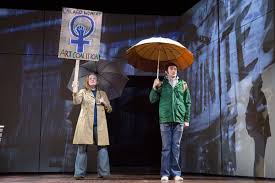
Throughout the play, the production invites spectators to witness Heidi’s awakening to her own agency, and her gradual understanding that women of her generation were encouraged to let men make decisions and speak for them. When her old friend Peter hijacks a demonstration against the absence of women artists in a Chicago museum, Heidi has to explain feminist activism to him (and to the audience). When he comes out to her as a gay man in that scene, Moss registers Heidi’s disappointment and acceptance that their relationship will never be sexual. In all of her scenes with her occasional and always inappropriate boyfriend, Scoop, Moss lets us see Heidi’s realization that being with him works against her own interests as an independent person.

Given Moss’s precision, intelligence, and likability, the moments when the play lets Heidi down are more glaring. The climactic monologue in the second act, when Heidi returns to Miss Crane’s School, her alma mater, to deliver a speech called “Women, Where are We Going?” remains strident and maudlin and overly personal because that’s how it’s written. Moss works through the speech beat by beat to find its essential humanity and tries to make it land for a community rather than just for the character. That she’s unsuccessful, and that the monologue still sounds like an indictment of feminism, isn’t Moss’s fault (or MacKinnon’s).
Even in that difficult, selfish moment, Moss makes compelling Heidi’s struggle to figure out her life in relation to the people around her. That she’s surrounded by privileged women more concerned about where to buy the latest athletic apparel, a particular breed of New Yorkers who make her feel “worthless and superior” at the same time, constrains what Heidi (and Wasserstein) can say about the feminist movement. The speech appears to indict feminism, but if you hear it as accusing only Heidi, for comparing herself to exactly the wrong role models, it sounds differently. The moment is about the character, but the problem is that it’s always read as about the movement.
When a play like The Heidi Chronicles was and remains the only one on Broadway telling even a partial, personal history of American feminism, the character and the playwright bear the burden of representation. Before she died, Wasserstein urged people not to saddle her with such responsibility, and argued forcefully and rightly that there should be more plays about women and feminism, so that she could tell her story without the impossible necessity that it represent all women’s stories.

Perhaps Wasserstein’s most cynical gesture was to use the character of Heidi’s erstwhile best friend, Susan (Ali Ahn), to represent options for certain kinds of feminists. Susan shifts lightning fast from being a radical feminist “shepherdess” on a feminist “dude” ranch in Montana to editor of the law review at Yale to an MBA-powered television producer trying to cash in on stories about quirky and powerful women. Ahn nails Susan’s shifts in tone, style, and costume, in a performance that’s broad without succumbing to parody. Casting an Asian-American woman as Susan also could be seen as addressing the charge that feminism in this period was only for white women. But Susan is written as shallow and self-serving from the start, making Heidi’s expectations for their friendship peculiarly misplaced. It’s really Susan who leaves Heidi stranded without an empathetic female friend to give her the reality check she so desires. Not feminism.
With Susan reduced to offering Heidi air kisses before she chases after celebrities in a restaurant, Heidi turns to the men in her life for support. Peter Patrone is the stalwart, sarcastic gay pediatrician, beautifully played with humor and steely knowingness by Bryce Pinkham. Scoop Rosenbaum (Jason Biggs, well cast and on target) is the snarky, straight, know-it-all operator Heidi first meets at a rally for Eugene McCarthy in New Hampshire in 1968.

Her encounters with these two very different men—Scoop indicted but admired for his patriarchal ambitions and adulterous predilections, and Peter ennobled by working with infants with HIV/AIDS—become determining for Heidi. She’s attracted to Scoop even though she knows he’s a shit, and she adores Peter even though he demands she accept that his life is more important and tragic than hers. Neither can really see her, but Heidi has nowhere else to turn in Wasserstein’s cosmology.

The play’s other women characters are caricatures. Lisa (Leighton Bryan), Scoop’s southern belle wife, is a gifted children’s book illustrator but is used narratively only as the butt of Scoop’s infidelity. Denise (Elise Kibler), Lisa’s sister, learns about feminism in her women’s studies courses at Brown and has carefully planned her life so that she can “have it all.” April (Tracee Chimo), the superficial, power-mongering television host, facilitates a conversation on her vapid morning show, “Hello, New York,” between Scoop, Heidi, and Peter in which the men speak over Heidi and publicly silence her. Fran, the fuzzy lesbian physicist at the Ann Arbor CR group, is fleshed out in this production by the brilliant Tracee Chimo’s loving portrayal, but remains famous for her declaration that “either you shave your legs or you don’t,” a rather reductive mantra for feminism, even in the early ‘70s. Given these choices, to whom might Heidi turn for empathy, experience, and insight?

Moss is a strong, emotionally acute actor who brings humor and strength to Heidi’s plight. The character laughs with instead of at the others, and what the script offers as self-deprecating, apologetic humor, Moss reinterprets as smart, if kind of kooky, lightheartedness. In other words, her Heidi is in control of herself and her emotions, and can laugh at herself even as she feels her way through the rough patches. You see her struggling to find her place among each of the groups in which Wasserstein places her. She’s angry at the end of the “Hello, New York” taping; ecstatic when she embraces the Ann Arbor CR group; and indignant on Lisa’s behalf when she tells the women at Lisa’s baby shower that she saw Scoop in Central Park with his mistress at the rally mourning the assassinated John Lennon. Moss gives Heidi spine, intelligence, and emotional depth, which makes her a much more compelling guide through the history Wasserstein sketches.
John Lee Beatty’s terrific set uses a stage revolve and blank white walls on which to project snippets of history as it passes through the play. Critics over the years, David Savran chief among them, have noted how Wasserstein superficially telegraphs history through her choice of song lyrics, played under the top of each scene to mark the narrative’s march through time. In MacKinnon’s production, however, the walls bear projections of newspaper headlines from significant moments, as well as television-shaped photos of American presidents, advertisements, and other redolent cultural images that play more schematically than literally, and better help the music situate the story in history. (Peter Nigrini’s projection design and Jill BC Du Boff’s sound design beautifully execute these conceptual choices.) The design respects the story and, at this remove, does better justice to history than the original did in 1989.
The great theatre historian Oscar Brockett always encouraged us to ask, “Why this play now?” as the central dramaturgical question for any production. I’m not sure I can answer that question about why The Heidi Chronicles should have been revived on Broadway in Spring 2015. The much-touted, critically acclaimed production closes May 3, after only 80 performances. Yet as Lisa Kron insisted in a New York Times article April 22nd about the production’s imminent closing, we don’t ask whether David Mamet’s plays remain relevant when they close quickly on Broadway. This production of Heidi, for whatever reason, didn’t take. The high ticket prices, perhaps? The fact that the current generation of young feminists might not know the play or the playwright, or care about its issues, as Chloe Angyal of feministing.com suggested in the same Times article? Because of its pat solutions and privileged women’s plight? Hard to say.
 Or perhaps the marketing campaign didn’t help. The publicity featured its star cast, posed against an empty white background, with Moss wearing a sexy red dress in the front of Pinkham and Biggs, would be enough to entice people to see the play. The advertisements and posters didn’t give audiences any insight into the play’s content or style. You’d never know it was a comedy, let alone about 30 years of American history, including feminism. Even the large political-style buttons handed out in the theatre’s lobby are cryptic. Against a bright pink background (of all things), the buttons proclaim, “I am ‘Heidi’” #HeidiOnBroadway. This in itself demonstrates the limited way in which the producers (or at least the marketing team) saw the potential audience: As only white upper-middle class women who would identify not just with but as Heidi? How unimaginative.

There’s a beautiful moment at the end of the hospital scene, the penultimate in the play, when Heidi decides she’ll postpone the year of teaching she’d planned to accept in the mid-West and stay with Peter in New York. He’s confessed his grief over losing his friends to AIDS and his anger that Heidi would abandon him when he needs her. Although her choice to stay could still be seen as another of Heidi’s self-sacrifices, Moss plays the decision as borne of her love for her oldest friend.
She and Peter embrace at the scene’s end, and Heidi cups his face in her hands to peer gently into his eyes with a gaze full of fondness. As the stage lights dim and the scene transition starts, you can see Moss repeat the gesture in the dark, as an actor expressing affection for her scene partner. I don’t know if the moment was planned or spontaneous, but it struck me that this is what makes the difference in this production. Moss appears to love Heidi, as well as the other characters and the actors who play them. Hers is a big-hearted performance, and that affection and intelligent feeling suffuses the play with new meanings. I, for one, found those new meanings very welcome.

The play still ends with Heidi ensconced in her “raw space,” entertaining Peter and introducing him to her adopted Panamanian baby while he confesses his plan to run for a seat in the Senate. Heidi still wistfully prophesizes that their children will experience the gender equality that remains out of their parents’ reach. In other words, the play’s conclusion remains unsatisfying from a feminist perspective.
But MacKinnon’s production and its terrific cast make the play worth reconsidering. See it this week if you can (discount tickets are available on line and at the TKTS booth in Times Square) and join the debate. Better yet, mount the play at your college or university or regional theatre and see what your students or local audiences think about its representations of feminism. Use it to start and continue a really important discussion about where we are, where we’ve been, where we’re going, and who we are.
The Feminist Spectator
The Heidi Chronicles, on Broadway, directed by Pam MacKinnon, written by Wendy Wasserstein, through May 3, 2015.

Laura Eason’s The Undeniable Sound of Right Now is a tight, wistful examination of time passing, losses calculated, and futures assessed, from the ramshackle context of a 25-year-old rock bar managed by a faded musician and his daughter. The bar’s “owner,” Hank (Jeb Brown), has curated bands that have gone on to great success. (Some of those referenced are real, like Nirvana, though the setting is fictional.) But his own life has wound down and settled into the lull of sentimental reminiscences. His daughter, Lena (Margo Seibert), adores Hank, but wants to move his taste into the 20th century; the play is set in Chicago in 1992. Lena gets involved with Nash (Daniel Abeles), a DJ who represents a bit too pointedly the next wave of music (hip hop) and technology (spinning instead of live playing). Lena’s relationship with the two men draws the play’s central conflict.

Along the way, Eason enumerates the costs and benefits of long-term family-like relationships. Lena’s mother was a drug addict who disappeared on her daughter and Hank; Bette (Luisa Strus), Hank’s girlfriend, became Lena’s surrogate mother. Toby (Brian Miskell), who works at the bar and pines for Lena, is like a brother/son to all of them. Joey (Chris Kipiniak), the money-grubbing landlord whose father once negotiated the bar’s rent with Hank, stands in for capitalist progress and gentrification, as the place is threatened by rent increases and changing neighborhood demographics.
Eason writes with an ear for dialogue and the nuances of relationships. The story moves predictably, charting the inevitable cultural and social changes that make the political, in this instance, also very personal. But the actors, under the crisp and even-handed direction of Kirsten Kelly, draw out the years of love, affection, and commitment among their characters in ways that ring sweet and true.

Brown plays acoustic and electric guitar when Hank has moments of solitary reflection, which bring the production intimate, soulful notes. And Strus, as the hard-bitten but big-hearted Bette, who’s taken her life in hand and moved out of the bar to the suburbs, provides warm comic relief and a sense of female camaraderie on which Lena relies as she navigates a world of competing men.
Seibert and Brown are particularly good as Lena and Hank. They’re a personal and professional team, even as Lena urges Hank toward accepting that people’s tastes in music have changed. As more than one of the characters proclaims, audiences now want more than just live performers to move them to the place where a collection of people becomes a collective, even for a moment.

Eason is a prolific playwright; she’s also a writer on the Netflix series House of Cards. She’s a former Artistic Director of Chicago’s Lookingglass Theatre and a Women’s Project Playwright’s Lab alumnae. She’s also been a musician herself, which shows in Undeniable Sound. The play looks with an insider’s care and concern at a moment when the music didn’t die, necessarily, but changed dramatically, and marked, in the process, transitional moments in people’s lives. Undeniable Sound of Right Now is a small (at 95 minutes), moving play, that makes me want to see and hear more of Eason’s work.

With this production, co-produced with Rattlestick Playwrights Theater, The Women’s Project Theatre finished its first season under Producing Artistic Director Lisa McNulty. The Undeniable Sound of Right Now; Tanya Barfield’s Bright Half Life; A Beautiful Day in November on the Banks of the Greatest of the Great Lakes, by Kate Benson, co-produced with New Georges Theatre; and When January Feels Like Summer, by Cori Thomas, co-produced with Ensemble Studio Theatre, were strong productions of rich, formally varied plays that explored women’s voices at the intersections of race, class, gender, and sexuality.
It’s been good to see the WP collaborate with other local writer-driven companies. I’m looking forward to next year’s season.
The Feminist Spectator
The Undeniable Sound of Right Now, by Laura Eason, directed by Kirsten Kelly, a world premiere co-production between the Women’s Project Theatre and Rattlestick Playwrights Theater, through May 2, 2015.
This is a lecture I gave at the University of Iowa on April 2, 2015 (thanks to Kim Marra for her invitation) and at DePauw University on April 16, 2015 (thanks to Tim Good for his invite). In the spirit of continuing thinking about feminist criticism, I share it here . . .
“The Feminist Spectator as Agitator: Criticism, Blogging, and the
Responsibilities of Being a Public Intellectual”
Over my years as an academic feminist theatre critic, I’ve proselytized for expanding our work from strictly academic venues into the largest public forums. Given the unequal representation of women artists and critics across disciplines— especially in theatre, film, and television, the arts about which I write—I’ve long believed that feminist critics need to speak into public debates as well as building knowledge through more academic research and scholarship. Our ability to be multi-lingual—or to “code-switch”—enhances the political effects of our work and extends our contributions to social change. This lecture, then, is an argument for feminist critics to produce rich historical and theatrical scholarship but also to ply our trade in the weeds of public discourse, where feminist voices are too often absent.
A range of issues confront American and global arts culture, from on-going gender inequity and racial disparities, to the ways in which theatre and other arts can be used for self-empowerment and economic development, to criticism as a crucial practice of world-making and social transformation, to questions of access for large, socioeconomically diverse audiences, and more. This persistent need for our commentary begs several questions about language and readership, labor and purpose. Who is the audience for feminist criticism? How might we attract wider and more varied readerships to the questions we find important? What language should we use to widely communicate our ideas? Why is it important for feminist critics to carve out our own spheres of influence by attending to the progress of theatre and popular culture? Why should we urge these fields in ever more progressive, socially just directions? How do we keep up our work, when so many of us have day jobs that leave only a few hours a week for writing that often feels more urgent than anything else? And finally, how do we maintain our poise in public forums that sometimes give readers permission to respond with ugly, vituperative criticism of their own?
Since I became a professor in 1987, the universities in which I’ve worked have structured how I deliver my ideas. They have rewarded me for good teaching, for publishing, and—rather solipsistically—for keeping them running with my committee work and my administrative labor. I’ve tried to be a feminist change-maker in those contexts, but working in higher education has organized my time and my outlook. As a university professor, I use the platform of my classrooms to teach students about women playwrights—and playwrights of color and LGBT playwrights, identity categories and contents that often overlap in complex ways—and to offer them a critical perspective on their cultural consumption and their spectating habits. My scholarship calls attention to playwrights, directors, ensembles, and performers who might not otherwise receive public notice. In some cases, my writing has moved these artists onto the touring circuits of university and college theatre departments in the U.S. and around the world. And I’ve tried to encourage my students to look beyond the conventional arts platforms to subcultural, experiment venues where innovative work is often staged.

I established my blog, The Feminist Spectator, in 2005, to give myself a venue for public commentary alongside my academic career.[1] The convenient persona that “the feminist spectator” offers facilitates my commitment to writing for public audiences. The Feminist Spectator is the title of my blog, but it’s also my authorial voice; I sign each post with that “handle.” This public identity, slightly detached from my real name, gives me permission to attend to the cultural prescriptions and resistances produced by live theatre, independent and popular film, and network, cable, and subscription television, which count among the proliferating forms of culture that many of us regularly consume. The feminist spectator persona also affords me a clear-cut public role, as it announces its political and ideological preoccupations up front and refuses to apologize for seeing from a particular standpoint.

The “blogosphere” has broadened its readers’ appetites for alternative perspectives, and a number of websites openly trumpet feminist points of view. While much of this is niche work, some popular web sites take a broad perspective on politics and public debate. Feministing.com and Jezebel, for instance, are sites that consolidate and produce content about politics and culture from various feminist perspectives, while Indiewire.com, an internet blog host, provides content from Women and Hollywood, a site that tracks the status of women working in film, television, and sometimes theatre (since these cultural spheres overlap more and more).[2] Criticism for every taste is available somewhere on the internet; The Feminist Spectator carves out a place in which to make its contribution.
In fact, many people seem eager to think about their cultural consumption through a gendered perspective that also takes racial justice, class inequities, and sexual difference into account. Some of my students might be hesitant to embrace the label “feminist”—though fewer than before—but most of them—across their own proliferating gender, race, and sexual identity claims—find that the critical practices of feminism give them purchase on a worldview that helps them explains their lives, as well as their cultural tastes. Across my ten years of blogging, I’ve also heard from readers who never presumed to understand or align with a feminist perspective that they, too, have found new ways to think about what they see and how they organize their consumption and spectating practices by engaging the term “feminist” in my posts. For other readers, my blog curates cultural experiences, as they decide to attend a performance or watch a television series based on The Feminist Spectator’s recommendations. I take responsibility for taste-making seriously, but I also consider my criticism part of a larger conversation about what culture means and what it does in the global imaginary. That is, I’m not a “reviewer” in the traditional sense; I don’t give stars or “grades” to what I write, but I try to place my criticism in a wider cultural context in which everything I see matters.
My students and other readers are often curious about how my blog operates, as though they are eager to look under the hood of a process that’s long been mysterious. They wonder how I decide what to write about and what considerations organize my critical view. How do I make the taste choices that organize my blog? Frankly, The Feminist Spectator engages what captures my attention. That said, I also set out 10 years ago with the intention of practicing what I call ”critical generosity,” which entails writing mostly about theatre productions or films or television shows I “like.”[3] My determination to be positive responds to common stereotypes of the critic as a person who advances mostly negative opinions about art. “Critic” and “criticism” both have a deleterious charge; I very much wanted The Feminist Spectator to dispel such presumptions.

In addition, as my books The Feminist Spectator as Critic and The Feminist Spectator in Action demonstrate, I’m eager to join the notion of “spectator” to the word “critical.”[4] As far as I’m concerned, being a spectator should in itself be a critical practice, in which “critical” means engaging in a heightened, thoughtful, analytical way with the representations we consume. I teach a course at Princeton called “For Your Viewing Pleasure” that advances the surprisingly radical idea that you can be a feminist spectator and still enjoy your cultural consumption. That is, critical engagement and pleasure don’t have to be mutually exclusive. Analysis can be a way to relish what we see on stage and screen.
I use the blog, then, to write about theatre productions and films and television series whose cultural, aesthetic, or political contributions I can discuss positively. When I describe work by women, lesbians, people of color, and work that intersects these categories, I hope my writing will popularize examples that might not be more widely known. One of the most important historical gestures of academic U.S. feminist performance criticism and theory in the 1980s and 1990s, in fact, was to bring work by Split Britches, Holly Hughes, Carmelita Tropicana, and the Five Lesbian Brothers, among other feminist and lesbian performers, playwrights, and theatre artists, into public conversation and notice.


Feminist theatre academics wrote about their work and invited them to our campuses, where they taught students how to be resistant artists, and how to consider gender, sexuality, and race in their performance practices while still having great fun. In this way, feminist performance theory and criticism helped circulate subaltern work onto syllabi and campuses, where feminist and queer artists taught new generations of students in ways that hopefully affected their own art-making and consumption habits.

I see my blog as another way to get the word out about performance that remains purposefully subcultural, as well as to address work by women who would like to be more culturally visible and powerful. My first blog post was about the Five Lesbian Brothers’ final ensemble production, Oedipus at Palm Springs, which they premiered at New York Theatre Workshop in the East Village of Manhattan in 2005.[5] Although they were by that time more interested in larger audiences than the more sectarian, primarily lesbian crowd they began performing for at the WOW Café, many people outside New York didn’t see that production. Writing about it became a way to let people know the new work existed as well as to describe its important formal innovations and the politics of its content and its reception context.
My blog continues to privilege performance work like this by women who don’t get the serious critical attention they deserve elsewhere. I write about playwrights working Off Broadway or in regional theatres whose work is caught in a peculiarly gendered netherworld, writers like Madeleine George, Danai Gurira, Kristen Greenidge, Sarah Treem, Naomi Wallace, Bathsheba Doran, Lynn Nottage, Paula Vogel, and many more. Their work should be more widely known and more frequently produced, and should garner the acclaim, income, and prestige of Broadway productions that women rarely enjoy. I hope to bring these artists notice and deep critical engagement as they wait to be propelled to the next level of distinction.
In that respect, I’m a critic/advocate/agitator. I’ve never believed critics can be objective or that they should sit removed from the work they judge. We come to our ideas from a standpoint deeply imbued with beliefs about art and politics, culture and society. I’ve always been open about my feminist standpoint and how much I value racial, sexual, and economic equality. I try to articulate what I see as the intimate relationship between the arts and our aspirations as a culture. I believe that any theatre production speaks into an historical moment, responding to and shaping the cultural mores of its time and place. The flip side of my project, then, brings a feminist perspective to work that’s too often let off the hook when it’s judged by critics who hold themselves to old-fashioned standards of objectivity. Because Broadway is so visible, like it or not, as the apex of theatre production in North America and abroad, and because its plays are too often presumed as a yardstick of cultural value unblemished by gender, race, sexuality, or class in the canon of universality, all of its productions demand rigorous feminist analysis.[6]
I curate my choices of what to see and write about based on intuition and expertise, as well as on my commitment to balancing attention to work by women and people of color with a concern for the on-going project of theatre in America and the stories for which it makes space and time in the world. I’m sometimes inspired to write about things that are trendy but haven’t been addressed from a feminist perspective, often musicals or splashy productions by white male playwrights that broadcast their cultural capital. But I choose what to see based mostly on hope: hope that a production will move me to feel or to think; that it will introduce me to a new idea, a new artist, or a new vision for theatre; or that it will be progressive in its politics and its aesthetics. When I choose wrong, I keep my pen still. When I choose right, and I’m thrilled or enthralled, I can’t wait to start trying to communicate my excitement. The writing becomes a way to sort out the nexus between pleasure and politics and my professional perspective on what I believe theatre can do as a cultural force. Once I’m moved to write, I take pleasure from somehow using words to recreate, engage, and do justice to performance.
I also engage materialist feminist understandings of modes of production, and performance studies methods that help me understand how the details of a play or film’s production situates it in a field of social meanings. I try to extend my critical purview beyond what I see on the stage or screen into production contexts that make certain forms and contents available to certain audiences and not others. Writing about lesbian feminist performances at the WOW Café in the early 1980s, for example, required taking into account the rent structures of lower Manhattan at the time, which made empty warehouse spaces and storefronts available to often renegade, multidisciplinary artists who could afford to live nearby. The relationship between art and real estate is a crucial part of how a feminist critic understands the politics of production.
I’m also interested in audiences and how they’re hailed and constituted by performances of all sorts across contexts. What happens off-stage—not just behind the scenes but in the audience and outside of the theatre—is another aspect of my feminist perspective. Performance studies methods first devised by scholar Richard Schechner, among others, remind me that the journey to and from a performance, and what happens in the lobby, and what the program looks like, and who else is in the audience, has a lot to do with our reception and consumption practices.[7] Taste, after all, is shaped in conversation with our own habits and the conventions of the culture through which we move. These relationships are always political.
As a feminist critic, I want to understand why some productions get financing and critical attention when others don’t, and why some artists are constantly produced and others are ignored. But in addition to interrogating production contexts and decisions about which artists work in the most powerful—or most marginal—theatre venues, feminist critics and spectators need to talk about the work itself, enumerating what it means, who it’s for, and what ideological as well as aesthetic work it does in the world. Considering content and context helps me speculate about why so many talented women, for example, write for television as well as theatre, and helps me track the new constellation of artistic relationships that support work across venues.[8] Do women succeed in television because series writers’ rooms are more collaborative, and the amount of product means less is at stake in each individual project? If so, we need to track women theatre artists who turn to other media to make their livings.[9]
As a feminist theatre critic, I actually write more and more about cable television and independent film, because so many writers who begin in theatre find more opportunities to get their work seen in other forms. In this new pattern of artistic labor, it’s no longer considered “selling out” to write for television. Writers can move from theatre to film to television and back to theatre, sometimes in the same season. This mobility effects cultural production in ways I find hopeful, as talented actors, directors, and writers blur the boundaries and taste presumptions among forms. The Feminist Spectator helps chart the cross-pollinations and influences and conversations staged among forms, and contents, and contexts. It points out that the worlds of theatre, independent feature films, and cable television overlap in ways that might enhance not just opportunities for women artists, but for feminist social intervention and commentary. The revolution happens everywhere at once now.
Of course, there’s a downside. The blogosphere is another site of public discourse where people sharpen their knives for feminism. Conservatives hope to defang its power and persuasiveness by publicly denigrating feminists. Self-proclaiming your politics, as I do on The Feminist Spectator, can make you a target for the shockingly violent and hateful comments that anonymous readers feel righteous about posting to school feminist bloggers into submission. I’m unsettled by people’s willingness to publicly revile feminist ideas. Look what happened to Zoe Quinn, Brianna Wu, and Anita Sarkeesian in the August 2014 “Gamergate” controversy; they were incessantly harassed and threatened with rape and death because they criticized the misogyny of video games and the gender imbalances in the video gaming industry.[10] Taking a stand in a public forum, even about something that feels as low-stakes as a video game or a Hollywood movie, or as ephemeral as live theatre, can be hazardous. I’m obviously arguing here for the importance of representation and culture, but let’s face it: we’re not talking about elections or passing legislation or Supreme Court decisions. Bloggers critical of existing political regimes in, for instance, Bangladesh, are being hacked to death on the street. On the other hand, that on-line commentators take the time to write back with such venom to feminist bloggers means that a nerve has been touched that moves through culture in vital ways. The stakes might not be as high, but they’re not negligible. For me, the pay-off for advancing public dialogue about gender and social justice in the arts and culture is worth the risk that public writing sometimes entails.


My own experience with ideological violence comes from bringing feminist critical attention to Hollywood films that mainstream critics excuse by failing to mention their gender, sexuality, or race politics. For example, I excoriated director David Fincher’s The Social Network (2010) for what I saw as its retrograde misogyny and racism. I criticized The Black Swan (2010), too, for how it depicted women artists as psychotic. And I abhorred Fincher’s Gone Girl (2014) for its deep and virulent misogyny. I set aside my critical generosity ethos when it comes to writing about Hollywood studio films, a scenario in which I’m only a David standing up to their Goliath. But when I write this sort of criticism, I often get attacked. And the zealotry of feminist-bashers startles me. I’m dismayed by the chastising, condescending tone strangers use in their public comments. For example, when I wrote positively about the film Silver Linings Playbook (2012) but remarked on things I found salient about gender in its narrative, my critique attracted this 2015 comment (three years after the original post):
It’s called common sense people . . . Stop reading into it like this. There’s no homophobic underlining. No political views. No sexism or feminism. It’s just a movie that’s a silly love story. Just like every other movie. That said, it’s a well- acted well written screenplay. Oh and on a side note, the Eagles vs Seahawks game Pat Sr. said Eagles were winning 23 – 20 or something like that. I can’t remember exactly. And then later Tiffany said the Eagles beat the Seahawks 14 – 7. I see all foul ups and that’s the only significant flaw in this movie. Other than Tiffany being a needy controlling manipulating woman. Not a bad flick.[11]
This comment exemplifies the responses I often get when I post on Hollywood films: Get over yourself! It’s just a movie! It’s not political or sexist or feminist! The continuity trivia is more important! But the comment’s writer feels justified to say with impunity that the lead, played by Jennifer Lawrence, is a “needy controlling manipulating woman.” In his or her humble opinion. But that’s not political or sexist, is it?
Representation remains a battle-ground. If it weren’t, who would take the time to comment harshly or derisively on a blog called The Feminist Spectator? My posts critical of films with large budgets and visibility, which are often glowingly reviewed by mainstream writers, might bring me wrath. But perhaps this signals the important and productive on-going ambivalence and anxiety in public culture about gender, race, and sexuality. If these respondents weren’t anxious about their masculinity (or their femininity, since my most brutal critics are sometimes women), or didn’t feel they had to defend heterosexuality or whiteness, we’d be in a much less fearful place as a culture. I take my lumps as evidence that feminism is actually working, if it’s making people defensive enough to strike out.
I’d prefer to think of feminist criticism as part of a more civil public discourse, a way of speaking into a forum that historically hasn’t made room for minoritarian voices. I’d like to think that as a critic, I can listen carefully, respond thoughtfully, and still disagree with an interlocutor.[12] I know that the politics of civility often shut down those who are outside the norms of race, gender, sexuality, or class. Demonstrators from Selma, Alabama, to Ferguson, Missouri, are too often accused of anger and unruliness, criticism meant to discipline them back into compliance with dominant ideology. But in a discussion about culture, I’d really rather talk and listen than try to outshout my readers. I hope I can make a strong case for my feminist perspective and that my arguments will stand on their merits whether or not anyone agrees with them. I’m not in it for the mud-slinging. But because of my refusal to participate in the nasty aspects of public culture, and my avowed determination to practice critical generosity, I’ve been called “an enthusiast” instead of a critic.[13] I’m actually happy to consider myself an enthusiast when it comes to theatre and performance and popular culture. But I’m also know that one way to dismiss and disempower feminist criticism is to call it amateur.

It’s possible to call feminist critics “amateur” because we don’t see enough of them in visible mainstream culture. I’ve participated in several Public Voices workshops presented by The OpEd Project, a non-profit that agitates for more women and people of color to be published on the opinion pages of major news and media outlets.[14] The organization crunches numbers that illustrate how those pages are dominated by white men who, as a result, control national public thought leadership. The OpEd Project workshop organizers encourage scholars to translate their academic specialties into public areas of expertise, and to position themselves as people who can be called on for opinions. The year I joined the Public Voices project at Princeton, our group of 20-odd women from across disciplines and university statuses productively translated our work to larger public forums.
 As a feminist theatre critic, I found lots on which to comment in public discourse, though I was sometimes stymied by the need to find a “hook,” which required keying a think-piece to an upcoming or “trending” cultural event. I published an essay on the Tony Awards season on the Huffington Post, and another on actor Cynthia Nixon’s comments about the malleability of sexuality in Alternet.com, both issues that were topical and relevant at the time.[15] I persuaded even our sometimes dubious if supportive workshop leaders that cultural commentary was as important and newsworthy as the opinions my colleagues in sociology, the sciences, and the humanities pitched to editors. I left the workshop more determined than ever that my theatre criticism and writing about culture could resonate widely.
But as our OpEd Project leaders left to stage workshops on other campuses, my Princeton colleagues and I struggled to maintain our writing momentum. We were, after all, academics, not freelance journalists or people paid by think tanks. We had to teach; we had to produce scholarship, as well as public writing; and we had to serve the university in numerous ways with our labor. Our university admires public commentary enough to link this writing to its web site, but not quite enough to reward it with salary merit increases, which are still weighted toward peer-reviewed research. How then might we continue finding the time to respond—quickly, as thought-leadership requires—to current events? Public writers watch the clock and the calendar. If you miss your chance to comment, or if the wave of attention to an issue crests, the moment closes over and public interest moves to the next trending debate. You have to be nimble and quick to be a public intellectual, and often, the burdens of the academy slow us down. And feminist critics without the luxury of academic positions need to make their living in other ways, which might preclude the speed and focus thought-leadership demands. In other words, the economy in which we labor has important implications for our ability to truly and consistently engage public dialogue.
But the challenge is worth contemplating. As more and more theatre critics lose their paid positions at print newspapers, I can continue writing my blog because my salary is paid by a university and my primary preoccupation is teaching. And I see a lot of theatre without asking for press seats because my academic salary and research account let me buy my own tickets. Because of that relative privilege, feminist theatre scholars hold a responsibility to public discourse, even as we continue to produce research vetted by juries of our peers. After all, scientists presume that once their colleagues certify their research, it will apply widely, to improve how we live in the world. Humanists, too, should be able to speak to multiple audiences and to presume the efficacy of our ideas. We should be adept at code-switching, not to water down our ideas or to pander to a low common denominator, but to popularize vital, transformative ways of seeing the world, which can and should extend well beyond our classrooms.
The arts perplex and enlighten us; frustrate and irritate us; enliven and exhilarate us; prompt us to think and to feel; and bring us an ongoing, ever-renewing sense of community and common cause. They invite us to contemplate the world as it was, as it is, and most importantly, as it might be. They urge us not just to observe, but to participate in creating and experiencing ever-new visions of human possibility. The arts introduce us to ideas and stories we might not otherwise experience. They provide platforms for narratives about who we are and who we might be to one another, not just in the future, but right now. These are transformative possibilities.
Feminist arts critics participate in the project of democracy, and lend our insights to how we speak to one another and what we say. For me, The Feminist Spectator remains an activist project because writing about the arts and popular culture changes minds, prods conversation, and encourages pleasurable engagement with the most important issues of the day. As a tool for cultural as well as aesthetic commentary, feminist theatre and performance criticism intervenes in social meanings, and offers new perspectives on our common humanity. I’ll end with a moment of proselytizing. If you like to write; if you have things to say; if you have feminist commitments . . . start a blog! Write for your local newspaper! Pitch ideas to online forums! Don’t be silent. We need more feminist voices in public discourse! Add yours to the mix. And thanks for listening to mine.
Notes
[1] The Feminist Spectator can be accessed at www.feministspectator.princeton.edu.
[2] See www.feministing.com, www.jezebel.com, and http://blogs.indiewire.com/womenandhollywood/, all accessed 11 February 2015.
[3] ‘Critical Generosity,’ in Public, http://public.imaginingamerica.org/blog/article/critical-generosity-2/, accessed 12 February 2015.
[4] The Feminist Spectator as Critic (Ann Arbor, MI: University of Michigan Press, 1991; 25th anniversary edition, 2013); The Feminist Spectator in Action: Feminist Criticism for Stage and Screen (New York: Palgrave Macmillan, 2013).
[5] See Dolan, “Blogging on Queer Connections in the Arts and the Five Lesbian Brothers,” GLQ: A Journal of Lesbian and Gay Studies 12.3 (2006): 491-506.
[6] As an academic with a stable income, I can afford to buy myself tickets to Broadway productions, which represent the most expensive theatre in the U.S. I never ask for press tickets, as do many critics and bloggers. I want the luxury to write or not to write, depending on how a production or a performance strikes me. I don’t want to be beholden to producers or to the artists who invite me to their shows. But I can pay for my own tickets because I have a day job.
[7] See for only one example Richard Schechner, Performance Theory: Essays on Performance Theory 1970-1976 (New York: Routledge, 1988).
[8] For instance, these women playwrights all work across media: Bathsheba Doran writes for the terrific Showtime series Masters of Sex; Sarah Treem is the creator and executive producer of Showtime’s Golden Globe-winning The Affair; Gina Gionfriddo and Laura Eason write for Netflix’s House of Cards; and Diana Son wrote a pilot optioned by NBC.
[9] Though of course, the numbers of women working in television and film continue to be nearly as abysmal as those in theatre. See Manohla Dargis’s series of three articles on ‘The Director Gap: Female Filmmakers and Their Fight for Equality’ in The New York Times, including the first, ‘Making History’, http://www.nytimes.com/2014/12/07/movies/ava-duvernay-makes-a-mark-with-selma.html, accessed 11 February 2015; the second, ‘In Hollywood, It’s a Men’s, Men’s, Men’s World’, http://www.nytimes.com/2014/12/28/movies/in-hollywood-its-a-mens-mens-mens-world.html, accessed 11 February 2015; and the third, ‘Lights, Camera, Taking Action’, http://www.nytimes.com/2015/01/25/movies/on-many-fronts-women-are-fighting-for-better-opportunity-in-hollywood.html?_r=0, accessed 11 February 2015. See also the continuing advocacy of Martha Lauzen at the Center for the Study of Women in Television and Film at San Diego State University, http://womenintvfilm.sdsu.edu/, accessed 11 February 2015 and www.womensmediacenter.com, accessed 11 February 2015.
[10] Sarkeesian canceled a speaking appearance in 2014 at Utah State University after the school received several anonymous terrorist threats, at least one of which claimed affiliation with Gamergate. The threats included allusions to Montreal’s École Polytechnique massacre, a 1989 mass shooting motivated by anti-feminism. Sarkeesian canceled her appearance when the school could not assure her safety under gun laws in Utah. http://en.wikipedia.org/wiki/Anita_Sarkeesian, accessed 11 February 2015.
[11] Unsigned blog comment, submitted for approval January 24, 2015.
[12] See Daniel Dennett, Intuition Pumps and Other Tools for Thinking (Norton, 2013), on how to compose a successful critical commentary: ‘You should attempt to re-express your target’s position so clearly, vividly, and fairly that your target says, “Thanks, I wish I’d thought of putting it that way”; [y]ou should list any points of agreement (especially if they are not matters of general or widespread agreement); [y]ou should mention anything you have learned from your target; [o]nly then are you permitted to say so much as a word of rebuttal or criticism’. Although I don’t agree with the notion of a ‘target’, I do wish the same code of conduct could be applied to critical commentary online, particularly to the indelible inferno of comments; http://www.brainpickings.org/2014/03/28/daniel-dennett-rapoport-rules-criticism/.
[13] This by a white male critic who writes for one of the few remaining powerful print newspapers, in an exchange over Twitter, in response to my essay in Public about critical generosity.
[14] The OpEd Project, www.theopedproject.org.
[15] ‘Tonys 2011: Where are the Women?’ in http://www.huffingtonpost.com/jill-dolan/tonys-2011-where-are-the-_b_875065.html, accessed 11 February 2015, and ‘Do We Need a More Nuanced View of Sexuality’ in http://www.alternet.org/story/154053/do_we_need_a_more_nuanced_view_of_sexuality, accessed 11 February 2015.

Jennifer Haley’s The Nether is a play of ideas whose plot shifts between plateaus of existence in a near-future. The Internet has morphed into something called The Nether, in which more and more people develop parallel “realms” where they live alternate realities. As characters spend more time in the Nether than they do in “real life,” the distinction between a fleshy reality and a persuasive virtual realm begins to blur, bringing along attendant moral issues about the substance of bodies and their effects.
In a bleak, oppressive interrogation room, Detective Morris (Merritt Wever) interviews Sims (Frank Wood), an effete gentleman who continually slips Morris’s attempts to call him a criminal because he procures under-aged girls for interested men to exploit sexually and romantically in the Nether. The place he adjudicates is called The Hideaway, an elegantly constructed, faux-19th century world full of its own rules and regulations. The “people” who roam this realm are avatars, virtual substitutes for the anonymous strangers who enliven them. In the Hideaway, men like Woodnut (Ben Rosenfield) seek sex with girls like the virginal but strangely seductive Iris (Sophia Anne Caruso). Sims (or Papa, as he’s known in the Hideaway) refuses to accept Morris’s claim that the sexual violence he facilitates across the virtual divide is harmful.

Director Anne Kauffman’s staging for MCC at the Lucille Lortel Theatre beautifully realizes some of the play’s theatrical challenges. How can a production represent the thin border between real life and the Hideaway, especially when the play’s moral quandary concerns the shadowy interactions of pedophiles who pay to spend with young girls? How to treat those characters, who are avatars (according to the script’s logic), but who present to us as real men and pre-teens?
Kauffman and her talented designers create an overlapping, cohabiting sense of space and time. Morris conducts her investigation at a table with two chairs in a gray, dungeon-like room with heavy wooden doors and cold light (by designer Ben Stanton) that evokes a palpable sense of entrapment. When a sliding barn door opens on to the Nether’s Hideaway, by contrast, shafts of what seem like warm, natural light tumble across Iris’s red and pink bedroom. On the opposite side of the stage, another panel opens to reveal what looks like a thick grove of trees, flourishing under what seems a warm summer sun. Although the light thrown here is somehow too bright and perhaps too warm, which signals its falsity, the Nether couldn’t seem more appealing.
That the real and the virtual are recreated in the fantasy space of theatre deepens Haley’s inquiry into the material effects of imagination. To maintain his carefully nurtured balance of power, Sims requires his clients not to become too attached to his girls. When intimacy beckons, he encourages Woodnut to “kill” Iris with an ax. Iris reassures her reluctant suitor that she always regenerates after her “death,” and hands him the ax with seductive magnanimity.

Playwright Haley, through Detective Morris, questions whether the perversity and violence wrought in the not-real should be legislated in real life, where its effects would certainly be more consequential. She asks us to consider the relationship between imagination and action, at a time when people are becoming increasingly enticed by the virtual. (Present-day parallels are posed subtly but clearly here. The 2013 case of the “cannibal cop” comes to mind, in which a man was prosecuted for internet posts in which he described his desire to kill, cook, and eat women, though whether or not he intended to follow through, in reality, wasn’t clear.)
In the play’s imagined future, more and more people choose to become “shades,” whose bodies are suspended on life support while they go to “live” in their preferred virtual realms. In fact, Morris’s investigation seems fueled by moral righteousness, until we learn that her own father has chosen to become a shade, leaving her without his attention in an progressively more unsatisfying real world. Her crusade to bring the pedophiliac Sims/Papa to justice becomes personal, as well as political, muddied by her own complex desire for both retribution and connection.

Doyle (the always terrific Peter Friedman), whom she’s enlisted (or blackmailed) to inform on Sims, is a mess of a man who’s lost all perspective. That he prefers to live in the Nether astounds Morris. But by the play’s end, his attraction to beauty, to an always replenished perfection, and especially to a literally blind love, which allows you to play out whatever you desire without judgment, presents its own attractions.
I won’t spoil the revelations that ground the play’s fascination. Suffice it to say that parallels between the Hideaway and the detective’s interrogation room lock together in surprising, deftly drawn ways. Haley poses complicated and difficult questions through tight narrative plotting and inventive theatricality.

Wood is terrific as Sims/Papa, moving elegantly between his shifty persona in the real and his oily supremacy in the Hideaway, where he serves a proudly patriarchal function. Wood and Friedman never fail to compel, given how they draw characters in a gesture, a grimace, or a precise vocal choice. Friedman is pathetic as Doyle, but his abjection is tempered by his mournful yearning. Caruso, as the pivotal Iris, is perfect in a role that could have been unsavory. (The young actress performed as Brigitta Von Trapp with Carrie Underwood as Maria in the live Sound of Music on television.) Caruso’s performance has a bell-like clarity and appeal, her youthful earnestness shaded with just a bit of sexual knowingness.
Merritt Wever, sadly, seems strangely discomfited as Detective Morris. Wever’s typical wry humor—much in evidence in her comic, poignant performance as Zoey on the Showtime series Nurse Jackie—is suppressed here for a wounded toughness that never quite convinces. Her physical and vocal choices seem slightly off; she’s loud and brash when she might be more menacing and insidiously threatening. She’s quiet and yielding when force seems more appropriate. She looks down and away from her acting partners when she should be confrontational.
Someone with a more powerfully glacial presence—an actor like Cherry Jones, or Ruth Wilson, or Jessica Chastain, women with some powerful secrets of their own to wrangle as they manage their probing intellects—might have been more persuasive as Morris. Instead, Wever’s more emotionally diffident performance goes by in blur, which is a waste of her talent and leaves a hole in an otherwise compelling production of a very good play.
The Feminist Spectator
The Nether, at the Lucille Lortel Theatre, produced by MCC Theatre, through March 14, 2015, and with a different cast and director, produced by the Royal Court Theatre, at the Duke of York’s Theatre, London, through April 25.