Here are two films that don’t pass the Bechdel Test: The Theory of Everything and The Imitation Game. In Theory, Felicity Jones plays Stephen Hawking’s stalwart wife, Jane, who stands by him as his helpmate and intellectual equal while his body deteriorates from a slow-moving form of Lou Gehrig’s disease (ALS). Jones is terrific as a woman who endures her frustration with a life circumscribed by her husband’s physical limitations, who put off her own plans for a PhD in medieval Iberian studies to tend to Stephen and enable his continued intellectual and academic success.
Redmayne and Jones as Turing and Jane
Eddie Redmayne’ Oscar-bait performance as Hawking offers a feat of physical, as well as emotional, virtuosity, playing a role that requires him to sit with his body twisted into the man’s S-shape, and eventually, when he could no longer speak, to communicate via a rudimentary computer that captured his thoughts and broadcast his speech. Redmayne conveys Hawking’s devilish humor and twinkling commentary by raising his eyebrows, curling the edges of Hawking’s misshapen mouth, and signaling through his eyes the man’s determination to continue living, thinking, and feeling, even as his body lost muscle mass and mobility.
Peake (as Elaine), Redmayne, and Jones
Redmayne will no doubt be nominated for an Academy Award and has a good chance of winning, since the role falls squarely in the tradition of Daniel Day Lewis in My Left Foot(1989), Dustin Hoffman in Rain Man(1988), Sean Penn in I am Sam (2001), and even Jon Voigt in Midnight Cowboy (1969), all playing men with physical or psychological challenges whose performances critics or peers rewarded. Women get noticed for gaining weight (for only one example, see Charlize Theron in Monster, 2003), but men get their laurels by imitating compromised versions of masculinity. They “dare” to go there, giving up the privilege of handsome, strong masculine bodies to play those the culture feminizes because of their differences.
Playing with his children
Hawking falls ill early in the film, just as he’s establishing his brilliance. His colleagues and mentors are generous with his physical deterioration because they so respect his mind. He retains his sense of humor and his intellect even as he becomes increasingly dependent on others. In one scene, his colleague cheerfully carries him up a large, wide flight of stairs on the campus green. As Hawking lays in his arms, the man defuses any implication of queerness by asking Hawking if he can still have sex. Hawking confirms that his penis works on a “different system,” and, in fact, he and Jane produce three children after the onset of his disease.
Charlie Cox, as Jonathan
As in many films about disability, in The Theory of Everything,how people relate to Hawking determines who’s “good” and who’s “bad,” making his disability less about him than a litmus test for the moral character of others. Jonathan (Charlie Cox), the church choir director who becomes a family friend, caretaker and, eventually, Jane’s romantic interest, is a good man because he tries to help feed Stephen, even when he doesn’t know him well. Elaine (Maxine Peake), a caretaker who becomes Hawking’s second wife, insinuates herself into his emotional world and is considered “bad” when she interrupts his relationship with Jane and indulges him with pornographic magazines.
Also represented is the wish for “normalcy,” in an admittedly poignant moment when Hawking, alone on an auditorium stage in his wheelchair listening as his computer gives a pre-loaded speech to a large audience, sees a young woman in the first row drop a pen. The camera follows Hawking/Redmayne’s gaze to the ground, then backs up for a fantasy moment in which the actor slowly straightens his body, lifts himself from the wheelchair, walks down the short flight of steps to the woman’s seat, and retrieves her pen for her. The moment ends with Hawking still, of course, in his chair, watching and yearning; we’ve been given insight into his sense of himself as able-bodied and his desire to be free of his physical challenges. The moment is moving but also rather smarmy, as it encourages spectators toward pity more than respect.
Hawking’s story is inspiring, and The Theory of Everything, despite my quarrels here, is emotional and absorbing. But what is it about all the “great men” movies that come out this time of year, with their rousing scores and distinguished performances, their bid for empathy and their patina of history and biography, all pitched with the (self-) seriousness of projects bidding for Oscars? Where are the great women’s stories, I wonder? Wild is significant in this batch, not because Cheryl Strayed is a “great woman,” but because it’s one of the few films I’ve seen this holiday season that even passes the Bechdel Test, which simply requires a film to include more than two female characters who talk to one another about something other than a man. How criminal that so few of the Hollywood releases at the end of 2014 came close to passing this easy test.
The Imitation Game, another “great man” movie that’s worth seeing, if only for its fascinating history, sports a feisty performance by Kiera Knightley as the brilliant Joan Clarke, but she’s the only woman in the film (besides Clarke’s mother, who barely speaks). The Imitation Game exemplifies what Susan Douglas calls “enlightened sexism”; the filmmakers know there’s only one woman in its story, but seem to blame its gender imbalance on truth of history, in which very few women were involved in cryptography during World War II (I guess; I have to take the film’s word for it). But that doesn’t explain why Knightley’s character needs to be so solitary and isolated in a film released in 2014.
Knightley and Cumberbatch
The Imitation Game tells the story of Alan Turing, a brilliant, difficult man who invented the first computer, which he used to break the Germans’ Enigma code in World War Two. He died in his early 40s, whether by suicide or murder has never been resolved. His centenary was celebrated in 2012. That Turing was “a homosexual,” as he tells Joan regretfully in The Imitation Game, explaining why he can’t, after all, marry her, also seems to authorize the film’s omission of other women characters. And according to A.O. Scott’s review in the Times, the film also erases Turing’s desire by eliding what was apparently his very active sexual life, before he was arrested for “gross indecency.”
Knightley and the guys
Benedict Cumberbatch, as Turing (more Oscar bait, as a man probably on the Asperger’s spectrum), Knightley, as Joan, and Matthew Goode, as a colleague who begins as a competitor and ends as a reluctant admirer, offer engaging performances and Graham Moore’s screenplay gives them sharp, evocative dialogue.
But all this enlightened sexism and liberal tolerance gets tiresome.
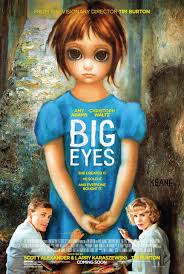
Amy Adams is terrific as usual in this curiously flat film that tells the true and outlandish story of Margaret Keane, who in the 1960s painted those ubiquitous images of sad children with large eyes that adorned everything from posters to coffee mugs. Turns out her charlatan husband, Walter (Christoph Waltz), took credit for her work as he relentlessly promoted the images while for all intents and purposes imprisoning her in their home, forcing her to produce ever-more paintings. Director Tim Burton’s film (written by Scott Alexander and Larry Karaszewski) doesn’t quite do justice to what seems the reality of the story, or that of any abused woman. That is, we don’t hear much from Margaret’s perspective, and there’s only so much Adams can do to register her hurt, then dismay, then anger, and finally, her righteous retribution for suffering years of Walter’s escalating emotional, verbal, and finally physical abuse.
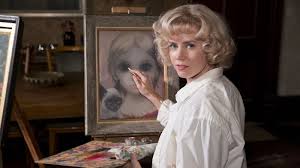
Adams as Margaret, doing what she loved
Walter forbids Margaret to tell even her daughter, Jane (played as a younger girl by Delaney Raye and as a young woman by Madeleine Arthur), the truth of the paintings’ authorship. Margaret hides in her locked studio most of the time, fracturing what had been her close relationship with her daughter. Adams dials her performance way down, as she mostly interacts with her canvases and the increasingly mournful images she produces, or with her dog, the only sentient being in whom she can confide. In other words, the script doesn’t give Adams much to do, although the actor’s intelligence and empathy is clear in every frame. Christoph Waltz, on the other hand, chews the scenery, first with Walter’s excessive charisma and later with his mad rage over Margaret’s desire to tell the truth.
The film seesaws between drama and campy comedy, as Burton can’t quite get the tone right. His Edward Scissorhands (1990) took a melancholy outsider’s view of the constraints of suburbia, and Ed Wood (1994) celebrated a genius oddball. But Burton doesn’t quite know what to make of the suburban oddball Margaret Keane. Her art is facile but somehow compelling in its weird expressiveness, but her paintings can’t be camped up in the same way Burton did Woods’ wacky films. Some critics see Burton moving into a more naturalist emotional terrain with Big Eyes; I only found it bumpy.
Terence Stamp as the critical gate-keeper
The film’s funniest scenes include Terence Stamp as the effete art critic John Canaday, who vilifies the Keane work as kitsch. He insists organizers take down a painting Margaret created at Walter’s behest for a very visible display at the New York World’s Fair in 1964. When reporters finally reveal the hoax about the paintings’ provenance, the critic practically chokes when he reads that the work is Margaret’s. You can’t help but wonder if he would have spent his venomous words on Keane at all if he knew she was a woman.
Through scenes like these, Burton’s film notes the pervasive sexism of the 1950s and early 60s. Walter insists that no one will take “lady art” seriously and Margaret believes him. She finds no evidence to the contrary (although she does mention Georgia O’Keefe as a counter-example). And she has no options outside of her nasty marriage, even though Big Eyes begins with Margaret leaving her first husband with a young Jane in tow. She moves to San Francisco to restart her life, where her one friend, DeeAnn (Krysten Ritter), a single woman peripheral to the art scene, seems able to make her way alone.
Walter is reassuring and helpful as he lays his trap for Margaret
This background makes Margaret’s quick capitulation to Walter’s manipulations perplexing. In an early scene, Margaret reads a letter from her ex-husband’s lawyer threatening to sue for custody of their daughter. Walter chivalrously offers to marry her so that Margaret can keep Jane with her. While she’s relieved at the arrangement, she can’t see through Walter’s facade to fathom his opportunistic calculations. In fact, Jane understands quickly and clearly the havoc Walter wreaks in their home, while it takes Margaret much longer to catch up.
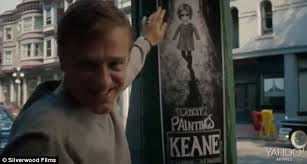
Walter (Waltz) putting up the posters that lead to his famous and lucrative reproductions
Big Eyes is most interesting for how it charts Walter’s genius for creating art in the age of mechanical reproduction. He perceives early on that the posters announcing Margaret’s art gallery show, with their copied images, are moving more quickly than the much more expensive paintings. Because he’s only in it for the money, he eagerly reproduces Margaret’s work on posters, postcards, and all sorts of cheap paraphernalia that builds what he calls their “empire.” Andy Warhol even makes a quick appearance to applaud the reproductions, as everyone in Big Eyes but Margaret obviously cares more about the replicas than the originals.
Jason Schwartzman as Ruben, appalled by the mechanical reproduction of Keane’s art
Ruben (Jason Schwartzman), the highbrow art dealer whose gallery stands across the street from the much more popular Keane store, sneers at Walter’s business sense and his willingness to make a popular movement of his wife’s images. But why not, Burton encourages the audience to ask? Why not make accessible and proliferate the very art people want to consume, even if it doesn’t meet standards established by elitist blue-blooded white men?
The film’s more interesting discussion, then, addresses the question of what really constitutes “authentic” art. But its last third hinges instead on issues about authorship and inspiration. Walter parades his proud cluelessness about the origins of art, since he’s never really created any. To provide his script for interviews in which he performs as the artiste, Margaret has to explain to him how her work expresses herself and comes from her heart. Like her paintings, Margaret’s is a rather puerile view of what art is, but compared to Walter’s philistinism, the film insists it will do. Walter instead concocts a story about seeing orphaned children in Germany after the war, who became the sad inspiration for “his” images and play on the sordid sympathies of his sycophantic audience.
Fighting over authorship
Margaret finally takes Walter to court for slander in a legal move that will allow her to retrieve ownership of her work. The climactic courtroom scene is both funny and painful. Walter serves as his own defense, blustering about the room, working his audience, and cross-examining himself until the exasperated judge forces him to stop. When the judge decides the only way to get at the truth is to have Walter and Margaret paint for an hour in the courtroom, Walter stares at the blank canvas with chagrin. He finally concocts a story about hurting his shoulder in a way that makes it impossible for him to lift a brush. Margaret obviously triumphs, although apparently, the real, delusional Walter protested until his death that he had created the paintings.
The real Margaret Keane and Amy Adams
I wish Big Eyes were the better, more interesting movie Keane’s story deserves, one in which she’s an agent and not just a victim. Burton resorts here instead to familiar battered woman clichés: When Margaret and Jane escape into her locked studio for protection from one of Walter’s rages, he shoves lit matches through the room’s keyhole that set a spilled tin of turpentine on fire. He rages from drink; he seduces other women right in front of Margaret; he doesn’t tell her he has a child from another marriage; he isolates her from her friends and from Jane; he works her to the point of exhaustion and doesn’t let her out in public alone.
While all of this is no doubt true and certainly appalling, Burton might have found other ways to tell the story that didn’t only victimize and finally silence Margaret just as Walter did. Burton can be a fabulous stylist but in Big Eyes, he resorts to a most conventional narrative, instead of creating a grander, more formally or structurally outlandishly film like his others. Following the recipe of Scissorhands or Ed Wood which might have captured the stifling weirdness of the misogynist, high art zeitgeist in which Margaret Keane’s sad and outrageous fortunes played out.
[Note: This post is courtesy of Stacy Wolf, who we affectionately call The Feminist Spectator II (or, FS2). She’s the resident feminist musical theatre expert.]
The Sondheim obsessed—I’m a mild case— anticipated the arrival of Rob Marshall’s film of Into the Woods with excitement, curiosity, and more than a little trepidation. For weeks preceding the movie’s December 24th release, though, Sondheim fan listservs were abuzz with consistently positive reviews of the film. According to those in the know, Marshall didn’t wreck it.
For those of us who spend a lot of time thinking about stage musicals, the challenge is to try to experience the film musical anew and to put aside expectations from previous productions. All frequent theatre-goers are blessed and damned with ghostings (thank you, Marvin Carlson, for this endlessly useful idea—that every production is haunted with memories of earlier productions), both good and bad, but Sondheim fans (Sondheimites?) are the worst. So I’ll just include a few thoughts about the stage version v. the film version of Into the Woods and then let it go. Or try to.
Lilla Crawford, as Little Red, starting her journey into the woods
The film’s creative team came with plenty of marks in their favor. Marshall had already proven his ability to translate a stage musical into film in the fantastic Chicago(2002); James Lapine, the stage version’s book writer and co-conceiver, wrote the screenplay; Meryl Streep took on the key role of the Witch; and a bevy of other excellent actor-singers round out the cast: Anna Kendrick as Cinderella; Johnny Depp as the Wolf; Tracy Ullman as Jack’s Mother; and Christine Baranski as the Stepmother, among others. Lilla Crawford, who played Annie in the recent Broadway revival directed by Lapine, plays Little Red Riding Hood.
Lucy Punch, Christine Baranski, and Tammy Blanchard as Cinderella’s step-mother and her evil step-sisters
The confident and musically talented cast singing great songs and tossing off their lines in a gorgeous setting with cool visual effects added up to a thoroughly enjoyable and engaging few hours for the Feminist Spectator (I and II). Honestly, just hearing Sondheim’s music sung well and Jonathan Tunick’s orchestrations with a full orchestra—even through movie theatre speakers—makes for a good night. We got a kick out of watching Streep and Christine Baranksi (as Cinderella’s step-mother) chew the scenery and watching all of the actors who don’t typically sing embody the pleasure of performing in a musical. Into the Woods, like most musicals, gives women more to do than a lot of movies, so we didn’t have to fret about the Bechdel test and could instead enjoy the singing and the story and seeing these actors work together.
Into the Woods plays with real and imagined fairy tales, linking them together and giving them a contemporary twist by reinterpreting them from a 1980s perspective that’s classic but sharply funny. The musical follows the stories, which all begin with an “I wish” song, of Little Red Riding Hood, Jack and the Beanstalk, Cinderella, and Rapunzel, plus characters invented by Sondheim and Lapine: the Baker and his wife, who set the musical in motion through their desire to have a child. Sondheim and Lapine also add a Witch who’s put an infertility spell on the Baker’s family to avenge the Baker’s father crime, which she explains in a brilliant and hilarious rap song (Sondheim’s rhythmic invention, heard on Broadway years before rap entered the popular music scene).
Emily Blunt and James Corden as the Baker and the Baker’s Wife
The Baker’s father stole greens from her garden, including her magic beans, when Jack’s mother was pregnant with his sister (now, Rapunzel, whom the Witch took and locked in a tower). In order to reverse the spell and allow them to have a baby, the Witch commands the Baker and his wife to gather a collection of items “in three midnight’s time”: “a cow as white as milk, a cape as red as blood, the hair as yellow as corn, the slipper as pure as gold.” The Baker must undo the sins of the father to become one himself. By racing and conniving to collect the objects, which other characters possess (or soon will), the Baker (James Corden) and the Baker’s Wife (Emily Blunt) succeed in filling the Witch’s demands, and everyone (or so it seems) gets what they want. The theme of desire and how to fulfill it comes to a clever conclusion by the end of Act One, as each character appears to be satisfied, as they sing in “Ever After.”
“Tug” as Milky White, the cow, Daniel Huttlestone as Jack, and Tracey Ullman as his mother
In a typical fairy tale, the story would end there. But Into the Woods has more on its mind. The musical’s second half shows each character’s fulfilled wish unravel. Despite their individual desires, their happiness depends on the community’s peace, which a female giant, furious that Jack has killed her husband, threatens to destroy. Many characters are killed as they try to escape her rampage, as the group blames one another and argues about who should be sacrificed to the giant. She only wants to murder Jack, since he also stole the giants’ money and their golden harp.
The musical’s second half, then, concerns the relationships between the individual, the family, and the community. Into the Wood‘s clear irony is that although the characters left standing at the end sing “No One is Alone,” their progress through the wood has proven that in fact, everyone is alone. In the end, we’re left with a reconstituted nuclear family: The Baker (whose wife has died), Cinderella (who has left the Prince and tells the Baker only half-jokingly that she likes to clean after all), Little Red, Jack, and the Baker’s new baby. Regardless of how fairy tales are dismantled, gender stereotypes contradicted, and family structures upended in Into the Woods, its conclusion is as pat as any Rodgers and Hammerstein musical.
Into the Woods opened on Broadway in 1987, and was Lapine and Sondheim’s second collaboration, after Sunday in the Park with George in 1984). Both musicals were developed off-Broadway, and both feature radically different first and second acts. Like many second musical theatre collaborations, Lapine and Sondheim built on their success. For example, they brought back Bernadette Peters to play the signature role as the Witch in Woods after using her as the female lead in Sunday. And unlike many Broadway musicals, which end Act One at a narrative high point and bring the audience back after intermission curious about what will happen and whether the inevitable lovers will get together, these two Sondheim/Lapine shows each reach a beautifully crafted, emotionally satisfying conclusion, narratively and musically, at the end of Act One. For both Sunday in the Park and Into the Woods, Sondheim and Lapine wanted to complicate easy conclusions and demonstrate that pat endings are never so simple. The second act of Sunday in the Park with George jumps forward in time to query the artist’s role 100 years later, and Into the Woods wrecks all of the first act’s supposedly happy endings.
Bernadette Peters (foreground) and the original cast of INTO THE WOODS
But when these shows are performed live in a theatre, the audience has time during intermission to settle into the conclusions of the first act, so that the show can take advantage of their complacency to jar their presumptions with the second. The audience gets up, walks around, and has a moment to absorb what’s just happened. The happy ending of Into the Woods’ first act is so insistent that some theatre-goers think that it’s the end of show. (And the frequently produced “junior” version for children does in fact end after Act One.) One of the great pleasures of this musical, then, just can’t happen in a movie. In the film version of Into the Woods, “Ever After,” the conclusion to Act One, moves directly into Act Two without a break. For a spectator unfamiliar with the show, I can’t imagine what they think just happened, as the film turns immediately and abruptly into the undoing of the characters’ happiness.
Another aspect of the stage production I enjoy and missed in the film is the simultaneity of all the stories, which live theatre can capture and film cannot. Most live productions split the stage into three sections, with the whole cast present at the opening or entering in turn on their character’s first few lines to set up house. Even though a film can play with special effects of all sorts to the musical’s advantage, it can’t quite capture that sense of real simultaneity without splitting the screen in a way that just cheats. So here, the interwoven stories have to be presented in tandem, rather than at once.
Kendrick as Cinderella and Blunt as the Baker’s Wife meet in the woods
Nonetheless, Marshall does a great job with sweeping crane shots, super close-ups, and quick transitions among the different characters’ opening vignettes as they express their wishes. The opening number, “I Wish,” sung by various characters, plays smartly on musical theatre’s convention of introducing characters with an “I Am/I Want” song. Here, Sondheim and Lapine extract the essence of that typical opening number, usually sung by the male and female leads, and foreground every character’s desire with musical phrases that will compel his or her action throughout the musical. Within the first few minutes of the movie, we see how desire connects characters across the different stories. But when the theatre audience sees the houses of Cinderella, the Baker, and Jack in one glance on the stage, we immediately understand the ensemble structure of the show.
In the film, after the opening segment in which the characters go into the woods “to see, to sell, to get, to bring, to make, to lift, to go to the Festival,” Marshall places his camera high above the scene to show the characters as little figures moving through the trees and towards each other, capturing visually how their stories will fit together. But then he mostly relies on close-ups and two- or three-shots in more intimate scenes to tell the story. As the film progresses, his long shots show the woods as dense and shut off, without people represented. As a result, we lose the interwoven tapestry of the characters and their stories.
Crawford as Little Red, trying to flee
The film’s realistic casting also sidelines a key plot point. On stage, the children’s roles, Jack and Little Red, are typically played by adults. Film, though, presumes realistic, age-specific casting, so it’s not surprising that Marshall uses children in these roles. (Milky White was also played by a real cow, sidestepping one of the great pleasures of seeing how the creative team in each stage production meets the challenge of creating her.) The Little Red-meets-the-Wolf plot in the stage musical demonstrates how he awakens her sexual desire. He’s a dangerous animal, threatening and seductive. After the Baker rescues Little Red by slashing open the Wolf’s stomach, freeing her and her Granny, whom he’s devoured, Little Red sings, “And he showed me things / Many beautiful things / That I hadn’t thought to explore,” and concludes, “And though scary is exciting / Nice is different than good.”
Depp as the Wolf, sort of seducing Little Red
The film literalizes the lyrics, as Little Red falls into the vortex of the Wolf’s stomach, down a long spiraling esophagus-pipe and lands at the bottom with her Granny. Marshall enacts Sondheim’s clever, double-entendre lyrics, but I missed this song’s usual presentation of sexual titillation, eager curiosity, and sly wonder. The casting of a child (albeit a young actor with terrific charisma, appropriate edginess, and a fantastic, clear voice) in a role typically played by a woman sadly forced a G-rating onto a number that’s really about sexual awakening.
Chris Pine, dashing as Cinderella’s Prince
On the other hand, the film also improves on some aspects of the stage musical. Marshall sets “Agony,” a hilarious, undeniably queer duet sung by Cinderella and Rapunzel’s Princes (here wonderfully played by a surprisingly good Chris Pine and a terrific Billy Magnussen), on a waterfall, where the two too-self-consciously handsome guys splash around the rocks and the water as they moan their longing for the women they’ve not yet acquired. In theatre productions, the men typically try to upstage each other with their competing heartache, but the film’s natural setting raises this silliness to a new level. As Pine and Magnussen ripped open their shirts and tried to top one another’s misery, everyone in the movie theatre audience howled.
Likewise, early scenes between the Witch and Rapunzel in her tower demonstrate real affection between the two that isn’t typically shown in the stage version. Rapunzel clearly loves the woman she knows as her mother. And, of course, film’s ability to create amazing special effects is a plus, too. The Witch’s frightful sudden appearances and disappearances in great swirls of smoke and leaves and dust signal her power and omniscience. These filmic visual treats are heightened by the script’s humor and Streep’s great, droll performance. For example, the Witch is frustrated by the Baker’s ineptitude, since he doesn’t realize that she can’t touch the objects she’s asked him and his wife to collect.
And when he and his wife find and lose Milky White, the cow, and then, the cow dies, they find a replacement cow and conceal its dark hide with white powder. The Witch easily sees through the trick, but the Baker explains that they didn’t think she’d want a dead cow. Streep, pitch perfect, rolls her eyes and says, “Of course I want a live cow. Bring the dead cow to me and I’ll bring her to life.” The Baker responds incredulously, “You can do that?” The Witch’s simultaneous power, which Streep expresses in strong gestures and excellent singing, and powerlessness, which Streep reveals in layered facial expressions we’ve seen in her many films, connects the Witch to all of the characters. She’s the fulcrum for the musical’s examination of agency, power, and interdependence.
The Baker’s Wife, doomed
From a feminist perspective, Into the Woods is a show that I love to hate and hate to love. Of course, that’s typical for a Sondheim fan, whose work often requires bracketing your feminist spectatorship. On the one hand, Into the Wood’s women are central and active. The Witch instigates the action; the Baker’s Wife (a wry, strong, and fantastically appealing Emily Blunt) quickly proves that he needs her to help gather the objects that will break the spell; Cinderella (Kendrick) is ambivalent about the Prince once she actually meets him, and she cleverly decides to leave her shoe for him “so as not to decide” her fate herself, which is its own kind of agency.
Streep as the Witch, transformed: beauty but no power
Still, gender stereotypes prevail. Cinderella does, after all, leave her fate up to the Prince. The Witch’s beauty and power are mutually exclusive, so that once she drinks the magic potion and regains her beauty, she can no longer cast spells. The giant is a woman avenging her husband’s death and a stranger’s intrusion into their magic realm in the sky. The film’s masculine stereotypes, on the other hand, are portrayed with humor; for example, in the reprise of “Agony,” both Princes are bored with their wives and eager for their next conquests (of Snow White and Sleeping Beauty, as it happens). And while the musical interrogates relationships between parents and children, it ultimately cares most about the Baker and his fatherhood.
Sondheim and Lapine wrote Into the Woods in the mid-1980s, and like all musicals, it converses with its cultural context. Katie Welsh, a Princeton senior, wrote her junior-year paper on the musical, reading its representation of its female characters in relation to sociological research she conducted into the historical moment. Welsh argues that Into the Woods figures Jack’s mother and the Witch as bad single mothers, a topic frequently parsed in newspapers and magazines at the time (remember Murphy Brown?). Welsh reads Jack as a juvenile delinquent who breaks into the giant’s house and steals things, and Rapunzel as a bad teenager who runs off with her Prince against her mother’s wishes, all in line with contemporary pop culture articles that blamed single mothers for children’s irresponsible and illegal actions.
The Witch and Rapunzel: the bad single mother?
Welsh also researches the considerable anxiety about women’s sexuality, which wasn’t new or unique to the time, but went hand in hand with its mood of an anti-feminist backlash (pace Susan Faludi). Welsh observes that Baker’s Wife is tough and ambitious in Into the Woods; she refuses to stay at home while the Baker has adventures, and she is allowed to express desire outside of marriage when she has a tryst with Cinderella’s Prince. But like the young women in horror films who have sex and die, the Baker’s Wife is killed off immediately after her encounter with the Prince.
All in all, the film adaptation of Into the Woods is not-to-be-missed. Nit-picking Sondheim fans will no doubt love and hate this film. For those without that depth of expertise or the desire to see a canonical musical rendered beautifully in another medium, the film is gorgeous and enjoyable to watch and listen to. Can you take your kids? Well, it’s not a fairy tale, finally, and it’s all a bit Freudian, though less so here than in the stage musical. The film’s visual aspect is dark and claustrophobic—after all, the way out of the dark, foreboding wood is never clear, and danger waits at every turn.
But there’s the narrative energy of Lapine’s smart, interwoven stories, and the tricky lyrics and painful emotions of Sondheim’s terrific score, thrillingly performed by a uniformly great cast of actor/singers. There’s nothing escapist about Into the Woods, but it’s fun to delve into this raw and dark musical world, to tap your toes as you munch your popcorn and to hum as you leave the theatre. It’s also fascinating to consider how the “great American musical” translates to the screen and how it does or doesn’t do the same ideological and aesthetic cultural work when it gets there.
Madeleine Olnek’s madcap film The Foxy Merkins stars her go-to lead, Lisa Haas (Codependent Lesbian Space Alien Seeks Same), as Margaret, a hapless, green-horn lesbian hooker who arrives on the streets of Manhattan fresh from a women’s studies degree with no skills and no money. Taken in by a more seasoned grifter, the heterosexual, upper-middle class Jo (Jackie Monahan, also an Olnek favorite), the dynamic duo prow the streets by Talbots, waiting for wealthy suburban matrons eager to pay them for sex. In Olnek’s conceit, New York thrives on this same-gender underground economy, in which closeted female conservatives take their delight with women who’ve resorted to servicing them to survive.
Filmed with grainy grit, Olnek imagines a female hooker subculture that mirrors that of the male hustlers American movies have turned into heroes before them. Olnek sees the desires these prostitutes fulfill as absurd and silly; that they’re paid for by conservative closet cases neatly makes her point about American political and social hypocrisy. The film’s politics, though, are light and implicit, as a string of comic situations propel the plot.
Margaret (Haas) and Jo (Monahan) in Port Authority Bus Terminal
Olnek directed and wrote Foxy with Haas and Monahan, whose witty dialogue sounds improvised, naturalistic, and comically understated. The actors (both have stand-up comedy credentials) are delightful together as Margaret and Jo. Monahan’s Jo is tall and slim, with a patrician-looking face often complemented by a jaunty men’s hat. Given that Jo has run away from a well-heeled suburban home of the just the sort that produces her clients, Monahan looks the part. When Jo rolls out from her makeshift bed underneath the sinks in the women’s bathroom at the Port Authority Bus Terminal, she looks beautiful nonetheless. Margaret, by contrast, sleeps nearby under a large sheet of transparent plastic, but no one using the restroom notices her because in her stillness, she looks like a pile of trash. When she throws off her cover and runs her fingers through her hair, Margaret is still disheveled and sleepy-looking, which gives the character an irresistible charm.
Olnek advertises the film as a lesbian buddy movie, in the tradition of all those guy films that put unlikely types together and follow their journey toward bro-mance. Because Monahan and Haas’s on-screen relationship clicks , the gender parody works. Jo is the Laurel to Margaret’s Hardy, the Mel Gibson to her Danny Glover, the John Voigt to her Dustin Hoffman. Monahan launches the jokes and Haas reacts, with an open, fresh-faced naivete that’s sweet and appealing (Haas’s cheeks even get red in Margaret’s more embarrassing moments).
The Foxy Merkins builds in a series of vignettes, framed by Margaret’s interactions with Ashley (Jennifer Prediger), the woman who will become, at the inevitably happy end, her real love interest. In between, Margaret and Jo have adventures servicing strange women. For those who know the downtown performance scene, where Olnek began her career as a writer-director at the lesbian/feminist/queer WOW Café, the film’s cameos are great fun. Babs Davy, of the Five Lesbian Brothers, and her partner, Betsy Farrell, share a scene as look-alike conventioneers who insist on their heterosexuality even as they hire Margaret and Jo to enact their lesbian fantasies.
Monahan, Haas, and Margolin in the movie theatre assignation scene
Deb Margolin, the solo performer/writer/teacher who began at WOW with Peggy Shaw and Lois Weaver as a founding member of the Split Britches trio, plays a woman with an MFA in Drama and no money, who picks up Margaret in front of a movie theatre where she’s about to see a digitally re-mastered version of Lassie. Margolin’s character crouches between Margaret’s knees at their seats, clandestinely eating her popcorn and drinking her soda while Margaret tries to watch the movie. Margolin’s wide eyes and wordless performance—the perfect complement to Haas’s befuddled incredulity—say everything about the complexities and comedy of desire. Performers Rae C. Wright, Elizabeth Whitney, and Susan Ziegler (of Olnek’s Codependent Lesbian Space Aliens) also have cameos.
Haas, Monahan, and Karpovsky, trading in merkins in a cemetery
Alex Karpovsky (Girls) has two small roles, one as a clandestine salesman who invites Margaret and Jo by buy “merkins” out of his trench coat when he meets them in a cemetery (don’t ask). Jo explains that a merkin is a vagina toupee, worn by prostitutes who shave their genitals. (Apparently, the OED traces the first reference to the early 1600s.) Hence, the film’s title.
Haas as Margaret and Ziegler as her fetish client
Olnek and company’s humor ranges from sly social observations—Jo notes that all their middle-aged white female clients listen to Sade—to silly toss-offs—Jo tells Margaret about the supposedly high prevalence of suicide among dentists, which explains why it’s always “four out of five” who are quoted in statistics. A running gag includes a client (Ziegler) whose fetish involves being raided by police while she and Margaret are together in a hotel room. The clueless, naked Margaret doesn’t realize she’s playing a “scene”; when the fake cops insist she “drop it” and she has nothing in her hands, she earnestly tries to wipe her empty palms clean.
The fake cops pretend to arrest Margaret
On the other hand, when the police-fetish client brings her African “maid” (Frances Bodomo, a Ghanaian filmmaker who’s the film’s associate producer) on one of their dates, the racial politics get a bit dicey. When the two white male “police” intrude again and the maid surprises them by entering from the bathroom she’s been cleaning, the cops appear to shoot her dead. Margaret’s client remarks that the police always shoot the first black person they see, and Margaret looks on in horror as they drag her “body” from the hotel room. In the wake of Ferguson and the protests against police violence, the joke seems tasteless, even though you can’t fault a film written and shot well before current events.
Writer-director Madeleine Olnek
Olnek’s humor is zany but sly, and her work, graced with Haas’s always glowing presence, is always sweet underneath the satire. The Foxy Merkins was an official selection at Sundance 2014, enjoyed a December 2014 run at the Made in New York Media Center in Brooklyn, and is now touring the international film festival circuit. Olnek holds down an important corner of the lesbian/queer performance/film world, creating uniquely earnest, fun comedy with an off-kilter parodic sensibility. Codependent Lesbian Space Alien Seeks Same is available on various streaming platforms; Foxy Merkins will be available soon (sign up for alerts here); two of her short films (Hold-Up and Countertransference) are free on YouTube; and the script of Codependent Lesbian Space Alien will be out in 2015 as part of the eagerly anticipated collection of material from the first ten years of the WOW Café co-edited by Holly Hughes, Carmelita Tropicana (Alina Troyano), and me. Enjoy!
Reese Witherspoon is exceptional in Wild, the film adaptation of Cheryl Strayed’s memoir about walking alone on more than 1,000 miles of the Pacific Coast Trail. The 2013 book is surprisingly gripping. Strayed narrates her hike—which she began with little preparation and no training—on a trail that lines the rugged western coastline, moving from the deserts of the south in California to the snow-covered peaks of the north in Oregon. She sets out on this endurance test to return to something true about herself, after her mother’s untimely cancer death and her own bout with grief-inspired drug-abuse and sexual promiscuity.
Witherspoon and director Vallee
Capturing a mostly interior monologue on film could have been daunting, but director Jean-Marc Vallée (Dallas Buyers Club) respects Witherspoon’s ability to convey Strayed’s transformation from a troubled drifter into a woman of strength and determination who, at the end of her journey, finally has the grit and knowledge she needed to embark on such a fool’s pursuit in the first place. Following the book closely, Vallée begins in Strayed’s hotel room near Death Valley, where she prepares for her hike by stuffing three times the supplies she needs into her pack. Staggering under the weight of what the hikers she meets call “The Monster,” she nearly expires in the desert heat, clocking a paltry five or eight miles a day for her first week.
Strayed (Witherspoon) and “the monster” pack
Flashbacks and quick cutaways intersperse her troubled memories with Strayed’s narrated interior monologue as she moves through a subtly shifting natural landscape. Cheryl’s mother, Bobbi (a remarkable Laura Dern), was abused by Cheryl’s drunken, violent father, but never wavered in her belief that life was good and that she wouldn’t change a thing. Raising Cheryl and her brother, Lief (Keene McCrae), on her own, Bobbi provided the searing light and faith from which an older, more sophisticated and dubious Cheryl turned away and came to doubt. Bobbi starts college as Cheryl is half-way through, embarrassing her daughter even as Cheryl was secretly proud of her mother’s confidence. And Bobbi was never bowed by her family’s poverty because she found her own emotional resources more than enough, even in the face of her husband’s fists.
Laura Dern as Bobbi, doting on her children
Dern plays Bobbi as a woman who adores her children and her life, who refuses to let regret, fear, or resentment color her hope for what her children will become and her faith in basic, simple goodness. Vallée films Dern dancing in the family’s tiny kitchen, seducing her children to join her through the sheer force of her happy, in-the-moment love of music, and cooking, and the ideas she’s absorbing at school.
Bobbi’s fast death from cancer at the age of 45 destroys Cheryl and her brother. Cheryl purposefully wrecks her marriage to Paul (Thomas Sadowski, clear and stalwart as the jilted but loyal ex-husband) and begins smoking, snorting, and finally shooting heroin and having anonymous sex, persuading herself away from romantic or emotional attachments for fear of being abandoned once again. When she finds herself pregnant and doesn’t know who the father might be, she’s jolted into trying to right her course. In flashback scenes, her friend Aimee (the wonderful but here underused Gaby Hoffman, of Transparent), listens and watches with concern as Cheryl continues to falter.
On the trail
The flash-back and -forward structure of Wild keeps the narrative fluid, but fits it together securely as Cheryl’s backstory fills in. As she navigates the glorious but forbidding trail, her ignorance is at first palpable. She doesn’t have the right kind of fuel for her portable stove; her boots are too small, so they rub her feet raw and break her toenails; she’s got bruises on her shoulders and waist from the weight of her pack; and she’s terrified by something crawling in her sleeping back that turns out to be a caterpillar. Scenes of her ineptitude make her endearing; without them, it might have been harder for Vallée to get the audience to empathize with a woman it’d be easier to judge as amoral or even criminal.
Witherspoon, too, makes it difficult not to like and side with Strayed in her journey back to a stronger, more resilient version of herself. The actress hides her natural beauty under layers of trail dirt to play Strayed. On the few occasions Cheryl is able to leave the PCT to shower and dress in decent clothes for a night or two, she looks unrecognizably alluring. On the trail, Witherspoon plays Strayed with a no-nonsense determination that hides her fear about whether she can walk for three months and 1300 miles through the wilderness alone and whether, at the end, she’ll be any different than she was at the beginning of her trek. Witherspoon registers each complicated emotion as Strayed finds the backbone that her mother’s cancer took from both of them. She gradually recalls reserves of bravery that let her walk with her feet wrapped in duct tape when she loses her boots and to tiptoe around a rattlesnake on which she nearly tramples.
Contemplative, by her tent
Strayed’s thoughtful writing is supplied here in Witherspoon’s voice-over as she walks and melded nicely with moments of Strayed talking out loud to herself along the trail. Cheryl keeps a journal, in which she wrestles with her feelings. She writes in the trail books signed by hikers beginning new segments, leaving quotes from famous writers and poets whose names she signs along with hers. She reads Adrienne Rich, pondering the poet’s meanings. She reads James Michener, a writer her mother loved whom Cheryl once criticized as middle-brow. She carries one of his thick novels across miles of trail to redeem her slight against her mother’s striving taste.
Vallée and Nick Hornby (who wrote the screenplay with Strayed) deliver these significant moments on her path back to goodness with a relatively light touch. Occasionally, the symbolism gets the better of them. A strange-looking fox appears like a vision to Cheryl when the hike overwhelms her; it becomes her talisman, her mother’s reincarnation, persuading her forward like a benevolent spirit guide. Aside from two hunters with terrifying bows and arrows strung across their backs, who intimate sexual violence, most of the men Strayed meets on the trail are benign, which is true to Strayed’s experience as she recounts it in the memoir, but seems somehow far-fetched on film.
Farther north
On the other hand, the film deftly illustrates the more ironic moments of her journey, and conveys without becoming sentimental the kindnesses she experiences. In one of her more absurd exchanges, Cheryl stands with her huge pack by the side of the road, hoping to catch a ride around a snowed-in portion of the trail. A reporter—an African American man improbably named Jimmy Carter (Moe McRae)—stops his car to interview her, saying he writes for Hobo Times and doesn’t get to meet very many women hobos. Strayed insists that she’s not a hobo, that she’s just hiking the trail, although she’s flummoxed when the man asks her where she lives. Taken with her perseverance, he asks, “Say, are you a feminist?” To which Cheryl responds, “Of course,” with the righteous indignation of those who think “yes” is the only answer to that question.
That moment, about a third of the way into the film, echoes through the rest. On one of her supply trips into town, Strayed spots a woman hiker, and greets her with delight,eager to find brief companionship with someone of her own gender. The women spend contemplative time together, which the film doesn’t allow her with any of the men she meets on the trail. Their short scenes are lovely and meaningful.
Grieving but searching
Finally, Wild is about grief and how it derails you, how it makes you howl and fight yourself and everything you’ve lost. Strayed’s story suggests that it’s possible to find your way back. In Witherspoon’s spare but bold, minimalist but deeply expressive performance, you feel Strayed begin to hope again. You see her accepting the kindness strangers extend, and learning again how to trust people and, most importantly, herself.
The lessons Wild imparts aren’t grand, though the scenery (filmed by cinematographer Yves Bélanger) is majestic. Instead, Vallée, Hornby, Strayed, and Witherspoon find the story’s moral in the little moments, when the portable stove finally lights, when the mush Strayed eats is warm instead of cold, when a stranger with a truck gives her whiskey and a ride to safety, and when she arrives, without fanfare, at the Bridge of the Gods in Oregon and stands mid-way across, reporting on her future as she leaves behind her past.
Witherspoon and the real Cheryl Strayed
Those are feminist moments, well worth witnessing in this very good, smart film adaptation of a terrific book.