All posts by THEFEMINISTSPECTATOR

Midsummer (A Play with Songs) at the Galway International Arts Festival

Midsummer, GIAFThe Galway International Arts Festival opened on Monday, July 14th, with Ballyturk, a new play by the internationally acclaimed Irish playwright Enda Walsh, which stars Cillian Murphy, Mikel Murfi, and Stephen Rea.  While I’m looking forward to seeing this festival centerpiece, the 2014 program includes homegrown, Galway-based work that’s just as revealing of the depth and inventiveness of Ireland’s theatre scene.

For instance, Andrew Flynn directed members of the Galway Youth Theatre and the Galway Community Theatre in Scottish playwright David Greig’s Midsummer (A Play with Songs), the production I saw at the intimate black box called Nuns’ Island Theatre on the first night of the festival.  With a cast of 15-odd non-professionals, ranging in age from 15-years-old to 78, Flynn staged what’s typically a two-hander as an ensemble choral storytelling piece.  This group of amateur actors was incredibly moving, as Flynn directs them with care and good humor and a wonderful sense of theatricality that allows the company’s collective delight in being on stage to propel the evening.

In Midsummer, Bob and Helena cross paths at 35-years-old, just as they’re both fed up with lives that have lead them essentially nowhere.   Bob is a petty criminal and Helena is a lawyer disillusioned by her affair with a married man.  When they happen to meet in a bar, their evening of drunken sex leads to emotional intimacy neither one of them expects and both of them need.

Greig’s play is charming and funny.  He draws the couple with the kind of rueful bemusement that made Kristen Wiig so appealing in Bridesmaids.  But here, both Bob and Helena share the lovable loser’s sense of defeat tinged with hope that keeps Midsummer engaging.  The lead actors in Flynn’s production have perfect chemistry.  Their journey toward one another is light and playful, but poignant nonetheless.

Flynn’s choice to set their relationship against the backdrop of an ever-present narrative community adds warmth and visual appeal to Midsummer.  Bob and Helena’s story stands out against the chorus of narrators, which makes it feel more universal than it might have with just two actors alone on stage delivering their tale.

In the production’s opening moments, the ensemble actors pass one another in various movement routes across the stage, creating a street scene that evokes the cityscape of Edinburgh, where the play takes place.  Otherwise, the chorus of actors is an interconnected mass, each actor keeping his or her hand staunchly on another actor’s shoulder.  Dressed for the most part in similar khaki green slickers that represent the city’s ever-present rain, they’re knit together like a benevolent set of rather hapless gods who hover with concern and good cheer over Bob and Helena’s action.

They all share the narrative, with some actors contributing a line here or there and others crafting paragraphs, each directing their words and their faces out to the audience in a pleasant bit of direct address.  They also provide the simple props that decorate Bob and Helena’s story.  Out of the mass of actors’ arms and legs come bottles of beer and glasses of wine, as well as the occasional Tesco bag full of stolen of cash or a pregnancy kit.  With these theatrical choices, director Flynn creates a physical scenography for the story that evokes the magic of imagination, in which things (and sometimes even the right people) appear just when they’re needed.

Some of the actors play multiple roles, signaling their new characters with a change of hat or eyeglasses.  The tallest actor plays all the bad guys, changing his voice and his affect with gestures and a different part in his hair.  The oldest actor plays the crime boss whose threat to Bob is neutralized at a climactic moment.  The youngest actor appears only once, for a scene in which Bob tries to reconcile with his teenage son, a boy he fathered when he himself was a teenager.  The scene is touching in part because the audience hasn’t seen this actor before; he’s as new to us as he is, in many ways, to Bob, singular in a community of voices that have come to feel familiar.

Three musicians accompany the story with guitar, ukulele, violin, and bass punctuation and with Gordon McIntyre’s simple ballads.  Flynn places them downstage left, where they’re softly lit and visible throughout the production.  They bring the same warm attention to the story as the rest of the ensemble, and their music raises the charm quotient even further.

The assembled actors and musicians are so utterly present in their performances, and so obviously delighted to be part of Midsummer, that their joy is infectious and affecting.  The production is funny and sweet, a testament to hope and human connection, to the collision of the ordinary with the magical, and to the ways in which theatre can create so much with a good story, a willing cast, and an imaginative director who can craft a warm and compelling evening.

The Feminist Spectator

Midsummer (A Play with Songs), at the Galway International Arts Festival, Nun’s Theatre, Galway, July 14-26.

The Kilroys . . . and Counting

The Kilroys

I was really heartened when I read of the new list of 46 plays written by women circulated by the Kilroys, a new advocacy group based in LA.  That the list got so much immediate uptake in the media was part of its appeal.  If nothing else, the continued protestation from (mostly male) artistic directors that they don’t know or can’t access good plays by women should be put finally to rest.  The list is obviously just a tease for the many more good plays by women constantly circulating through American theatre circles but not receiving the productions they deserve.

That said, the list and the interview with several of the Kilroy’s principals (Joy Meads, Carla Ching, Annah Feinberg, and Kelly Miller) that Polly Carl published yesterday on HowlRound raise some important issues (and generated rich and resourceful comments).  People grumble that the list is “exclusive” (especially if they’re one of the playwrights whose work isn’t mentioned).  Of course–but what list isn’t partial, often for good reason?  The Kilroys reassure people that new lists will be forthcoming.  An on-going, ever-renewing list of plays by women is an important addition to advocacy for gender equity in theatre.

The Kilroys created their list by canvassing 250 theatre professionals (all of whom are listed on their web site).  Of the 127 responses they received, they collated the plays most mentioned into the published list of 46.  The names of the rest of the plays are also posted on their site.  But Meads, Ching, Feinberg, and Miller admit that because of who they contacted, the character of the list is particular.  Polly notes that most are single authors (only one play is a collaboration), and wonders if the plays’ formal qualities, too, are similar.

Miller admits as much, and asks, “Who else do we need to reach out to? Places like LaMaMa? Places like 3-Legged Dog in New York? People that are working outside of the traditional structure of new play form?”  I would answer a resounding “Yes” to this question, because venue is such an important determinant for what the work looks like and to whom it’s addressed.  LaMama, HERE, InterArts, the WOW Cafe, Dixon Place, the Flea, Soho Rep, Incubator Arts, and other venues that tend to curate more formally inventive work with diverse content or more collaborative, sometimes community-based artistic processes would propose titles that would be a real boon to the list’s variety.  And only by opening the conversation to many different kinds of “theatre professionals” will what American theatre looks like (and who it speaks to) change at all.

A list, finally, is just a list.  An annotated list, with information about narrative, style, genre, meanings, and mood, for just a start, would be an even more interesting document to circulate through the places the Kilroys’ first list of 46 is moving.  Still, I’m delighted by this gesture and only want more:  more critical engagement with the list would demonstrate why these particular industry professionals think these particular plays should be produced.

After so many years of public discourse about the lack of parity for women playwrights, and so many articles bemoaning their unequal fate (see the latest, by Alexis Soloski, in the New York Times recently), I want to hear more about the work.  I want to read–and teach, as well as see–all the plays on the list, so that I can understand what kind of stories these women are telling, through what kind of narrative and theatrical forms.  Then I’ll really know why it’s such a crime that these plays–and so many more good ones like them–aren’t regularly produced.

The Feminist Spectator

Stranger by the Lake

Stranger, posterThis French indie seems a parable for gay male life in a weirdly post-AIDS age, or perhaps a cautionary reminder of a time when HIV/AIDS was epidemic instead of chronic for communities of white gay men.   In writer/director Alain Guiraudie’s morality tale, young, handsome Franck (Pierre Deladonchamps) frequents a cruising spot by a lake in the French countryside, a little slice of beautiful nowhere that sits in the center of the film’s frame like Eden.  The first shot establishes the trees around which the men park at the end of the gravel road that leads to their idyll, as Franck drives his old Peugeot up to his regular spot, making a wide turn to line up beside the thick tree’s trunk.

The parking tree
The parking tree

Guiraudie cuts to Franck walking down the path that leads to the lake through the woods, towel in hand.  We see the lake from his point of view, as he arrives by the shore to find other men like himself in various stages of undress, sprawling on their towels.  Each of the men remarks Franck’s arrival, with a bored look or a casual wave; only one gets the honor of his European-style cheek kisses.  Guiraudie repeats Franck’s apparently mundane ritual to establish every new day in this Jeanne Dielman-, Chantal Akerman-style slice of gay life.

After his first swim of the season, Franck dries off beside Henri (Patrick d’Assumcao), a portly, quiet man who sits off to the side of the others on a slight rise, observing.  He and Franck soon establish an intimacy based not on sexual attraction, but on a terse and warm companionship.  Henri says he’s just been left by a woman, and insists that he comes to the cruising ground only for the quiet and the solitude.  But he likes Franck, even if the younger man leaves him to go off in the bushes with other men.

Franck and Henri
Franck and Henri

One of the most handsome, well-built men along the lakefront catches Franck’s eye in a smirk that promises a future, even as Franck watches him be lead into the brush by a young man with a proprietary attitude.  The consequences of that exchange of looks set in motion the film’s tense journey into the thickets of sex, death, and danger.  Michel (Christophe Paou) stays late one night to swim with the young man Franck thinks is his lover.  As Franck returns from a tryst with someone else, he stops among the trees to watch Michel and the other man wrestling far out in the water.  What seems at first playful turns mortal when Michel drowns his lover and swims back to shore, unperturbed that he’s left a corpse behind.

Franck on the trail
Franck on the trail, watching Michel

But instead of responding with fear, Franck pursues Michel, lured by his seductions and by their hot, unprotected sex.  Franck’s earlier date stopped their encounter when Franck said he didn’t have a condom.  But when Franck tells Michel he doesn’t want to use a condom, Michel blithely agrees, as though “protection” is way beside the point.

And so the filmmaker’s allegory plays out, as the ravages of HIV/AIDS infection is displaced onto Michel’s violence.  The isolation of this small gay male community allows Michel literally to get away with murder, as Franck keeps quiet about what he saw.  The day after the drowning, the others resume their affairs at the lake as if nothing’s happened.  Only Inspector Damroder (Jérôme Chappate), a nosy straight detective, who wears glasses and walks with his hands clasped behind his back like a parody of Sherlock Holmes or Hercules Poirot, cares enough to untangle the truth.  But Franck refuses to answer his questions, even as Damroder’s probing comes close to revealing Michel’s guilt.

Inspector Damroder
Inspector Damroder

To follow the allegory, the Inspector might represent Larry Kramer’s activist rhetoric during the AIDS epidemic’s earliest years.  Damroder hectors the men he questions about their ethics, given that they ignore the dead man’s towel and shoes on the shore and his car in the lot, carrying on their sexual encounters as usual.  And although Franck saw Michel commit murder, he’s intoxicated by love and sex and happy to have Michel for himself.  Damroder hectors Franck about his morals to no avail, much as in the “AIDS play,” The Normal Heart (in a film adaptation about to premiere, finally, on HBO), Kramer’s stand-in, Ned Weeks, rails against a system that will neither act nor listen, and a community of gay men who refuse to recognize their impending doom.  Although Damroder is an outsider to this closed world of lake-side cruising, he becomes a character device like Ned Weeks—a lone voice of reason in a place where conventional morality just doesn’t pertain.

Unlike Weeks in The Normal Heart, however, Guiraudie refuses to let Damroder play the film’s hero.  He also resists a tidy ending, fading out on his narrative at the height of its danger and tension.  If the film is in fact an allegory, the filmmaker seems to imply that if gay men refuse to protect themselves from an infection that will still kill them, they should be very, very afraid.

I can’t quite tell when Stranger by the Lake takes place, whether when the HIV/AIDS epidemic first began or now.  No external markers keep time.  Days pass as the sun moves overhead from afternoon to sundown, and each new day sees Franck drive up to park by the same rather foreboding tree, filmed from the same removed angle.  The cars the men drive are beat up and old, but then, none of these characters seem to have jobs.  No one has a cell phone, either, but perhaps there’s no service in the countryside.

Maybe the period is left purposefully vague so that Guiraudie’s morality tale might resound into the present instead of moldering in the past.  But nonetheless, Stranger by the Lake feels like a story from the early 80s, when silence equaled death and sex and death were so intimately linked.  Guiraudie makes sure that in certain shots, in fact, it’s not clear whether one man is having sex with or being murdered by the other, purposefully blurring that line to recall a moment in history when those acts were presumed to be closely conjoined.

Stranger by the Lake is a disquieting film that doesn’t sit easily.  The sex scenes are explicit and don’t appear to be simulated.  But the labor of these men’s passionate exertions and the tenderness of their post-sex interactions humanizes them and makes their desires ordinary, even mundane.

Michel and Franck, tender

The actors are compelling.  Deladonchamps, as Franck, is appealing and winsome, an unambitious young man who is sensitive, if morally confused.  Deladonchamps plays Franck’s sexual appetites with persuasive ease, and his affection for the physically undistinguished Henri is sweet and surprising.  Paou, as Michel, looks like a French Tom Selleck, without the wry self-deprecation that made the American fun to watch.  The only humor in this film is carried by the supporting cast of gay men with odd proclivities—the masturbator who likes to watch and turns out to be harmless; the man in the bushes who pretends he’s looking for women instead of men.

Deladonchamps, as Franck

The film’s uneasiness lands when you realize that there’s no elsewhere in this story, that Guiraudie will never follow Franck or Henri or Michel away from the lake to the rest of their lives.  Fantasies of sexual utopias like this lake-side cruising spot require a nowhere, and the singular bubble-like atmosphere of the lake and the film emphasize that here, there is no outside, only inside, no there, only here, no past or future, but only the present.  And that, finally, is its undoing.

The Feminist Spectator

Stranger by the Lake (L’inconnu du lac) (2013), Strand Releasing, 97 minutes, in French with English subtitles.  Available for rent or purchase on Vimeo on Demand.

As High as the Sky

As High, poster as-high-as-the-sky-dvd-keyart-final-lo-res-209x300This women-produced and -starring indie is a sweet, subtle character study of two very different sisters whose common family tragedy sent their lives spiraling in entirely different directions.  Margaret (Caroline Fogarty), thirteen years younger than her sister, Josephine (Bonnie McNeil), was raised by two daft and reproving aunts when her parents died in a car crash.  Now a walking OCD symptom of a life spent repressing her early loss, Margaret’s life is upended when Josephine and her 10-year-old daughter, Hannah (Laurel Porter), arrive on her doorstep in LA, apparently as a lingering stopping point in their nomadic lives.

First-time film director and writer Nikki Braendlin and her adept cinematographer Tarin Anderson set up the inevitable clash of opposites.  After establishing that Margaret can’t have a glass out of place on her table or a pillow at the wrong angle on her couch or bed, Josephine and Hannah bound into her home with their messy lifestyle and emotional effusions.  Margaret nearly buckles under the weight of their liveliness.  By contrast, she is prim and overly proper, tucking her sister and her niece’s clothes into their drawers and suggesting tightly that they move some of their things into their car, since her guest room is small.  Where Margaret seems as thin and fragile as a wintered twig, Josephine and Margaret are ample and tough; where Margaret keeps her distance and wears her face like a remote mask, Josephine and Hannah lounge against one another, splash together in Margaret’s pool, and play silly games that overtly perform their emotions.

As High, goofy faces
Laurel Porter, as Hannah, playing silly games

Margaret’s life has been hardened into rigid routine by multiple losses, from the tragic death of her parents when she was four-years-old to her boyfriend’s recent, unexplained desertion.  Because she’s been raised by two women invested only in tamping down messy emotions —the unseen aunts, Deborah (Dee Wallace) and Barbara (Jenny O’Hara), regularly hector her by telephone—Margaret is unable to explain her own feelings.  Most of her social interactions concern rules and organization—she’s a professional party planner, accomplished at celebrating the lives of others while her own goes by unnoticed and unremarked.

Margaret (Caroline Fogarty) watering her rocks

When Josephine and Hannah disrupt Margaret’s life, the character contrasts provide the film’s humor and its insight.  Hannah is wise and knowing beyond her years; Margaret is bereft and naïve, though talented and connected in her LA world of organizing parties for the rich and famous.  Once her relationship with her niece begins to form, the role-reversals allow Hannah to tell Margaret stories about her parents that Margaret’s aunts never deigned to share.  The triangulated relationship between Hannah, Margaret, and Josephine clarifies as they inch toward their entwined destinies.

Josephine (McNeill) and Hannah (Porter)

Braendlin makes sure her characters accomplish all their unfinished business and articulate their unsaid emotions by the film’s bittersweet end.  You can see the moves coming in As High as the Sky, and the film’s redemptive trajectory is clear from the start.  But the filmmaker’s affection and compassion for her characters radiates from the screen.  And it’s satisfying to see this particular formula play out through rich, complicated women characters whose motivations and reactions are often surprising and fresh.

Josephine, Margaret, and Hannah, moving toward reconciliation

The three earnest, empathetic central performances carry the film.  Laurel Porter as Hannah is unstudied and wry without being irritating or overly precocious.  Fogarty and McNeill offer a crisp, unfussy portrait of sisters growing towards warmth and understanding, a gradual intimacy between women seldom seen in films.  In fact, the only male character here is Margaret’s ex-boyfriend, who’s represented in a photograph and never seen on screen.

As High as the Sky also disparages conservative notions of family.  While the aunts scoff at Josephine’s unconventional lifestyle and her emphatically single motherhood, Margaret grows protective of her progressive sister’s choices and ends by adopting them herself.  And even though the self-righteous aunts chide Josephine, they’re clearly “maiden” aunts . . . also an unconventional kinship choice.

Braendlin’s focus on women’s relationships (and her almost all women crew) is welcomed in an independent film landscape in which so few women have the opportunity to write and direct, and in a popular film scene in which so few stories address women at all.  As High as the Sky labors with love.  In the post-film DVD extras, Braendlin describes her own experiences with OCD.  And the film was shot in Fogarty’s actual home in Los Angeles, a beautiful modernist bungalow that let Braendlin and Anderson take advantage of the home’s natural light and architectural surfaces and angles.  The filmmakers adopt a leisurely narrative pace and craft unobtrusive camera work that allows spectators to focus on the women’s faces and their emotions.

The pay-off is a sweet, specific study of two women and a girl trying to figure out how to love one another and to lead honorable lives in the face of loss.  I’m game for that.

The Feminist Spectator

As High as the Sky, Cinema Libre Studio, now on DVD, 91 minutes; streaming options (Amazon Instant, Hulu, and Cinema Libre On Demand) start June 6, 2014.

Academy Awards Show 2014

Ellen OscarsI’ve been thinking all day about Ellen DeGeneres’s hosting of last night’s Academy Awards show broadcast, which seems to have drawn mixed reviews.  I was personally delighted by her low-key opening monologue, by her folksy, day-time-TV presence, by her subtle queer jokes, and by her numerous outfit changes.  Thank goodness she moved from that horrible, femme-y bow-y thing that she wore with her first tux to a more gender-mixed-appropriate, open neck tuxedo shirted white tux with a chic white scarf, before she changed into that silly fairy godmother outfit and then into her final, sparkly black affair.

Ellen pizzaMany on my Twitter and Facebook feeds last night seemed bored by DeGeneres’s antics, especially the extended pizza delivery and payment routines that took up much of her time in the last third of the already very long show.  But I’d much rather see DeGeneres try to build however fabricated community among the glitterati than to hear last year’s host Seth MacFarlane made tasteless jokes about women’s boobs.

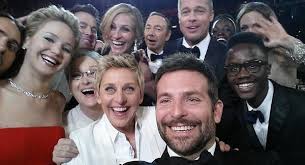
Takin' a selfie
Takin’ a selfie

Sure, taking and live-tweeting that selfie was silly.  But when it turned up instantly on Twitter, it turned out to be a really good picture.  It showed stars from Meryl Streep to Julia Roberts and Kevin Spacy, as well as Lupita Nyong’o’s brother, game enough to put their happy faces into the frame as Bradley Cooper held the camera.  And sure, the Samsung product placement was nauseating, but the Oscars are about nothing if not overt corporate sponsorship.  Let’s not ring our hands too much over the obvious.

So on the whole, yes, host DeGeneres felt almost too lightweight, casual, and inoffensive.  Except, of course, for that weird note at the beginning, when she called people racist if they didn’t vote for 12 Years a Slave.  And except for her teasing an obviously confused and distressed Liza Minnelli about being a female impersonation of herself.  And except for the juvenilia of creeping up into the seats behind the stars to surprise them on camera.

But I appreciated that she cast her lot in the house with the stars, instead of lording a presumptuous gender and racial superiority over them and us from the podium, as MacFarlane did last year.  In her daytime show, DeGeneres is famous for coaxing some personal authenticity from those who’ve otherwise sold themselves to the Hollywood machine.  That she tried to remake the Oscar telecast into the image of her own television show finally seemed kind of bold.

Lupita Nyong'o accepting award for Best Supporting Actress
Lupita Nyong’o accepting award for Best Supporting Actress

As for the evening’s awards, kudos to Lupita Nyong’o for her win and her graceful, inspiring, generous acceptance speech.  And to Cate Blanchett for taking her moment at the microphone to chide those (many) people who think films about women aren’t important and don’t make money.  Her feminist intervention was necessary and refreshing in an evening when too many people steered clear of the politics of their own work.  Jared Leto, winning for his role as a transgender woman in Dallas Buyers Club, finally tried to say something intelligent, after an awards season’s worth of uninformed remarks that called attention to himself instead of the history his character represents.

Hero to himself
Hero to himself

And Matthew McConaughey?  His bloviating, self-aggrandizing paean to his god and himself was remarkably tone-deaf, given what the film was about.  To not mention HIV/AIDS or the real person on which the film was based?  To talk only about being a hero to himself?  Disgraceful.

Of course, as so many have pointed out since Dallas Buyers Club premiered, it’s easy to write stories that generate empathy for straight white people with HIV/AIDS, and to award straight white men playing people grappling with the disease.  Have we really not come very far from Tom Hanks in Philadelphia, oh those many years ago (21, to be exact)?  And do Leto and McConaughey truly think that they can play these characters without remarking on their role in history or on the fact that the disease whose early days the film represents is still a deadly and stigmatizing social scourge for so many around the world?  Do they really think that their work is just about them?

Of course they do.  That’s what our culture tells actors.  We admire their personal transformations—McConaughey’s touted weight loss and Leto’s physical performance as a trans woman—because all we’re encouraged to see is the superficial aspects of an actor’s work.  The Academy likes to award actors who appear to take huge physical risks, especially with weight gain and loss—Charlize Theron in Monster and Christian Bales in The Machinist, among so many more—in part because it’s a visual marker of transformations that we don’t otherwise know how to talk about. The average theatre- or movie-goer has no idea what it means to act.  We all think we understand celebrity, but that has nothing to do with the craft of acting.  People don’t know the language of beats or super-objectives, physical choices or blocking, concentration or emotional recall, the creation of a character through the careful building of an imagined history that informs every facial expression, physical gesture, and mannerism.

People know nothing about creating the illusion of character “psychologically” or “from the outside in”; those of us who do know these terms have done very little to popularize them. Acting remains mystified, by critics and theatre- and filmmakers alike.  As I remarked at a colloquium on criticism organized by Karen Fricker at Brock University in St. Catharine’s, Ontario, two weeks ago, how often do we attend talkbacks only to hear spectators ask actors how they learned so many lines?  People don’t know what else to ask because we’ve abdicated the responsibility to teach spectators how the crafts of theatre work—whether acting, or directing, design, or playwriting, for that matter.

As a result, blowhards like McConaughey and Leto can get away with their self-involved, pious statements, because we let them subscribe to the commonsense notion that actors are inspired by gods.  I’m not disparaging the religious faith of many artists, which I know is sincere and motivating.  But some artists ascribe their work to gods or a mysterious muse, instead of describing in detail the hard work and informed choices that go into creating characters or devising stage or film images, choices that resonate in a social context in which they mean something.

Cate Blanchett accepting her award for Best Actress

How important, then, to hear Blanchett emphasize the importance of producing stories about women, and to hear director Steve McQueen, accepting the Best Picture award for 12 Years a Slave, talk about the persistence of slavery, as an historical memory and in its contemporary manifestations.  How important to hear John Ridley, who adapted the narrative on which the film was based, honor the free man who was enslaved for too many years as the lifeblood of the story.

McQueen
Director Steve McQueen accepting award for Best Picture

And how terrific to see Darlene Love, one of the featured performers in the award-winning documentary 20 Feet From Stardom, take the stage at that theatre and just open her mouth and arms to sing gloriously and joyfully, as if to say to spectators, “This is what my work is all about” or “This is how we did it in this film.”  She showed her delight by showing her talent and her work.

Darlene Love singing out when 20 FEET FROM STARDOM won Best Documentary

The Oscars, after all, shouldn’t be all about the dress, or the tux, for that matter, as the simpering, fawning red carpet “commentators” would like us to believe.  Awards for the “best” of the year should be about the stories and the craft, and the show (and all the criticism and feature articles that precede it) should be about honoring the particulars of the artists’ work.  Wouldn’t it be something if all spectators knew how to talk about an actor’s work on stage or in a film, just as most Super Bowl viewers can talk about an athlete’s work on the field?

The Feminist Spectator