Peggy Shaw’s latest solo show, Ruff, explores with brutal honesty and frank clarity the physical and emotional costs of surviving a stroke. Shaw says her 2011 stroke felt as though an icicle was falling into the ocean-bottom of her mind. She didn’t know, at the time, what was happening to her; she thought her world was tilting, perhaps as payback for the perceived sins of her life. Just let me get through this, she reports thinking, and she’ll give up coffee, “get gay married,” pay market-rate rent in New York, take anti-depressants, stop wearing skinny jeans, and do “right” all the things that a gender renegade like Shaw has refused to do all her life. If only she can survive the stroke. (See a video of this part of the performance, which Shaw staged for The New York Times, here.)
Happily, survive she does, though the physical toll is steep. As the performance begins, she tells us that she coughs now—but not to worry, and don’t offer her water, please. Sucking on something will soothe the cough. Later on, she admits she lied, and finds a bottle of water to drink. She also calls attention to the three large monitors that share the small, narrow stage space at LaMama with her, on which her script is written. Even so, she sometimes gets lost in a moment, and reminds us again not to worry, that she’ll find her way back and through.
And again, she does, telling us an elegiac story of nostalgia and loss, of mortality and survival. As the doyenne of the downtown lesbian/feminist/trans/butch performance scene for the last 45 years, Shaw is a consummate master on stage. She still brings her charismatic self out into the audience to chat and flirt, but Ruff is prompted by a more urgent need to share what she’s learned about her brain and its vulnerabilities. She tells us to remember the acronym F.A.S.T., and asks us to follow along as she demonstrates how to recognize the symptoms of stroke: Does the person’s Face droop when they smile? If you ask them to lift their Arms, does one drift downwards? Is the person’s Speech slurred when they talk? If so, it’s Time to call an ambulance. Shaw proudly shares this newly learned list of signs; when she had her stroke, she just thought she was suffering some sort of biblical punishment.
Shaw’s long-time artistic partner, Lois Weaver, directs Ruff with a light touch, grounding the performance in a matter-of-fact style and structure. Shaw’s monologue is backed by a video-taped band of women musicians, including Vivian Stoll, Shaw’s frequent musical collaborator, who plays the drums; Ellie Covan, the impresario of Dixon Place, who plays her accordion; and the lovely Sharon Jane Smith, one of the original WOW Café performers, who plays a guitar. They provide musical accompaniment and counterpoint and basic punctuation to her tale as they gather on the screen behind Shaw.
Shaw in front of the videotaped, on-screen band
I missed seeing Shaw interact with live musicians; she and Stoll are always warm and sweet together, and Stoll’s live drum stylings bring rhythm and texture to Shaw’s performances. But there’s something compelling about the ghostly, disembodied, filmed appearance of the band in Ruff that nicely underlines Shaw’s themes. A stroke takes something away; it produces a kind of gauze between reality and experience. It reminds you that your mind is an archive in which the boxes aren’t necessarily acid-free. Memory becomes both sustaining and corrosive and the future looks a little tenuous and remote.
But the stalwart Shaw marshals her vital life force and continues, in the performance environment in which she thrives. At 69-years-old, she’s a butch/lesbian/feminist/trans icon, an activist with an ever-keen eye on social inequality, and a fierce warrior against the depredations of our culture and the deterioration of the mind. She’s an inspiration.
Ruff, LaMama ETC., through Sunday, January 26, 2014.
There’s a bit of a firestorm on Twitter and on line these past few days about criticism (again), prompted in part by Polly Carl’s HowlRound post, “A New Year’s Diet for the Theater,” in which she cites my essay on “critical generosity” from Public. The offending phrase from my piece seems to be where I take Ben Brantley and Charles Isherwood of the New York Times to task for not being responsible to the “deleterious effects” of their criticism, and where I suggest that criticism is “always political,” whether or not it’s “masked by the ‘objectivity’ that power bestows on their work.”
The offending moment in Polly’s piece seems to be where she argues that we should be “nicer”: “Let’s be nicer this year,” she proposes. “There is a growing critical edge to social media conversation that is beginning to wear on me.”
Some commentators on Twitter quickly conflated “critical generosity” with “nicer” and protested that being nice has nothing to do with criticism; that it gives feminism a bad name; and that daily critics don’t have the leisure to have an extended generous (whether or not “nice”) dialogue when they write about theatre.
George Hunka, in his blog post, “We are All Victims Now,” admitted, “Nobody likes a good round of Times-bashing more than I do,” but chastised me for not citing any of Brantley or Isherwood’s reviews “that would lend substance to [my] accusation of political, aesthetic, and ‘objective’ motivations for negative critical verdicts.” Then he digs up the old Arlene Croce debate in The New Yorker from 1994 about Bill T. Jones’s piece Still/Here, which Croce refused to review because she dubbed it “victim art.”
A peculiar gender bias haunts this conversation which, as Polly might note, blew up in edgy and quickly accusatory ways on Twitter (a format I find pithy but not really conducive to thoughtful and, I admit, generous commentary). That is, “nice” is quickly equated with a kind of sentimental, non-evaluative, dishonest, non-confrontational, frankly and stereotypically “feminine” kind of engagement. And daily critics—whether or not, I should say, they are men or women or any other mix of gender identifications—are positioned as the brawny, masculine laborers being stalwart and honest and clear as they do the difficult and sometimes painful but always necessary work of telling consumers where to spend their money on theatre.
That’s too bad.
I agree with Polly. The arts are beleaguered. We’re not “victims,” as Hunka accuses me and Polly of suggesting (I think). But I would expect most of us to agree that when money dries up for artistic experimentation and innovation and the nourishing of new voices, we should all be worried. I believe that we need to take care with the work we see and engage, to honor the impulse that produced it; to see it in a broad context of social relevance and meaning; to consider it through a variety of aesthetic and taste traditions; and whether or not we “like” it, not to dismiss it out of hand, even when we see its flaws and failures. That’s what I mean by critical generosity. Word count and daily deadlines shouldn’t excuse derogatory dismissal.
Critics—good, professional critics—are experts. We know a lot about theatre and performance. We know its history, its debates, its forms, genres, and contents. Many of us are experts in particular kinds of theatre and performance. I know a lot about feminist theatre, queer theatre, women playwrights and directors, self-avowed political theatre, contemporary American theatre, solo performance, and a few other things. But that doesn’t make me superior to the work about which I write. I don’t want to stand above the work. I want to see myself in conversation with what it means, how it feels, what other people thought about it, what it does in the world. And yes, I do want to engage with kindness and rigor. I don’t think they’re mutually exclusive. A performance can make me angry and I still want to write about it carefully and I hope kindly. That’s also what I mean by critical generosity. (See this story about a new blog that documents random acts of kindness by academics. It’s relevant.)
Any critic also has a perspective, a way of looking that guides their engagement. I would propose that ways of looking are always ideological, never objective (see John Berger’s foundational series and book, Ways of Seeing). But then, I’m a feminist. I don’t think power is equally distributed. The Times and its first- and second-string critics have a certain influence, power also determined by their relative status at the paper. Anyone writing for a daily paper has visibility that gives their words weight and meaning. And obviously, they negotiate with the editors and advertising managers who supervise them, and are beholden to deadlines and word counts that constrain their writing.
Arts critics’ positions are also being reduced or de-funded at daily papers all over the country, a trend that will certainly affect the discourse about arts in this country. How can we proactively reimagine, then, how we stage our conversations about theatre and performance?
I started this blog (nearly 10 years ago now) because I wanted a place for a counter-discourse, one in which I could participate in a different kind of conversation about the theatre and performance to which I’m committed. My writing isn’t beholden to editors, word counts, or advertisers; I have that beautiful freedom and leisure. My writing is political and ideological; but then, because I’m a feminist, I believe all writing is marked by position and power, that all writing is rhetorical and wants to persuade. Why else would we write?
I look at theatre and performance—and film and television—with an interest in what and how it tells me about gender and sexuality, about race and class, about how we’re hailed as citizens of the world. I’m interested in how form and content and context complement each other around those themes. I’m interested in reception and production, in how artists frame their arguments and how audiences see and hear them. I’m interested in talking about the arts as though they have a real effect on our lives and what we’re capable of imagining for ourselves and others–because I believe they do.
Other critics look at and for other things. I’d love to have a real conversation—not an accusatory conversation—about the work of criticism and what it makes possible for artists and audiences. I don’t think I’m always right.
On that note, I’ll apologize to Brantley and Isherwood (whom I don’t know) for suggesting in my Public essay that they “revel in their power to destroy productions they don’t like.” I don’t know if they really revel in that power; perhaps it keeps them up at night. Sometimes, when I read their work, I don’t sense much concern for what their criticism might do to the artists whose work they’re evaluating. But as I’ve admitted, I’m sensitive to biases and to power inequities. My own words about Brantley and Isherwood in that essay come from too many years of frustration with the lack of audible alternative critical voices in public forums with the power to shape the public arts conversation.
But what I said wasn’t very generous. So I’ll follow my own injunction. I didn’t mean to be mean; I respect daily and weekly and monthly critics, as well as those who blog frequently or irregularly. I feel connected to other people who write about the arts and appreciate their labor; I want to be in dialogue with them, as well as with artists and audiences.
When I teach my students how to write criticism, they assume they have to be negative. I’d rather teach them how to be rigorous and generous about what they see, how to refrain from ad hominem attacks and respect the artists about whom they write, and use their words to create a dialogue about what works and what doesn’t and why, and what it all might mean.
Am I sentimental? I don’t think so. Are those of us in the arts victims? Not at all. Are we people with a common purpose, which at least in some small part is to champion the arts and the diversity of stories that deserve to be heard and explored and contested and provoked under its auspices? I hope so.
I often begin writing blogs that for one reason or another don’t get finished. I’m taking this New Year’s Day 2014 opportunity to spend a few words (well, more like 5,000 words!) mentioning a few films, TV shows, books, and other theatre- and pop culture-oriented events that I missed discussing fully in 2013. I’m hoping that for the continuing TV series I engage here, I’ll be able to post full blogs in 2014. (And later, I’ll break the writing below into short individual posts for easy searching, so that you can read in full or read by topic.)
Thanks as always, this New Year’s Day, for reading The Feminist Spectator. Sharing the blog with all of you is one of my chief pleasures.
* * *
I’m jazzed by Masters of Sex, the new Showtime series that stars Lizzy Caplan as the pioneering sex researcher Virginia Johnson, and Michael Sheen as her collaborator, Bill Masters. A stable of women writers and show-runners use the series to explore the bias in the 1950s against women doctors and against research into women’s health (including the then-nascent Pap smear to detect cervical cancer). Masters of Sex also considers the judgments brought against women who dared to enjoy their own sexuality in an historical moment in which they were taught otherwise.
The show also addresses racism and homophobia hand-in-hand with sexism. Beau Bridges is wrenching as the closeted gay provost of the university hospital where Masters and Johnson conduct their research, and Allison Janney is eloquent and heart-breaking as his sexually frustrated but finally forgiving and progressive wife. Janney’s story arc mirrors Caplan’s, as both characters come at the question of sexual self-determination from different directions. Julianne Nicholson plays a talented but overlooked and therefore bitter woman doctor, herself suffering from cervical cancer, who fights to get her own study approved by the university.
Caplan is the reason to watch this show so far, although it’s also interesting to see how verboten sex research was in the mid-1950s. She’s glorious as a woman who was a nightclub singer and takes a clerical job in a hospital that brings her to the attention of William Masters (Sheen), who hires her as his assistant because she’s plainspoken about sex and shares his curiosity for all things scientific. She had no formal schooling, but a keen intelligence and a frank, unflappable ability to deal with research subjects who had to perform sexually with strangers, wearing all sorts of measuring devices and knowing they were being watched through the two-way glass mirror.
Caplan and Sheen as Johnson and Masters, watching
Johnson is sexy and charismatic, but she’s also very smart, a woman ahead of her time (she’s divorced, with two kids, likes friends-with-benefits sex, and doesn’t want a relationship). The man she beds, a doctor determined to make her his wife, can’t understand how someone with such sexual appetites could be anything but a whore, especially when she rebuffs his desire to have a real relationship. Infuriated, he slaps her and calls her names, but she’s undaunted and determined. When he comes around again, later in the season, he’s contrite and forced to be more progressive in his views about women’s sexuality and their work.
The show charts how Johnson’s reactions to her experiences predict the women’s movement and its focus on female sexual agency and employment equality. (The real Virginia Johnson died in July 2013.) With smart writing and elegant, intelligent and emotional performances, this feminist series perceptively addresses historical themes with contemporary resonances. Catch the first season and stay tuned for season two.
* * *
In a delightful case of mainstream culture catching on to a chestnut of feminist criticism, Sweden last year adopted the “Bechdel test” for rating films. It’s simple: a film passes the test if 1) it includes at least two women characters who 2) talk to one another about 3) something other than a man. Amazing, though, how many films still fail the test. Watch Kirby Dick’s masterful documentary This Film is Not Yet Rated, which exposes the hypocrisies of the long-standing American rating system and its arbitrary, secretive, and capricious way of judging films. The MPAA system actually punishes projects that depict female sexuality with strict R ratings in favor of those that gleefully display what my dad calls “murder and mayhem.” Rating systems are bankrupt, in my opinion, but think about how a feminist critical consciousness would be popularized if Bechdel’s test were widely employed in the U.S. to consider the “appropriateness” of films.
Speaking of Alison Bechdel, writer Lisa Kron and composer Jeanine Tesori’s musical adaptation of her graphic novel, Fun Home, at the Public Theatre, is one of the best shows in New York this season. The ground-breaking musical about a lesbian growing into her sexual identity and confronting her father’s barely concealed, morally suspect queer life uses both humor and pathos to spin Alison’s story against the backdrop of 1970s America. Beautifully written, sung, and acted, Fun Home deserves a spot on upcoming regional theatre seasons around the country. Here’s hoping it joins the popular repertoire.
Beth Malone, Sydney Lucas, and Alexandra Socha in FUN HOME
I caught the show for the second time last weekend, and was struck once again by its elegance and emotional intelligence. This is one of the first productions to depict lesbian memory on stage (think of The Glass Menagerie, so well received on Broadway this season, narrating a gay man’s family memories). The second time around, I was still amused and awed by Sydney Lucas’s portrayal of Small Alison, and loved her “Call me Al” and “Ring of Keys” numbers, in which the young girl discovers her lesbian moves and desire. Emily Skeggs, the replacement for Middle Alison, wasn’t quite as convincing as Alexandra Socha as the college-age woman who comes out at Oberlin, thrilled to her core by finally enacting her desire.
But I was more moved this time by Beth Malone’s adult Alison, and better understood the story through her watchful, meditative eyes. In a way, Fun Home is a “making of” musical, as Alison the graphic artist threads herself through her memories, sketching her novel and deliberating out loud how to caption her images of her family and her friends. The show meditates not just on memory itself, but on the vexed ways we try to name and claim the past, to understand people and events that form us, like it or not. All three Alison’s relationships with her father, played by Michael Cerveris, have also settled in and become more heartbreaking than ever. (The show plays at the Public Theatre in Manhattan through January 12, 2014.)
* * *
Playwrights Horizons continues to model what a truly democratic, gender- and race-aware Off Broadway theatre season should be, presenting a majority of plays written and directed by women without fanfare. The 2013-14 season last boasted Madeleine George’s The (Curious Case of the) Watson Intelligence, a smart, lively inquiry into the dilemmas technology has wrought across history (crisply directed by Leigh Silverman). This production followed Marlene Meyer’s The Patron Saint of Sea Monsters and Anne Washburn’s Mr. Burns: A Post-Electric Play, which has made several year-end “best of” lists in New York. Mr. Burns’ innovative premise—in a post-apocalyptic world, people trade staples for currency derived from remembering the dialogue and plot of episodes of The Simpsons—was theatrically realized by director Steve Cossen.
Coming up at Playwrights Horizons
Coming up in 2014 is Sarah Ruhl’s latest, Stage Kiss, directed by the fabulous Rebecca Taichman (whose production of Paula Vogel’s lovely A Civil War Christmas I had the pleasure of catching at Baltimore’s Center Stage), as well as the Rude Mechs‘ resident playwright Kirk Lynn’s Your Mother’s Copy of the Kama Sutra, directed by Anne Kauffman (who’s also directing Lisa D’Amour’s new play, Cherokee, at the Wilma Theatre in Philadelphia starting this month), and a new musical called Fly by Night conceived by Kim Rosenstock, Michael Mitnick, and Will Connelly, and directed by Carolyn Cantor.
Louisa Krause and Aaron Clifton Moten in THE FLICK
Last season at Playwrights included D’Amour’s razor-sharp social satire, the Pulitzer Prize-finalist Detroit, also directed by Anne Kauffman; Amy Herzog’s The Great God Pan, directed by Carolyn Cantor; Annie Baker’s elegiac three-hander, The Flick, a study of historical shifts and character growth set against the backdrop of a movie house changing from celluloid to digital projection; and Tanya Barfield’s excellent family drama, The Call, directed by Leigh Silverman, which addresses the complications of race, class, and adoption.
PH artistic director Tim Sanford continues to belie the misbegotten claim that you can’t program a season with an eye toward gender and racial parity and aesthetic quality at the same time. His selection of plays and productions is consistently artistically challenging and socially diverse. Continued kudos to him and his company.
* * *
The Women’s Project’s JACKIE, BETHANY, and COLLAPSE from 2012-2013
The Women’s Project, so ably lead by artistic director Julie Crosby, had a terrific 2012-13 season, with Bethany, Jackie, and Collapse in their current cozy and compatible presenting space at City Center. Written by Laura Marks and directed by Gaye Taylor Upchurch, Bethany starred America Ferrera as a woman caught in the economic downturn who’s frantic to reclaim the child taken from her by social services. As a smart and relevant critique of the inequities of class, the play was impeccably produced and performed. Likewise, Jackie, a one-woman play by Nobel Prize winner Elfriede Jelenik, directed by Tea Alagic, showcased performer Tina Benko’s elastic physical and emotional talents in this North American premiere of the post-modernist text by the famed Austrian female playwright.
This year, the Women’s Project’s three-production season includes two full-length plays—one by Jessica Dickey and one by Catherine Trieschmann—alongside The Architecture of Becoming, a piece directed by three women ,written by five women, and produced by five women, conceived by all of them and two others. The Women’s Project continues to be a visible, powerful incubator and launching site for excellent plays written and directed by women.
* * *
The Women’s Project also has a directing lab that trains generations of young women in a field that’s still too dominated by white men. But, in fact, the visibility of mostly white women directors off Broadway and on has been notable this year. In alphabetical order, Tea Alagic, Anne Bogart, Carolyn Cantor, Anne Kauffman, Tina Landau, Pam MacKinnon, Emily Mann, Diane Paulus, Lisa Peterson, Leigh Silverman, Anna Shapiro, and Rebecca Taichman are among those consistently working in high profile New York and regional venues on notable productions by new and established playwrights. Their continuing clout can only help improve the status of all talented women working in theatre.
* * *
From Tanya Barfield’s THE CALL at Playwrights Horizons
I participated in a panel discussion at the National Theatre Conference (NTC) in December 2013, for which the wonderful Alison Carey (Oregon Shakespeare Festival) organized me, Lisa Kron (Fun Home), Tanya Barfield (The Call), Caridad Svich, and Elizabeth Frankel, the literary manager of the Public Theatre, to discuss the on-going status of American women playwrights. The NTC has an three-year project, founded by Pulitzer Prize-winning playwright Robert Schenkkan, which advocates for increasing the visibility of women playwrights in university and regional theatre seasons, and collects data from those that meet the challenge of mounting full productions. (Read about the December conference and the NTC 2013 awards–one of which went to playwright Lynn Nottage, another to OSF’s Bill Rauch–here.)
While I’m always happy to talk about issues of gender discrimination and the still relatively low visibility of women playwrights in American theatre, it struck me as we all spoke last month that perhaps it’s time to reframe our thinking about this issue. The data is dispiriting, I agree. But the work that is produced is really very good, and deserves to be discussed in some critical detail. That is, one way of advocating for women’s work is to teach it, produce it, and discuss it as often as possible, to address what is there instead of the ongoing imbalance in numbers of production that aren’t there.
I’m not saying that the continuing discrimination doesn’t matter, or that the good work of 50/50 in 2020 (whose members were represented in the audience at the NTC panel), or the League of Professional Theatre Women, or On Her Shoulders, or History Matters/Back to the Future doesn’t remain crucial to activism for increasing the gender and racial diversity of American theatre. But after that NTC panel, I wished we’d spent the time talking instead about Kron’s, Barfield’s, and Svich’s terrific work, and atomizing what’s good about it, and who they worked with, and how it got produced. Or I wish we’d talked about Carey’s own important work directing the American Revolutions United States History Cycle of plays project with OSF (where the remarkable Bill Rauch and his own thoughtful producing is another national model of gender and race parity, along with Sanford’s at Playwrights), instead of once again bemoaning the numbers. Just a thought.
* * *
Television continues to be the best place to consume long-form dramatic writing, with well-written scripts with complicated story lines and complex characters getting high-caliber artistic treatment. In addition to Masters of Sex, watch the eight-episode mini-series Top of the Lake, written and directed by the Australian feminist filmmaker Jane Campion.
Elisabeth Moss as Robin in TOP OF THE LAKE
I binge-watched this series on the Sundance Channel, utterly enthralled by the austere New Zealand lake-country setting and by Campion’s equally grim story. Elisabeth Moss stars as Robin Griffin, a young woman who returns to her hometown—isolated, insular, secret-filled Laketop—after starting her career as a detective in Sydney and dawdling in a nine-year engagement to a policeman named Steve. Her mother’s cancer brings her home, but the pregnancy and subsequent disappearance of a 12-year-old girl named Tui persuades her to stay. Robin is an expert in child sexual abuse, for personal reasons that become clear halfway through the show’s eight-episode arc. She immediately attaches herself to the enigmatic, biracial Tui (Jacqueline Joe), and begins to rehearse her own adolescent traumas through her reintegration into Laketop.
Robin (Moss) and the soon-to-go-missing young girl, Tui (Joe)
Campion writes and directs, leading a terrific cast through stories as murky and mysterious as the frigid lakes that wend their way through the mountain town. With craggy peaks enshrouded in fog looming over the proceedings, and icy water the seems to beckon troubled characters into its depths, Top of the Lake’s setting becomes as defining to the story as the past that lurks around the corner of every life. Robin rekindles an affair with Johnno (Thomas M. Wright), an old high school boyfriend, which soon leads her to confront the sexual assault that haunts their relationship. Lording over the town and its incestuous relationships is Johnno’s tyrannical, psychotic father, Matt Mitcham (Peter Mullan), a long-haired, desiccated white warlord whose iron-clad control over his elaborate family and the townspeople, most of whom work for him, becomes the focus of Robin’s investigation.
GJ (Hunter) and her acolytes
Moss’s award-nominated performance shows her range as an actor. Her accent is impeccable and her sharp watchfulness as Robin, combined with her ambivalence about her own history and the complexity of her own desires, make her riveting to watch. Holly Hunter also has a wonderful turn as GJ, the charismatic leader of an all-women commune that sets up camp just outside of town, enraging the violent local patriarch and his clan. The scenery is gorgeous, the writing elliptical, the characters richly drawn, and the story entirely feminist.
* * *
Showtime’s inimitable dramedy Nurse Jackie ended its fifth season last fall. This was the year of Jackie’s recovery (or so we thought). She began a relationship with Frank (Adam Ferrara), an NYPD cop with a sunny disposition and a kind temperament, who is more patient and reasonable than any grown person should somehow be able to be. Dating him, Jackie (Edie Falco) tried to reinvent herself as someone with fewer quirks and flaws, as a “real” woman who dresses up for dates (even if they turn out to be at down-heeled outdoor restaurants where Jackie and Frank eat fried fish). She even puts on lipstick and tries to be a responsible parent to Grace (Ruby Jerins), her teenaged daughter,whose rebellion is based on her mother’s addiction and her parents’ divorce.
In other words, instead of narrating an out-of-control life balanced precariously by a woman who was very good at keeping her addiction a secret, Nurse Jackie reincarnated its heroine as a paragon of ordinary virtue and lost some of its more interesting edge in the translation. But in the final moment of the season (spoiler alert!), when she’s on her way to her one-year sobriety anniversary, Jackie reaches for the single pill she’s kept in a jewelry box on her bedside table . . . and takes it. Jackie proceeds to celebrate her anniversary high, which will bode poorly for her, but no doubt well for the returning series.
Falco and Cannavale on NURSE JACKIE
Because Dr. O’Hara (Eve Best) was missing in action after she delivered her baby last season and suddenly, inexplicably returned to her native UK, the close female friendship that once grounded the series was replaced by Jackie’s sexual and romantic interest in Frank (and her grief sex with Mike Cruz [Bobby Canavale], the hospital administrator whose son died of an overdose). As part of her purported recovery process, she also apologizes to her ex-husband, Kevin, as he stands suspiciously behind the counter of his bar. The well-written scene is lovely. Dominic Fumasa, as Kevin, was reduced to steely silence and frustrated reactions to his ex-wife’s antics this season, but he’s a terrific, empathetic actor. Kevin’s willingness to forgive Jackie and their new-found, unfortunately necessary bond over their daughter Grace’s deterioration is convincing and frank, and gives the narrative some nuance and emotional weight.
Merritt Wever, terrific as Zoey on NURSE JACKIE
Hopefully, when the show returns for its sixth season, the happily Emmy Award-winning Merritt Wever will get even more airtime as Zoey, the green but maturing nurse who Jackie mentors and comes to befriend. Although Zoey can’t quite take O’Hara’s place, their more sisterly or mother-daughterly relationship has the potential to shift the emphasis back to intimate relationships between working women that gave the show its feminist bona fides.
* * *
The Netflix series Orange is the New Black polarized viewers who debated its representations of women of color in a story (adapted from a memoir by Piper Kerman) about an upper-middle class white woman who goes to prison for drug-running for her then-lesbian lover, ten years after the fact. As Piper Chapman (Taylor Schilling) shows up at prison to serve her term, she’s about to be married to her boyfriend (a sad-sack New York Jewish boy played by Jason Biggs). As narrative coincidence would have it, her former girlfriend, Alex Vause (Laura Prepon), is serving her term in the same facility and after a bit of trial and error, they resume their old relationship. Their central story is surrounded by those of the other female inmates, many of whom are African American or Latina, and who keep to racially self-segregated groups.
Piper starts out as unlikable, privileged, and presumptuous, but she comes to see how much she shares with her fellow inmates, who find cautiously common cause even as they preserve their separate spaces, histories, and experiences. The initial focus on Piper shifts as the other women inmates accumulate back-stories that explain how they arrived in prison, which typically involve economic constraints and social options delimited by their race, ethnicity, and/or class. The male prison guards, played mostly for laughs, demonstrate degrees of oppressiveness, from the extreme of Pablo Schreiber’s “Pornstache” Mendez to Michael Harney’s bumbling chief, Sam Heaney, to Matt McGorry’s naïve newbie, John Bennett.
The cast
The excellent cast is a pleasure to watch, and make the most of often too-short scenes. Danielle Brooks is particularly good as Tasha “Tasty” Jefferson, who is released and returns to prison shortly after, unable to “make it” in the “real world” for reasons the episode depicts frankly. Dascha Polanco is excellent as Dayanara Diaz, who becomes pregnant by the earnest new guard. Trans actor Laverne Cox is quietly sensitive as the trans inmate, Sophia, who worries that she won’t be able to continue her hormone therapy while she’s serving her time. Annie Golden is sweet as the mute Norma, who breaks her silence with a haunting Christmas song in the season finale. Michelle Hurst is uncompromising as the stern Miss Claudette, who has been imprisoned for a righteous revenge killing and sets the rules in the African American women’s population to which Piper is assigned. Kate Mulgrew is sharp and sardonic as “Red,” the Russian tyrant who runs the kitchen. And Natasha Lyonne is great as Nicky, the lesbian whose wry observations and laid-back demeanor provide a counterpoint to the mayhem that ensues around her.
Taryn Manning as Pennsatucky
The first season ended with a melodramatic showdown between Piper and her nemesis, Tiffany “Pennsatucky” Doggett (Taryn Manning), a working-class white woman whose zealotry is engineered by a rabid organization of the religious right. I’ll be curious to see where show-runner Jenji Kohan (Weeds) takes season two. With so many juicy roles for women (white and of color), and with such a diversity of race, class, gender, religious, sexuality, and ethnic issues entangling in the hot-house prison atmosphere delivered with dramedy shadings, I admit that I find Orange irresistible.
* * *
Olivia Colman in BROADCHURCH
This year (well, as of today, last year), I also enjoyed Broadchurch on BBC America, the British mystery about a young boy’s murder in another remote, seaside town in the UK. Although David Tennant headlines the show as a detective who comes from the outside to work the case, Olivia Colman stole it out from under him as his locally-based partner. Her effort to be empathetic but ethical as her fellow townspeople behaved badly was marvelous to watch, in a restrained, nuanced performance that inevitably shifted focus her way.
I’m still watching the first season of The Returned, a French series on the Sundance Channel about a group of formerly dead people who mysteriously return to their lives in yet another small, remote town. The performances here, too, are understated and compelling, as survivors’ loved ones suddenly reappear and they have to corral their astonishment and figure out how to reconcile their present happiness with their former grief. That “the returned” come back as less than benign presences keeps the plot suspenseful, though the show’s “horror” is mostly unseen. The series creates an uneasy, moody atmosphere.
Alicia (Margulies) and Cary celebrate in THE GOOD WIFE
I’ve also continued to enjoy The Good Wife, with this season’s surprising machinations and Julianna Margulies’ persistently excellent performances and, of course, Scandal, with plot turns that never fail to shock and delight, all grounded by Kerry Washington’s terrific, Emmy- and Golden Globe-nominated performance as Olivia Pope, fixer. The turn to melodrama on network television series isn’t news (see also the wonderful Connie Britton and Hayden Panetierre in Nashville), but Scandal and The Good Wife did exceptionally good jobs this season of twisting and turning plot points in unexpected and refreshing directions.
Kerry Washington stars as Olivia Pope on SCANDAL
Scandal is one of the few shows I want to watch when it airs, instead of on demand or on DVR, mostly because I don’t want Facebook and Twitter feeds to spoil the plot surprises. The scene toward the season’s end between Joe Morton as Olivia’s evil (or is he?) father, Rowan, and Tony Goldwyn as President Fitz Grant, her boyfriend, offered terrific writing and acting, as Rowan called Fitz “boy” up and down and slurred his authority and his relationship with Olivia. That scene alone demonstrated the tours de force of which show-runner Shonda Rhimes is capable. As the ABC teaser goes, this is “OMG TV.”
* * *
I was also happy to catch the first short season of Getting On, the new HBO series starring Laurie Metcalf as Jenna James, a doctor with aspirations working below what she thinks is her pay grade at a geriatric women’s hospital. Metcalf masters the art of smiling with only her teeth, lifting her lips in perfunctory grimaces meant to impersonate warmth, and then dropping them abruptly without really caring if she’s convinced anyone. Like the female leads in Veep (Julia-Louis Dreyfus) and the tragically cancelled Enlightened (Laura Dern), Metcalf’s Dr. James is far from a heroine. She’s flawed and often unlikable, especially when she’s obtuse about the straitened financial circumstances of her nursing staff. But Getting On also clarifies that as a middle-aged, only moderately successful but still ambitious woman doctor, James has to work five times harder than white male peers. Her effort to be taken seriously for her research on geriatric stool discharge is hilarious but also poignant, as her colleagues laugh her off thoughtlessly.
Borstein and Nash as Dawn and Didi, on the job
Alex Borstein and Niecy Nash are pitch-perfect as nursing colleagues caught in the twilight zone of a hospital that wants to treat its patients like customers on a cruise, while at the same time addressing difficult-to-manage conditions like dementia, incontinence, end-of-life, and the sexual appetites of the elderly. Borstein is terrific as the sexually voracious, misguidedly romantic head nurse, Dawn, and Nash is all sarcasm and surprising empathy as Nurse Didi, her more sober, stable counterpart. Mel Rodriguez is hysterical as Patsy De La Serda, the closeted gay male nursing supervisor who leads Dawn on and always wears his Bluetooth earpiece (though he rarely talks on his cell phone).
Laurie Metcalf as Jenna James in GETTING ON
Getting On satirizes a medical system in which for the most part well-meant nurses are guided by preoccupied, self-centered doctors, all at the expense of patients warehoused as they die. Class, race, ethnicity, and gender biases are lampooned with subtle but pointed humor and adept physical comedy. Metcalf, Borstein, and Nash exemplify the talent and potential of middle-aged women assigned complicated characters whose motives and methods are always surprising. The writing somehow manages to be razor-sharp and funny but at the same time compassionate and conscious of the complexities of aging, gender, sexuality, race, and class. I look forward to seeing how the series develops.
* * *
I also read some good fiction this year, including A.M. Homes’ award-winning May We Be Forgiven, which I found a lovely, funny, bittersweet story of one dissolute middle-aged man’s redemption; Meg Wolitzer’s The Interestings, which draws so well and poignantly the long-term relationships of a group of friends that begins at summer camp when they’re kids and extends into their fifties; and part of Veronica Roth’s young adult Divergent trilogy, still another consideration of a dystopian, fascist future in which a young woman with ethically staunch special powers saves the day. I’ve finished Divergent and am halfway through Insurgent. I admit to being entranced by these stories and glad for their “girl power,” though this one feel a bit too centered in its heterosexual love story, unlike The Hunger Games trilogy, in which the romances seemed a less important byproduct of the narrative. Still, Roth’s plotting is fast and compelling, and it’s fun to read about a slight sixteen-year-old girl triumphing over evil.
* * *
Jennifer Lawrence as Katniss in CATCHING FIRE
Speaking of The Hunger Games, I was disappointed by Catching Fire, the second film installment, in which I thought the only things catching fire were the costumes. The new director, Francis Lawrence, shoots Catching Fire in dark blues and greys, an oppressive visual scheme unalleviated even when the tributes are sent back into the arena for their next gladiatorial combat. Jennifer Lawrence’s gifts as an actor were on display elsewhere this year (especially in David O. Russell’s American Hustle, in which her determined Jersey housewife was a model of corrupt righteousness and grit). In Catching Fire, Lawrence is given criminally little to do but react to the special effects happening around her, or to look alarmed or dismayed at the displays of state fascism Katniss’s growing popularity seems to inspire in the oppressed districts of Panem. This film sets up the growing revolt against President Snow and the capitol, as Katniss and Peeta’s victory tours across the country are met with citizens who raise their arms in a three-fingered revolutionary salute to their heroine and are quickly dispatched by the misnamed Peacekeepers. But little of import happens and very little emotion flickers across any of the actors’ faces.
Jena Malone, as reported by critics elsewhere, makes a strong showing as Johanna, one of the tributes who is surreptitiously working for Katniss and Peeta in the arena. And New York stage mainstay Lynn Cohen is lovely as Mags, the elderly tribute who’s carried around the arena by Finnick Odair (Sam Claflin) until she commits suicide by fading away into the poison fog to allow the young ones to escape. But the dialogue here is laughable, and the final line (“District Twelve doesn’t exist anymore” or some such ominously intoned proclamation) provoked peals of incredulous laughter in the audience with whom I watched the film. I liked the first film, but this one doesn’t at all capture the story’s building excitement. Such is the fate of trilogies adapted one-by-one for the screen, whose attenuated release dates and money-making machinations tend to leach out all the momentum gained by reading them on the page. (That said, here’s a link to a smart NPR piece about how Peeta is Katniss’s “movie girlfriend,” which reads the film’s representation of gender roles in interesting ways.)
* * *
(Spoiler alerts!) In other bad pop culture news, after her second Emmy win in two years for Best Actress in a Drama, season three of Homelandconsigned Claire Danes’ Carrie Matthews to being Saul’s pawn and to yearning for the missing-in-action Brody. That Carrie went off her bipolar meds didn’t seem to affect her work at all, an unlikely scenario for a woman whose condition so profoundly influenced her actions in earlier seasons. I found this season’s complicated plot difficult to follow and the stakes manufactured from events, rather than from character growth or considered story-telling. Fine, Brody’s off the show; by the time he was hanging from that crane in Iran as Carrie shouted to him frantically over a fence, all I could think was good, let’s move on. As episodes unraveled, the writers seemed to be visibly scratching their heads over what to do with Damien Lewis’s character.
Mandy Patinkin as Saul in HOMELAND
More interesting to me this season was the increased role of Saul Berenson, played by Mandy Patinkin as a morose, ambivalent leader in a position he never asked for. Seeing a Jewish man as a figure of authority, wearing his ethnicity so clearly, was fascinating. And by pairing him with F. Murray Abraham as his nemesis and/or compatriot, Homeland did something I’ve never seen a TV series do, which is to take Jewish men seriously. How often do we see Jewish men on television who aren’t schlemiels or comics or ethnic sidekicks? Saul’s style is rabbinical, almost Tevye-like in his indecision, and utterly compelling to watch. The odd couple combination of Patinkin and Danes was also compelling, he of the keening Jewish soul and she of the manic and then maudlin bipolar shiksa spirit. I would rather have seen more screen time between Saul and Carrie than Carrie and Brody, which became the inevitable emphasis as the season devolved.
Berenson desperately clung to his position as interim head of the CIA, while Tracy Letts’s slimy Senator Andrew Lockhart conspired to replace him. Saul’s gravitas and his doomed determination in the face of threats from Letts’ very WASP-y, Machiavellian superior read as a certain kind of ethical Jewish intellectualism, and the discrimination against him felt somehow racial. His complicated, bittersweet but grounded relationship with his South Asian wife, Mira (so thoughtfully played by Sarita Choudhury), rounded out the personal and the professional for Saul, and also somehow kept him othered. F. Murray Abraham played a wily, ethnically marked if less determinate, character called Dar Adal, Saul’s colleague (or his boss? hard to tell) at the CIA. Watching Abraham and Patinkin perform their ethnicity and debating how its meaning shaded their characters and resonated through the series kept me tuned in to an otherwise disappointing season.
* * *
I look forward to engaging with you about all matters theatre, film, television, novels, and popular culture in 2014. My warmest wishes for the new year.
The cast of WHAT’S IT ALL ABOUT? (photo Joan Marcus)
I grew up on the music of Burt Bacharach and Hal David, often whether I knew it or not, singing along to scat-like sounds of Dionne Warwick in “Do You Know the Way to San José?” and la-la-la-la-ing to the Carpenters’ “Close to You,” and bopping about to “What’s New Pussycat,” and many, many others. They populated the Top 40 back then, often moving from film soundtracks to the radio and back again. I remember all of Hal David’s lyrics—they come back to me as though they’ve never left, riding on that wave of Bacharach’s wide open sound.
Kyle Riabko (photo Joan Marcus)
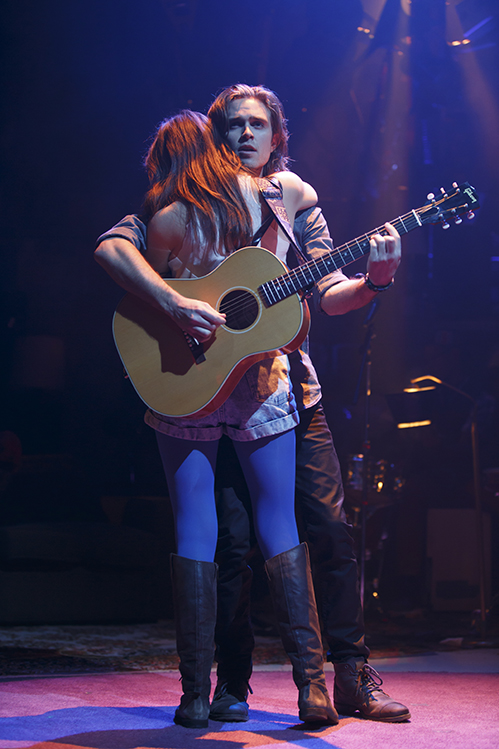
Actor-musician Kyle Riabko (Spring Awakening and Hair) conceived What’s It All About (though David Lane Seltzer is also credited) with Bacharach’s blessing. The sweet, low-key, 90-minute performance begins with Riabko telling the audience how he grew up listening to his mom sing him these songs, and returned to them as an adult, challenging himself to make them relevant to his own generation. He called Bacharach and asked to play him the new arrangements, and relates how nervous he was to sing Bacharach’s songs for the iconic composer. Riabko ends his curtain speech by playing a voicemail Bacharach left for him, which Riabko interprets as giving his blessing for the project.
The wide, deep stage of New York Theatre Workshop is set like a 1970s rec room, with comfortable chairs and sofas scattered about, some even lining the walls, where old blankets and quilts hang as decor. (The evocative scenic design is by Christine Jones and Brett J. Banakis.) Tickets are sold for on-stage seats, so a handful of spectators become part of the scene, almost as though they’re proud family members watching these kids perform after dinner. Each side of the back wall is dressed with a sofa that hangs 10 or so feet from the ground, on which people who turn out to be cast members lounge before the show begins.
Upstage center is decorated with a collision of guitars and basses, upside down, sideways, and otherwise strung together in a big collage of instruments. The stage walls and floor are peppered with standing lamps, table lamps, and sconces of various shapes, sizes, and shades, all of which work not to light the set, exactly, but to create the homey atmosphere in which the evening plays out.
Although it takes a moment to distinguish them from the on-stage audience, the six band members are pre-set around the space, chatting with one another, looking at their phones, and gazing out into the audience until Riabko finishes his speech and invites them down to introduce them. Daniel Bailen, Laura Dreyfuss, James Nathan Hopkins, Nathaly Lopez, James Williams, and Daniel Woods all appear to be 20-somethings like Riabko; two are women and three appear to be of color. They wear their hair shaggy and large, and their clothes (designed by Andrea Lauer) are eclectic, almost Godspell-like mash-ups of styles and eras, tastes and statements. The actors look contemporary and not, just as the music, too, sounds both nostalgic and relevant.
James Williams and Laura Dreyfuss “playing” the guitar . . .(photo Joan Marcus)
All six cast members, in addition to Riabko, who stars, play instruments and sing, although I was disappointed that the two women played mostly “girl” instruments like the tambourine. Dreyfuss strums a guitar at one point, but wholly without the conviction with which all the men play. While their fellow band members shift among guitars and basses, or play the keyboard and piano, Dreyfuss and Lopez do the girl back-up singer thing and mostly add rhythm.
. . . compared to the boys rocking with theirs . . . (photo Joan Marcus)
The men are directed to be athletic and rigorous as they sing and play; I was disappointed to see the women given relatively little physically musical chores to do.
Nathaly Lopez (photo Joan Marcus)
Both of them, though, have some of the best solos in the show. Lopez offers a vigorous rendition of Warwick’s “I Say a Little Prayer for You” and Dreyfuss is moving and understated with “Walk on By.” Riabko takes many of the other solos. His arrangements mostly slow the songs down, stretching their lyrics into something more soulful and reflective. “What’s it All About,” for example, echoes around the stage many times as a kind of question before “Alfie” is sung in full. A few numbers are revved up to rock out.
What’s It All About isn’t a jukebox musical, but a revue, for which Riabko writes arrangements that interweave phrases from various songs throughout the evening. They echo and repeat and foreshadow the full songs, working thematically to make the evening more of a rumination not just on Bacharach, but on what it means to reimagine him and his sound and his collaborators’ lyrics in 2013. Sometimes, you just hear a snippet of a song before it’s gone; sometimes, a song repeats; and sometimes, it’s left in the archive, an aural tease of memory. Director Steven Hoggett (who choreographed the musical Onceand provided an abstracted movement vocabulary for The Glass Menagerie, both directed by John Tiffany) also brings his signature style to the choreography. Occasionally, the cast kicks off a few synchronized steps that look almost like line dances. And Hoggett keeps the short production moving, with a double revolve that sometimes spins very quickly, and directs the cast to whisk the standing mics into and out of position with great whooshes of movement.
Gorgeous concert-style lighting (photo Joan Marcus)
Japhy Weideman’s gorgeous lighting design gives the production a rock concert feel, as cones of light silhouette the cast from the wings, then alternate with more subtle, practical light thrown by all those on-stage lamps. The lighting vocabulary moves from rock arena to folk club, and goes a long way toward keeping the production varied and emotionally textured.
The whole production is very liquid and very loving. The cast seem to be having a wonderful time, and their affection for one another is either genuine or very well performed. They also seem to adore Riabko, their band-leader, and sometimes mouth the words to the songs as he sings.
I was moved, not only by the nostalgia of the lyrics and the melodies, but by watching seven young people find so much emotion in these old songs, and by listening to them render Bacharach so beautifully.
An egregious moment of perhaps inadvertent sexism, when Riabko plays the guitar around Dreyfuss, turning her into something of a romantic instrument for his agency . . . (photo Joan Marcus)
Just let those women do a little more!
The Feminist Spectator
What’s It All About? Bacharach Reimagined, New York Theatre Workshop, extended through February 2, 2014, though I won’t be surprised if it’s extendedagain or moves to a larger uptown house, as did Once.
Unlike Emma Thompson in Saving Mr. Banks, Oscar Isaac plays an unlikeable character who never quite redeems himself. The Coen brothers’ latest film is shorter on the quirky outlandishness that sometimes marks their films, and longer on a kind of weary, cynical heart. Isaac plays the title character, a singer-songwriter living in Manhattan in 1961, just before Bob Dylan appeared to break open the complacent folk music scene. Davis has recently lost his performing partner, who jumped to his death off the George Washington Bridge. Although we know little more about Llewyn Davis’s history than that, he gets a fair amount of mileage from those who presume his ill-humor comes from his grief.
In fact, Davis is something of a shit-magnet. He spent one night with his friend Jim’s girlfriend, Jean, and she gets pregnant. (Carey Mulligan, as Jean, is rather drab in a wasted part, with an accent that makes her performance feel like something out of Christopher Guest’s folk music satire, A Mighty Wind.) Davis couch-surfs because he can’t afford to pay rent, and gets tossed out of one apartment after another. In one case, the household cat escapes before he can close the apartment door, and because he doesn’t have keys to get back in, and can’t offload the animal on anyone in the building, he’s forced to carry the photogenic tabby with him (and his guitar and his man-bag) on his perambulations around the city. People glare at him on the subway, especially when the cat escapes down the aisle. And his subsequent couch-owners aren’t delighted that he shows up with a feline companion. Davis’s mopey big eyes, floppy curly hair, and down-turned mouth are somehow softened, though, with the yellow tabby along for his ride to nowhere.
Isaac as Davis and one of the five cats employed to perform with him
Only when he sings does Davis’s life turn around, as his rich voice and glorious guitar-playing (both of which Isaac performs himself, with soulful conviction) captivates his audiences at the famed Gaslight Cafe folk club in Greenwich Village. The predatory manager, Pappi (Max Casella), knows he’s good, but can’t quite keep Davis in rent money, as most performers at the noted venue play for whatever patrons put in the collection basket at the end of a set. When Davis makes his way to Chicago to see Bud Grossman, a famous promoter, Grossman (played with weary impatience by F. Murray Abraham) tells him frankly that his music “doesn’t sound like money.”
Isaac as Davis, Timberlake as Jim, and Adam Brody as Al Cody in the studio session scene
Davis is caught with a talent that expresses his essence but can’t support his life. And his resolutely bad luck means he can’t turn shit into gold. When Jim (a likable, earnest Justin Timberlake) invites him to be a studio musician on a session, Davis is so hard-up for cash he works as a freelancer, relinquishing his rights to future royalties. Of course, the silly but catchy ditty he helps record will go on to make his friends a lot of money.
Davis playing at the Gaslight
The film and the character would be much less poignant without Isaac’s diffident, lived-in performance as Llewyn Davis. He can’t get his act together, but somehow, you can’t blame him. Isaac plays him as a vortex of loss—he’s lost his partner to a senseless, unforeseen death; his father, a former seaman, is fading away in a nursing home; his sister hates him; he loves Jean but she’s involved with Jim; and he can’t support his musical talent. Isaac’s eyes hint at depth and the despair of a man not looking for his big break, but trying to make some sense of how stalled he seems, despite what he understands as his abilities. Isaac makes Davis a man of big feeling and limited communication, especially when he’s not strumming his guitar and singing with his eyes closed.
John Goodman as Roland Turner, heroin-addicted jazz musician
That fateful trip to Chicago pairs Isaac with John Goodman, a Coen brothers’ mainstay, as Roland Turner, a heroin-addicted jazz musician being escorted across the country by a young would-be actor named Johnny Five (Garrett Hedlund), who mumbles to Davis that he was performing in The Brig, the Living Theatre’s infamous production, before the police closed it down. Turner hauls his considerable girth through the world on two silver-knobbed black canes, and spends the car ride haranguing Davis about folk music, sneering that it’s puerile and feminine. His taunting monologue provokes Davis to reveal something of a fighting spirit, and also demonstrates his isolation. When he isn’t yelling, Turner nods off through most of the long trip and Johnny Five smokes until his eyes are slits but won’t respond to Davis’s questions or conversational gambits. It’s a weird, surreal, claustrophobic world—in the film’s one section of more typical Coen brothers’ macabre fantasy-making—but it makes Davis look sober and ambitious by comparison.
Inside Llewyn Davis is a period piece and a mood movie, a character study and a slice of history that remembers Greenwich Village as a hotbed of artistic desire and sometimes even achievement. It’s a reminder of a time when people turned up in smoky cafés because they loved the music and the progressive impulse it represented, when artists played for pennies and rambled through the city mostly homeless in return for those privileged moments of feeling the spotlight bathe their faces and of knowing that people were listening as they sang.
Davis (Isaac), Jim (Timberlake), and Carey Mulligan as Jean, listening to a set at the Gaslight
The Coen brothers capture that liminal moment just before Dylan arrives in New York to turn the folk scene on its ear. He appears as both a harbinger and as something of a mirage at the very end of the film as part of the Gaslight’s backdrop, a young, green singer with a guitar in his lap and a harmonica wired to his neck.
The film beckons to memory without sentiment, and winds up being moving and compelling, especially when the filmmakers just let the performers sing. Most of the song performances are filmed complete from beginning to end, which makes Inside Llewyn Davis not quite a concert film, but certainly one that appreciates its music (curated here by the awesome T Bone Burnett) and has nothing but respect for the artists who made it.
Carey Mulligan with little to do or say as Jean
Does it pass the Bechdel test? Not by a long shot. Mulligan and the very few other women characters in the film are as frumpy and sexless as Isaac is soulful and sexy, in his abject sort of way. But there is something vaguely feminized about Llewyn Davis’s predicament, and his hapless lack of agency as an artist. His agent, Mel (Jerry Grayson), scams him. (Sylvia Kauders is a vision as Mel’s secretary—the two are a Catskills comedy team in their brief scenes together.) Pappi, the Gaslight impresario, insists you can’t play his club unless you sleep with him (even though he means women), which throws Davis into a rage. He’s angered on Jean’s behalf, but the narrative implies that any artist is beholden to the vaguely sexual whims of the powerful male producers who decide their fates.
The film’s loopy narrative structure doesn’t quite clarify itself, which doesn’t quite matter, since the point is simply that Llewyn is caught in a life he doesn’t really want to escape. The story begins and ends with Davis being beat up in an alley outside the Gaslight by a tall dark stranger, who kicks him to the ground to defend someone else’s honor. Davis never gets a chance at payback and doesn’t even seem to want it, another powerless, feminizing character choice.
Feminist film? No. Worth seeing for its flawed hero and how the Coen brothers evoke the early 1960s New York folk scene? Definitely.

 And again, she does, telling us an elegiac story of nostalgia and loss, of mortality and survival. As the doyenne of the downtown lesbian/feminist/trans/butch performance scene for the last 45 years, Shaw is a consummate master on stage. She still brings her charismatic self out into the audience to chat and flirt, but Ruff is prompted by a more urgent need to share what she’s learned about her brain and its vulnerabilities. She tells us to remember the acronym F.A.S.T., and asks us to follow along as she demonstrates how to recognize the symptoms of stroke: Does the person’s Face droop when they smile? If you ask them to lift their Arms, does one drift downwards? Is the person’s Speech slurred when they talk? If so, it’s Time to call an ambulance. Shaw proudly shares this newly learned list of signs; when she had her stroke, she just thought she was suffering some sort of biblical punishment.