All posts by THEFEMINISTSPECTATOR

Mrs. Warren’s Profession

Shaw’s moral drama about sexual hypocrisy and the constraints of gender offers two terrific roles for women and somehow always seems relevant. Shaw embeds his polemic in a story of a singular mother and a strong-willed daughter whose lives stand at cross-purposes. Kitty Warren (played by the eminent Cherry Jones, who I’d hazard to say is one of the best American actors working on stage and screen today), unbeknownst to her daughter, Vivie (the British actress Sally Hawkins, late of Mike Leigh’s film, Happy Go Lucky), is a madam on a grand scale, maintaining “houses” in Brussels, Vienna, and elsewhere around the continent that allows her to fund her daughter’s education and comfortable country life.

When Kitty descends on her daughter’s rural estate with two of her city friends—the dandyish Praed and the opportunistic Sir George Croft—Vivie demands to know more about her enigmatic mother.At the end of the evening, Kitty confesses the history of the straitened circumstances into which she was born, and the lengths to which she and one of her sisters were forced to travel to survive. That Kitty neglects to tell Vivie that the brothels in which she made her way continue to thrive, with Kitty now at their helm, becomes the source of their ultimate, permanent estrangement and undoing.

Doug Hughes directs this production for Roundabout Theatre with confidence and verve, pruning the text and keeping the performers moving at a distinctly contemporary clip. Scott Pask’s beautiful set folds out and back on itself to reveal the garden of Vivian’s country estate and then its wood-paneled interior. The second act’s revelation scene takes place in the garden of the nearby rectory, where the dithering clergyman Samuel Gardner (Michael Siberry) and his wily son, Frank (Adam Driver), fall under the spell of the Warren women in their own ways and for their own mercenary reasons. The set changes here are rather old-fashioned; a “show pause” interrupts Act One and Two, and then Act Three and Four, after intermission, so that the rather realistic set can be transformed, which recalls Shaw’s social realist intent.

In the secluded garden, backing the 13th century church where the far from religiously worthy Rev. Gardner delivers sermons he buys pre-composed, the machinating gentleman Sir George Crofts tries to manipulate Vivie into marrying him. He tells the young woman the truth of her mother’s fortune and intimates the truth of Vivie’s parentage. In the play’s final scene, Vivie has moved permanently to the city, stripping herself of vestigial illusions, vehemently rejecting Frank’s romantic propositions and her mother’s continuing financial support or emotional connection. The small, worn actuarial office in which she works looks claustrophobic, the light from its large windows glaring with harsh and hard reality.

In Hughes’ brisk interpretation, Shaw’s play is by turns a comedy and a scene-chewing melodrama.The humor trades on Praed’s dandyism (delivered with perfect, smug self-possession and posing by Edward Hibbert), Crofts’ paper-thin veneer of probity (well-represented by Mark Harelik), Rev. Gardner’s moral lassitude, and Frank’s oily flirtations. Vivie and Kitty’s relationship carries the melodrama, with Hawkins and Jones ripping through their confrontations with deliciously focused zeal.

As Kitty, Jones is festooned in gowns just short of garish and oversized hats that frame a curly red wig, her chest and arms hung with ornaments. Jones swans about the stage, flaunting Kitty’s nouveau riches. But Kitty’s façade is riddled with holes that Jones reveals when her too grand gestures devolve into slouching postures, and when her purposefully hybrid British accent begins to sound more Cockney than country. Jones plays Kitty as highly performative. She and Hughes chart how her performance of a proper English woman finally flounders on the shoals of Vivie’s distrust, accusation, and rejection.

Hawkins, dismissed in the New York Times by Ben Brantley as miscast, offers what I instead found a compelling interpretation of Vivie’s journey toward knowledge and independence. Hawkins is a small, slight woman. One of the play’s first sight gags has Vivie’s overly firm handshake sending the newly arrived Praed and then Crofts into spasms of surprise and pain. Given Hawkins’ stature, this usually funny, meaningful shtick doesn’t play as clearly. But Hawkins’ size makes her determination to be independent, finally free of emotional, familial, or financial indebtedness, that much more poignant, because you can see how hard she has to work to persuade even herself that she’ll be able to live without Frank’s attentions and her mother’s investment.

Hawkins proves a worthy match for Jones’ Kitty in part because they appear so different physically.Vivie’s dresses are plain and utilitarian (perfectly designed by Catherine Zuber), suitable for a very smart young woman whose life plays out among books and the actuarial tables that she studies for a friend in town. Mrs. Warren’s operatic outfits—and Jones tall and solid stature—let her tower over Vivie, yet finally don’t protect the older woman from the devastation of her only daughter’s rejection.

In their final battle, Hughes and his actors find a distinctly homoerotic tension between the two women, as Kitty describes how she rebuffed the attentions of the girls in her employ, saving her love for the daughter she expected to comfort her in her old age. Vivian’s refusal feels like the struggle toward independence of the pure young mistress who’s been kept on the side in the country while her older lover makes her life among the corruptions of the city.

Although Vivie’s father may or may not be the dissolute Rev. Gardner, Hughes’ production underlines that Kitty is undoubtedly her mother’s daughter. Vivie proclaims that she will never cry or faint; likewise, Kitty is distressed at the thought that she, too, might be seen crying. Jones daubs her brightly painted face with a handkerchief, pushing away the emotion she thinks weakens her.

Hawkins keeps her back straight but allows an array of conflicting emotions to continually cross her face. When she finally shows Kitty the door in the worn, small office to which she’s consigning her future, Vivie asks her mother for one last handshake. Jones nearly growls at her, lurching toward the young woman with her teeth bared. The moment is chilling and right, but only an actor as strong and willing as Jones would be brave enough to play it.

Mrs. Warren’s Profession isn’t exactly a feminist classic, but Shaw’s dramaturgy gives the canon of modern drama two meaty women’s roles among its collection of men who illustrate the moral hypocrisy of his era and our own. When the brutal Crofts tells Vivie the truth about Kitty in a base effort to buy her hand in marriage, he asserts the impossibility of keeping oneself pure in transactions of any kind. That Vivie would be repulsed by her mother’s business, he suggests, demonstrates her naiveté more than a superior morality.

Vivie consigns herself to much reduced circumstances with her high-brow revolt against her mother’s occupation. With Hughes, Hawkins, and the amazing Cherry Jones commanding the story, Kitty and Vivian’s final battle of recrimination, need, and obstinacy plays as a devastating emotional break-up more than the principled stand against immorality as which it’s often staged.

Vivie’s rejection of her mother plays as the self-defeating pride of a young woman pretending that she doesn’t need the parent whose money has supported her but whose absence has destroyed her.Kitty’s final exit punctuates what is here an emotional rather than a moral defeat. Kitty has lost her daughter, but her faith in the necessity and righteousness of her profession is unshaken.

In this production, the play describes a complicated relationship between two women cut from the same cloth, who finally can’t find enough space between them to continue living in the same orbit.But Shaw’s political message resonates nonetheless. Vivie stakes her claim as the unmarried, independent “new woman,” but in Hughes’ interpretation, hers isn’t a victory so much as a rather defiant, compromised choice among a very constrained pair of options. Shaw’s incipient feminism is heightened here by tempering the moral consequences of the play and underlining that given their historical moment, neither woman can truly win.

The Feminist Spectator
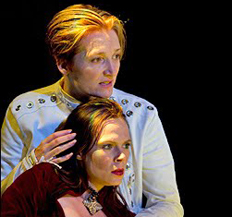
Orlando, Classic Stage Company

Virginia Woolf’s Orlando is a flight of gender fantasy written as a love letter to Vita Sackville-West who, along with her husband, Leonard Woolf, anchored Woolf’s emotional and amorous life.Orlando is something of a feminist classic, the story of a young nobleman who inexplicably becomes a woman half-way through a life that extends across hundreds of years.

The book provides a happy complement to Woolf’s oeuvre, demonstrating the imaginative possibilities of believing that gender really is mutable and malleable, a plaything of culture rather than a true expression of body or soul. Sally Potter re-imagined Orlando in a 1992 film version that starred Tilda Swinton, she of sharp cheekbones, flaming red hair, and angular body, whose androgynous appearance and avant-garde art pedigree let her slip easily into the role.

In a program note for this Classic Stage Company production, playwright Sarah Ruhl calls Orlando“part novel, part fabulation, part biography, part theatrical escapade, part poetry.” Ruhl adapts it into a sweetly theatrical love letter to love and life itself, with a great deal of affection for story-telling and performance thrown in along the way.

With Rebecca Taichman’s inventive direction, Annie-B Parson’s subtle, gilding choreography, and exuberant performances, especially by Francesca Faridany in the title role, Orlando becomes by turns wistful, lustful, wondering, and affirming as a tale of a man/woman who wants to love, to live, and especially and finally, to write.

Woolf’s words provide the text Ruhl creates, framing Orlando’s story reader’s theatre-style. Three men dressed in white pants, vaguely stylized white jackets, and undershirts (by Anita Yavich, whose costume design helps along nicely the production’s fluid representations of gender) form the chorus of narrators who play men’s and women’s roles as the story proceeds.

Tom Nelis and Howard Overshown are wonderful as Russian sailors, female parlor maids, ruffled attendants to the queen, and various other incidental characters with whom Orlando interacts in her various guises. Along with assisting the story telling, David Greenspan plays the Queen—an unsurprising but humorous bit of casting that lets a queen play a queen—as a fusty but kind old woman taken enough with the young Orlando to bring him to her court as her consort.

The ensembles’ changing roles are marked with bits of costume or none at all as, without much fanfare, they change their voices and their gender performances. Greenspan’s queen dons a royal costume and neck ruff that descends from the flies like an oversized paper doll dress. He hangs it from his shoulders and buckles it around his waist, extending his arms to either side in imperial gestures required by the circumference of his outfit.

These meta-theatrical flourishes demonstrate not just the potential of theatre to transform character, but the surface enactments of gender and power, and the ways in which our culturally and historically situated costumes often do contour our movements and inflections.

Greenspan’s trademark mugging works appropriately here to underline what Woolf and Ruhl already present as a gentle satire of queenly gender. That he carries his flamboyant queerness into his narration and his other characters also productively emphasizes sexuality and gender fluidity.

Likewise, Nelis and Overshown move freely through a range of gendered behavior, and while their white outfits might aim toward a “neutral” baseline, Taichman and the actors are in fact careful not to suggest that a performance could be fashioned in which gender isn’t present. Happily, then, thisOrlando doesn’t present “non-gender” as some sort of desirable utopia, but suggests instead that the joy comes from how we might continually reinvent our gendered performances.

Faridany, as Orlando, achieves the same non-prescriptive gender goal. Yavich dresses her, too, in white, with slim riding pants and a flowing over-shirt not exactly hiding her body so much as muting its contours. The Queen and Orlando’s lovers comment on his shapely legs, already suggesting something of female allure in his boy’s body.

The brown suede knee-high boots Orlando wears throughout—even under the rustling dress that cloaks her after her transformation into femaleness in the second act—ground him/her in action or its possibility, and makes him appear both mobile and somehow soft. They allow Faridany to stay grounded but quick, and let her sink easily into the grass Orlando so wants to describe through poetry (but can only, inadequately, humorously, repeatedly call “green”).

Throwing herself whole-heartedly into Orlando’s wonderings and wanderings, Faridany is a pleasure to watch, from Orlando’s earliest boyish musings and yearnings to the more mature yet still happily wide-eyed reflections of her middle years as a woman. Faridany’s voice brings a deep, resonant quality to Woolf’s language, and her British accent seems to authorize the story without making it sound pretentious or distanced. The narrative, after all, moves from the 17th century to the present, as the ensemble and Orlando announce the passage of moments in quick succession.

All five actors beautifully command the vocal and physical rigors that Ruhl and Taichman construct for the story, as together, they create a world that both transforms and stays the same over time.When Orlando leaves his nobleman’s home for the Queen’s court and winter descends, the three men cover the green stage turf with a shimmering white cloth.

Suddenly, the scene transforms into snowy ice on which Orlando sees Sasha, the woman who will become his true love, skating by in her red velvet coat and round Russian hat. Parsons choreographs the skating like a dance, and subtle effects deliver the sound of steel scratching against ice.

Annika Boras plays Sasha, the only character and actor whose gender stays constant throughout.Yet Sasha, too, wears trousers under her velvet robe, and her scrappy femininity is hardly quiescent.Using a broad Russian accent for laughs, Boras is all vitality and lust, falling into Orlando’s arms and practically devouring him as they gaze into one another’s eyes.

Boras and Faridany are terrific together as the lovers, in performances physically precise and exuberant and emotionally sweet and full. Taichman directs them to be in constant contact, arms entwined or draped around each other’s shoulders, eyes locked, hands cupping one another’s necks and in each other’s hair, lips crushed together—this is love as an explosion of erotic energy, full of agency and barely contained desire.

But Sasha betrays Orlando, her wily, hungry sexuality overcoming any impulse toward fidelity. First she flirts with a Russian sailor who reminds her of home. Then Sasha fails to arrive at the rendezvous Orlando has planned so that they can run away together, escaping the marriage of propriety to which Orlando is already engaged. Faridany’s response to Sasha’s betrayal of Orlando is physical as well as emotional; she climbs a ladder at the stage wall to look for Sasha, crying out in agony when the woman is nowhere to be found.

And then Orlando falls into a deep sleep, laying his head on huge pillows that the ensemble brings to cushion his fall into unconsciousness. They hide the hero with another shimmering white cloth large enough to cover the whole stage, while they describe Orlando’s refusal to be awakened. When he finally opens his eyes and stands, letting the silky sheet fall from his loins, Faridany is naked, stretching her limbs in light that looks like the sun. The ensemble gazes at Orlando’s new form in wonder before wrapping her back up in the sheet and closing the first act.

This moment in Orlando offers quick visual evidence of the character’s transformation. Flashes of full-frontal female nakedness like this are sometimes uncomfortable. The performer’s vulnerability becomes palpable, and the symbolism of the moment can be heavy and obvious. Kathleen Chalfant’s brief, triumphant nudity at the end of Wit comes to mind, as the professor who’s died of cancer achieves a spiritual, if not physical, transcendence in death.

But in Orlando, Taichman and Faridany (and lighting designer Christopher Akerlind, who floods the moment with the glow of a brand new morning) use nudity to illustrate Orlando’s turn in the road rather than a “rebirth”—that is, Orlando/Faridany stays relatively the same, even if her apparatus has miraculously shifted.

The contemporary resonances of the story solidify in the second act. Orlando, now weighed down with the floor-length, wide dresses of Victorian womanhood, finds herself responded to through the lens of her new femininity, rather than addressed as the still independent, clamoring subject beneath. She’s first told that she can’t own property as a woman; Faridany’s eye-rolling response carries the feminist critique.

Orlando tries on her new physical exterior while she resists the constraints femininity seems to bring, so that the character does seem to have simply changed his clothes and not really his affections. She marries a man—just as Woolf did—but Sasha continues to play in her emotional imagination as the unattainable erotic object on whom Orlando’s affections fix.

When the “present” dawns, the ensemble peels away Orlando’s dress to reveal the pants and tunic in which she began her journey, and her body relaxes back into the grounded, easy physicality of her younger male self, even though she’s now a 36-year-old woman. She moves through time and cultural mores, weathering them all with a wry knowingness, and preserving the freedom of spirit and soul that lets her engage with such eagerness and ease across each era.

Orlando wants nothing more than to write. In fact, Ruhl’s note explains that Woolf suffered from a terrible writer’s block before she wrote Orlando. The program quotes Woolf’s 1927 letter: “Yesterday morning I was in despair . . . I couldn’t screw a word from me; and at last dropped my head in my hands: dipped my pen in the ink, and wrote these words, as if automatically, on a clean sheet:Orlando: A Biography. No sooner had I done this than my body was flooded with rapture and my brain with ideas. I wrote rapidly . . .”

The production, too, ends with Orlando him/herself settling back down into her beloved green grass, and finally constructing the well-turned sentences that have eluded her throughout.Taichman has Faridany scrawling happily on the ground, creating her story(ies) as the play—a valentine to theatricality and perpetual self-recreation—ends.

Lovely images as well as emotions support the tremendous heart in this production. The CSC space is arranged in a modified thrust, with the audience surrounding the playing space on three sides and actors entering and exiting through the aisles, which creates the warm intimacy on which the performances capitalize.

Orlando’s estate is represented by a doll’s house of sorts, its windows alight with a soft glow. The sprawling mansion is portable; Nelis carries it across the length of his arm to represent Orlando’s early travels, and then places it in a high ledge on the upstage wall, where it glimmers intermittently, a beacon of home to which Orlando eventually returns.

A canted, gilded mirror hangs over the green square that frames that action, suggesting the funhouse of time, action, and performance in which Orlando’s antics play out. The richly green artificial grass that carpets the stage floor lets the actors’ costumes stand out in sharp relief against its backdrop, and evokes a pastoral setting for the production’s playful confrontation with cultural constraint.

Orlando’s production design evokes the binaries—nature/culture, male/female, inside/outside—that the performance challenges so good-naturedly. The ensemble moves simple wooden chairs around the outside of the square, perching on them to watch, comment, or move the narration along, creating suggestions of place and movement.

Taichman keeps the theatricality simple, so that the performers’ bodies and voices carry the story’s verve and wonder. With a light touch, and an unerring, warm feel for humor and affection, she brings Ruhl’s adaptation of Woolf’s text alive. Orlando’s gender performances—played so fearlessly, commandingly, and compellingly by Faridany—become the stuff of possibility and potential.

Orlando isn’t a romance about lovers whose stars are crossed by gender confusion, but an embodiment of Woolf’s text, a love letter to our human capacity to love, perhaps outside the cultural dictates of gender. The production turns Woolf’s story into a wistful, funny, moving meditation on what it means to long, to love, to be alive, and to construct yourself not through gender—which here is just something to pass into and out of—but through words and the transformative power of the stage.

The Feminist Spectator

Link to original post on Blogspot.

The Hunger Games

I seem to be about 10 steps behind the zeitgeist, coming to the Larsson trilogy and now Suzanne Collins’ young adult dystopian novels later than most. I stumbled onto The Hunger Games, the first in the series, just as Mockingjay, the final installment, was making its debut, and I’m now almost through the second book, Catching Fire. But what a wild ride. Not since the Harry Potter series and Carl Hiassen’s eco-mystery-satires have I been so gripped by stories written for young people.

The Hunger Games trilogy stars its narrator, Katniss, the sixteen-year-old girl who is thrust into heroism by offering herself as a substitute for her 12-year-old sister, Prim, in the brutal reaping that populates the barbaric Hunger Games of the dystopian nation of Panem. The country is divided into twelve districts, each of which bears responsibility for a certain sector of production: agriculture, industrial, mining, etc. The Capitol controls these districts, employing Peacekeepers to keep the population in line, while its own residents revel outlandishly in their safety and privilege.

People in the districts constantly face starvation and physical deprivation, as their food is strictly rationed and their subsistence-level existences require scraping out the most meager of livings. In the Capitol, residents cavort freely and excessively, painting their skin in vibrant colors, wearing outlandish wigs and adornments and outfits of luxurious and loud materials, and bingeing and purging so that they can consume huge feasts of rich food. The division between the haves and have-nots couldn’t be more sharply drawn.

Katniss’s father was a miner who died with other men in an explosion in her own District 12, leaving her to care for her severely depressed and withdrawn mother and Prim. The scrappy Katniss uses what her father taught her about hunting—illegally, outside the electrified fence that surrounds the district—to feed her family and to supply squirrel, rabbit, and wild turkey meat to the Hob, the center of the black market exchange where Katniss trades her game for other necessities.

Katniss hunts with her friend Gale, a taciturn but determined young man who dreams of escape, and whose beautifully set snares entrap as much food as Katniss can fell with the bow and arrow she wields like an Olympic archer. They risk death to provide for their families, since hunting outside the boundaries of their district is forbidden. But the Peacekeepers of District 12 are lax, participating in its underground trade and turning a blind eye to their community’s illegal activities. In other districts, such violations are punished with death.

The Capitol’s cruelest mode of control is the annual Hunger Games, staged to remind citizens of the costs of rebelling against the government’s control. Every year, two “tributes” from each of the nation’s twelve districts are brought to a pre-constructed arena where they battle to the death until only one of them remains alive and is declared the victor.

The tributes are young people from each district, one boy and one girl between the ages of twelve and eighteen, who are selected in the “reaping,” an annual, public lottery in which the unlucky kids’ names are read aloud. Twenty-four young people travel to the Capitol, where they prepare to compete.

When Katniss’s sweet sister Prim is selected in the reaping that begins The Hunger Games, Katniss immediately, frantically offers herself as Prim’s substitute, an allowed but almost unheard of gesture of nobility and selflessness. Implicitly sacrificing her life for her sister’s, Katniss is whisked off into a world driven by the Capitol’s illusion-making machinery, which orchestrates every bit of the pre-Games festivity and eventually, the Games themselves.
Peeta, the son of District 12’s baker, is selected as its male tribute, Katniss’s partner but ultimately just another of her enemies in the Hunger Games.

The two are shepherded through their preparatory sessions by the drunken Haymitch, the only former tribute from their district to have won the Games, and by Effie Trinket, the affected martinet assigned by the Capitol, who makes sure they adhere to their schedule. Effie sees Katniss and Peeta mostly as her meal ticket, as she stands to benefit professionally should one of them win the Games.

The four travel by train through Panem to the Capitol, where their scarred and worn bodies are buffed and polished for presentation to the cameras that track their training and their performance in the Games. Their abilities are assessed as their bodies are strengthened, and they’re taught additional skills that will at least make them viable competitors, if not victors.

Katniss and Peeta are fattened up like calves on their way to the slaughter. The meals they’re served on the train and in the training center are so rich they can barely keep them down. The ministrations of their “teams”—make-up artists, costume designers, performance consultants, along with Haymitch and Effie—are calculated to make them as appealing as possible to the viewers who watch their interviews and see every moment of their progress toward the competition. Eventually, every moment of the Games themselves is televised live.

By presenting the Hunger Games as the Capitol’s cruel entertainment for Panem’s citizens, Collins skillfully critiques the contemporary media industry for how it constructs a reality that serves the powerful and manipulates the masses through carefully controlled scripts and images.

The tributes’ appeal, after all, is part of what will keep them alive. As the Games progress, viewers who can raise the necessary funds are able to send support to contestants, which enhances their chances of surviving and even winning the cruel struggle. A contestant with no appeal to spectators risks being left on his or her own during the Games, while one for whom the audience cheers could potentially receive additional food, medicine, or weapons that will increase his or her chances of staying alive.

And so Katniss and Peeta are molded into a narrative with clear sex appeal. In their first public appearance, the couple is presented together in a chariot, with their costumes set on fire, a captivating image that becomes Katniss’s motif throughout the pre-Games events. Her master stylist, Cinna, has a talent for how to sell his new client, and his insights and empathy extends into their personal relationship, as he becomes one of the few on her team whom Katniss really trusts.

The melancholy of these relationships is evident from the start, as Katniss and Peeta’s team prepares them to compete, while everyone understands the odds against their winning. The two young people are really being prepared to die.

[Spoiler alert.]

In between bouts of falling down drunkenness, their mentor Haymitch devises a love story for the two District 12 tributes that encourages Panem’s citizens to invest in Katniss and Peeta’s survival. The strategy works, as the romance captures the viewers’ attentions and their emotions. But unbeknownst to Katniss, Peeta truly is in love with her, while she burns something of a flame for Gale, whom she knows is caring for the family she left behind at home. Thrown together in extreme circumstances, though, Katniss and Peeta develop an intimate relationship that Katniss, too, begins to believe is real.

To Collins’ credit, though, The Hunger Games can hardly be called a tween romance novel, even of the Gothic sort that drives the Twilight saga. Although she has feelings for Gale and eventually Peeta, Katniss doesn’t want to marry, because she knows any child she’d bear would become part of the machinery of reaping and tributes and the brutal, gladiatorial Games that organize every citizen’s life and presage their deaths.

The seeds of her resistance to the Capitol’s fascism appear in her refusal to believe in the gendered narrative of giddy romance her handlers insist she perform. In her portrait of Katniss, Collins demonstrates that gender is indeed a performance. The independent, athletic, wily young woman has to be coached in the giggly, submissive, head-over-heels-in-love, clinging femininity that she performs to persuade viewers that she’s in love with Peeta.

The Hunger Games trilogy crosses 1984’s sci-fi dystopia with mythic stories of more typically male heroism. Collins twists the gender expectations, since Katniss is the hero who undergoes a series of trials and obstacles to arrive at her goal. Collins creates an Orwellian world in which invisible cameras are always watching and broadcasting as the Games begin and proceed.

As Katniss and Peeta enter the arena and begin their desperate attempt to survive, the brutality of the Games is sharpened by their knowledge that their every move is scrutinized by the viewing nation. Watching the Games is mandatory, since through this annual rite, the Capitol secures its power over the districts. Even at night, securing herself to branches high in the trees she climbs for safety, Katniss can’t let down her guard.

Collins propels us through the Games at a breathless pace. The narrative, told in Katniss’s voice, is unadorned, grim and determined, as we read about Katniss strategizing first toward her own survival. The Gamekeepers constantly manipulate the rules, sending new trials and tribulations, from fire to water to “muttations,” reengineered mutant beasts determined to savagely kill off the tributes. When they decide that for the first time ever, two tributes from the same district will be allowed to win the Games together, Katniss and Peeta join forces to overcome their enemies.

Throughout the violent proceedings, Katniss’s inventive, clever ideas keep her and Peeta alive. It’s Katniss who keeps Peeta from certain death, after he’s attacked and lies bleeding in the mud by a stream. It’s Katniss who outsmarts the “Career” tributes, those who’ve been bred for these competitions and band together to kill off the others before competing with one another to become the last to survive.

When the evil Gamekeepers decide to change the rules back at the end, insisting that only one tribute be allowed to win, it’s Katniss who offers poisonous berries to Peeta, intent on staging a joint suicide that will secure their mythology as star-crossed lovers and that would leave the Capitol with no winner of the Games at all.

That final act, which keeps Katniss and Peeta alive and heralded as the Games’ dual winners and the heroine and hero of Panem, brands Katniss a rebel, as she’s dared to flout the Capitol’s authority. When the trilogy’s second book, Catching Fire, opens, she pays the price for her daring when she’s visited in her new, luxurious, well-provisioned home—the gift to all winners of the Games—by President Snow, the reptilian leader of Panem, whose breath smells like roses and blood.

Snow tells Katniss that he knows her relationship to Peeta is only a performance and that her rebellious joint suicide attempt must be defanged by her future fidelity to the script of their headlong tumble into love and, he insists, marriage. Katniss pleads that she threatened to eat the poison berries because she was hopelessly in love; Snow knows her plan was a ploy to keep both herself and Peeta alive. Now, he demands reparations, and if he’s not happy, he threatens to kill Gale and Katniss’s mother and Prim.

I’m racing through Catching Fire, propelled by a plot that keeps twisting and turning, and by word of the hopeful rebellions growing in the other districts, for which Katniss reluctantly begins to see she must stand as a symbol throughout the nation. Panem’s citizens, it seems, aren’t quite as convinced as they might be by the Capitol media’s manipulations, and are beginning to see beneath the charades presented to further its own power and ideology.

Katniss is the perfect leader for such a rebellion, a girl heroine for the ages—tough, smart, and cunning, with her emotions roiling but in check, so that she can be responsible to those she loves and insure their common survival.

The Feminist Spectator

Link to original post on Blogspot. 

Holly Hughes’ The Dog and Pony Show (Bring Your Own Pony)

Holly Hughes has been plying her particular brand of solo performance for over 30 years now, experience that provides her authority and refreshing, admirable self-assurance in her latest, The Dog and Pony Show (Bring Your Own Pony), which ran for two, too short nights at Dixon Place during their recent “Hot” Festival.

Holly’s last full-length piece was Preaching to the Perverted (2000), which detailed her experience as a so-called pariah during the culture wars in the 1990s, and her run-in with the NEA and the subsequent Supreme Court case over its grants to individual artists. Dog and Pony takes a different turn, narrating Holly’s attachment to the dogs with which she and her partner, the eminent lesbian anthropologist Esther Newton, have created their family.

Hughes’ politics here are as incisive as usual, but also personal and subtle. The self-deprecating irony is gone, as Holly takes physical, emotional, and intellectual command of Dixon Place’s gloriously wide, deep space. Holly and director Dan Hurlin set her story within simple décor: a small, comfortable armchair to which Holly retreats to tell some of the story; a tall wooden stool on which she sometimes perches; and a music stand from which she occasionally consults her script to mark her progress through the tale.

Slides of historical women and their dogs run behind her, punctuating the story with humor and a gentle reminder that this is an on-going, timeless relationship, into which Holly and Esther find themselves cast. In one of the show’s funniest visual moments, Gertrude Stein and Alice B. Toklas pose in a projected photo with their poodle between them. As we watch, the image morphs into Newton and Hughes, neatly tracing the legacy of famous lesbian couples and their canine kids.

In another very funny visual moment, lesbian singer Phranc is on hand for “Phranc Talk,” a segment in which she films Holly and her Norfolk Terrier, Ready, preparing to execute a difficult agility course. In an affectionately satirical style reminiscent of Best in Show, Phranc narrates as Holly and Ready go through their paces. Ready scurries obediently across the course, bounding up steep ramps, down see-saws, through tunnels, and over challenging obstacles, while Holly offers vocal encouragement to keep the pup on track as they move through the stations together.

Much of Dog and Pony pokes good-humored fun at the routines and obsessions of “dog people,” in this case largely middle-aged white women, whom Holly says need their bodies to carry stuff around the same way they need a good truck, and who, in erstwhile lesbians-of-a-certain-type style, simply throw clothes over themselves that immediately signal that they’ve “given up.”

Yet rather than belittling this community—of which she clearly considers herself a part—Hughes understands that at a certain point, the body becomes a vehicle, like those trucks, a means of delivering something or of getting somewhere rather than an end in itself. Even the funny bit about how these women dress signals a freedom from convention, a liberation from worrying about how they look so that they can concentrate on what they do and what, at the end of the leashes they hold with such seriousness and care, their dogs can achieve.

Likewise, Hughes’ description of her life with Newton and their dogs becomes a sly allegory for the vagaries of lesbian families. Hughes honors the importance of the primary domestic arrangements many of us have created with partners and beloved pets, taking seriously the nature of these special kinship structures.

The reference to offspring is always present, happily morphing into stories about their dogs. An anecdote about Holly and Esther waiting until the eleventh hour to reproduce turns into the hilarious and instructive tale of taking Newton’s prized poodle, Presto, for sperm collection. Holly describes Presto as her son, and admits she felt as if she were taking him to a whorehouse for the first time when they take him to the vet for an appointment with a flirtatious bitch.

She relates her mortification when Presto’s interaction doesn’t produce enough sperm to make him a good stud. That even in the world of dog breeding gender presumptions go without saying is part of the story’s moral, but Holly plays it for laughs instead of lessons. She describes the dog’s maleness in their lesbian household as a challenging curiosity (Newton, Hughes says, won’t have the dog fixed because she likes to look at his balls).

Likewise, the story of Hughes and Newton buying a sectional sofa so that they and their nine dogs can have “family time” together paints not just an hysterical picture of “dog lesbians” (as Hughes calls them), but also describes a viable alternative to more conventional lesbian families (if that’s not a contradiction in terms). I can still picture Holly and Esther on their ever-growing sofa, surrounded by terriers and poodles competing for their humans’ attention.

In Dog and Pony’s opening speech, Holly announces that the lesbian community remains divided:there are dog lesbians and cat lesbians and the asthmatics who can’t breathe either way. But her declaration underlines that the lesbian community continues to exist and even thrive despite these (and obviously other) differences. Holly continues to enjoy community and to find it important, a refreshing commitment in the face of its more trendy disparagement.

She might have left New York and the pleasures of WOW, the theatre “home for wayward girls” comprised of performance artists Holly recalls were kicked out of one feminist organization or another in the early 80s. But in her Michigan residence, she’s clearly embraced another community of women with practices as equally out of the ordinary. In fact, she says, dog people are a lot like artists; no one cares what they do.

Alongside stories of dog agility, breeding, and the women who know just how to do it come Holly’s observations about being a lesbian and a feminist of a certain age, about how her work and her life have always been inextricable from the politics of gender and sexuality. This aspect of Dog and Pony is poignant, politically smart, and often moving. When Holly announces her identifications, her performed declarations are really rather performative—that is, they do something to remind us of how potent the words “lesbian” and “feminist” once were and still can be, said with the conviction and faith and historical depth of experience Holly brings them.

A vignette about Holly wearing a “This is What a Feminist Looks Like” t-shirt to give a lecture at a university and the political fallout that ensues from her talk is terrific, as it illustrates the muddle of expectations people bring to contemporary politics. Invited by a lesbian academic to address the bad reputation of feminism among college students, the woman winds up accusing Holly of giving a talk that only exacerbates the stereotype of feminists as “angry lesbians.” Astonished, Holly retorts that “angry” and “lesbian” are her schtick—why was she invited if that’s not what this woman wanted?

Despite ironies such as these which she continues to track, Dog and Pony presents Holly in a generous mood. The lovely writing describes her relationship with Newton, and with a new best friend in Ann Arbor, where Holly is now a professor in the Art Department at the University of Michigan. These relationships clearly matter to her a great deal, and their texture and import color her stories with a new depth of feeling.

I consider Hughes one of the most important artists of our generation, someone who’s always taken formal risks to tell stories that too often go unheard in other cultural venues (mainstream, lesbian, and feminist alike). This new show retains her trademark outré humor, but also delivers authoritative insights in a style that’s beautifully modulated and tonally diverse.

Holly’s stories ring with the confidence of a cultural warrior who’s come out of the fray not just intact, but wiser, with a distinctive clarity about where she’s been, where she’s going, and what it all means. We’re invited to laugh with her, in Dog and Pony, to see the grace and beauty of ordinary people with their crazy but somehow humble obsessions.

For the performance’s final, lyrical bit of image-making, Holly stands downstage center and describes a silver wolf, with four legs that “spell fear,” coming out of the woods to assume the place created beside human beings when evolution left us without as much to do. Dogs, she protests, don’t descend from wolves; she credits the animals with agency, suggesting they chose their place beside us to help create us, just as we, with great empathy and affinity, help to create them.

As Holly takes her curtain call, one last video clip plays of a woman handling a Golden Retriever that she’s trained to dance beside her. The two perform in a large, nearly empty arena to music we can’t hear. Both of them seem thrilled to be moving in sync, dancing as a cross-species couple. The grainy image is striking and poignant, an homage to mutually fortifying, joyful and enabling relationships between humans and canines.

Thanks to Holly’s beautiful rendition of Dog and Pony Show, those relationships become a model for us all.

The Feminist Spectator

The Kids are All Right, Redux

After I posted my own blog on the film, I read several other responses from queer bloggers and LGBTQ folks in mainstream internet outlets —Jack Halberstam on Bully Bloggers, Kate Clinton at The Huffington Post, and Mark Harris at Entertainment Weekly, for only several example—and wanted to add an addendum to my own post as a result.

I enjoyed Cholodenko’s movie and don’t feel at all ashamed to say it. I don’t go to mainstream Hollywood films expecting radical ideological positions; call me conservative, call me liberal, but I don’t expect that particular form to be the one in which we save the world.I’m happy for a mainstream film that depicts lesbian relationships at all—how many, after all, can we list?

Isn’t this why The Kids are All Right bears what Kobena Mercer called so long ago now “the burden of representation”? Because there are so few representations of lesbians in the mainstream, everyone brings to them their own investments and standards, and it goes without saying how impossible it is to please everyone.

Yes, as Kate Clinton notes, the movie is in some ways the same-old same-old, and there’s no good lesbian sex “with skin.” But as Mark Harris says, Cholodenko seems more interested in what makes a long-term relationship than in sexy representations of lesbian moms. He thinks The Kids is one of the best films ever to describe what marriage means and how it looks. But some people think it didn’t do justice to long-term lesbian relationships, either.

Sure, the movie isn’t perfect. How could it be? As Sarah Schulman says on Bully Bloggers, it’s an achievement that it got made at all, a testament not only to Cholodenko’s skill as a filmmaker (given her track record with High Art and Laurel Canyon), but no doubt to her ability to move through Hollywood deal-making structures that of course will have some bearing on the final product. To expect otherwise is unrealistic.

But can’t we look at what this film does and acknowledge that while it doesn’t do everything, it makes a contribution to however liberal a discourse about lesbians—white, upper-middle class, LA lesbians, who co-parent in a committed relationship; in other words, a certain type of lesbians—in the mainstream imaginary?

I found the film funny, moving, and observant about what it means to work through the ups and downs of a long-term relationship.And despite my own choice not to parent, I admire women who buck the odds, adopt one another’s biological children in conservative states like Texas, for only one example (where, had the movie been set there, the story might have been utterly different), and use their daily lives as a site of their activism.

The relationship Cholodenko depicts isn’t mine, either. I’ve been with my partner for 21 years, but we don’t call one another “wife,” as they do in the film. In fact, we cringe at that language, and want no ceremony of any sort (marriage or commitment) to mark our relationship. But we live in New Jersey, where we did take advantage of civil union legislation, in large part because we want to be able to make health care decisions for one another should it become necessary (and it will).

Implicit in some negative discussion about The Kids is judgment against the kind of lesbian families or relationships the film represents. Calling the film’s central relationship only normative seems exaggerated. Lesbians (and gay men) who want to marry might be assimilationist, but are there so many lesbian and gay families that they’re already widely recognizable and accepted, especially outside the west coast urban context in which the story plays out?

Doesn’t the film at least add to the number of public, mainstream representations of a family form that might still be alien to many people who see this film? If Nic and Jules seem “just like us” to many of those viewers, is that a bad thing, really? Some lesbiansaren’t just like the mainstream and don’t aspire to be. But some do; should they be judged badly for that?

It seems to me futile to prescribe what’s “truly” radical in a lesbian relationship, or to suggest that any mainstream representation is just bound to get it wrong.

The good thing about The Kids are All Right is that it gives us something to argue around the perennial question of how the margins should be represented in the mainstream.

I hope, in 2010, that lesbian/gay/bi/trans/queer social movement activism can accommodate multiple efforts on multiple fronts.It’s desperately important that we keep reimagining different ways of being people, reconfiguring the relative value of sexual practice, and re-envisioning potentially new arrangements for domestic structures.

I’d hope there’s room for work like Cholodenko’s alongside work by more formally and ideologically radical artists, like, for only one instance, Holly Hughes, whose newest performance, The Dog and Pony Show (Bring Your Own Pony), I just had the pleasure of seeing at Dixon Place in New York.

I’m personally eager to see both ends of the spectrum, and everything in between, and to treat it all with the kind of critical generosity I think it deserves.

The Feminist Spectator

Link to original post on Blogspot.