Hello I Must Be Going

Amy sullen at dinner

In this sweet, small indie, Melanie Lynskey plays Amy, a heart-sick, recently divorced woman who moves from New York back into her parents’ house in Westport, Connecticut, because she can’t fathom where else to go.  She spends three months without leaving the (lavish, waterfront) property, wearing the same frayed shorts and faded red t-shirt, her lassitude emanating from her in funky waves.  But when her father’s potential business deal forces her to shower, wash her hair, and dress for a dinner with his prospective client, she stumbles into an affair with a younger man that renews her interest in her own life and that teaches her a few things about who she really is.

In his New York Times review, A.O. Scott points out that in similar films about men who move back home to reorient their lives, the guys are usually given the benefit of the doubt (see, for instance, Jeff, Who Lives at Home).  Women, no such luck.  In Hello I Must be Going, Amy’s parents and her brother are downright cruel.  They’re derisive about her pain; her mother bluntly and condescendingly suggests that she go on anti-depressants, and they criticize her appearance at every turn.  Though her life has been completely upended by her unexpected and very recent divorce, the general consensus is that it’s her fault she can’t seem to get on with her life.

Rubinstein and Danner as Stan and Ruth

Directed (by Todd Louiso) and written (by Sarah Koskoff) with offbeat humor and confident knowingness, the film sees the blighted world of suburban Connecticut white privilege from Amy’s perspective.  Her parents live in a large, light-filled house made noisy by constant construction work, as they complete their renovations room by room, years after they first moved in.  At the same time, Amy’s father’s precarious financial future means that her parents, Ruth (Blythe Danner) and Stan (John Rubinstein), wander the house perseverating about losing what they have and—god forbid—moving into an apartment together.  The plot turns on Stan’s ability to secure a new client; without the necessary income, they’ll have to sell the house, he won’t be able to retire, and he and Ruth won’t be able to take a much anticipated trip, aptly called Gallivanting the Globe.

Because they’re fairly stereotypical Jewish parents (even though their ethnicity is never expressed, their last name is Minsky), Ruth and Stan manage to make Amy feel guilty, implying that her personal trauma will somehow prohibit this crucial business venture.  When they insist she come to dinner with the client and his family, Amy wears a borrowed a dress and sits sullenly, diffident and vague when asked questions about her life.  The client, Larry (Damian Young), and his wife, Gwen (the always hilarious Julie White), resemble Amy’s parents; they’re wealthy, preoccupied, and superficial, as they skid the surface of their lives with little interest in anyone else’s.

But they bring to dinner Gwen’s young son, Jeremy (Christopher Abbott, recently of Girls), who immediately sees in Amy a kindred spirit.  As she loses her enthusiasm for pretense and excuses herself from the table, he follows her out of the room and after a brief exchange, is bold enough to kiss her.  To her surprise, Amy kisses him back.

Jeremy and Amy relearning to drive

Although she’s in her thirties and he’s still a teenager, Amy and Jeremy begin to see one another, alternating sexual escapades with conversations about their lives.  Abbott plays Jeremy as a sensitive boy coming into adulthood and chafing at the oppressive supervision of a hovering mother who believes his life mirrors her own.  Jeremy captures Amy’s affections and she reawakens under his sexual and emotional ministrations.  They’re warm and funny together, kindred spirits who share an artistic bent—he’s an actor and she’s really a photographer—but feel stifled by the presumptions of their families.

Much of the film’s humor comes from situations in which Amy and Jeremy contrive to keep their relationship secret.  Amy doesn’t want to jeopardize her father’s business deal.  Because his first starring role was playing Robert Mapplethorpe, Jeremy’s mother thinks her son is gay, an assumption she makes with the pride of a knee-jerk liberal.  Amy cuts the power to her parent’s security gate so that its alarm won’t sound when she slips out at night, and Jeremy makes up elaborate stories to cover his time with her.

The baseball beanbag chair

In a happy role reversal, she throws stones up at his bedroom window when she wants to see him, playing the Romeo to his Juliet.  They drive around in her mother’s car, parking by the beach; they have sex in his childhood bedroom, embarrassingly decorated with a beanbag chair shaped like a baseball and a mass of toy soldiers that belonged to a much younger version of Jeremy’s still young self; and they swim naked in his parents’ pool, provoking one of the movie’s funniest scenes when Gwen and Larry return home earlier than expected (because an understudy went on for Patti LuPone in the play they went to see on Broadway).

Caught in the act by the parents

The movie traces Amy’s return to life through Jeremy’s affections.  With no hope for a future together, even though he fantasizes about escaping with her, Amy is free to live in the moment, which brings her clarity about her past.  She stopped working on her graduate degree in photography when she married her husband, David (Dan Futterman), sacrificing her own interests by presuming that a partnership with a successful entertainment lawyer mattered more than her own artistic pursuits.  Her mother chides her for her failure to finish things, even though Amy believes she’s chosen to give up her career to follow the conventionally prescribed path.

When she meets David for lunch in the city, after some time with Jeremy, the older man’s deficits are clear.  He can’t keep his eyes from his smart phone long enough for her to finish a sentence.  And when she pushes him to talk about what went wrong in their marriage, he feeds her a standard line about not wanting to have already arrived at the end of his life so close to its beginning.  Staying with her, he intimates, would have been a kind of settling.  And Amy suddenly realizes that she would have settled, too.

Watching her old slides, Jeremy helps Amy rekindle her love of photography

Nothing in Hello I Must Be Going is surprising (so these really aren’t spoilers).  Stan gets his client and his cash.  But he decides not to retire, forcing Amy to reconcile her difficult relationship with her hyper-critical mother and gallivant around the globe in Stan’s place.  She decides to finish her photography degree by shooting her mother beside rivers around the world (Amy loves to take pictures of water).  She says goodbye to Jeremy, telling him he’ll enjoy Oberlin, where he’s about to go off to college.  And she happily, wistfully takes her life in her own hands as she rides off in a taxi.

The film’s story, rehearsed plainly, is the simple backbone on which Amy’s trajectory is hung.  We still don’t hear enough about women like her, relatively ordinary heterosexual women (despite her privilege and her parents’ wealth) who think they’re doing the right thing when they start relationships that will please their families without really considering if they please themselves.  Even her old high school friends seem more clear-eyed about what love means than Amy.  And they’re all ensconced in traditional suburban marriages, looking forward to women’s nights out once a week when they can get roaring drunk.  Amy’s been buffeted about by other people’s wishes; once she understands what happened to her, she can sort through her own.

Coming back to life, age difference be damned

Louiso skirts the potential ethical queasiness of an older woman’s sexual relationship with a younger man by casting actors who don’t actually look that different in age.  Melanie Lynskey is a young-looking 30 something Amy (she’s actually 36), and Christopher Abbott, as Jeremy, looks well into his 20s, rather than the 18-going-on-19 he’s supposed to play (he’s actually 26).  But a generous suspension of disbelief allows you to enjoy the way the two misfits find and proceed to empower one another.  That Jeremy is supposed to be younger means that Amy isn’t rebounding after her marriage so much as she’s starting over, correcting her course by seeing through the eyes of someone just beginning his own adult life.

Played by the radiant Lynskey, Amy is a lost soul with just enough sense of irony to keep her from being maudlin.  Lynskey’s reactions indicate Amy recognizes that the people who surround her are ludicrous, including her social-climbing, prattling mother (in one of Danner’s less intelligent, less flattering performances), her more sympathetic but still clueless and somehow impotent father, and her selfish, narcissistic brother.

Lynskey’s Amy knows that her life is a muddle and that where she’s landed is not where she wants to be.  She’s forced to come to terms with what she wants, against all the models lined up for her to emulate.  Moved by Jeremy’s just passed adolescent soul-searching, Amy can restart her own life.  And Lynskey’s empathetic, emotionally intelligent, sweetly funny performance of a not-so-young woman rebooting her system resonates with insight.

The Feminist Spectator

Nashville

The heroic, sexy, smart Connie Britton

During a fall semester so busy that I haven’t been able to blog for almost eight weeks, one of my guilty television pleasures has been watching Nashville (ABC), which is now on hiatus until January 9.  How could I resist a series starring Connie Britton, much beloved from five seasons on Friday Night Lights and just off of one season in American Horror Story?  In Nashville, the country music soap opera written and produced by Callie Khouri (Thelma and Louise), Britton stars as Rayna Jaymes (oh for those twangy “ay’s”!), a middle-aged country star who feels her heels nipped by a young, all-about-Eve-inspired upstart named Juliette Barnes (Hayden Panettiere).

Juliette making her music video

To Rayna’s chagrin, her two young daughters love Juliette and her music.  Rayna thinks that Juliette represents a new generation of country, gaudy and arrogant, inspired by pop and rock and boasting the kind of celebrity in which talent is boosted into the limelight by notoriety.  But as FS2 says, though the show might critique Juliette’s looser morals, it doesn’t dispute her talent.  She’s young; she became a star quickly; and she knows how to manipulate her fan base with music videos and social media, while Rayna clearly prefers a more old-fashioned cult of personality and charisma.  But when Rayna’s latest album fails to move up the charts, her bottom-line-oriented record company suggests she tour with Juliette, performing as the younger woman’s opening act.  Rayna refuses, sparking a personal and professional competition between the two women that plays out on the storied stages of Nashville, in small local bars, in the singers’ rehearsal halls, and even in their bedrooms.

I love seeing Britton return to a version of her Friday Night Lights character, Tami Taylor, the stalwart, smart, feisty but empathetic wife/mother/guidance counselor/school principal she played for five years (2006-11) on the acclaimed and way too short-lived NBC series.  While Rayna has all of Tami’s grit, she’s gilded by country music stardom, which requires Britton to refashion the earthy Tami archetype into a sexier, more public version of herself.

Eric Close plays Teddy, who's running for mayor of Nashville

No one does exasperation quite like Britton, and Nashville gives her a lot to roll her eyes over.  Eric Close, as Rayna’s husband, Teddy Conrad, plays a morally flawed, emotionally ambivalent character that lets Close shake off years of playing close-mouthed detectives in crime dramas like Without a Trace. The lock-jawed, impassive, and not too impressive Powers Boothe plays Rayna’s father, Lamar Wyatt, the local kingmaker who’s intent on using Teddy to fulfill his own political desires and his capitalist greed.

Teddy has been jostled into political position by the scheming Lamar, who sets him up to run for mayor of Nashville so that Wyatt can protect his own real estate interests.  Rayna had promised her support to Coleman Carlisle (Robert Wisdom), the local African American politician who now must run against Teddy and Wyatt’s heavy-handed interests.

Nashville seems vaguely interested in the city’s racial politics, although they no doubt won’t figure as heavily as they did in Friday Night Lights, in which Britton’s character often sorted out the taut tensions of race and class in the two high schools the show depicted.  But Rayna, in Britton’s hands, is acutely sensitive to political undercurrents and empathetic to the marginalized.  Britton excels playing a particular brand of heroine:  the casually sexy, liberally inclined, irony-aware but earnest, strong but emotionally resonant middle-aged woman.

Britton captures the charisma and thrill of performing as a beloved country music star

Britton isn’t exactly a singer, but as an actor, she plays a very convincing version of a country music star.  With her low-slung jeans and studded shirts, her relatively bigger hair, her closed eyes and clutched microphone, she delivers on the soulful, thwarted romance themes of the genre.  Britton fashions Rayna into a country music icon who won’t be shoved aside.

Until he leaves the band, Deacon haunts Rayna onstage and off

One of Nashville’s plotlines follows Rayna’s still-simmering attraction to her band member and former writing collaborator, Deacon Claybourne (Charles Esten).  Esten’s handsome, smoky-sexy Deacon provides the polar opposite to Close’s buttoned down, diffident Teddy.  Britton and Esten have terrific chemistry.  In the show’s second episode, Rayna joins Deacon in a duet at the Bluebird Café, a (real life) proving ground for up-and-coming singer-songwriters and an intimate setting in which old-timers try out new material and play for the love of music.  A powerful producer has suggested that Rayna and Deacon go out on the road alone to perform their old songbook, so they play a number in front of sympathetic fans at the small café.

Acoustic crooning at the Bluebird Cafe shows the couple's true feelings

The beautiful guitar-backed song adds more heat to the couple’s old flame and the actors handle the moment with a lovely sense of rue and longing.  Seeing a man and woman with lines on their faces regret their lost romantic opportunities just isn’t that common on television.  I found myself moved by the moment, partly because Rayna’s wistfulness and her on-going desire for Deacon is so persuasive and clear.

The plot uses Deacon as another pivot around which Rayna’s and Juliette’s competition turns.  Juliette wants to steal him from Rayna’s band, and seduces him into her bed as a prelude to the professional coup she schemes.  It’s a tad unbelievable that the otherwise upright Deacon would fall for her wiles; he’s a recovering addict with a sober sense of morality. He’s also a middle-aged man no doubt flattered by young Juliette’s sexual attentions.  But he and Rayna seem to have a long-lasting, deep bond, which makes his betrayal seem too easy.

Deacon and Juliette hash it out front porch-style

That said, Deacon’s tryst with Juliette is casual and fleeting.  He ushers the girl’s wild-card mother, Jolene (Sylvia Jefferies), into rehab and tries to help Juliette forgive the woman’s bad parenting.  But Juliette resents the depravations of her white-trash past and only sees her mother as a threat to the fairy-tale image Juliette and her handlers try to create.  When Juliette acts out with some gratuitous shoplifting and then refuses to atone for the theft properly to her adoring fans, her manager insists she date Sean (Tilky Jones), a squeaky-clean athlete, to burnish her public image.

Sean and Juliette making music

Although she bristles at the arrangement, Juliette and the square-jawed Sean hit it off.  Turns out he’s from a conservative religious family and, in one of the show’s least believable plot twists, refuses to have sex outside of marriage.  That a guy with six-pack abs and palpable sex appeal would be a chastity-promoting bible-thumper strains credulity.  But the always wily Juliette plays along—in the last episode aired, she asks Sean to marry her.

None of Nashville‘s characters are quite as good as Britton’s Rayna James.  With Britton’s trademark determination to do right by her character, and her insistence that Rayna should have a life of respect and dignity, Rayna is the series’ fulcrum and focus.  And as FS2 says, what a pleasure to see a female lead character who’s not a gun-toting detective, like most other central women on television.  Rayna’s struggle to maintain her dominance (and her heart and her ethics) in the country music world gives Nashville some feminist heft.

Scarlett and Gunnar transport audiences at the Bluebird Cafe

Some of Nashville’s secondary characters are drawn too quickly, but maybe they’ll gather depth as the show plays along.  Rayna’s sister, Tandy (Judith Hoag), is their father’s toady, with nefarious financial motives of her own for cow-towing to the old man.  Scarlett (Clare Bowen), a poet/waitress at the Bluebird, starts the season living with Avery (Jonathan Jackson), a would-be rocker eager to make his mark in the music business.  But she’s drawn into a song-writing/singing partnership with Gunnar (Sam Palladio), who’s already fallen in love with her.  Their romantic duets are heartfelt and tuneful and nicely mirror the primary relationship between Rayna and Deacon.

The Avery subplot carries the weight of conventional how-to-make-it-in-show-biz stereotypes.  When he starts sleeping with his older female agent to make his way to the top, Scarlett leaves Avery.  But the remarkably naïve (though wonderfully talented) young woman can’t yet admit that she already reciprocates Gunnar’s desire.

Khouri’s husband, T Bone Burnett, provides original music for Nashville, and has contracted a host of famous musicians (Elvis Costello and Diane Krall, among others) to write for the show.  Although Nashville follows in the music-theatre-television footsteps of Glee and Smash, the music here is integral to the narrative, and so far, the show has a clear sense of the soapy story it means to tell.

With singing a natural part of the character’s lives, Nashville doesn’t have to force rhyme and reason onto its musical numbers.  The first season of Smash did so without much success, unable to fuse its Broadway musical setting with the strangely unmotivated performances that happened in the characters’ off-stage lives (like that notorious Bollywood number).  Even Glee often forces performances into its story inorganically, though it’s maintained a healthy sense of its own absurdity, where Smash saw itself as fatally serious.  (With a new show-runner onboard Smash for the upcoming season, all bets might now be off.)

Bridging generations at the Ryman Auditorium

Unlike Glee or Smash, the music on Nashville has a logical function in the narrative.  Watching Britton and Panetierre put over songs curated by Burnett is a lot of fun and the country style hides the weaknesses of the actresses’ vocal talents.  They both act the hell out of their songs, keeping most of the singing firmly ensconced in the narrative trajectory that the music helps deliver.  (See Jon Caramanica’s smart piece in the New York Times, “The Soundtrack as Co-Star,” about how the show takes advantage of real Nashville musicians to produce some very good cuts, now released as an original soundtrack recording.)  For example, when Rayna and Juliette are forced to sing a duet at the Ryman Auditorium, a marquee Nashville venue, they reluctantly but successfully write and then perform a number that lifts the roof off the hall while it keeps their characters’ mutual mistrust and distaste intact.  It’s a beautiful performance (and a terrific song).

Deacon (Esten), the love object whose back-story isn't at all as important as the two female leads'

Britton and Esten, as Deacon, cook up some nice heat, playing their never resolved, still simmering romance.  Will Rayna and Deacon be together at the end as they’re meant to be?  Will he maintain his hard fought sobriety and stave off the addictions that kept him from being with Rayna in the first place?  Will Teddy’s relationship with an old high school sweetheart sabotage his campaign for mayor?  Will Juliette’s addicted white trash mother ruin the career of a daughter trying very hard to cover up her less than pretty past?

Ultimately, none of this matters very much.  The actors lift the material from melodrama’s nether regions, but it’s mostly the music that carries the series.   When Khouri keeps her eye on the songs and everyone’s relationship to them, Nashville tightens up and means a little something more than contrived competitions and comeuppances.  You can see why young and fading stars would want to keep wrapping their vocal chords around those lush tones and twangs.  When the music is the message, Nashville sings.

Of course, it’s also just nice to see Britton headlining a series.  And it’s great fun to see her paired with such a worthy nemesis as Panetierre’s Juliette.  I just wish the stories were a little more complex and sophisticated and that the show regarded its audience as adults with attention spans and reading skills.  Kind of like Friday Night Lights used to do.

The Feminist Spectator


Liberal Arts

Josh Radnor wrote, directed, and stars in Liberal Arts, a lovely film about an emotionally “stunted” 35-year-old man who visits his alma mater and realizes he’s never really grown up.  But it’s also a film about coming to terms with aging in the best possible way, by imagining a life lived simply, with love and respect and affection for who we’ve been and who we might become.

It’s also a film about reading books and talking about them, about loving poetry and music and the way artists can transform how we understand our lives.  Liberal Arts is a paean to the delights of literature and music as much as it is a tribute to the life of a mind nestled in a happily loved body.  And for all that, it’s light, funny, and sweet.

Jesse (Radnor) is an admissions officer at a college in New York, where an opening montage shows him repeating a similar sales pitch to potential students, all from the same position in the same seat in his same old office.  He’s clearly stuck and uninspired, even if his position keeps him close to the college days he remembers as among the best of his life.

When a beloved former professor invites Jesse to his retirement dinner back on his old campus, Jesse jumps at the opportunity to return.  He’s just broken up with a girlfriend and some thug stole his clothes from his Brooklyn Laundromat.  Mostly, he haunts his local bookstore, where he reads the last few pages of every book he buys, which he stacks with many others on his bedside table.  He lives his solitary life more in books than in the world.

Radnor, the joy of reading on the quad

Jesse comes alive when he returns to his old college in Ohio.  (Though it goes unmentioned until the final credits, the film was shot at Kenyon College in Gambier, Ohio, where Radnor went to school.) The camera loves the idyllic, green, pristine campus as much as Jesse does.  He can’t stop himself from jumping on the benches that line the quad’s walkways, or from rolling on the grass, or from grinning at students throwing Frisbees and reading on the lawn.

His visit back, though, underlines Jesse’s long-brewing mid-life crisis.  His retiring professor, Peter (Richard Jenkins in an empathetic, wrenching performance), insists he’s thrilled to be done with faculty meetings, but sobers the mood at his own farewell dinner when his mixed emotions barely allow him to speak.  His colleagues leave the party embarrassed by his anguish, but Peter can’t read their cues, and spends an excruciating scene trying to persuade the department chair (a man he hired twenty years earlier) to let him teach for several more semesters.

But Peter has already been replaced by a hire fresh out of graduate school, leaving the older man to confront a life that feels unmoored and unfamiliar after decades on the faculty.  He tells Jesse that the world’s dirty secret is that no one ever really grows up.  Peter and Jesse both feel like they’re still nineteen, despite physical evidence otherwise.

Happy back at college with Zibby (Olsen) and Jesse (Radnor)

If Peter represents the end of a certain life line, the undergraduate Zibby (the magnificent Elizabeth Olsen) seduces Jesse with his own nostalgia for beginnings.  She actually is nineteen, though she says she feels more “advanced,” and is partly attracted to Jesse for the jump-start he promises on her own life’s journey.

Their kindred spirits seem to dissolve their age difference.  Zibby shares her new love of classical music with Jesse, who finds Beethoven and Rossini transforming his quotidian New York City habits when he returns from Ohio.  They hand-write letters to one another; Radnor films them separately delighting in their prose, as they court one another with old-fashioned pen, paper, and art-fueled feelings.

Although he’s drawn to Zibby, Jesse can’t help doing the math when their relationship heats up.  With a sixteen year span between then, Jesse is embarrassed by his attraction to a young woman who wasn’t even born when he was a teenager.  But he follows his heart, returning to Ohio at Zibby’s request, until she asks him to spend the night with her.  When she admits that she’s a virgin, her sexual inexperience forces Jesse to articulate moral and ethical boundaries that help him embrace his own adulthood.

Olsen and Radnor, splendor in the grass

Jesse also meets Dean (John Magaro) on campus, a student known as brilliant but troubled, who was recently hospitalized because of a “manic” episode.  When Jesse notices Dean reading a hefty paperback in the local coffee shop, they share their admiration for the author (who’s left unnamed but is mostly likely David Foster Wallace, and the book most likely Infinite Jest).  Jesse is as drawn to Dean as he is to Libby, for similar but different reasons, and offers the boy brotherly attention that winds up saving Dean’s life.

As Jesse helps guide Zibby and Dean’s choices, he remains influenced by his own mentors.  Peter is undone by his choice to retire from a school that’s been his privilege and his prison for nearly 40 years.  Another of Jesse’s former professors, Judith Fairfield (a terrifically tart Alison Janney), who transformed him by teaching him Romantic poetry and 18th century British literature, turns out to be embittered by her own career in the isolated small town.  She seduces Jesse at the local bar, brings him home for quick sex, and then immediately boots him out of her bed while she lingers over a scotch and a cigarette.  With Peter and Judith, Radnor deftly draws the pros and cons of small-town college life.

Radnor, Janney, Jenkins, and Olsen

In some ways, Jesse returns to campus as a teacher himself.  When he sees that Libby is reading Twilight for what she insists is just fun, he reads the book himself so that he can persuade her why it’s a terrible waste of her time.  But when Dean tries to kill himself, he prescribes the Twilight series to the re-hospitalized boy, recommending that Dean abandon the post-modern author who committed suicide himself.

Part of the film’s pleasure is the joy Jesse takes in talking about books, music, and poetry.  The skillful script demonstrates how ideas matter for these characters, not in a My Dinner with Andre sort of way, but as a palpable, formative, moving part of their lives.  Jesse, Zibby, and Dean are all looking for models, ways of moving through the world with dignity, love, and respect, and they find inspiration in literature and music.

Radnor draws with affection the contrast between New York, where Jesse moves through crowded, over-stimulating streets with a book opened in his hand, and Ohio, where lush cornfields roll by his rental car and the campus seems to resonate with deep thought.  Radnor creates a full sense of place in Liberal Arts, capturing the quiet beauty of a small college town alongside the bustle of New York.  Scenes between Jesse and Zibby at the college coffee shop and bookstore, in the college chapel, and on the stage in the college theatre all pregnant with the possibilities of young people just starting out their lives.

By the film’s end, Jesse finds a bit of Ohio in New York by dating a clerk at his local bookstore (sweetly, simply played by Elizabeth Reaser) who loves books as much as he does, and who worries that she, too, leads her life through the page more than through her own agency.

Cautious chemistry, Olsen and Radnor

Radnor and Olsen perform Jesse and Zibby’s chemistry with warm intimacy and a precise if often unarticulated current of what’s at stake in a relationship neither one of them can really afford to launch, despite how suited they seem for one another.  Olsen is a young actor to watch; her terrific performance in Liberal Arts follows her breakout role in Martha Macy May Marlene (2011), in which she played a young woman brainwashed by a religious cult who manages to break free but can’t quite come to terms with resuming her life.  Her quirky honesty and luminously present performance in MMMM was as filled with palpable, inchoate pain as her work in Liberal Arts is with a determined, intelligent, if still-young power.

I don’t watch How I Met Your Mother, the television show on which Radnor came to fame, and I haven’t seen his first movie, happythankyoumoreplease (2010).  But I found myself enchanted by his hapless, sweet, sincere man-boy performance as Jesse.  I smiled through much of the film, recognizing with my own affection his portrait of campus life in a small liberal arts college.

I also appreciate how the script crafts Jesse’s relationships with other men, from his mentor, Peter, to the melancholic Dean.  Nat (Zac Efron), an enigmatic free spirit given to speaking in aphorisms who Jesse meets wandering across the campus at night, seems a bit off tone.  But Efron and Radnor perform their scenes, too, with casual warmth that models different ways for men to be with one another on screen.

Jason Segel in Jeff, Who Lives at Home

Liberal Arts joins the growing genre of films about sensitive men approaching middle-age who struggle to find their way in a culture that dictates certain versions of white masculine success they can’t (or won’t) emulate.  Jesse reminds me of Jason Segel (who also performs on How I Met Your Mother) in the wonderful indie film Jeff, Who Lives at Home (written and directed by brothers Jay and Mark Duplass) in which Segel plays a mournful, stuck, not-so-young man who lives in his mother’s basement, looking for signs about how he should lead his life.

Jesse and Jeff also remind me of Jack (Mark Duplass) in writer/director Lynn Shelton’s Your Sister’s Sister.  They’re all white straight men approaching the end of their youth who struggle to reject the patriarchal privilege of their race, gender, and class, and who try very hard to figure out what it means to be ethical and good.

Mark Duplass, in Your Sister's Sister

Theirs are stories of existential crisis over how men like them might escape the confines of conventional American masculinity.  Radnor’s, Segel’s, and Duplass’s characters try to craft soft, warm-hearted gender performances because they’re so anxious not to be the bad guys.  These films seem born of feminism, and the sensitivity and sweetness of the characters and the screenplays that draw them give me hope for how white straight masculinity can be re-envisioned at the movies.

In the last scene of Liberal Arts, Jesse and Ana (Reaser), his new girlfriend, imagine being old—not necessarily together, although clearly, they’ve found love and affection for one another.  But they imagine themselves and each other, he with a paunch and baggy pants, she with long grey hair worn in a ponytail and lots of wrinkles on her face.  They snuggle together, each within their own imaginings, as the film fades out on a lovely note of comfort in a vision that living until you’re old might in itself be an art.

The Feminist Spectator

Children of Killers

Katori Hall’s 2011 play takes on the difficult task of theatricalizing the haunting national trauma of the 1994 genocide in Rwanda by considering the children of Hutu militia born after their fathers perpetuated mass murders, rapes, and maimings against their fellow Tutsi nationals.   The young men around whom the play revolves, Innocent, Bosco, and Vincent, are teenagers just coming into their manhood when they learn that the first wave of Hutu soldiers has been released from prison to return to their villages.

The boys anticipate the appearance of men they’ve never met, about whom they’ve created their own mythologies from a mixture of fear and impossible admiration; Innocent boasts that his father killed more than 600 people and Bosco’s father more than 700. Vincent’s father assumes an elevated place as allegedly the most adept of the patriarchal killers.  In a chilling scene, Innocent and Bosco imagine in graphic detail how their fathers slaughtered their victims, cutting off their limbs with sharp machetes, using their detached heads as soccer balls, and forcing women to eat the body parts of their children.  They also taunt one another with details of the rapes, proposing that the sexual violence was perpetrated by those with “the sickness” to insure that HIV/AIDS would kill their victims slowly and painfully.

Esperance, a young, maimed Tutsi woman who survived by hiding under a pile of bleeding dead bodies after one of her arms was severed, crosses the boys’ territory as a living reminder of their fathers’ violence.  Innocent and Bosco threaten to harm Esperance (LaTonia Antoinette) when the statuesque young woman wanders into their space bearing a large plastic water jug on her head, the scars of war painted in white against her dark skin.  The boys encircle and taunt her, calling her “cockroach,” the despicable nickname that helped justify the Hutu’s massacre of their country’s ethnic minority.

When Vincent steps in to protect Esperance, Innocent and Bosco protest that they were only joking.  But it’s clear that these children can’t come to terms with the history of violence into which they’ve been born, and their anxiety over their fathers’ return simply heightens their tense relationships.  If the three boys are haunted by the legacy of their fathers’ violence, Esperance carries the bodily memory of her own victimization.  She remembers trying to breathe beneath the heavy load of her butchered fellow Tutsis, and surviving only to watch her mother die of AIDS.  Esperance now protects Emmanuel (Khadim Diop), her young, rather hapless brother, who insists that his conception was “immaculate,” like Jesus’s, when the other kids know that he’s a child of rape.

Playing guhahamuka

Although the play proceeds in a realist style, Hall represents the memory of national trauma in ghostly children who haunt several of the central characters in turn.  Played by ten young actors, who serve as a movement and vocal ensemble on- and off-stage, they collectively embody guhahamuka, a Rwandan word that apparently came into wide use after the Tutsi genocide that means “the breathless attempt to articulate the inexpressible.”  Hall and director Emily Mendelsohn represent guhahamuka as a persistent, terrifying, resonating memory of historical violence with visions that each character suffers alone.  The others can’t see or hear the taunting specters that infiltrate the scene, sometimes projected as over-sized shadows against the scrim that surrounds the stage, sometimes present as an undulating mass of bodies dressed in soft blues and beige, sometimes simply heard as voices chanting or laughing with manic, threatening energy.  None of the characters can shake these ghosts, who accompany them everywhere as reminders of their own national complicity.

But even as the boys are haunted by genocide and await their fathers’ return, they dream of other lives and desires.  Bosco (Melech Meir) wears a Lakers basketball shirt, and boasts that his good looks will win him a place as “Rwanda’s Top Model.”  Innocent (Sidiki Fofana) brags of his nascent sexual prowess, developed without the advice of a male role model.  Vincent (Terrell Wheeler), despite his father’s renown as a butcher, is the most conflicted boy, ambivalent about his father’s return and inexplicably drawn to the Esperance, who rebuffs his efforts at warmth as no more than ethnic guilt.  Vincent’s turn to violence at the play’s end seems out of character, a surprising action for a young man who appears to be noble and strangely hopeful throughout.  Hall’s story probes the effects of a nation’s trauma on its youth, but Vincent seemed poised to break the historical cycle, until it catches up with him, too.

In fact, the play’s last scene underlines historical repetitions.  Vincent’s father does return to the village, and is welcomed back into his home by Vincent’s mother, who’s adorned her lips with bright red lipstick to make herself appealing to her long-missing husband.  In his absence, Mama (Suzanne Darrell) has had to barter sexual favors for food and basic survival; she’s had a daughter with another man.  Her husband sits at her table, eating food she’s prepared while she watches, still, silent, and fearful.  When he reappears, Vincent Sr. (Raphael Agbune) acknowledges young Vincent as his son; he says he recognizes himself in the boy’s eyes, metaphorically seeing the violence Vincent has just inflicted.  But Vincent Sr. banishes Mama’s daughter, Felicite (Naja Jack), from his table, knowing that she’s not his blood.  As the lights dim, the patriarch resumes his place, eating across the table from his son while Mama contemplates a continually troubled and uncertain domestic–and by extension national–future.

Children of Killers, at 65 minutes, necessarily schematizes a complex and devastating national history.  Theatricalizing genocide is challenging—witness the canon of Holocaust plays over the years that have pondered how to represent the meanings of mass murder.  Embodying genocide in a realist play is bound to reduce its horror.  For instance, Vincent comes to Esperance’s rescue in a gesture of both chivalry and budding sexual attraction.  Under the terms of realism, the play requires the typical romantic trope to motivate and help explain his climactic violence.  Such realist justifications remove the characters from the very history Hall wants to represent and explore.

On the other hand, the Castillo Theatre’s production is well wrought and compelling.  The young actors in the leading roles and in the ensemble representing guhahamuka are appealing and convincing, imbuing their characters with verve and determination despite their ambivalence about their historical inheritance and their concern for their immediate and long-range futures.  Many of the performers in Children of Killers train at the Castillo’s theatre school and participate in the theatre’s All Stars Project which “seeks to provide opportunities for young people and adults to express themselves through performance in ‘mixed company’: that is, before our highly diverse audiences. . . . In selecting our plays and performances, we are guided by basic democratic principles of inclusion, artistic freedom, and freedom of speech.”

The Castillo’s demonstrated commitment to social justice in the plays it selects and in its production values was a felt experience in the audience the night I saw Children of Killers.  In its flexible theatre, director Mendelsohn and set designer Joseph Spirito placed the two domestic settings—a kitchen and a bed—at either end of the long, wide playing space.  The central outdoor action took place between two groups of spectators arranged in rows on risers facing one another.   Rather than peering into the fixed and inexorable frame of a proscenium, we swung our heads from one end of the playing space to the other, and in the process, looked across at the other half of the audience.  The space required us to contemplate our own closeness to and complicity with the action taking place in and represented by the play.

Children of Killers was commissioned by the National Theatre in London and performed as part of its Connections Festival, a year-long celebration of writing for young people (see Hall’s web site).  The Castillo Theatre’s very earnest American production raises crucial issues for consideration.  What do children do with a legacy of violence?  How can a nation address a recent past of ethnic brutality in which so many people were slaughtered so viciously?  How does a people and a country move into the future on the basis of such a bloody past?  It’s impossible not to applaud Hall’s attempt to use theatre to address these questions.

The Feminist Spectator

Children of Killers, Castillo Theatre, New York, through October 28, 2012.


Detroit

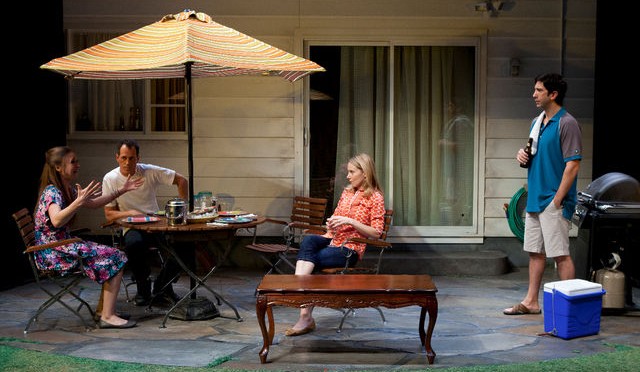
The suburban setting, hiding underlying malignancies

Lisa D’Amour’s Detroit was a finalist for last year’s Pulitzer Prize, which ultimately went to Quiara Alegría Hudes’s more earnest Water by the Spoonful.  Detroit is instead a rather vicious examination of American dreaming and its attendant disappointments and perversities, all delivered in comic dialogue that carries less of a wink than a bite.  It’s a perfect play for an era of economic uncertainty and political shape-shifting.

Despite all its ordinary suburban appearances, nothing in this strangely disquieted, more or less middle-class neighborhood is as it seems.  In fact, despite the play’s title, the Playwrights Horizon’s program is vague about the place, which it describes as a “’first ring’ suburb outside of a mid-size American city.”  Because the play is called Detroit, it’s easy to read it through that city’s economic depression and racial strife.  But D’Amour is after something bigger than profiling just one declining U.S. city desperate to revive itself.  The city becomes a synecdoche for the country itself, and its white, purportedly middle-class characters tell a cautionary tale about those in the so-called fly-over states who so often represent the “real” America in political discourse, whether idealized or disparaged.  The play succeeds by telling a story nearly David Lynch-like in its ability to get at the seamy underside of middle-class American life.

Directed crisply and sensitively by Anne Kauffman, D’Amour’s play puts two ordinary-seeming white couples together in close proximity and watches how the four characters push and prod one another toward revealing the fear and wrenching disappointment covered by lives of prosaic propriety.  Mary (Amy Ryan) and Ben (David Schwimmer) live in a house that seems, from the back- or front yards where the action is set, perfectly acceptable and conventional.  And as gracious suburbanites, they’re quick to invite their new neighbors, Kenny (Darren Pettie) and Sharon (Sarah Sokolovic), over for dinner.

Ben cooks outside on a large and handsome propane-fueled Weber affair, boasting about throwing “these puppies on the grill” when he’s ready to prepare the steaks he and Mary serve.  Schwimmer plays Ben with a perfect mix of bumbling anxiety and calculated, if only finally hopeful, arrogance.  Ben has recently been laid off from his job as a loan officer, and boasts that he’s starting his own financial planning consultancy on a web site he’s creating.  When he offers to practice his new skills on Kenny and Sharon, D’Amour intimates that Ben isn’t quite as competent as he takes pains to seem.  In his trademark Friends-inspired style, Schwimmer plays Ben’s reactions with blankly confused expressions, as the poor guy is always a beat behind the others in figuring out what just happened.

Mary, on the other hand, is sharper at keeping up with conversational subtexts, even if she doesn’t have the wherewithal to act on her instincts.  She works as a paralegal, fond of pretending to type letters while she’s actually shopping online.  She also has a drinking problem, easily sniffed out and diagnosed by Sharon, who’s a recovering addict.  Ryan beautifully communicates Mary’s sneering confidence, which thinly veils her own resentments and concerns about a future that suddenly seems much less than secure.

Sharon and Kenny are noticeably less adept at middle-class decorum than their new neighbors.  Sharon seems younger than the other three, and Kenny seems moody and mysterious in ways that make him stand out against the more conventional masculinity Ben tries to achieve.  Pettie plays the shifty Kenny as a handsome rogue who can’t quite look at people full on.  He jiggles his legs impatiently and always seems to have an eye on the door, even outside, where each scene takes place.

Sharon and Kenny announce at the first of the foursome’s dinners that they met when they entered rehab at the same time.  That their story quickly unravels, along with their sobriety, helps D’Amour move along a plot that doesn’t seem to have a central conflict or even a focal point.  The play instead moves subtly toward its rather shocking and spectacular ending, permeated by a tension the source of which is difficult to pin down.  D’Amour’s achievement with Detroit is that the play seems infected with a malignancy that never really takes firm shape, but erupts instead from within the characters themselves, as drugs and alcohol and finally music free them to enact the anger and unhappiness and desire they work so hard to quell.

That is, Mary and Ben work hard at it.  The coiled Kenny and the impulsive, wacky Sharon—beautifully played as a Hippie-manqué by the charismatic, loose-limbed and energetic Sokolovic—seem to have confronted their truths in rehab and their twelve-step programs.  They live comfortably in the present-tense, using the know-and-forgive-yourself-and-others rhetoric of recovery.  Their apparent openness about their past lives and excesses seduces Mary and Ben into addressing their own hidden demons, though the cost for the more conventional couple turns out to be quite high.

Kenny (Pettie) and Ben (Schwimmer): defining masculinity

Kenny resembles the Brad Pitt character in Kalifornia, the guy whose footloose and fancy free attitude is seductive to the more buttoned-down Ben, who doesn’t recognize the violence Kenny harbors.  When Mary and Sharon go off on a long-planned, much idealized camping trip together, Kenny talks Ben into joining him at a strip club for the evening, despite Ben’s protests about his monogamy and his morals.  That neither the men’s nor the women’s outings go as planned doesn’t matter; D’Amour indicates that to arrive at the kind of intimacy the trips promise, the characters would literally have to leave their homes.  Such freedom from their own domesticity—represented adroitly by designer Louisa Thompson’s agile set—rarely occurs, as each couple seems saddled with the repetitive performances of a too-settled married suburban life.

Thompson’s evocative set revolves from the back to the front of Ben and Mary’s house and to the front and back of Kenny’s and Sharon’s, making palpable their stultifying sameness and stasis.  Even the dialogue repeats with each new grilling episode.  Although Kenny makes fun of Ben’s forced cheerfulness at their first meeting, when Ben and Mary come to his house for dinner, he, too, announces that he’s going to throw “these puppies on the grill,” turning American masculine can-do-ness into a kind of performative that he well knows is constructed.

Though they’re neighbors, these two couples live at far different ends of an economic scale.  The set and costume design (costumes by Kaye Voyce) and D’Amour’s dialogue illustrate the layers of difference within the supposedly homogenous “middle class” of America.  When Ben and Mary visit their neighbors, their house looks almost identical, except that its siding seems dirtier and its appointments are in disrepair.  The deck Kenny is building isn’t yet finished; Kenny and Sharon’s grill is a small charcoal Hibachi, beside which Kenny sits, coaxing the coals and the hamburgers to heat.

The treacherous, unfinished deck

At their second dinner at her home, Mary inexplicably tries to impress Kenny and Sharon by serving them upscale hors d’oeuvres.  She lays out an array of delicacies from Whole Foods, including caviar and pink salt, pompously explaining each item to her new friends as Ben watches, incredulous.  When Kenny and Sharon host, Sharon suddenly remembers that she’s forgotten to serve the “appetizers,” running back into the house to retrieve a plate of what she calls “white trash” food, including Cheez Whiz and Saltines.  Sharon is too earnestly good-humored, if slightly unhinged, to be mean; she’s simply meeting Mary’s gesture in kind and demonstrating the couples’ vast differences in class presumption in the meantime.

Given its setting in these closely connected tract homes, you might think that Detroit’s action would be static and contained.  But D’Amour and Kauffman keep the pace quick and the events surprising.  Ben and Kenny get hurt in one another’s yards, Kenny with a patio umbrella that closes unexpectedly, and Ben by a loose plank in the deck Kenny is trying to build, both in a rather neat displacement of masculine violence.  The women, too, circle around one another, never quite articulating the sexual competition and the erotic tension that crackle in their mutual air.  The play’s erotics and violence only explode at the end, when a mix of drugs and alcohol and propulsive music let the foursome bump and grind out their lusts and longings.  In the climactic scene, Sharon kisses Ben and then Mary, neither of whom can understand nor resist the desire she suddenly ignites in them.

[Spoiler alert.]  In fact, the metaphor of heat and ignition becomes literal when Sharon decides “we’re going to have a fire,” and lights up Ben and Mary’s wooden patio furniture.  As the couples dance around the flames in a suburban tribal ritual of catharsis and reclamation, Kenny wanders into Ben and Mary’s house to set the kitchen and then the whole house alight.  Thompson and lighting designer Mark Barton create a compelling and convincing conflagration, which dies down to reveal the charred skeleton of Ben and Mary’s house.

As Frank, John Cullum explains it all

In Detroit’s embers, Kenny’s uncle Frank (John Cullum, perfect in a one-scene role) appears to explain that Kenny’s name is really Roger, and that his nephew has a history of drug and jail trouble.  Kenny and Sharon have disappeared, leaving Frank to deliver the eulogy over the suburban dream that the likes of his nephew ensure will never again be actualized.  Scanning the neighborhood’s horizon with bitter nostalgia, Frank remembers its heyday, when neighbors borrowed sugar and shored up one another’s illusions that their cookie-cutter way of life was right and true.

The stunned Ben and Mary listen without quite comprehending, strangely thankful that the home that constrained them no longer exists.  They’re unwilling to blame Kenny and Sharon, and ruefully tell Frank that the couple was nice, that they liked them.  The fire and its aftermath free Mary and Ben, loosening the bounds of expectation enough that they think they can start their lives over.

Throughout the play, Sharon has teased Ben, insisting that he’s really British.  It turns out that Ben actually does harbor a secret desire to be British.  Mary thinks he’s visiting internet porn sites while he’s pretending to build his web site, but in fact, he’s visiting addresses that encourage him to play at the noblesse oblige of aristocratic British life.  With their house in ashes, Mary surprises Ben by suggesting they move to the U.K.  She also calls him “Ian” in front of Frank, beginning again the process of trying to remake yourself, just as Kenny/Roger did, that’s as much a part of the American way of life as (supposedly) moving to the suburbs.

Although their dream of escape and renewal is no doubt a fantasy, D’Amour lets Ben and Mary believe for this last moment in the pretense of “elsewhere,” a place where they can be upstairs rather than downstairs, a new place that happens to be an old place, and the delusion that returning to the “motherland” will revive their fortunes.

Detroit is a smart, poignant play and Playwrights’ exciting, visceral production keeps spectators glued to the scene, wondering about and never prepared for what will happen next.  In the absurdist tradition of Albee, D’Amour shows us a reverse image of the American dream, leaving us disconcerted and yet strangely, productively hopeful nonetheless.

The Feminist Spectator

Detroit, Playwrights Horizons, extended through October 28, 2012.