I’ve been traveling throughout the month of July and will spend the next week or two catching up with “The Feminist Spectator.”
Much to discuss, including:
The Emmy Award nomination for Kerry Washington for Scandal, the first for an African American leading actress in way too long;
The Heat, the female buddy-cop film with Melissa McCarthy and Sandra Bullock, as well as McCarthy’s Identity Thief, a horrible example of man-loving, woman-hating comedy with Jason Bateman, both of which raise huge and troubling questions about casting and writing stories for unconventionally attractive (that is, not wraith-thin and tall) women like McCarthy;
Top of the Lake, the stupendous television mini-series written and directed by Jane Campion about a female detective sorting out the disappearance and molestation of a young girl in a remote, incestuous town in New Zealand, starring the incomparable Elizabeth Moss;
And more!
Meanwhile, I want to call your attention to a new on-line magazine called Symposium, for which I contributed to the inaugural issue. Here’s the mission statement:
An innovative digital magazine and blog, Symposium Magazine offers a common address for academics and non-academics alike to engage in debates on politics, culture and society. As the recent proliferation of academic blogs shows, more and more professors are looking to share their research with a broader audience. Our monthly edition of essays feeds the public’s appetite for deep coverage of debates within the academe and how they relate to the outside world, while the daily blog lets readers engage with authors. Above all, we promote rich journalism that is increasingly in peril in today’s media landscape.
Since Lingua Franca stopped publishing decades ago, few outlets have existed for this kind of public exchange. I’m looking forward to reading and contributing to Symposium. Take a look at the inaugural issue with my essay, “The Rebirth of Viewing Pleasure,” on teaching feminism and popular culture, here.
Moe Angelos and Marianne Weems of The Builders Association have created a mesmerizing new media performance from the recently published diaries of Susan Sontag. The spoken text is adapted from the first two volumes of the diaries and various interviews with Sontag and those who touched her life. The visual text is produced live and digitally from an array of cameras and projections. Both combine seamlessly to create an emotionally, theatrically, and intellectually compelling work.
Angelos adapted Sontag’s diariesby selecting scenes and moments she felt cried out to be theatricalized. (The New York Theatre Workshop’s dramaturgical notes on the production are quite useful; they can be found here.) The stories she embodies are indeed vivid—a 15-year-old Sontag describes being taken to gay bars in San Francisco in the 50s, seeing people dressed across gender, and becoming intoxicated by the queer scene and by her older female companion, the mysterious “H,” with whom she maintains a life-long friendship. Angelos’s script also captures scenes from Sontag’s life as a young undergrad at UC-Berkeley; as an expat studying at Oxford and in Paris; as a bohemian in New York; and as an intellectual prodigy who married young, had a child, and divorced early, as she couldn’t bear to be confined by conventional domestic life.
These vignettes from Sontag’s life, all described through journal entries that Angelos excerpts and stitches together, are structured chronologically, from when she was 15 to about 30. Angelos, as Sontag, sits behind a large desk center stage, embodying the writer as she leaves her intellectually and sexually promiscuous teen years to become the astute cultural critic of her 20s and beyond. To the audience’s right, projected on an otherwise transparent scrim across the front of the stage, Sontag as an older woman appears in black-and-white from the shoulders up.
Sontag the elder boasts her trademark skunk’s stripe of white across her thick dark hair and wears a scarf draped around her shoulders. She smokes continuously, comments, and watches her younger self from a perch somewhere in the future. The older Sontag’s running, often wry and cutting commentary on her younger self offers a delicious counterpoint. In one of her first lines, for example, as the very young Sontag is enthusing over or bemoaning some event in her life, the older Sontag notes that childhood is a waste of time. Throughout the production, the woman watches us watch the younger Sontag, guiding our reactions and measuring herself against the progress of her own history.
Apparently, Sontag frequently reread her diaries, commenting on her entries in the margins as she aged. The journals, as Angelos’s script notes, allowed her to create herself. Far from private reflections, she always intended them to be read, and wrote with the sly impetuousness of a young woman who cared not at all for the bad impression she might give of her fellows or, for that matter, herself. Sontag Reborn underlines that Sontag’s life was performative; she lived it as she wrote it, rather than vice versa.
Angelos and Weems rehearsing
Sontag’s journals are ripe for theatricalizing because she used the page to create her persona, crafting herself the way other young women use their mirrors to primp and prepare to be observed and admired. The gift of the production is that it chronicles the self-making of a woman who was so smart and fearless about living contrary to her day’s dominating ideology. It’s entirely refreshing to watch a performance about a woman who loved to think, who held strong, even fierce, opinions, who was a cultural omnivore (even if her tastes ran to the highest art), and thought deeply about everything she consumed.
The production makes that intellect pleasurably material. Angelos as Sontag rifles through stacks of books, showing us their spines and reading out their titles. She lists books she needs to read and films she needs to see, pushing herself far and fast and holding the highest expectations of herself. As she writes down her thoughts, they’re projected in urgent handwriting across the screen upstage of her desk. Thinking, in Sontag Reborn, is a physical and emotional exertion, and in Angelos’s terrific performance, it’s a deeply embodied experience.
Rather than a static recitation of an exultant mind, the production gives us Sontag as a bundle of energy, who can barely contain the ideas firing through her brain. She lies across her desk, thinking among her journals, books, and papers, while we see her on screen, reflected by an overhead camera that projects her image in a loop that also brings movement to the scene. (NYTW also has a great “making of” video available here.) Both the young and the old Sontag smoke incessantly, crooking their hands with just the right insouciant flair to make the habit seem debonair and sexy, if not something of a mysterious curtain over the world-scrutinizing woman beyond. Angelos masterfully moves Sontag through the years, aging her so subtly–as the Feminist Spectator 2 noticed–that it’s only on reflection that we can see the vocal and behavioral differences between the various versions of herself.
Susan Sontag
Sontag, obviously, is perhaps the most famous American female public intellectual in history. But how often do we see such remarkably smart women holding center stage by themselves? And how often are their stories about rejecting not just conventional interpretations of motherhood but also of romance? In the short period that Sontag Reborn charts, the writer has many love affairs. And for someone so young (not to mention someone coming of age in the 1940s), she seems utterly unruffled by all of them. She says she wants to have sex with lots of people—and though she calls herself, in this production, “homosexual” in the lingo of the day, she has sex with men and women alike—but doesn’t seem eager to settle into a relationship. Her marriage to the sociology professor Phillip Rieff happens young and impulsively and doesn’t last long. Her lust is literally for life, which she soaks in through books and thought and the utterly engaged way in which she experiences the world.
Three layers of imagery: front scrim, live performance, back screen
What a gift to get to spend time with her this way. Angelos and Weems create a theatrical experience that makes excellent use of the mediated environment. A scrim and a screen sandwich the live action. The visual accompaniment they provide includes animated moments of Sontag writing in the journals, in which her handwriting is projected in creamy white across the journals across which Angelos’s hands fly. Because it’s so difficult to theatricalize thought, the visuals (by video designer Austin Switser, scene designer Joshua Higgason, and lighting designer Laura Mroczkowski) do an excellent job of making her intellectual and artistic process both material and abstracted into stage art. The designers also illustrate the performance with video clips and photo archives and long lists of titles and words, none of them exactly documentary, but all of them evocative of the Sontag aura and gestalt. The choreography of the visuals mimic the lightning speed of Sontag’s mind and illustrate the collision of ideas populating her brain.
By mixing the kind of declamatory statements found in abundance in her journals with more meditative passages, and visualizing her thought process with an astute collection of moving images, Sontag Reborn gives us a rare glimpse into the life of the kind of woman seen and celebrated too rarely onstage and in “real life”: a smart, towering intellect who was willful, determined, sometimes caustic, and always inspiring.
The Feminist Spectator
Sontag Reborn, New York Theatre Workshop, Off Broadway, June 26, 2013.
So here’s the thing about Diane Paulus and how she directs musicals: She takes song-driven, narrative-lite titles like Hair and Pippin and makes them practically irresistible. She’s very good at creating a sense of on-stage community, in which actors seem to be having a great deal of fun, as themselves as well as the characters, in an almost Brechtian separation that’s obvious but not intrusive.
Watching Pippin from the first row of the left orchestra, we had a clear view of the actors’ faces and their more intimate reactions to one another in a show that’s all but not entirely about spectacle. We could see how Paulus does a really good job of modulating between the production’s circus setting and its more subtle moments, pacing the action and the show’s rhythms so that the acrobatics never get overwhelming and so that you never lose track of the story.
I’ve seen Pippin several times, and have never really quite “gotten” what it’s about, because the show’s gimmicks often obscure what turns out to be a very simple story about searching for yourself against the dictates of dominating culture. Pippin (Matthew James Thomas) is the son of King Charlemagne (known as Charlie and played here by the appropriately sardonic Terrence Mann). The pseudo-historical setting means very little, aside from giving the story its king and queen and its lost, Hamlet-like prince. Pippin dithers over what he should do with his life, determined to have and be more than the path that seems set out for him.
He’s inspired in his quest by the Mephistophelean (and Machiavellian) “Leading Player” (Tony Award-winner Patina Miller), who entices him away from the ordinary towards inflated schemes of power and influence and difference from the norm. But in the end, Pippin rejects both his royal lineage and his dream of uniqueness for a more ordinary life, joining Catherine (Rachel Bay Jones), a widow, and her son, Theo (Andrew Cekala), to live as a simple, loving family, disappointing the Leading Player but finally, wistfully, pleasing himself.
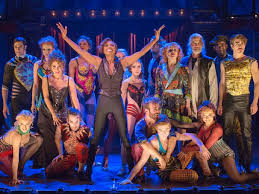
Across that simple (heterosexuality-) affirming story, though, the tale Paulus really tells is about the seduction of theatre and performance. The production is all about charisma, and the entire cast’s power to entice and seduce one another and the audience. Paulus’s actors demonstrate precise control of each moment and gesture, and thrill to holding the audience in the palms of their collective (Fosse-inspired jazz) hands.
Patina Miller as the Leading Player
When the show starts, the front stage curtain is closed. As the orchestra begins the familiar, seductive chords of “Magic to Do,” Miller, as the very sexy, vaguely menacing Leading Player, is back lit, her curvy shadow gradually enlarging as she approaches the stage apron from behind the curtain. When she parts that cloth and appears, singing, “Join us . . .,” the tone is set for the whole show. (You can see a video clip of this moment and “deconstruction” of how it works on the New York Times web site, here.) With her jaunty hat and skin-tight black costume, she personifies the seductions of a history of American musical theatre performance. With sly control and perfectly sleek poise, Miller looks out into the audience, beckoning us closer with her fingers and her words.
I saw Pippin shortly after the Tony Awards were handed out, which seemed to suffuse the whole production with a proud joy (and the audience with a gleeful purchase on cultural capital, since we’d all had the foresight to get our tickets before the Tony’s were announced). Miller, who won for Best Actress in a Musical, was sublime, using her polished charisma to move Pippin and the rest of the show along, always lurking on the margins of a scene, following through on Paulus’s concept that Pippin be enticed into powerful spectacle and away from the mundane that would entrap him (and us).
For those couple of hours of performance, we’re carried along with Pippin into a world in which you can sample daring feats of physicality and emotion and then change your mind about committing to them; when, for example, you can commit patricide and then think better of it, rewinding time and retrieving the knife you plunged into your kingly father’s chest.
Pippin samples the pleasures of "Flesh"
The audience, like Pippin, is vicariously invited to try different ways of being in the world: to be the benign ruler who abolishes taxes and empowers the poor, only to quickly realize that, shucks, you can’t please everyone; to be the romantic partner who rescues the lonely widow and her melancholy son, only to feel trapped by domestic banality; to be the warrior in your father’s army, except that you really can’t get with the program of marching, murder, and mayhem; or to be prey to the pleasures of the flesh, passed from one undulating body to the next in a scene reminiscent of the Hair, and then to accept that, gee, you’re not the Casanova that you thought you might be.
Matthew James Thomas, as Pippin, is a wonderful foil for the antic goings-on that Paulus constructs around him. The character is sometimes a cipher, the least interesting part of the musical, despite bearing its title. But Thomas performs Pippin as sweet and earnest and hopeful, tempered with just a bit of wry exasperation that keeps him from seeming saccharine. For much of the production, Thomas plays against conventional masculinity; watching him try to be a soldier is quite amusing, as he very physically demonstrates that blind obedience and armored displays aren’t for him.
Thanks to Thomas’s commitment and his physical and emotional intelligence as an actor, Pippin’s somewhat repetitive arc—“I’ll try this; oops, doesn’t work; I’ll try that!”—seems fresh in every instance. Thomas performs with a keen awareness that Pippin is a cog in the wheel of the performance and the story, a chance for the virtuosic Paulus to move the other performers around him and for composer/lyricist Stephen Schwartz to show off his chops (he wrote the show as an undergraduate at Carnegie Mellon; see here for Broadway World‘s terrific compendium of video clips from the history of the show).
But Thomas carries off the part as more than just the straight man. He’s game but he’s also strong enough—as a singer and an actor—to ground the whole thing in a smart sense of absurdity. In his hands, Pippin moves from ambivalence to a reluctant but ingenuous understanding that he’s not that special after all. We see him accept that stepping in as husband to Catherine and father to Theo might not be such a terrible compromise, despite the Leading Player’s fury at what she finds Pippin’s accommodations.
Pippin and Catherine, "Love Song"
If, by the end, the heterosexual family is once again secured (and when isn’t it, I ask you?), at least up until those last moments, the production places its hegemony in doubt. Even the beautiful, intimate number in which Pippin and Catherine sit on the very edge of the apron to sing “Love Song,” with Thomas appearing to play guitar, is edged with light irony. Thomas and Jones both seem to play at the iconic moment rather than fully succumbing to it. I got the impression that the two actors are great friends and that they love performing this duet, more than I felt the characters finally expressing their love. That moment and many others like it in this production gave Pippin a critical if not fully Brechtian frame that let spectators enjoy the show without necessarily subscribing to what turn out to be its awfully conventional values.
Terrance Mann as the rather louche Charlie
Terrence Mann as Charlie, the king, and Charlotte d’Amboise as Fastrada, the queen, are also terrifically droll, commenting on their roles even as they fill them so comically. Mann has the most to do (and better, funnier lines) but d’Amboise makes much of her role as the dunderheaded queenly side-kick who’s in love with her son, Pippin’s brother, Lewis (Colin Cunliffe, understudying for Erik Altemus at the performance I saw). Lewis is blood-thirsty, muscle-bound, and rather clueless, the perfect counterpart to Pippin’s bleeding-heart-on-his-sleeve liberalism. Somehow, though, they both seem queer, Pippin because he’s ill-equipped to deal with the demands of war and royalty, and Lewis because he seems a gym rat with more than a little hankering for his fellow fighters. The performance of various less than conventional masculinities is one of the show’s many pleasures.
Miller and Thomas also make a wonderful gender (and race) contrast. As the Leading Player, a role originally played by Ben Vereen (and typically played by a man), Miller just gleams. She masterminds Pippin’s picaresque journey, pushing him hither and yon with a slithering charm. Miller is everywhere on stage, watching from the wings, hanging from a trapeze in an impossible position way above the action, and dancing among and between the other characters as an omnipresent chimera who for the most part only Pippin can see. Miller’s opening number, “Magic to Do,” is luscious; how could you not join her on this journey, when she’s dancing and singing and curling her fingers toward you with a presence so enticing you just want to bound onto the stage with her?
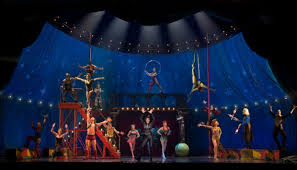
Thanks to Paulus’s direction, Chet Walker’s rebooting of Bob Fosse’s original choreography (the program credits Walker with choreography “in the style of Bob Fosse”), and Gypsy Snider’s circus staging, the show boasts an exciting combination of circus and theatre spectacle, in which acrobats and contortionists are mixed in with the singers and dancers. Most of the musical numbers are embellished with trapeze flying or floor stunts, with the strong and nimble bodies of the men handing one another off or catching one another mid-air with impressive grace and precision.
Male acrobats and their balancing acts
The women circus performers are mostly contortionists, appearing in positions difficult to comprehend that add bits of spectacular color and liveliness to an already busy stage. The men are more memorable; they fly through rings and slide over inflated balls and hand-walk down staircases and leap backwards off the bridge that crosses the back of the playing space. Their gravity-defying antics make Pippin’s inability to boost his life into warp speed flight that much more obvious.
Paulus and company keep the show moving so fast you can see the sweat flying from the actors’ brows. She gives you a lot to look at—I’m sure I missed a number of impressive moments while I was oohing and aahing over others in this literal three-ring circus of a production. But she also knows when to slow things down and focus your attention. For instance, Andrea Martin’s Tony Award-winning number “No Time at All” is a masterful turn of vaudevillian shtick and invention, for which the 66-year-old veteran actor performs a trapeze act that sees her literally hanging upside down from the arms of Yannick Thomas, one of the circus pros.
Martin as Berthe and Thomas as Pippin
Martin, as Pippin’s grandmother, Berthe, doles out each morsel of her delicious number with the command of the stage equivalent of Julia Childs. She’s masterfully in charge of each comic moment, whether cajoling the audience to sing with her on the song’s chorus (the lyrics projected across the scenery with Mitch Miller-esque bouncing balls marking out the rhythm) or chiding us to shut our mouths while she sings the verse. Her physical timing is extraordinary as she rips apart the Velcro buttons of her ordinary-looking gown to reveal the tights and unitard of an acrobat below. When she grasps her flying partner’s wrists and is lifted up to his lap on the trapeze, the number literally stopped the show the night I was there, with a long standing ovation, thanks to Martin’s brilliant charisma and command. At the performance I saw, Matthew James Thomas as Pippin was in stitches and needed a moment to gather himself as Martin took her bow.
Perhaps because of the recent Tony Awards, the audience was utterly enthralled and enthused all evening. The ovation for Martin seemed to acknowledge and celebrate her well-deserved award, and the glee with which Miller was greeted every time she was on stage seemed equally generous and knowing. The whole production was buoyant and glowing with a post-Tony’s gleam.
The big top set
Seeing Pippin reminded me of those moments of utopian performativity about which I’ve written and which I continue looking for in the theatre. Through the whole show, I smiled ear-to-ear, clapping, singing along, captivated by the circus acts, entranced by the performers, and delighted by my own willingness to be swept away by theatricality. And I felt my fellow spectators similarly inclined. The audience seemed communally buoyed by the performance, having that particular kind of fun that being together, live, and watching virtuosic people who love performing can inspire.
Was there a progressive political quotient in evidence? I won’t go that far. But I will say that watching an African American woman perform so impeccably as the evening’s master of ceremonies felt pretty profound. And so did watching a 66-year-old white woman perform a show-stealing number. And so did watching d’Amboise and Mann perform a strikingly non-royal kingly and queenly duo. And so did watching a very game young white male actor perform in a register implicitly critical of conventional white heterosexual masculinity.
Paulus’s revival intervenes just a bit in Pippin’s conventional ending. After Pippin decides to stay with Catherine and Theo, infuriating the Leading Player with his choice for reality over magic, she manages to seduce young Theo back into the circus ring, suggesting that the cycle of an ambivalent, wondering life journey will begin again in the next generation. I liked the sense of history repeating itself with which the production leaves us (some critics apparently didn’t).
But given how vivid I found its critique of masculinity, wouldn’t it have been more interesting and poignant if Theo, in Paulus’s production, were played by/as a girl, just as the Leading Player’s gender was shifted? If a girl-Theo (or perhaps Theodora) were left at the end to fall under the Leading Player’s spell, something more innovative and even progressive might have been implied by this new ending. New possibilities might have opened on the musical’s gendered landscape.
Maybe another time.
Is Pippin theatre for social change? No. Is this production kind of feminist? Maybe—the women leads are powerful and stellar throughout. Does it demonstrate how wonderful it feels to be in an audience that’s thrilled to be together, witnessing feats of derring-do and pure theatrical magic? Absolutely.
The Feminist Spectator
Pippin, Music Box Theatre, Broadway, June 20, 2013.
I’ve been reading around in the blogosphere, catching up on current debates and controversies. I noted with interest Laura Linney’s remarks, on the occasion of her Crystal Award for women in film, as well as playwright Mike Lew’s response to the Lilly Awards on his blog; Jonathan Franzen’s sudden and surprising shout-out bout the unequal status of women in theatre, which he wrote in respond to Frank Buni’sNew York Times op-ed, “Sexism’s Puzzling Stamina,” about gender discrimination; and the frank conversation about race and representation between director Mary Zimmerman and Silk Road Rising Artistic Director Jamil Khoury on the company’s blog.
I find this recent flurry of conversation about race and gender in theatre heartening, although the more pessimistic (though rarely revealed) side of my psyche thinks, as usual, that these debates are cyclical rather than sustained. And why, after all, don’t they change anything about the status of women and people of color and queer people in theatre
'nuff said . . .
Franzen’s letter to the editor in the Times struck me as something of a red herring, a diversionary tactic to displace scrutiny from the still unequal position of women in literature. After all, this is the author who famously disparaged Oprah Winfrey for selecting his novel, The Corrections, for her book club, dismissing the project as too low-brow for his participation. And this is the novelist whose work is reviewed so frequently that the gender imbalance in book reviewing it demonstrates prompted the organization VIDA to begin crunching numbers and publishing the appallingly unequal results. As novelists Jodi Picoult and Jennifer Weiner pointed out at a public conversation at Princeton last April, gender and genre are still intimately intertwined. Franzen might be doing women in theatre a favor with his letter, but why doesn’t he also put his shoulder behind increasing the number of book reviews accorded to women writers?
Laura Linney accepting the Crystal Award
Several theatre people recently articulated the gender inequity problem in our field very nicely. Laura Linney’s remarks beautifully demonstrate her commitment to fellow women artists, outlining for the Women in Film crowd who presented her award the gender differences she found in working in film compared to her native theatre community. She notes that women film actors rarely have scenes together; that few women work on film crews; and that when women film producers visit sets, they tend to keep to themselves, creating a climate of gender isolation and perpetual singularity. Linney exhorts women to mentor one another, to share knowledge and connections, and to listen to one another’s experiences and insights and try to do something to improve their common situations.
Likewise, Mike Lew, on his blog, describes attending the Lilly Awards, named in memory of Lillian Hellman and begun in 2010 by playwrights Julia Jordan, Marsha Norman, and Theresa Rebeck to honor work by women in theatre. Lew does a really nice job of excoriating artistic directors who refuse what they see as “quota systems” in season selection and who excuse their white-male heavy selections under the rhetoric of “excellence” and choosing the “best play.” As Lew writes, “The ‘best plays’ system allows you to choose based on gut decisions, without any metrics for measuring success, without any accountability for the larger effects that your decisions have on the ecosystem of theater.” Theatre shouldn’t be a meritocracy; it should be a cultural production practice with some accountability to the diverse local and national communities from and with which it speaks.
At a time of year when theatres around the country announce their upcoming seasons, I’m fascinated once again by which companies I can count on and which I can’t to be ethical about gender, racial, and ethnic diversity in their selections. Leading the pack with numerous women playwrights and directors again in the 2013-14 season is Playwrights Horizons. Their spectacular selections include Anne Washburn’s Mr. Burns: A Post-Electric Play, directed by Steve Cosson; Marlane Meyer’s The Patron Saint of Sea Monsters, directed by Lisa Peterson; Madeleine George’s The (Curious Case of the) Watson Intelligence, directed by Leigh Silverman;Sarah Ruhl’s Stage Kiss, directed by Rebecca Taichman; Kirk Lynn’s You Mother’s Copy of the Kama Sutra, directed by Anne Kauffman; and Fly by Night, a new musical conceived by Kim Rosenstock and written by Rosenstock, Will Connolly. and Michael Mitnick.
Mr. Burns, this season at Woolly Mammoth in DC
Washburn’s Mr. Burns is a terrific post-apocalyptic meditation on popular culture, systems of exchange, and the stakes of building and maintaining community when the social contract is sundered. George and Ruhl are two of my favorite playwrights, whose elastic use of dramatic form and structure is matched by their commitment to imagining the potential diversity of human relationships. Meyer returns to theatre after many years writing for television. Her early play, Etta Jenks, was a complicated look at the porn industry and its impact on its women workers. Kirk Lynn (a co-artistic director of my favorite Austin-based theatre company, the Rude Mechs) is always a smart and inventive artist, using dialogue and settings to skew narrative in unexpected ways. And the assembled directors are terrific; four out of the six announced so far are women. How excited am I for this season?
The Women’s Project, under Julie Crosby’s expert leadership, had a good 2012-13 season, leading me to look forward to the next. All three plays, presented at City Center’s Stage II, were compelling and well-executed, and each production used the three-quarter thrust in entirely inventive ways. Bethany, with America Ferrera, written by Laura Marks and directed by Gail Taylor Upchurch, was a terrific exploration of economic exigencies told from the perspective of a woman desperate to retrieve her child from foster care. Jackie, Gitta Honegger’s translation of Austrian Nobel Prize winner Elfriede Jelinek’s one-woman play, was directed with fluid momentum by Tea Alagic and performed with manic but precise verve and exciting energy by Tina Benko. And Allison Moore’s Collapse, directed by Jackson Gay, also addressed the complications of how we balance psychic and economic constraints and continue to maintain productive social relationships. The season was theatrically, intellectually, and politically astute and inspiring; the Women’s Project will announce their next season in mid-July.
I won’t do an exhaustive review of the season announcements I’ve read so far. I’ll only say I think it’s important to notice how the plays and productions selected are distributed across gender and race, and to suggest that if the seasons are written and directed exclusively by white men, I won’t be subscribing or donating money. Women playwrights and directors should be afforded just as many opportunities to succeed or fail as white men. (Speaking of which, I found Annie Baker’s The Flick one of the best shows mounted at Playwrights last season, despite the controversy over its length. The play flew by for me, captivated as I was by the nuances of those three, moving characters and the narrative of the old-fashioned celluloid cinema replaced by a digitized movie chain. Gee, people seem very indulgent of Tony Kushner’s long plays . . . but not Baker’s?)
Andre de Shields and Mary Zimmerman rehearse The Jungle Book
Two last thoughts. I was cheered by the exchange about The Jungle Book adaptation that unraveled in Chicago and online this last week. In an interview with Chicago Magazine, director Mary Zimmerman was quoted saying what seemed to be very offensive comments about race and colonialism in the context of adapting the Disney movie and Kipling’s book for the stage. Jamil Khoury wrote a very smart, impassioned critique of her interview, called “The Trouble with Mary,” which prompted the Goodman Theatre, which is producing The Jungle Book, to arrange a meeting between the two theatre artists.
The upshot of their personal conversation seemed a great deal of good will and an email interview Khoury conducted and published that allowed Zimmerman to clarify her thoughts and her work on the production. Would that more artists were willing to have public conversations about the political impact of their artistic choices, and would that more theatres took seriously their responsibility to public discourse and debate.
Finally, I’m spending a few days in San Francisco this week, accompanying The Feminist Spectator 2 on a research trip to Mill Valley, where she’s interviewing middle- and high-school students and the artists who work with them about their commitments to amateur musical theatre. As part of her research, we attended for the second year in a row the famed Mountain Play at the top of Mt. Tamalpais, which celebrated its 100th anniversary producing theatre 2,000 feet above sea level. The natural amphitheatre, which seats 4,000 people, was sold out for all six performances this year of The Sound of Music, presented by amateur performers (except for the Equity actor who played the Captain).
I was charmed once again by the community-building capacity of theatre, as Stacy and I observed the intrepid spectator take school buses from the local high school in town up the winding road to the summit of Mt. Tamalpais. The drivers avoided the bikers who crowd both lanes on the weekends, making their torturous route to the top for their exhilarating ride back down to the bottom. As you turn into the final leg of the road before you leave the bus to walk to the theatre, the views off the side of the mountain make you feel like you’re flying high above the clouds layered over the shimmering sea below. Once you arrive at the theatre, you can see the Marin headlands and San Francisco Bay stretched out in front of you in a spectacle so breathtaking, you wonder how in the world you’ll wrest your eyes away to watch the play.
But the Mountain Play folks take advantage of the beautiful natural setting to mount really good productions of classic American musicals. The Sound of Music was particularly wonderful, as director Jay Manley (new to the organization this year) moved the cast full of children playing children and adults playing nuns with an ease that let the musical clip through its paces. Manley also took advantage of the road into the playing area to use a real 1940s-style automobile and a real motorcycle with side car to stage the Nazis chasing the von Trapps out of the Austrian national performance arena and over to the abbey late in the play. Stacy tells me that using the environment in inventive “real” ways is one of the trademarks of Mountain Play. But the spirit of fun and fantasy and friendly community the production inspired was moving and exemplary.
We arrived early to watch the cast rehearse, enjoying those playing the von Trapp kids going through their paces in cut-off jeans and sunglasses and seeing the nuns out of their habits singing in their flip-flops. We watched the audience arrive with their coolers and picnic baskets full of food and drink, slathering on sunscreen and renting stadium chairs to ease their backs on the rock benches that serve as seating. We enjoyed folk performances by kids from a local music school prior to the show, and finally, we tried not to sing along too obviously to “Climb Every Mountain” and “Doe a Deer” as the cast used the mountain setting to tell the story of Maria and the Captain and the children and the Nazis (whom the audience booed and hissed loudly at each of their entrances).
Gazing back down into the bay at the performance’s end as we made our way to the parking lot, I thought again how good theatre experiences really do put you on top of the world. It doesn’t get much better than that.
Can’t Neil Patrick Harris (NPH) be hired to host all of the televised award shows? Good thing he’s already lined up to do the 2013 Emmy Awards in June. If the producers of the Oscars were smart, they’d hammer out a contract and sign him on. Compared to the puerile, offensive humor of Seth MacFarlane as the host of last year’s Academy Awards, NPH’s PhD in hosting easily trumps McFarlane’s nursery school rendition.
NPH, of course, is openly gay, which I have to think lands him closer to the center of the hosting bulls eye from the start. He somehow understands the fine line between satire and parody and sincerity that these shows demand, as they both honor and send-up the nominated work. If awards shows are really just long commercials for the product they’re touting, and a chance to see adorned celebrities read from Teleprompters or improvise and show their “real” selves, a good host has to strike the balance between toast- and roast-master.
NPH singing and dancing his heart out in the opening
NPH most often trades snark for sweet, with self-deprecating charm that brings the whole audience along instead of aiming only for the lowest common denominator (take note, MacFarlane). And he sings, dances, and patters with the best of them, willing to aim both high and low. Shouting out to the kid watching somewhere and yearning to be part of what was all night honored as “the Broadway community,” NPH noted, “We were all that kid” (one of the show’s early highs).
French-kissing Sandy the Annie dog, as they sat companionably on the side of the stage at Radio City, might have been lowbrow, but I found it hysterical. NPH doesn’t take himself too seriously, and he positions himself squarely inside the crowd he’s addressing. He creates a “we” that invites the television audience in, too, and lets us feel proud of and involved in a field of culture in which most of us are just consumers. That’s a gift.
The production numbers last night exemplified the best of any awards show in recent memory. Medleys or pastiches from nominated musicals (or from previous winners, like Once, which was cheated out of a full scene when the show ran late) were filmed and edited with kinetic verve and visual detail, offering movement, fluidity, and energy that nicely translated the three-dimensional song-and-dance numbers into television’s two.
Kinky Boots
Projections and set pieces offered the flavor of each show’s style and design, providing the numbers with color and texture, excitement and flare. Even the choice to announce the awards in front of a marquee-style posting of each category, with warm wood doorways coloring the television frame, helped give the show warmth and immediacy, eschewing the more formal pomp and circumstance that often bogs down the Oscars, for instance, in more remote glamour.
In fact, the 2013 Tony Awards show underlined beautifully that Broadway is all about real bodies laboring in real time to create a magical, meaningful experience for spectators. I loved how the television camera captured NPH sweating and panting after his terrific opening production number.
And you could see all of the performers actually singing (no lip-syncing here, even, I’m pretty sure, for the Phantom of the Opera number, one of the evening’s more gratuitous scenes, which only served to honor the staying power of one of Broadway’s money cows). The labor of those Broadway artists was palpable and impressive all evening.
Was it my imagination that the show also seemed politically and socially progressive and might point to a hopeful moment in Broadway theatre? Each of the musical numbers seemed strikingly multiracial, from the cheerleaders of Bring it On to the fearful but feisty students of Matilda, and from the factory workers of Kinky Boots to the singers of Motown, in which the one or two white people in the chorus nicely reversed the typical demographic balance. Even Annie’s orphans included African- and Asian-American girls.
Four people of color won major awards for acting: Courtney B. Vance for Lucky Guy (sorry for leaving him out in my first posting of this blog!); Patina Miller for Pippin (whose gown, when she accepted, showed off her gorgeous, strong arms); Billy Porter for Kinky Boots (who thanked his mother for her graceful acceptance of things she doesn’t understand which, he suggested, could be a model for us all); and the elegant elder stateswoman, Cicely Tyson for Trip to Bountiful (who deserved more than the 30 seconds of speaking time she received).
Miller, Tyson, and Porter, winners all
Women, queer people, and drag queens stood out in the winners’ category all evening. Diana Paulus won early for directing Pippin, eloquently urging people watching to “do what you love.” Pam McKinnon won shortly after for directing Who’s Afraid of Virginia Woolf. She, too, spoke beautifully and sincerely about her long relationship with Edward Albee and the importance of the arts. My Facebook feed exploded with shock and delight that two women took home this year’s directing honors, but Playwrights Horizon’s Beth Nathanson’s remark—“It’s about fucking time!”—seemed most astute.
Stark Sands and Porter, out of drag
Drag roles abounded in the nominated musicals. Although Billy Porter performed the televised Kinky Boots number in civilian clothes, all the show’s press focuses on his high-heeled drag glory. Bertie Carvel (Matilda), who lost to Porter, performed his misshapen villain turn as the hideous Miss Trunchbull. And the less-noticed but equally adept Gregory Haney was on hand as La Cienega, the trans-cheerleader in the scene from Bring it On.
Though no one in Cinderella played in drag, even that musical hints at the old English pantomime tradition of dame roles in which men played women. The numbers’ fluid gender performativity, along with NPH’s out-ness and the several gay male winners who acknowledged their husbands from the stage, gave the evening a happy queer vibe. Even Jane Lynch, singing Annie’s “Little Girls,” brought a cool lesbian affect to the drunken, child-hating Miss Hannigan.
Most of the skits and patter worked beautifully all evening. Andrew Rannells (The New Normal), Megan Hilty (Smash), and Laura Benanti (Go On) joined NPH for a funny number about Broadway stars whose television series were cancelled. The skit wittily underscored the economics of the arts and the differences between LA and NY, while letting all four demonstrate the acting, singing, and comedy chops that their televised experiences only flattened.
Lauper accepts for Kinky Boots
Sigourney Weaver deserved a better presenting partner than NY Mayor Michael Bloomberg (who should never, ever wear a red bow tie), and a few of those reading from Teleprompters sounded stilted and wooden. But for the most part, the show’s writing was superior and the stars’ delivery smooth and warm or appropriately funny. Steve van Zandt’s rambling introduction to The Rascal’s “Good Lovin’” struck a sour note, even though he’d earned the moment by producing the Broadway musical, The Rascals: Once Upon a Dream. The band’s number, played live over a montage of scenes from this year’s plays and musicals in which people kissed one another (wtf?), seemed to have wandered in from “The People’s Choice Awards” circa 1966. Cyndi Lauper, who was sincerely moved as she accepted her Tony for Kinky Boots, did a much better job performing “True Colors” live in front of the “In Memoriam” slides.
Vanya and Sonia and Masha and Spike
Finally, the evening demonstrated the synergy between universities and regional theatres, as Diana Paulus thanked Harvard’s president, Drew Gilpin Faust, for supporting ART and Emily Mann, accepting the Best Play award for Christopher Durang’s Vanya and Sonia and Masha and Spike as McCarter Theatre’s artistic director (where the show was first produced before it moved to Lincoln Center and its Broadway run), thanked Princeton University, which hosts the theatre on its campus. The presence of Paulus, Mann, and Martha Lavey, who accepted the Tony for Best Revival of a Play on behalf of Who’s Afraid of Virginia Woolf, which originated at Steppenwolf Theatre, where Lavey is Artistic Director, illustrated the power of women who head significant regional theatres.
The 2013 Tony Awards made me surprisingly proud to be part of the “Broadway community” honored throughout the night—as a critic, a spectator, and a fan. The queer-, women-, and people of color-friendly show and the work its awards honored just rocked.