All posts by THEFEMINISTSPECTATOR

Porgy and Bess

This controversial production comes to Broadway with the baggage of both historical and contemporary critique.  First produced in the 1930s as a “folk opera” by George and Ira Gershwin, and DuBose and Dorothy Heyward, this production, directed by Diana Paulus with a revised book by Suzan-Lori Parks and Deirdre L. Murray, opened August 17, 2011, at the American Repertory Theatre in Cambridge, where Paulus is the artistic director.

Before he’d even seen the production, Stephen Sondheim excoriated the artistic team for what he found unethical meddling with the Gershwin’s original work.  But as Hilton Als wrote in a lovely background piece and review for The New Yorker, the “original” was full of racism, an artifact of a moment in theatre history when white people represented their skewed vision of people of color for other white people.  Why in the world would anyone want to preserve such original intentions for a 21st century audience?

More than a bit of sexism surfaced in Sondheim’s argument, too.  Here’s a young white woman director and two talented women artists of color engaging one of famous narratives of American opera and theatre, all with an eye to renovating the central character of Bess, the drug-addicted woman whose desires drive this revision’s plot.  Given this refocusing, Sondheim’s unfortunate objections might derive from his personal taste and respect for some artists over others, as well as from his professional investments in preserving the sanctity of the original text.

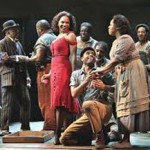
The Sondheim kerfuffle sent the production to Broadway on a cloud of critique, but from my perspective, this Porgy and Bess provides a transformative theatre experience.  With a simple set by the talented Riccardo Hernandez; unobtrusive but evocative choreography by Ronald K. Brown; a superb ensemble, each one of whom seems to follow his or her own grounded and nuanced narrative arc; and stage pictures that seem organic instead of posed, the production offers a thrilling experience at the theatre.

Hernandez creates down at the heels Catfish Row, in Charleston, South Carolina, with a one-dimensional curvilinear back drop, all corrugated tin and wooden window frames through which light (designed by Christopher Akerlind) projects in geometric patterns that change with the time of the day.  A simple working water pump establishes the outdoor scenes, and performers bring on wooden chairs and crates to give the stage picture levels and textures.

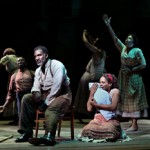
Yet with so few props and such a schematic set, Paulus and her actors create a whole world, an African American community of fishermen and washerwomen, of tinkerers and tradespeople, of grifters and preachers, and of good people and bad.  The ensemble moves constantly, providing a living backdrop to the story of Bess and Porgy’s doomed relationship.

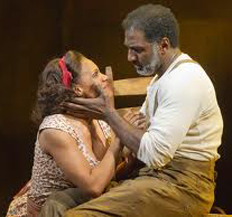
Paulus draws attention to her stars through their costumes.  Bess (the sublime Audra McDonald) wears a beautiful, bold red dress when she arrives in Catfish Row on the arm of her evil lover/procurer, Crown (Phillip Boykin).  Costume designer ESosa leaves McDonald’s arms bare and her breasts heaving over the bodice, accentuating her figure with a high slit up the side and barely supportive straps.  Porgy (Norm Lewis) wears layered, dirty but pure white shirts, which help him stand out among the rest.

Although the careful design and direction lets spectators track the show’s central couple, Paulus embeds Porgy and Bess’s story within a lively, close-knit neighborhood both visually and narratively.  Theirs isn’t a singular story, but a relationship aided and abetted by a community that’s very protective of its “crippled” friend.

Porgy, hobbled from birth, walks with a stick and a limp, his hips extended awkwardly and his left leg twisted impossibly.  His disability makes it difficult for him to maneuver more than a few steps without being offered a seat by one of his neighbors.  But Lewis plays Porgy with quiet dignity, not an ounce of self-pity, and a sexy magnetism that makes him the production’s emotional core.

Shortly after he and Bess arrive at Catfish Row, Crown murders one of the community’s men.  To avoid prison, Crown hides out on an island off the coast of Charleston while Bess slowly, hesitantly begins to embed herself in the domestic life of Catfish Row, forming an awkward relationship with Porgy.  When she joins her new neighbors for a picnic on the island where Crown happens to be hiding, and dallies behind when the others board the boat for home, Crown accosts Bess, insisting that she’s still his woman and that he’ll come for her once he thinks it’s safe.

In a scene that could easily be played as a rape, Paulus’s direction and McDonald’s terrific acting indicate that although his physical force makes it difficult for Bess to resist Crown, she’s also attracted by his sexual clarity.  Her desire confuses Bess.  In this production, it’s not her drug addiction that’s her Achilles heel, though that weakness appears at key moments to throw her integrity into doubt.  But it’s Bess’s deep sexuality, her own desire, by which she’s ultimately undone.

In Catfish Row, women are supposed to channel their sexuality into marriage and child-rearing.  The upstanding, loving couple Jake (Joshua Henry) and Clara (Nikki Renée Daniels) represent the ideal relationship, one to which Bess knows she should aspire but can’t quite figure.

She holds Jake and Clara’s new-born baby with great wonder and tenderness, staring into its face as though it holds a secret she wishes she could fathom.  And when the couple dies in the hurricane that rocks Catfish Row, Bess insists that their baby now belongs to her.  But exactly this contained and proper domesticity eludes Bess, however truly happy she seems in Porgy’s embrace.

Although Porgy repeatedly scoffs that “no cripple can hold Bess,” he never really seems to believe it, because the character’s goodness radiates from Lewis’s presence whether or not he’s speaking.  Lewis’s is a smart, clear, intensely human performance, in which the typical pitfalls of the “crippled” character redeeming the “abled” through his unsullied humanity admittedly is present, but not as salient as it might be.  In this revision, his character feels fuller and more fleshed out, and in fact, Porgy doesn’t ever really redeem Bess.  The typical trope is foiled in ways that help play against the stereotype.

Porgy loves and protects Bess, and finally finds his manhood by killing Crown, who continues to appear in their lives like a demon that just won’t die.  After Porgy stabs Crown to death in a stage fight in which they struggle on the ground, the only level at which Porgy might have a chance to even the odds against Crown, Porgy struggles to stand and declares that he’s now a man.

It’s unfortunate that the disabled Porgy distinguishes himself through violence, and that his gentler, more domestic masculinity is pitted against Crown’s volatile force in the first place.  Boykin, as Crown, is a muscular, large, dark-skinned African American man, who presents the character in all his brutal sexuality and contrasts starkly with Porgy’s less stable physical presence.

Even after Porgy kills Crown, theoretically freeing her from the violent man’s hold, Bess is seduced by Sporting Life (played by David Alan Grier as a kind of Ben Vereen-as-the-Leading-Player-in-Pippin spin-off), who tells her that Porgy will be imprisoned for life and that she belongs in a big city.  Sporting Life smoothly urges her toward the boat that’s leaving soon for New York (in another of the musical’s many numbers that became standards in the American repertoire).

Played by the truly astounding McDonald, Bess’s desires muddle her, pulling her from one choice to the contradictory next.  She clearly feels safe with Porgy, but her blazing sexual heat draws her to danger and to a larger palette on which to paint herself.

Bess never looks quite comfortable in the cotton shifts in muted prints and soft fabrics that signal her acceptance into the quotidian life of Catfish Row.  The image of her lush body presenting itself draped in red in those first scenes always haunts her attempt to be just one of the women, to domesticate herself for her own safety and acceptance.

Nonetheless, this production doesn’t demonize Bess and neither does it leave Porgy broken by her disappearance at the end.  He decides he’ll follow Bess to New York to win her back.

What will happen after is anyone’s guess, but that future isn’t as important as knowing that both Porgy and Bess have opted to move out into a larger world, one less predictable, perhaps, one less full of love and care and fellow-feeling than the landscape of Catfish Row, but one in which they can find bigger, more ennobled versions of themselves in which to live.

That, in itself, is an achievement.

The Feminist Spectator

Porgyand Bess, Richard Rodgers Theatre, Broadway.

Link to original post on Blogspot.

Wit

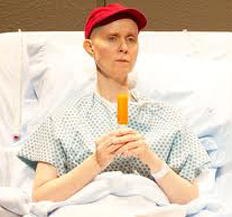
Cynthia Nixon, playing the lead in the Broadway revival of Margaret Edson’s play, Wit, does a heroic job putting her own mark against Kathleen Chalfant’s signature performance as the dying Vivian Bearing, the professor and scholar who meets the only fight she can’t win in her struggle with ovarian cancer.

In fact, by the time her cancer is diagnosed, Prof. Bearing is as good as dead.  At stage four, the cancer is already metastasizing and her treatment will mostly benefit science rather than herself.  But in perhaps her one selfless choice, according to a script that finds its heroine mostly distasteful, Vivian signs up to undergo a rigorous eight-month treatment that doesn’t save her body, but in most ways saves her soul.

Bearing is hardly a sympathetic character.  By acquiescing to be the subject of research instead of a researcher herself, she learns that there’s more to life than finding new knowledge.  The long hospital stay that ends her life is her last lesson in how to have the relationships that she regularly denied herself, devoting her time to the obscure and difficult sonnets of John Donne instead.

Edson’s play, which won the 1999 Pulitzer Prize for Drama, wants to have it both ways.  It indicts a medical establishment that sacrifices the humanity of its patients to its quest for their cure, but at same time indicts its patient, who’s devoted her own life to a similar kind of exacting and dehumanizing (at least in Edson’s version) research.

Chalfant played this sacrificial character with a dignity and nuance that made her a truly tragic figure.  Vivian learns too late in her life that she can relate to people instead of just teaching them, and that human feelings are more ennobled by living them than by engaging them on the page.

Through direct address to the audience from her hospital bed, Vivian lays out the story of her life and her sudden illness, describing how her father rewarded her zeal for reading, and how her own intellectually significant female professor inspired her to ever better research and writing.  Her tone is mordant and a bit self-deprecating, as though she’s embarrassed to think back on her trajectory from its sorry end.

In the right hands, Vivian can be an engaging and self-aware narrator of her life’s excesses and can suggest that hers are just a different variation on those we all suffer.  But as directed for laughs by Lynne Meadow, Nixon’s Vivian is a bit strident, her humor too forced and ironic, until the morphine finally calms her down toward the play’s end.  She finds her humanity just as the medical establishment reaches the epitome of its objectification of her body.  But Vivian is such an unlikable character until then that it’s hard to see her story as anything but a joke at the expense of a smart woman who’s happily chosen to devote her life to her work, however esoteric.

Nixon is a smart performer, and emotionally enough in tune with the role that she does strike nice chords of sympathy with Prof. Bearing.  And clearly the cancer narrative appeals to her.  At a moment when so many women (including Nixon, who’s a survivor) are diagnosed with breast, ovarian, and other cancers, a play that addresses their situation with the frankness of Wit is very welcome on Broadway.

It’s just too bad that Edson asks us to think only about how little agency women have in their own medical care.  That, perhaps, marks her play’s age—witness the recent uproar over the lack of women testifying before Congress about their proposed legislation on women’s reproductive health, which might indicate how fed up women have become with just the kind of objectification and powerlessness that Edson’s play indicts.  But a play that also allows audiences to laugh at the righteous pursuit of a life of the mind that Vivian Bearing’s career represents compromises its otherwise feminist intent.

In this Broadway revival, Suzanne Bertishbrings terrific verve to her role as Vivian’s inspiring professor.  She relishes the knowledge she imparts to her pupil, and then demonstrates utmost compassion when she finds Vivian again at the end of her life.  When she crawls into Vivian’s hospital bed to read to her former star student, the moment is wrenching, not just because all she has at hand to read aloud is a children’s book she recently shared with her grandson, but because she loves and respects Vivian for who she is.

The professor’s compassion at the end bears no moral judgment, which is so palpable in the rest of the play.  She brings only a clear love and felt presence that finally ushers Vivian out of her life and into a kind of peace.

This production ends as the original did, with Vivian’s resurrection of sorts after the death that finally, supposedly, frees her from physical and spiritual pain.  Downstage right, Nixon unfolds from an embryonic ball of limbs and flesh into a triumphal, extended human “V,” naked and, I suppose, liberated.

The moment is a bit too stark for my taste and too symbolic of the empty freedom that Vivian’s release into what Donne called the “pause” that is death brings.  She holds her arms above her head in a peculiar, Pyrrhic victory.  But her naked body seems also to signal how she sacrificed her physical desire for her intellectual ambitions.  It’s the wrong kind of triumph to celebrate, and leaves the play rather hollow at the end.

Nonetheless, it’s good to see Nixon claiming Broadway real estate to perform a serious play written by a woman.  Edson never wrote another play after Wit, and still insists she has no intention of returning to the form.  She continues to teach at an elementary school in Atlanta; Witwas the one dramatic story she wanted to tell.

Given new oncology protocols, the play feels dated, though its critique of medicine’s essential inhumanity remains sadly relevant.  Its portrait of a female professor as brittle and emotionally stunted still smarts.

When do we get to see a story about a smart, talented woman intellectual who’s not punished by a fatal disease?  These stories have been tiresome since Wit was first produced in New York in the ‘90s.

I’m always glad when work by and starring talented women is visible in public forums, but how I wish we could hear stories that celebrate instead of implicitly denigrate their accomplishments, and that let them thrive instead of fade.

The Feminist Spectator

Wit, on Broadway through March 17th.

Link to original post on Blogspot.

The Oscars, 2012

What’s a feminist spectator to make of an awards show that honors films that have so little to do with women behind the camera or as central to their stories?  Other writers have detailed the appalling lack of women nominated for Best Director this year, after Kathryn Bigelow’s historic win for The Hurt Locker in 2011.  God forbid a pattern should emerge of even nominating, let alone awarding, work by women directors.  In my alternate reality version of the Oscars, Dee Rees (Pariah) and Maryam Keshavarz (Circumstance) would both be on that list.

Instead, Academy voters nominated nine films for Best Picture, only one of which has anything remotely to do with women.  And that’s The Help, a movie whose racial politics are so compromised that it’s difficult to applaud its nomination, though its actors were uniformly excellent.

Frankly, Viola Davis was robbed by her friend Meryl Streep, who won her third Oscar for Best Actress.  That Streep should win for playing Maggie Thatcher as some sort of pseudo-feminist heroine, instead of Davis winning for bringing dignity and empathy to Aibileen, an entirely oppressed African American maid working in the heart of the pre-Civil Rights racist South . . . that’s just cruel and unusual.

Streep was right when she anticipated that people watching Sunday’s telecast would say, “Aw, no!  Not her again!”  But when she won a Golden Globe for her role this year, Streep named her fellow nominees with admiration.  She even mentioned actresses whose glorious work wasn’t nominated (including Pariah’s Adepero Oduye).

Instead of repeating that generous gesture at the Oscars, Streep smugly brushed off imagined objections to her win and didn’t even nod at the pack of excellent actresses she bested for the award.  She did embrace Davis on her way to the podium, but some more sincere public recognition of her steal would have gone a long way.  Even her pithy and earnest speech about the importance of friendship was too oblique to acknowledge the surprise of her win over Davis.  When will Davis, even with her talent and stature in the industry, again be cast in an Oscar-worthy role?  We can only hope soon.

Also robbed last night were Annie Mumolo and Kristin Wiig, whose biting, knowing, hysterical screenplay for Bridesmaids deserved recognition.  Sure, Midnight in Paris, which did win, was clever and even heart-felt for the typically more cynical Woody Allen.  But how predictable for him to write still another movie about a younger version of his anxious and conflicted self.  And how predictable for the Academy to acknowledge him again (even though he never attends the show, nominated or not).

When have we ever seen characters like those Mumolo and Wiig wrote for their comrades inBridesmaids?  When have we seen a woman conflicted about losing her best friend to the bridal industry and social prerogatives of marriage?  When have we seen a story about women so invested in being “the best friend” that they practically fist-fight to speak into a microphone at an engagement party?  When have we seen a stocky, pearl-and-bowling-shirt wearing woman seduce a man pretending he’s not an air marshal on a plane?  Or seen women getting sick every which way in the bathroom of a bridal shop?  So much of Bridesmaids was refreshing because it was told from a smart, talented, desiring, and ambivalent woman’s point of view.  Why wasn’t that story honored by the Academy?

Perhaps because it turns out that most Academy voters are white men whose median age is 62.  A recent Los Angeles Times study found that 94% of voters are white and 77% are male.   Of course that crowd will nod instead to Woody Allen.  Of course they’ll honor other stories about boys and men, like Hugo (however sweet), Extremely Loud and Incredibly Close (however sad), War Horse(however wrenching), The Artist (however quiet), Moneyball (however smart), The Descendants(however noble), and Tree of Life (however oblique).  Even in the Oscar show’s montage curated to demonstrate how much we love the movies, all the clips showed either heterosexual love scenes or men racing to get themselves out of trouble.

The only girls or women in evidence outside of those embracing men in the montage were Linda Blair, layered in her extreme exorcism make-up, and Meg Ryan, doing her extremely fake public orgasm in When Harry Met Sally (a rather self-serving scene for host Billy Crystal).  This, then, is how we love women in the movies?  Only if they’re in love with men, possessed by demons or by sex, or completely absent?  Please.

I liked the interstitial interviews with actors and filmmakers on the Oscar show, in which they described when they began to love the movies.  But only Reese Witherspoon seemed to get any screen time there, among a host of men telling anecdotes.  At least a few women got to speak to their work during the production clips, for which short quotes from interviews with nominated artists played alongside images from their films.  Those moments brought dignity and respect to the profession, in stark contrast to the ubiquitous, mindless prattle between presenters who can only seem vacuous in that context, regardless of their intelligence.

(But even those short clips elide the fact of women’s lack of advancement in the film industry.  Martha Lauzen’s recent study about women and the “celluloid ceiling” reports the dismal percentages of women producers, editors, and cinematographers working on the top 250 films of the year.)

The Christopher Guest crew’s funny spoof about focus groups, in which the assembled tweaked The Wizard of Oz out of its Dorothy, offered the best writing (and some of the best performances) of the Oscar show evening.  The standing ovation for Octavia Spencer, winning for her performance asThe Help’s stalwart Minnie, was moving, but I wish she’d won for better material than the stereotypically sassy maid who’s redeemed by the socially mobile white woman who tells her story.

Watching Beginners’ Christopher Plummer accept his award for his fine performance as a gay man coming out late in his life was heart-warming.  But his win for playing gay didn’t make up for the fact that no one awarded this year thanked same-sex partners or referred in any way to queer lives.  Along with women, LGBT folks were invisible in the show (unless you count the vaguely homoerotic flying men in suits in Cirque du Soleil’s strangely out-of-place spectacle).

I’m glad The Separation was the first Iranian movie ever to win a Best Foreign Film award.  But the film’s wife/mother in the story is demonized for wanting a better life for her daughter, and for precipitating another woman’s tragedy by “abandoning” her own family.

What kind of message do these awards send about women?

Finally, here’s Billy Crystal, trotted back out to host the show for the ninth time.  How self-congratulatory of him to structure his entire opening monologue about whether or not he should accept the invitation to host?  His shtick all evening seemed to me like Jewish minstrelsy.  We won’t even mention his blackface routine as Sammy Davis Jr. alongside Justin Bieber in that silly, manufactured scene from Midnight in Paris.  Crystal shrugged his shoulders like a low-rent Bob Hope and tried to raise eyebrows that looked paralyzed by Botox.  Crystal seemed a parody of himself, a canned, predictable, self-immolating copy of the quick-witted, genial host of shows past.

I’ll just keep hoping that next year, things will change.  Maybe Tina Fey and Kristin Wiig will write and host the show.  Or maybe they’ll write and Viola Davis and Octavia Spencer will host.  Or maybe Janet McTeer and Glenn Close will do the honors, dressed in matching tuxes.

And maybe the nominated material will be rich examinations of the lives of women, people of color, and LGBT people, as well as straight, white, male people.  Wouldn’t it be nice to hear and see stories that say something we haven’t heard before?

Eternally optimistic,
The Feminist Spectator

Link to original post on Blogspot.

Queer Dance at U of Michigan

I was in Ann Arbor last weekend for the first-ever conference on queer dance, co-organized by Clare Croft (whose dissertation I was pleased to advise at the University of Texas at Austin) and University of Michigan dance professor Peter Sparling.  Two days of panel discussions, workshops, and film screenings were capped each evening by a program of performances that showcased some of the most interesting work in the field, and that read back nicely over the days’ discussions about how we define, study, and create queer dance.

Presented in the Betty Pease Studio Theatre at the University of Michigan (whose Department of Dance and an impressive number of other campus units hosted and sponsored this landmark event), the performances offered a fascinating mélange of bodies in motion, choreographed abstractly or in snippets of narrative scenarios brushed with wit, beauty, and grace.

Diverse across gender, race, ethnicity, and the performatives of sexuality, both performance evenings played with the known tropes of queerness, referencing the familiar without being predictable.  For instance, the drag duet called “TheCherdonna and Lou Show,” performing out out there (A Whole Night Lost), might have reminded spectators of drag queen and drag king performances, since the two performers were costumed and made-up in the over-emphasized gender accoutrements of out-sized masculinity and femininity.

But that both performers were women and that their duet was funny and entirely unexpected, lent the act a freshness and surprise that made it memorable.  “Cherdonna,” the femme (I guess you would call her), towers high above “Lou,” the “butch,” whose slight form is nevertheless appealing, with her drawn-on beard and moustache, her bowler hat, and her plaid suit.  Cherdonna wears a pleated white dress, high heels, and an even higher bouffant hairdo that poufs memorably over her head while she dances.

Both performers’ faces are made-up in the clown-like lipstick, eye-shadow, and colorings reminiscent of the late Ethyl Eichelberger or Taylor Mac, a kind of Godspell-esque presentation of outré gender that’s both funny and queer in this context.  The dance shows the duo as a couple whose affection alternates with rage and who finally pull (obviously fake) knives on one another, stabbing their partner and themselves in rhythm to light-hearted music danced with whimsical steps.  The piece is a hysterical, warm commentary on relationships and Cherdonna and Lou’s bodies and movement styles muddle anything we might presume as binary gender.

In her conference welcome speech, Croft situated the panels and the performances in both a personal and critical lexicon that refracted usefully across the two days.  She shared an anecdote about the first time she was ever called “queer,” which was in a dance class when she was eight years old.  A little friend turned to Clare with haughty antipathy and called her the name.  Croft said she thought for a moment, and then told her friend that if “queer” meant “strange,” she stood guilty as charged, proudly claiming her difference without at that point needing to carry what later became its sexual baggage.

The sweet and funny story linking queerness to a profitable strangeness echoed throughout the conference, in Cherdonna and Lou’s odd couple and in other equally generative performances of unaligned, cock-eyed, off-kilter gender and scenarios of sexual desire which, by accumulation, demonstrated “strange” as a really useful way of thinking about embodied queerness.

In her too-short discussion with the performers after the final evening’s presentations, Croft also noted that what distinguished much of the dance we saw together was that the performers looked back at the audience, an invitation to intersubjectivity that might in itself be particularly queer.

In fact, the conference’s first panel, “Queer Nations/Queer Boundaries,” included papers by Ramón Rivera-Servera (Northwestern) on dance floor gossip in queer Latino/a clubs; by Nic Gareiss (University of Limerick) on being a queer performer in traditional Irish dance; and by Sara Wolf (UCLA) on artist damali ayo’s performance of a public claim for race reparations.  All three papers teased out the specific queerness of public intimacy.

Gareiss described how the popular Irish dance form (marketed especially to tourists) interdicts the exchange of queer gazes by insisting that the male dancers look either at their female partners or out at the audience but never at one another.  Gareiss demonstrated his queer resistance to these constraints, showing a clip of him dancing solo, accompanied by a male Irish fiddler, in which he seemed to be performing the step dance directly for his musical accompanist.  The personal yet public performance exchange rewrote the more frontal and certainly more heterosexual conventions of the dance.

Likewise, Rivera-Servera’s ethnography described what he called queer world-making through gossip on the dance floor.  He suggested that gossip creates a profitable friction around what can be a too homogeneous notion of latinidad.  He quoted informants who watched and critiqued sotto voce one another’s dancing from the sidelines, pointing out the differences in styles across the ethnic diversity inherent in a pan-Latino community.  Gossip about movement, Rivera-Servera proposed, nuances what might look like a shared politic.

This public intimacy and useful parsing of queer differences seemed very much evident in the performances as well as in the papers.  Jennifer Monson and DDDorvillier presented RMW(a) & RMW, a piece they first performed together in 1993, revived in 2004, and have presented once a year or so since.

In the first half of the two-part dance, they wear wigs and make-up reminiscent of Cherdonna and Lou’s, the drag-like/clown-like, exaggerated eye-makeup and inked outlines that signal overt gender performance and that point in a Butlerian sort of way to gender as a surface rather than a depth.

Monson wears a black and white, short print dress and blond wig, while Dorvillier cavorts in an oversized lime green shirt and pink gym shorts, wearing a curly black wig.  The two women dance in parallel, taking turns performing more angular and abstracted movement while the other sets a timer and then watches her partner dance.

As Rivera-Servera pointed out to me later, the scene is vaguely cruise-y, as it seems like they’re purposefully performing for one another.  It’s certainly seductive; one of the performance’s pleasures was how keenly Monson and Dorvillier watched one another.  It occurred to me that we rarely see lesbians looking at one another in representation.  How pleasurable it is for queer spectators to witness that gaze exchanged.

The two switch places by mirroring one another’s last gesture as they then take over the solo.  With their increasingly rigorous movement, their wigs fall off and are kicked aside.  As this first part ends, Monson and Dorvillier lie on the ground with their costumes pulled up toward their chins, their bare torsos and buttocks making funny sucking sounds against the dance floor as the lights fade out.

When the second part begins, the pair appear dressed in matching white t-shirts and rolled-cuffed jeans and jackets that soon come off.  They proceed to dance one of the most erotic, athletic duets I’ve ever seen two women perform.  They rarely (if ever) lose contact during the piece’s second half, climbing over and across and around one another’s bodies in a tangle of limbs and muscles and desire that was thrilling to watch.

In one glorious moment, Dorvillier climbs up Monson’s legs and torso and stands on Monson’s flat back, balancing precariously but somehow surely.  This second half builds to a wonderful deep kiss, and then Monson and Dorvillier literally lock lips, remaining attached at the face in this extended erotic contact as they keep moving their bodies around and about and over and under one another.

Part of what was moving and lovely about this piece, in addition to its frank woman-on-woman sexuality, was that the two dancers are squarely middle-aged.  Breathlessly watching them perform such virtuosic athleticism felt like an affirmation of persistent lesbian desire.

By “persistent,” I mean continuing over time—that is, knowing that Monson and Dorvillier have performed the piece for almost 20 years demonstrated that time can be a medium in which a relationship like this—physical, affective, aesthetic—can grow, change, and continue with a queer sort of commitment.  Such persistence, and such lesbian/queer relationships, are too often disappeared (and I mean that as an active verb) in live performance and representation.

In fact, Hannah Schwadron (UC-Riverside) gave a wonderful paper about the Darren Aronofsky film Black Swan earlier that day in which she argued that it refers to lesbian sexuality only to deny it, just as the film also “disappears” Jewishness through the conventions of white-encoded ballet (and the Anglicized names of its stars:  Natalie Portman, née Hershlag; Mila Kunis, born Milena Markovna Kunis; and Barbara Hershey, born Barbara Herzstein).

Given how often especially middle-aged lesbians are forced into invisibility in mainstream and even queer representation, watching Monson and Dorvillier so palpably, frankly, and beautifully create, explore, and perpetuate a queer desire felt exciting, as well as deeply political.

Other performances were equally provocative and generative.  Remnant Hit/fix, by performer/choreographer Amy Chavasse, set more quotidian movements to various texts and songs, as Chavasse addressed the audience with a frank and ingenuous tone.  She seemed to talk personally, but as in many of these pieces, the status of “autobiography” was difficult (and somehow unnecessary, finally) to ascertain.  To finish the piece, Chavasse selected a woman out of the audience to sit on a stool across from her and listen to Chavasse’s final monologue.  Again, the public intimacy was moving and compelling to watch.

Cositas, choreographed by Joel Valentin-Martínez, presented dancer Javier Marchán-Ramos in a tight-fitting red satin ball-gown with a corset-like closure laced up both his chest and his back.  He entered from downstage right, and slowly crossed upstage left, trailing the exceeding long train of his dress behind him.  Part of the simple dance’s allure was the suspense over how long his train would actually be; the end didn’t appear until Marchán-Ramos was practically on the other side of the stage.

In addition, because of the dress, the corset, his carefully coifed dark hair, and his rather coy gaze, Marchán-Ramos’s gender read as ambiguous and mysterious.  He’d glance over his shoulder at spectators as he crossed the stage, but it wasn’t until the piece’s second part, when he gathered the dress in his arms and performed more athletic movements, did a more familiar performance of masculinity emerge.  The performance seemed to glow and practically shimmer with the richness and clarity of its images.

In her solo Walking the Line, excerpted from her longer piece SILO/SOLO, choreographer/videographer/performer Andee Scott accomplished one simple, enormously provocative movement.  Naked from the waist down, Scott slowly moved from center stage to downstage center, walking out of the stage’s darkness into the light of a projector that made her bare torso, chest, and neck into a projection screen.  The moving image reflected in sharp, bright light and vivid color showed Scott wearing a full white dress, dancing alone in a rural landscape between two low hills.

Although the projected image extended only from one side of her body to the other, the vibrant scene seemed full of freedom and light.  Watching Scott’s video play across her chest and collarbones made for a very vulnerable, tender moment of performance.  Rather than narcissism, which could be expected from a dancer projecting herself onto herself, the image conjured the sublime liberty of solitude, of nature, and of self-expression.

Watching Scott use her skin, unfettered by modesty or convention, reminded me of Peggy Shawperforming To My Chagrin, in which she projects a video of her then-small grandson, Ian, playing by himself, across her bare breasts.  As in Shaw’s piece, Scott’s represented not just intimacy butheart, love, and closeness that seemed wonderfully generative and physically and emotionally generous.  That Scott stood quite still and half naked in the moment of performance, and used her body to represent a moment of past or prior movement, also seemed to queer her dance.

Nudity appeared fairly frequently in these performances.  The first evening began with dancer/choreographer Gina Kohler’s dream [factories].  Kohler was pre-set in the Pease Studio, sitting naked on a drop cloth center stage, methodically pouring beet juice meant to represent (I assume) blood over her white body.

As she emptied the deep red liquid from jars over her head and across her limbs, Kohler slid her body across a shiny, slippery piece of Mylar or something that she’d placed in the middle of the cloth.  The red liquid pooled around her as it ran off her skin, leaving rivulets of red across her face, torso, arms, and legs.  As Madonna’s “Like a Prayer” played, Kohler spun around on her back, flipped to her stomach, looked out at the audience, and twirled some more before she finally stood up.

The performance reminded me of Carolee Schneemann’s Interior Scroll.  Although Kohler didn’t pull a text out of her vagina, as Schneemann did in the ‘70s, the evocation of blood beckoned to the same kind of insistence on the difference of the female body that Schneemann performed in the 70s.  Here, Kohler was joined on stage by another female performer, dressed in briefs and a bra in a bathing suit sort of costume, covered with gold paint and glitter and wearing a unicorn on her forehead that she caressed and pointed with throughout the piece.

Although the second dancer (Sara Procopio) never directly interacted with Kohler, she represented an onstage spectator for Kohler’s bodily acts, directing and refracting our gaze.  A male collaborator (Eric Kohler) trained a video camera on Gina Kohler throughout this first part of the piece, projecting a live feed onto a screen upstage that focused on her face or body parts as she moved.  His filming also seemed to both direct and to interrupt our gaze, yet rather than representing “male” power over Kohler’s female body, his camera seemed to offer just another way for us to look at it.

In the second of the three-part piece, Kohler strapped on a harness and transparent acrylic dildo and danced to Leonard Cohen’s “I am Your Man.”  The movement here was both more every day and more frontal, and necessarily more symbolic and abstract.  Seeing a naked woman dancing with a dildo on, regardless of what it’s supposed to mean, is pretty powerful in performance and forestalled whatever claims of female essentialism might have been evoked by the blood and beet juice scene.

In the third part, Kohler executed jumping jacks non-stop while Cohen’s “The Future” played.  For the length of the song, she faced the audience and scissored her arms and legs together and apart while the unicorn-wearing dancer watched.  The endurance test left her breathless.

Although dream [factories] didn’t necessarily cohere (these three moments were extracted from a longer piece), each individual image was arresting.  Kohler’s matter-of-fact stage persona undercut the sensationalism of her nakedness and of the dildo.  She looked out at the audience throughout, engaging us with a kind of butch dare.

Because she wasn’t wearing clothes, I wondered how she performs her gender off stage, since so many of our cues for reading gender are determined by sartorial choices and the movement styles they dictate.  But throughout the piece, her gaze back at spectators read to me as butch, which worked in a productive tension with her naked female body.

Nakedness and gender and sexuality conjoined in Kohler’s dream [factories], in Monson and Dorvillier’s RMW, and in ThomasDeFrantz’s collaborative performance, Theory-ography 4:  We Queer Here!  Generated with a group of six local Michigan students and DeFrantz’s own students,Theory-ography was the most text-based and post-modern of the performances.

The performers collected index cards from spectators before the piece began, on which they invited the audience to write an instruction or a description that the dancers were later asked to embody. Early in the piece, DeFrantz read out a card that commanded, “Disrobe.”  Most of the performers stripped off a layer.  When DeFrantz again commanded “disrobe,” James Morrow, the one man in the performance, went all the way.  His nakedness was disarming and charming.

The dance here was improvisational and angular, much of it rooted into the floor in emphatic and erratic movements for which the performers hurried across the stage or threw themselves onto the ground.  Watching Morrow’s penis flopping happily against his stomach, and watching him seem to feel liberated rather than embarrassed by his nakedness, was quite lovely.  His naked presence also echoed Kohler dancing while wearing the harness and dildo from the evening before, and commented profitably on the construction of sex.

The woman of color performing in Theory-ography stripped down to her underwear when DeFrantz announced the instruction to disrobe, revealing that her breasts were bound and that she was wearing black “men’s” jockey shorts.

That they did take off their clothes proved these two performers, in particular, generous and acquiescent, but somehow also full of agency.  They inhabited a physical sexual difference with élan, once again unruffled by the audience’s gaze.  These performers gazing back, or inviting what performance theorist Dwight Conquergood called “co-presence” with spectators, felt rather happy and comfortable.

Theory-ography was one of the more cerebral performances at the conference, but these two gender/sexuality representations warmed what might have otherwise been a playful but “cool” piece.  José Muñoz’stext about queer utopia didn’t sound particularly illuminating as the performers took turns reading from his book into a microphone.  But as they called out “Queer me” to signal they were ready to switch narrators, passing the text among the performers made it multivocal in interesting ways, and the fact of reading it, in itself, seemed generative.

Likewise, that one of the performers always trained a video camera with a live feed on the proceedings made the piece a multi-layered experience.  And the text projected over the feed—such as “where is queer,” “queer is here,” and other verbal interrogatories and assertions—offered another level of wondering that made the performance fun and self-reflexive.

Perhaps because the conference attendees were also for the most part participants (since most people presented papers or performed) and perhaps because we saw two nights of performances after two days of panels, workshops, and screenings, the audience for these pieces felt like a community of sorts, however “imagined.”

Watching performers whose nakedness seemed matter-of-fact and comfortable; whose virtuosity, regardless of age or ability, seemed admirable; whose queerness (or not, since finally, who can tell just by looking at someone moving?) seemed multiple and fluid; the richness of these experiences created a temporary public of people buoyed by witnessing, creating, and thinking about queer dance.  I appreciated every moment.

The Feminist Spectator

Link to original post on Blogspot.
Smash

With only two episodes aired, it’s difficult to say where exactly Smash, the new NBC series about backstage Broadway lives, will take us.  Executive produced and so far written by playwright Theresa Rebeck, the show responds to Fox’s Glee by embedding lavish musical numbers in its story of a lyricist-songwriting team creating a Broadway show about Marilyn Monroe.  The plot line so far addresses the intrigue that surrounds producing, casting, and directing such a behemoth.

Of course, the whole thing is an elaborate fantasy.  First, Angelica Huston (whose once expressive face is now, sadly, barely mobile) plays Eileen, the sole producer of the new musical.  In reality, Broadway shows are littered with people whose financial investments, if nothing else, give them above-the-title producing credit.

Second, Rebeck’s script for Smash has streamlined the process so that in just two episodes, the dynamic music-and-lyrics duo Julia (Debra Messing) and Tom (Christian Borle) have moved from the glimmer of an idea into staffing and casting the show.  In real life, a project like this would be workshopped for years and involve a zillion people before it arrived at the point where Smash picks up.

But here, by the second episode, Eileen has encouraged the director, Derek (written as a sexy sleaze and played by the British actor Jack Davenport, late of FlashForward), to do a quick workshop production and then get the show on Broadway’s boards.  Would that it were all so easy!

The musical’s partners are played with verve and somehow, believability, by Messing (cast as Rebeck’s doppelganger) and Borle (who last season played a superb Prior in Angels in America at the Signature Theatre Off Broadway).  So far, Borle has little to do as Tom but basically play out-and-proud gay.  He flirts with his impossibly cute but untrustworthy assistant, Ellis (Jaime Cepero), and lobbies for his friend, Ivy Lynn (Megan Hilty), to get the lead in his show.

The show’s conflict comes from the competition it manufactures between its would-be Marilyns, two talented young women with very different looks and takes on the iconic star.  Hilty (Wicked and 9 to 5), a bona fide Broadway performer both in actuality and in character as Ivy, represents the body-type.  She’s blond, buxom, and can belt with the best of them.

Former American Idol star Katharine McPhee plays Karen Cartwright, an untested young woman from Iowa (of course), whose brown hair and slight build make her less recognizable, at first, as the curvy, breathless 50s personality who seduced Joe DiMaggio, Arthur Miller, and President Kennedy.  But in the show’s intercut fantasy sequences, dolled up in the right costume, wig, and make-up, Karen passes for Marilyn very well indeed.

The first two episodes have careened along on the suspense of who Derek would cast as the musical’s lead. He summons both young women for private meetings, calling Karen late at night and requiring that she come to his (mouthwateringly lavish) apartment for a private audition. In the first episode’s most unlikely scenario, she goes, and somehow maintains the upper-hand in a situation clearly constructed for sex.

Derek tells her he needs to “see everything,” and she changes in his bathroom into a large, white, man’s shirt, then performs the equivalent of a private lap dance and signature Monroe-style song. At its end, she tells Derek that’s all he’s getting, and leaves his apartment unscathed (though it’s unclear whether he respects her for her fortitude or loathes her. He must ultimately respect her, because he calls her back and lets her continue the audition in public).

Hilty’s character, Ivy, is less reticent when Derek makes his moves.  They’re working alone in a rehearsal hall when he asks if he can let down her hair (literally) and then frames her blond locks around her face meaningfully.  The next scene shows them rollicking naked in bed together.

All this reaffirms the stereotype of the Broadway (and Hollywood) casting couch, the mythic place where powerful men have sex with desirable and desiring young women to authorize and launch their careers.  Because Karen has a boyfriend, Dev (Raza Jaffrey, who plays a functionary at the mayor’s office), and because she’s rejected Derek’s advances, she’s portrayed as the ethical, fresh-faced, unspoiled young thing from the flyover states.

Ivy, on the other hand, is already performing in a Broadway show.  Her friends are gypsies, the corps of performers who sing and dance in musicals and make their living as unknown but employed and talented company members.  Many of the men are gay, and in Smash, that stereotype holds fast.  One of Ivy’s friends is hired to dance in the Marilyn musical’s rehearsals, and passes information on to Ivy about Karen, her competitor.  Since Ivy is already part of Broadway culture, she’s portrayed as wiser to the ways of the world and more willing to play what Rebeck describes as the professional theatre’s necessary games.

Subplots abound here, all meant to humanize Julia, the Messing character, who is the show’s lead.  Julia and her husband, Frank (Brian d’Arcy James), live in a comfortable brownstone with a huge kitchen, huge bedrooms, and a huge patio or porch off its dining room, its real estate representing another of the show’s fantasy aspects.  He stays home to supervise the household and their teen-aged son.  Julia is the family breadwinner, although in the pilot, she’s supposed to be taking a break from her professional work to concentrate on her family’s child adoption process.

Frank’s disappointment in her decision to develop yet another musical instead of being available for the social workers and other bureaucrats who fill the U.S.-China adoption pipeline establishes another plot conflict that will no doubt play out this season.  Julia balances on the precarious edge between being a good artist and a good wife/mother and Smash tries not to judge her for putting her work first.

But by the second episode, the balance shifts, as Julia reveals her deep emotional commitment to the adoption and Frank wavers, admitting he wants to go back to work as a science teacher and that he’s afraid he’s too old for a new baby.  Watching how this dilemma plays out along or against typical gender expectations should be interesting.

Smash is fun television, and the musical numbers, which so far represent more of a tease than the series’ meat, are energetically choreographed and beautifully performed.  Smash has an impressive pedigree; it’s produced by Steven Spielberg in conjunction with a number of Broadway notables, directed by the very talented Michael Mayer, and cast with some of the best actors in New York.

Rebeck, the series’ show-runner, is one of the few successful women playwrights who, like Wendy Wasserstein before her, can open a play directly on Broadway.  Her most recent hit, Seminar, which stars Alan Rickman (though Jeff Goldblum has just been announced as his replacement) and Lily Rabe, is a funny, smart play about a creative writing workshop lead by a preemptory, haughty snob.  Rebeck’s ear for dialogue and witty repartee and her talent for slick plotting is unparalleled in the contemporary American theatre.

And Rebeck’s commitment to women playwrights is well-established.  Her keynote for the 2010 Laura Pels Awards excoriated powerful theatre producers and critics for their gender bias and demanded action.  She’s been an outspoken, visible, and powerful advocate.

Sometimes, though, Smash tells stories in which its women are maligned without necessarily critiquing how they’re forced to compromise.  The first two episodes turn on the caricature of the mean-spirited but talented, wicked but sexy straight male director who tests his female stars in the sack as well as on the stage.  The story line forces Karen and Ivy to compete for his attention sexually as well as professionally.  That might be how Broadway business is conducted, but ifSmash is a fantasy anyway, why not imagine a different kind of theatre world?

I’ve only seen two episodes so it could be entirely too soon to tell where the story of Smash will take its characters and its audience.  It’s fun to watch a television show that’s actually about theatre, instead of one like Glee in which the musical numbers are justified by the high school club setting.  And it’s fun to see the gay subculture of Broadway represented so nonchalantly.

The song-and-dance numbers (choreographed by Joshua Bergasse) so far are energetically performed and filmed with high style and verve.  And it’s wonderful to see Rebeck’s name splashed across the credits so prominently.

I’ll stick with Smash, because it’s significant and important that Rebeck is a woman carrying a high profile, big-budget series.  And I’ll keep believing that the women characters will get more complicated and the show’s story lines more nuanced.  Then the show really will be a smash.

The Feminist Spectator

Link to original post on Blogspot.