Yearly Archives: 2011

John Gabriel Borkman

This production, by Dublin’s Abbey Theatre, of one of Ibsen’s last plays, is beautiful from top to bottom, but the set and the performances far outweigh the text itself. The play is a pot-boiler that touches on most of Ibsen’s major themes without offering any new insights into his well-established views on bourgeois corruption and stultification. Because the Abbey’s production doesn’t reimagine the text—in what the program calls a “literal translation” by Charlotte Barslund, although the credits indicate Frank McGuinness provided this “new version”—the play seems an anachronistic chestnut, even as the lead performances by Fiona Shaw, Alan Rickman, and Lindsay Duncan make it a vivid, compelling evening of theatre.

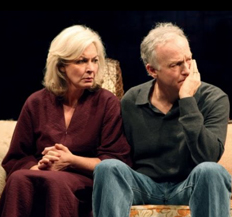
The title character (Rickman) is a bank manager of raving ambition, who was caught embezzling and sent to jail for five years. As the play opens, he’s eight years into his subsequent freedom, but has traded his prison cell for a domestic incarceration that’s in some ways even worse. He and his wife, Gunhild (Shaw), occupy separate floors of the family home. Borkman’s incessant pacing across his study floor above her drawing room drives Gunhild mad, and her fury with her husband for sullying their family’s name keeps her stewing in her own resentments and regret.

Gunhild pins her hopes for a resurrected social standing on her son, Erhart (Marty Rea), a flighty young man who can’t bear the weight of his mother’s mission. Erhart is in love with the wealthy divorcée, Mrs. Fanny Wilton (Cathy Belton), who plans to spirit him away from his family’s estate for her own amusement. Into an already fraught domestic scene “descends” (as the others describe her unexpected and undesired arrival) Ella Rentheim (Duncan), Gunhild’s twin sister and Borkman’s once lover, whose own wealth has saved the family from certain ruin during and after Borkman’s imprisonment.

Ella arrives with her own designs on Erhart, whom she looked after during Borkman’s trial and conviction, when Gunhild was in no shape to be the smothering mother she’s now become. For her own apparently good reasons, Ella wants Erhart to live with her again, and to take her name, so that the Rentheim line won’t die out at her own (imminent) demise.

Ibsen’s creaky plot grinds into gear, laying the seeds of its ultimate, unsurprising conclusion.Characters reveal few secrets to overturn the audience’s expectations and little suspense propels the plot. Borkman’s characters confront one another, digging deep into the psychology of their immorality and enmity. But ultimately, they don’t tell us anything we don’t already know or can’t surmise, given the genre and the author.

The actors play Ibsen’s histrionics admirably, and director James Macdonald keeps them all on the same heightened plane. Shaw modulates Gunhild’s resentful fluttering with moments of real strength, when the actor’s comic physicality almost seems to comment on her character’s simpering. Duncan holds Ella erect with calculated effort, carefully maintaining her superior façade. When Ella confronts Borkman in his study, we learn that he ended their relationship in a cold-hearted deal that won him his position. Ella accuses him of murdering love; he doesn’t disagree, but nor does he care.

The characters’ wanton, calculated inhumanity to one another makes it difficult to empathize with any of them. As if anticipating this response, Macdonald encourages the actors to play up the worst in these people, reassuring us that we don’t, in fact, have to like any of them. If they become a bit caricatured, as a result, the heightened style allows spectators to forget about a deeper emotional response and to simply enjoy the artifice of the plot and, especially, the setting.

Designer Tom Pye keeps the bare back walls of BAM’s Harvey Theatre in view (if in shadow), and director Macdonald calls our attention to the flies very high above the stage floor action. Because Gunhild and Ella continually look up, haunted by the persistent sound of Borkman’s footsteps as they ring above (thanks to Ian Dickinson’s terrific, ominous sound design), spectators are repeatedly encouraged to note the high black void into which they peer. The heaviness of that empty space—infrequently punctuated with lighting designed by Jean Kalman—bespeaks a hollow heaven to which no one can appeal for forgiveness or assistance.

The drawing room in which Gunhild and Ella stage their initial showdown (which, played by Shaw and Duncan, is probably the juiciest scene in the production), is set with furniture pieces that seem to float in undefined space. The interior scenes are surrounded on three sides by mounds of glistening white snow, which seems to sparkle off the polished, black stage floor. The cold outside encroaching inside is a fine analogy to the essentially frozen void in these characters hearts’.

The play’s penultimate scene takes place, in fact, outdoors, as Erhart and Mrs. Wilton escape by sleigh, and Borkman leaves the house to breathe fresh air for the first time in eight years. He refuses to return to his captivity, even as a fierce blizzard blows in to freeze him, Ella, and Gunhild. The stage-hands create a storm of blowing wind and snow that covers the stage floor and the actors’ costumes and rains down through most of the final scene. The spectacle is as heightened as the acting, but in many ways more subtle, beautiful, and effecting than any of evening’s dialogue.

Giving in to the story’s extremes makes John Gabriel Borkman most pleasurable. Ibsen starkly draws the characters’ struggles: Borkman’s raw ambition requires power, money, and influence, and he’ll sell his soul to achieve it; Gunhild requires social approbation, and will sell her son’s soul to get it back; Ella yearns for the love Borkman extended and withdrew, and will steal her nephew’s affections to retrieve it; and Erhart himself desires only the satisfaction of his own pleasure, provided by the willing and able, slightly older and more sophisticated Mrs. Wilton. Only Erhart gets what he wants, and in her exit speech, Mrs. Wilton suggests that even she understands their hedonistic arrangement won’t last forever.

The play ends with a rapprochement of sorts between the sisters, over the body of the man whose fortunes kept them separate for most of their lives. But Borkman isn’t one of Ibsen’s feminist plays.Shaw and Duncan play Gunhild and Ella with wily passion and strength. But women are regularly betrayed and belittled here, often with lines that provoke unintentional laughter from the audience.Presented with the spectacle of a grim, misogynist modern drama, unadorned and unredeemed by a good rethinking, laughter might be the best response.

The Feminist Spectator

John Gabriel Borkman, BAM’s Harvey Theatre, through February 6, 2011.

The How and the Why

Perhaps the most amazing aspect of Sarah Treem’s terrific new play, in a beautiful production directed by Emily Mann at the McCarter Theatre Center in Princeton, is that it’s a two-hander for women in which no one kills themselves. Performed with commitment, humor, and nuance by Mercedes Ruehl and Bess Rous, The How and the Why is actually a play of ideas.

Much of the dialogue addresses competing philosophies about the evolution of women’s reproductive systems. To hear two women scientists of two different generations, both clearly brilliant, parse out their concepts and compare notes on what it means to do research about womenas women is a distinct pleasure. My evening at McCarter reminded me how rarely women’s ideas, spoken by fully formed, complex female characters, are heard on stage.

To reveal that Rachel Hardeman (Rous) is the 28-year-old daughter that Zelda Kahn (Ruehl) gave up for adoption when Rachel was born isn’t to spoil a major plot point. Although their relationship is clarified gradually in the first few scenes, their mutual awkwardness quickly tips off the audience that this is the meeting of a daughter given up by the woman who gave birth to her.

Rachel, whose initiative prompted their meeting, displays a volatile mix of hostility and guarded curiosity, while Zelda tries to contain her excitement and interest in the young woman. But because she’s a scientist, Zelda approaches their first-ever conversation with efficient reasonableness, proposing that Rachel’s questions must fall into categories like the biological and the psychological, as well as the personal.

Rachel, however, has a more complicated agenda, and she isn’t easily maneuvered by Zelda’s power and authority. Although they meet on Zelda’s turf, in the spacious, wood-lined office of the university where she’s a distinguished evolutionary biology professor, Rachel’s ambitions keep her moving into and out of Zelda’s range, as the two women get to know one another by sparring over their work.

Zelda’s career was secured by a theory she calls the Grandmother Hypothesis, which suggests that women live longer than men because in primitive cultures, women were constantly pregnant, and could never have provided their growing young children enough nourishment without another adult woman caretaker (who wasn’t continuously pregnant) lending a hand.

Rachel’s nascent career depends on her own theory about women and reproduction, which proposes that women menstruate not to flush away the uterus’s unused reproductive apparatus each month but because male sperm is toxic and creates a bacterial environment that needs to be cleansed. (Both theories are, apparently, real; Treem, a lead writer for HBO’s In Treatment, mentions in the program notes that she discovered them in Natalie Angier’s book, Woman: An Intimate Geography.)

Although Rachel resents Zelda’s abandonment, she can’t help but envy the older woman’s access to the very circles of power that Rachel longs to join. When Zelda offers her an open spot at a major conference from which Rachel was initially rejected, Rachel jumps at the chance, but with one twisted condition that sets out the play’s major sub-theme. Her boyfriend, Dean, who’s also an evolutionary biologist, must present the paper with her, ostensibly because they share their research.

Rachel’s wrong-headed impulse becomes the occasion for Treem to explore two very different generations of women’s relationship to feminism and its capacity for describing and defining not just their professional but also their personal lives. Zelda has never married; her work, she insists, has been more than enough. Rachel sees this as a personal sacrifice she finds anathema. Her adoptive parents recently died, and Dean is the only person to whom she’s emotionally connected.

Even though the couple’s professional competition is lopsided—Rachel is clearly the more talented researcher, with a post-doc waiting when she graduates and an NIH award already in hand—Rachel thinks she should put Dean’s career first. Because they talk through their work together, she also thinks she owes him the shared conference spot. The idea drives Zelda wild, because from her perspective, Rachel’s choice makes her subservient to a man, deferring her own career options to bolster his.

To Treem’s credit, the opinions on both sides, throughout this very argumentative play, are thoroughly persuasive, so that the deck isn’t obviously stacked in either woman’s favor. Since I am closer to Zelda’s generation of white American feminists in their mid- to late-50s, her arguments sounded familiar and reasonable. And as someone who takes great pleasure in my own work, I could understand Zelda’s commitment to her hypothesis and her research. But I can imagine people aligning themselves in numerous ways with the arguments advanced by both women.

For instance, Rachel, on the other hand, archly suggests that a stellar career isn’t worth it if you’re alone in your life (something—I would submit—people rarely suggest is the case for men). She presumes that Zelda is lonely, but Zelda corrects her, and thankfully, again, Treem doesn’t fall into the clichéd trap of punishing Zelda for her own professional choices. In fact, Rachel envies Zelda’s example, since even though she’s not yet thirty, Rachel already feels she’s too old to be the wunderkind she wants to be. She longs to make her mark in the scientific community, and clearly sees Zelda as a professional role model.

But Rachel’s ambivalence, too, has weight and makes sense. When is dedication to your work too much, even when that work can have revolutionary consequences? How do we measure the success or failure of our lives, when we’re trying to reinvent them, and the possibilities for women, especially, to make new choices? The play is sympathetic to both women’s perspectives, and lets the audience carefully contemplate what might be gained or lost from our own viewpoints and investments.

Treem refuses to moralize against either character. Zelda, played with intensity and humor by the terrific Ruehl, is a firebrand, full of articulate ideas and helpful career advice for Rachel, which she delivers with the passion and generosity of a professor mentoring a promising young student. Ruehl persuades the audience, if not the obstinate Rachel, that Zelda has a very nice life, full of lovers (of both sexes, since, she notes, she could never resist experimenting) and travel and success.

Zelda is the kind of driven woman professor whom students hope will shine the light of her attention on their work. In Treem’s vision of the character, Zelda has mentored other women, one of whom becomes Rachel’s nemesis at the important conference. Zelda also has women colleagues to whom she turns for advice and consultation about her (and about Rachel’s) research. Treem puts Zelda squarely in the center of a lively intellectual field in which she wields authority but is open to challenge and change.

Unlike, for example, the women professors in either Margaret Edson’s Wit or Wendy Wasserstein’sThird, Zelda is surrounded by peers who offer fertile intellectual and professional sustenance. Unlike so many women academics portrayed on stage and screen, Zelda isn’t isolated by her power, but centered in community and willing to be displaced by new ideas she knows will come to correct her own—even (or especially) if they come from her own daughter. As such, Zelda is a real step forward for women characters in contemporary American theatre.

Rachel is less appealing, in a conventional sense, but her bristling edginess is justified by her anger at being given up for adoption. Treem layers the character with complicated motivations and impulses, so that she wants to walk out on Zelda, to inflict some of the hurt she’s suffered, but also needs to impress the woman whom she occasionally slips and calls her mother (to Zelda’s delight). Rachel wants to believe she’s different from Zelda, but ironically, they’re very much the same, even if, according to the rules of evolutionary biology by which they both live, they’re different generations of the same genes and influenced by a different set of historical exigencies.

I disagree with Charles Isherwood’s rather uncharitable New York Times review of Rachel as truculent and irritating, a whiny child intent on getting her way. Instead, I find the character to be Treem’s deft representation of what some commentators call “third wave feminism,” a brand of political identification formed in reaction to second wave feminism’s ambitions and analyses. Where second wavers of Zelda’s generation were often willing to forego conventional relationships and were often eager to re-theorize family of all kinds, third wavers like Rachel insist that these social structures can be rehabilitated from within.

Zelda, for example, sees love as a trap—in fact, in one of the play’s best laugh lines, she defines it as “stress”—for which she isn’t willing to compromise the work that sustains her. But Rachel can’t imagine her life without Dean, even though he’s quick to leave her when she takes Zelda’s advice and presents at the conference alone. Unlike Isherwood, I think Treem gives the characters’ arguments equal weight, and doesn’t end their debate with a too-pat solution. Rachel is both more like Zelda than she thinks and is indeed someone different, made from the impulses of a generation who could afford to reject the more stringent ideology of women Rachel dismisses as “you feminists.”

That the play takes a sudden turn in its final moments doesn’t come as a surprise so much as it raises the stakes for the future of Zelda and Rachel’s relationship. I won’t reveal that development here, except to say that the signs of this outcome have been carefully posted by Treem throughout the play. The ending in fact solidifies and makes even more coherent and committed Zelda’s life choices, and Ruehl’s performance avoids sentimentality or easy bids for empathy.

Rachel, too, eludes the clichés awaiting her character had she been drawn by a playwright less astute than Treem. Rous’s performance gets Rachel’s ambivalences exactly right, tracking her character’s dramatic mood shifts and infusing them with thought as well as feeling. Rous presents a carefully wrought performance that matches Ruehl’s moment by moment.

This engrossing production compels from beginning to end. Daniel Ostling’s set is beautifully designed and built. He fills Zelda’s office with both gravitas and chaos, and creates a down-at-the-heels bar in which the women meet in the second act with such detail and authenticity you can practically smell the stale beer and cigarette smoke.

Emily Mann’s direction is unobtrusive and confident. She paces the women’s encounters so that they move quickly and so that the scientific information they share remains fascinating. At the same time, she shades each scene with suspense and a ruminative quality that highlights the script’s emotional undertones.

The How and the Why ends with Zelda’s admonishment that we keep ourselves off the edge of despair by pushing always onward. She suggests that we do our work not because it’s a noble sacrifice but because it creates us and recreates us, and allows us to change ourselves, one another, and the course of history.

Treem brings us to this finale after two absorbing hours with two finely formed, interesting, smart, and captivating women of two different generations. That Treem, Mann, and their collaborators have taken us along on their journey so masterfully is a very rare achievement indeed for women in and at the theatre.

See this production of this play. It runs at McCarter through February 13th.

The Feminist Spectator

Link to original post on Blogspot.

Lost Lounge

This elegiac evening with Peggy Shaw, Lois Weaver, and musician Vivian Stoll is a beautiful meditation on change, loss, and aging, delivered as a Sid Caesar/Imogene Coco-or Mike Nichols/Elaine May- style lounge act with post-modern stylings. In Dixon Place’s expansive basement black-box theatre—excavated, as Shaw and Weaver imagine, from three stories of layered dirt—the inimitable lesbian pair and their musical partner trade songs and repartee against a visual and sonic backdrop of the city being demolished and (presumably) reconstructed in unrecognizable ways. The images never picture the new; they only show us the wreckage, through an aperture that expands as the evening progresses. Lost Lounge testifies to the past, keeping its view of the present and the future only rueful.

The show is melancholic, the laughs wistful and poignant. Seeing the performance just a day or two after the death of Ellen Stewart, the doyenne of New York’s downtown theatre scene, made the performance even more of a testimony to time’s passing, an even more nostalgic, slightly doleful examination of life’s fleeting.

Before the show begins, as the audience waits upstairs in Dixon Place’s own small lounge, Shaw mingles, asking people what they miss about New York (be it a person or a building) and taking notes on small pieces of square white paper. Dressed formally in a black tux and cumberbund, with a lively black and white bow tie topping her on-going illusion of gentlemanliness, Shaw is a woman with a mission—she chats, but she’s collecting impressions, ideas, words, names. When the audience descends to the theatre, Shaw accompanies us.

Weaver is pre-set, sitting on a black wooden stool and slumped against the black wire bar that’s the evening’s only set piece. Weaver wears a wide black-and-white horizontally striped dress adorned with excessive petticoats, a black velvet bodice, and a décolletage deep enough to store some of her (and our) secrets.

Stoll, too, is already present, standing sentinel by her electronic keyboard, an unlit cigarette dangling from her lips, white against her purple-black dinner jacket. Throughout the short evening, she plays, sometimes 1950s standards to which Shaw and Weaver sing in off-key, heartfelt renditions, sometimes instrumentals, wistful melodies that set the evening’s scene and its tone.

The “lounge” act provides the evening’s conceit and its structure, while “lost” provides its theme.Shaw and Weaver play—although Lost Lounge is in some ways a “reality” show—an embattled duo who’ve worked together long enough to be able to predict one another’s moves and motives, whose long-term relationship chafes just enough to give their act a testy edge. In fact, when Weaver turns her back, Shaw flicks folded up bits of paper at her, whether to get her attention or to annoy her.

Weaver and Shaw have explored these themes before in their duets as Split Britches (they formed the influential, historic feminist performance troupe with Deb Margolin in the early 80s, and now use the name themselves). Their work together—It’s a Small House and We Live in it Always, for example—often tracks the emotional complications of a once romantic, life-long working relationship.

But the performance of on-stage intimacy takes on new poignancy in Lost Lounge, in part because Shaw and Weaver are now squarely middle-age, and in part because they perform their own longevity and their relationship’s changes against the backdrop of a city transforming in ways they mourn.

The video projections of demolition and deconstruction and the clanging, beeping sounds of jackhammers and dump trucks backing up and moving out also evoke the work that’s been on-going at Ground Zero for the last 10 years. But it also recalls the rest of downtown Manhattan and its many, if less cataclysmic, losses. When, at the show’s end, the performers read the slips of paper Shaw collected from us in the lobby, describing what and who we miss, we hear people refer to restaurants and other neighborhood locales that no longer exist, as well as people (more than one referred to Stewart’s death).

Weaver expresses her own astonishment at how quickly these changes are wrought. One day, she remarks, the Bowery mainstay Marion’s is there, flourishing, and the next, the neighborhood restaurant is just . . . gone. Spectators hiss at the mention of NYU, whose corporate expansion plans have changed much of the West and East Village into a student dorm.

Lost Lounge mourns these changes, but at the same time, it celebrates what endures. Weaver and Shaw (or their “characters”) might harp at one another, but they’re there, witnessing one another’s solo performance turns and helping one another with grace, respect, and love. One of the evening’s loveliest numbers is meant to be funny—and generates a few laughs and no doubt a lot of smiles—but it’s also deeply moving: Shaw and Weaver dance, partnering one another through iconic ballroom dancing poses and moves. But they need assistance to carry it off; instead of accomplishing the bends and lifts and twirls with which a younger couple might display their virtuosity, the ubiquitous black stool is used as an assistive dancing device for those whose bones and muscles and tendons can’t emulate those movements without it.

Weaver lays across the stool as she falls back into Shaw’s arms in a conventional swoon, and rather than lifting Weaver when she leaps, Shaw holds up the stool. Weaver reaches up toward it, representing, rather than executing, the balletic moves of a conventional romantic duet. The partners accomplish the scene with the wink and nod that’s the signature of Lost Lounge, but its elegiac implications are inescapable. These performers are aging women, whose bodies can’t quite realize everything for which their imaginations continue to wish. And yet at the same time, they’re observant, mordant, and smart, prodding us to see what’s lost and what’s gained in the inexorable progress of personal and public history.

Shaw and Weaver have always been very physical performers, actors who devise their own choreography (with help from Stormy Brandenberger) and dialogue, fashioning their numbers from a wish-list of images, ideas, and issues to which their desires lead them. Lost Lounge lets them mash up the crooning melodies of lounge singers (one of their best duets is “Autumn Leaves”) with the direct address of stand-up comics, combined with the feminist insights of the political project that always grounds their work.

Their career-long interventions in conventional gender performance and the signs of sexuality continue to flourish here, as Shaw’s mercurial gentleman courts and cares for Weaver’s femme dynamo. Shaw runs through her quintessential poses, arms up in the air, Richard Nixon-style, pointing and punctuating, fiery and present. Weaver is a solid, dependable presence, hands on her hips around her big hoop skirt, casting her ironic gaze in our direction.

Both performers get down and dirty. Shaw lies on the floor close to the top of the show to listen, she says, to the sounds of the earth, and Weaver falls to the ground later on, her petticoats awry, to deliver a ruminative monologue. They aren’t ginger with themselves—Weaver and Shaw’s whole-hearted physical investment continues to be risky and delightful, a model for how to dispense with fear of foolishness.

These two have always been clowns of a sort, but rather than playing for laughs, they play for insights, creating a community of presumptively like-minded folks. We’re something of a coterie crowd, the audience at this performance, an assumption borne out when Shaw, Weaver, and Stoll read what spectators miss about New York, and the performers, invariably, nod in recognition and agreement. Shaw and Weaver see the world through the unique, productive perspective of people who’ve been around the block and know its history intimately.

A palpable sense of “then and now” infuses Lost Lounge. But Shaw and Weaver don’t intend to chastise those who know the present better than the past, but rather to suggest a kind of costs-benefits analysis of what happens when time passes, when neighborhoods change, when the small get devoured by the large.

Lost Lounge is finally a generous gesture, an opportunity, Weaver tells us, for us to “rest,” since we so rarely get the chance. In fact, the show moves more slowly than much of their other work; several times, a big digital clock is projected on the screen behind the performers, and they stand, silently, while a few minutes tick by in something of a doomsday countdown. Or perhaps it’s just a time-out, a real rest, an opportunity to truly lounge, together, inspired and moved by our favorite lesbian feminist downtown performers, who carry our history and help us imagine our collective future.

The Feminist Spectator

Link to original post on Blogspot.

Jomama Jones: Radiate

Jomama Jones: Radiate, an incomparable performance art/concert created by singer-lyricist-performer-playwright Daniel Alexander Jones, is the first downtown theatre must-see experience of 2011. Jones (Jomama and her alter-ego, Daniel Alexander) is a brilliant persona, full of love, light, and beautiful lyrics and stories. The abundance of charisma and good will emanating from the small stage at Soho Rep makes the house feel ten times its size, enlarged by the presence of a personality who could fill a space ten times larger still.

Jomama calls herself a “diva”—in fact, one of Soho Rep’s supplementary “Feed” events is a panel discussion called “What Makes a Diva?” But while she comports herself theatrically, Jomama is far from the imperious narcissism the image implies. Jomama performs herself with the calculated flair of the constructed personality she is—she’s a fiction wholly of Alexander Jones’s creation. But she’s got so much heart, and her interactions with her audience, her back-up singers, and her bandleader are so genuine and generous, it’s easy to forget that she’s not, well, real.

Jomama’s warmth is fueled her delightful singing. She carries her 1980s-brand funk-, R&B-, jazz- and disco-inflected original songs with ease and aplomb, each number revealing a new side of Jomama’s soulful performance stylings. Her dancing is casually choreographed, showing off Jomama’s great legs and beautiful carriage, which are gilded by costumes (designed by Oana Botez-Ban and Ron Cesario) that shimmer and slink and cut across her shoulders on provocative biases. Jomama boasts three different costume changes (as any diva should—the appearance of each new gown is a small, sweet joke in Radiate), each of which heightens her statuesque beauty and its performativity.

Her first dress is white, tight, and short, cut straight to hang halfway down her thighs and loosely across her muscular chest. Her next outfit is steel gray, cut on a diagonal, leaving one shoulder bare and her legs freer, which lets her dance with more abandon. Her last costume is a stately gown that extends down to the floor and up to Jomama’s neck, bringing her more stature than seems possible, given that she already wears staggering platform shoes that help her tower over her companions on stage. When Jomama appears after the show to greet friends and admirers, she’s wearing yet another costume, a feathery, bright red number that seems to make even her huge, round, 1970s Afro glow. To say she cuts a striking figure is a desperate understatement; she’s a wonderfully special effect.

But in performance, her theatricality is also effective. Jomama entertains with joyous, infectious abandon that provokes the audience to shout their approval at the end of each song and to join in the clapping and the moving and grooving while she sings. Jomama is also a woman with a mission; her patter delivers hope and social faith that Alexander Jones carries off without sanctimony or excessive sentiment.

Thanks to Jomama’s ingenuous earnestness, she’s entirely winning as she tells the audience how she left the U.S. for Europe in the 1980s because she didn’t like where the country was heading politically. She’s warily decided to return home to stage her own comeback, and to participate in what she wants to believe is Obama’s on-going culture of change. Jomama handily creates such an ethos in her performance, making an audience of strangers into a community of people she encourages to care for one another, however fleeting our moments of connection. Like a lovely, smart, embodied Tinkerbelle-cum-drag queen, Jomama invites us to make wishes and to believe along with her, and damn if she doesn’t pull it off.

The evening’s magical quality begins as soon as spectators enter Soho Rep, where we’re met near the box office by the spritely Jing Xu, a slight, young performer dressed in a sparkly white costume that seems like a cross between a gymnastics uniform and a riding outfit, a look that seems at once futuristic and fantastical. Clown-white make-up outlines and extends her eyes, which contrasts starkly with her spiky black hair. She encourages us to write a wish on cards she draws from a basket in her arms. Spectators gamely scrawl down their thoughts, leaning up against the theatre’s walls or crouching by chairs to write.

Later in the evening, toward the show’s end, Jomama and her back-up singers, the Sweet Peaches (played deliciously by Sonya Perryman and the dazzling Helga Davis), take turns reading aloud spectators’ wishes. These short desires are by turns comic or sincere, but all are announced with the graceful hope that through community, our wishes can in fact come true.

Jing Xu acts as a kind of Puck figure throughout the evening, welcoming the audience and providing the night’s benediction much in the spirit of Puck’s “If we spirits have offended, think but this and all is mended . . .” speech at the end ofMidsummer. She moves stools on and off the stage for Jomama and the Sweet Peaches, and brings Jomama the occasional glass of water, moving with the fluidity of a dancer and the heightened theatricality of someone who knows she’s collaborating on a charmed event.

The narrow, deep stage at Soho Rep is set and dressed for a concert. Band-leader Bobby Halvorson (who wrote and composed the music with Alexander Jones with help from Sharon Bridgforth, Grisha Coleman, and Amy Hunt) fronts a five-piece band behind a round platform surrounded by sheer white curtains that Jomama and the Sweet Peaches pull around a track to expose and reveal the band and themselves in different configurations throughout the night.

The band and the singers are dressed in neutral shades of white, gray, and khaki which, thanks to lovely lighting designed by Lucrecia Briceno and David Bengali, seem to shimmer and reflect prismatically (occasionally assisted by the disco ball that hangs from the flies like a talisman).

Jomama grounds the heavenly scene, interacting with the musicians, the Sweet Peaches, and what quickly becomes her adoring audience. She’s beautiful, her Afro large, her heels high, her long legs striking, her face handsomely made-up, and her body passing convincingly as female. One of the pleasures of Alexander Jones’s drag, in fact, is how lightly it’s worn. His effortless performance suggests, in fact, that he’s not “crossing” gender so much as embracing a femininity that’s as much a part of him as masculinity. Neither does he parody women.

Alexander Jones’s is a lovely, loving, and lived-in performance that lets him revel in his adornments and use them as a vehicle for affect more than effect. So many drag performances are about surface, about gender as a set of constructed social codes we perform by cultural agreement. But that chestnut of feminist and queer theory isn’t Alexander Jones’s central point. His achievement with Jomama is how he fills in her outline with affective substance, with emotional care and connection that trumpets his (and by extension our) humanity.

Jomama interacts with the audience like a quick-witted stand-up comic. She asks people their names, playing off their responses with good humor and style. The evening feels improvisational, as good concerts do, persuading us that the performer really is with us in the moment and hasn’t told her stories a hundred times before. Kym Moore’s subtle but confident direction helps Jomama establish a physical connection with the audience. She comes off the stage into the house halfway through the show to tell part of her story, standing in the aisle for one of her numbers and shaking people’s hands. In between songs, house lights come up on the audience, so that Jomama and the Sweet Peaches can see who they’re addressing from the stage.

Jomama’s patter relates the story of her come-back. Although the character is fabricated, Alexander Jones appeals to the malleable operations of memory to nearly persuade us that we can remember her original performances in the ‘80s, and to convince us that we’re happy she’s back. In fact, Jomama’s amazing and amusing “realness” brings her fully to life. Alexander Jones believes in his character, and her charisma and caring makes it easy to invest in her presence.

He delivers the cabaret-style act with dialogic panache, a Martin Buber-esque enactment of intersubjective attention that ennobles both speaker and listener. Buber, the Jewish philosopher-theologian, also believed in the “wish” as a kind of performative utterance, something transformative for not just the person wishing, but for the world. Jomama and the Sweet Peaches embody just this sort of potential.

Jomama’s voice beautifully blends male and female sounds into a resonant baritone. Davis and Perryman harmonize gracefully, and provide additional radiant energy and focus that gleams like an aura around their star. Halvorson sometimes joins the trio on stage to sing along. The performers’ musical camaraderie is accomplished, their pleasure contagious.

I saw Jomama Jones: Radiate the day after the New York Times ran its favorable review. Many of the wishes Jomama and the Sweet Peaches read out at the show’s end were from people on the waiting list hoping to get in to see the performance. ButTimes reviewer David Rooney slightly missed the point of Radiate. He compared Jomama to the drag persona created by Justin Bond for the lounge-singing duo Kiki and Herb. The comparison couldn’t be less apt. Where Kiki is a liquor-soaked harpy at the piano, mercurial as she swings between contrition and vengeance for her difficult life, Jomama’s voice and her presence is all about shining light.

Alexander Jones’s reference isn’t Bond’s Kiki, but divas of color like Josephine Baker, Lena Horne, and Teena Marie, who graced the world not just with their strength of their voices, but with the size of their souls. Like each of them, Jomama, too, has struggled; Alexander Jones creates her as a woman for whom being in the world requires persistence, faith, and a spirit of grace.

The on-stage world that he conjures, accompanied so ably by Davis, Perryman, and Halvorson’s band, is one of love and hope, embodied in an evening of theatre magic. Alexander Jones’s performance is filled with a sharp theatrical and political intelligence that’s most obvious when he’s improvising with the audience. His eyebrows raise, his voice deepens for a moment with interest, empathy, and a wicked wit, and his foot jumps off up the ground just enough to lift his hip in a kind of wry punctuation.

But Jomama doesn’t invest in irony. Her music and her outfits—and in some ways, her outlook—might hail from the ‘80s, but Alexander Jones doesn’t parody her anachronisms. On the contrary, she reminds us of something good and right, something we might reach back to and forward toward all at once, to grasp a pre-terror New York when we could with easy confidence be the community Jomama wishes for us throughout the evening.

It’s impossible not to be affected by Jomama’s example. She radiates the love and hope she wishes for us all.

The Feminist Spectator

Link to original post on Blogspot. 

A Small Fire

Although it takes a moment or two to pick up speed, Adam Bock’s play at Playwrights Horizons gathers momentum as it hurtles toward a conclusion that might have left me bereft but instead is surprisingly hopeful and heartening. A Small Fire is ultimately about what we can survive without, and how elemental love might become when there’s little left to feel with but your sense of touch. The play works metaphorically as it contemplates the stuff of relationships, but its content is quite brutal. I left the theatre feeling intrigued, but uneasy that once again, a ballsy middle-aged woman seemed to have been punished for leading her own singular life.

Emily Bridges (Michele Pawk) owns a construction company. She works in a man’s field in a man’s way, literally wearing pants and a hard hat, sauntering around construction sites swearing like the best of them. But while she might appear rough, and even upbraids her construction foreman for paying too much for a load of carpet, Bock establishes fairly early that Emily’s got a hidden soul and a basically big heart. Her care, however, is easier to express outside the confines of her small family. For instance, she’s concerned about a worker whose father is ill, and whose cousin was recently killed by a baseball bat wielded by her out-of-control son. But she has a harder time working up interest in her own daughter.

Emily trades stories about the workers with her foreman, Billy, a big teddy-bear of a guy whom she seeks out to trade confidences more often than she does her husband. John Bridges (the always wonderful Reed Birney) is a mild-mannered guy who adores his wife, probably more than she does him, and mediates patiently between her and their daughter, Jenny (Celia Keenan-Bolger). The two women, it seems, have never gotten along, and the daughter’s upcoming marriage to a man Emily expressly dislikes has salted a long-festering wound.

Bock spends perhaps 15 of the play’s 80-minute run time with short scenes of strangely awkward set-up. These small exchanges between two characters at a time aren’t really exposition, because we don’t learn a whole lot more than I’ve just shared about these people. Bock establishes that Jenny sides with her father in what she perceives as his bad marriage to her mother. He also indicates that John is happy with Emily, despite Jenny’s projections about her mother’s neglect. More than the family’s past, the first few scenes are in some ways about their future. Jenny and John sit at the kitchen table going over a seating chart for Jenny’s wedding as they discuss Emily and her difficult demeanor. Jenny wants John to leave Emily, a strange desire for a child to express to a parent so openly.

In these initial scenes of both over- and understatement, Bock seems to make his case for why it’s soon going to be okay to cut Emily off at the knees. That’s the only explanation I can think of for these preliminaries, since we don’t know the characters well enough to care about who gets seated next to whom at Jenny’s wedding. Even though Bock notes, in his print interview with Playwrights Horizons’ artistic director Tim Sanford, which is handed out in the theatre lobby, that there are perhaps 80 different characters mentioned in his play, we see only four of them onstage. The others are cited too fleetingly and schematically to inspire empathy or interest. They’re the wallpaper of the Bridges’ lives.

As a result, Bock seems to be telling more than he’s showing in those first few scenes. Even when Emily fails to smell the small fire of the play’s title, which she’s inadvertently started by leaving a napkin near a stove burner, the play’s events seem prosaic.

But that insignificant fire augurs the strange things that start happening to Emily.When she announces that she’s in fact lost her sense of smell and taste, and that the doctor she’s seen can’t do anything for her, the play takes on a new sheen of urgency. Suddenly, the woman who doesn’t fit easily into her husband and daughter’squotidian domestic world now has physical excuses for feeling alien. Emily can’t taste the wedding cake Jenny brings to her parents’ house for approval. While John revels in its lusciousness, Emily complains that it tastes like chalk. John is disconcerted by his wife’s reaction, but Jenny thinks Emily’s uncharitable response to the dessert represents only how much her mother hates her fiancée.

As Emily abruptly, inexplicably begins to lose her senses, each of John’s is suddenly heightened by comparison. For no apparent reason, as the couple sits at home talking, Emily loses her sight. She comes to Jenny’s wedding anyway, helped into her dressy clothes by her daughter in a moment of mutually uncomfortable physical intimacy. But at the wedding reception, Emily sits alone on a chair, heart-breaking in her new disability, feeling both invisible and conspicuous because she can’t navigate away from the chair in which John has placed her.

In one of the play’s most touching scenes, John brings Emily champagne—which she refuses, since she can’t really taste it—and sits beside his wife, holding her hand and recounting the happy events taking place off stage. John vividly and joyfully describes someone catching the wedding bouquet, and the sometimes fraught results of the seating chart he and Jenny prepared earlier. Emily feigns polite interest, but she’s clearly terrified and perplexed by what’s happening to her, and finally admits she needs to go home. Soon after, she suddenly loses her hearing.

Pawk plays Emily with a beautiful mix of compassion, empathy, and irony. She seems to realize that in many ways, her character is more an absurdist symbol than she is flesh and blood. But at the same time, Pawk commits fully and convincingly to the devastated emotional response people must have to losing their senses after a full lifetime of enjoying them. When she realizes her hearing is gone, along with her sight, her smell, and her sense of taste, Pawk plays Emily’s reaction with palpable, wrenching terror.

Bock writes short, small scenes with a compacted emotional tension and energy. Director Trip Cullman moves the four actors gracefully and simply across a suggestive set by Loy Arcenas that allows the scenes to fade quickly into each other, and allows the actors to stay in character as they move from place to place. Pawk and Birney transport their emotions from moment to moment with equal fluidity and grace. If the situation is unconvincing as realism, Bock and Cullman manage to create a poignant Absurdism, one in which John and Emily find their way back to one another almost as a result of their changed circumstances. The play ends—spoiler alert—with this ordinary middle-aged couple having fairly graphic if simulated sex, after which Emily gratefully proclaims that “I’m still in here, John.” Bock and Cullman offer a moving affirmation of how people can continue to connect, even with very little left to go on.

Pawk and Reed manage to wring gravity and nuance from their cipher-like characters, and their chemistry with one another makes them convincing as a long-married couple. They find their way to something essential with one another, despite the adversity Emily’s mysterious deterioration presents and whatever emotional and physical drifting might have predated their new challenges. But what does Bock mean to suggest with these metaphors of loss and disability? What’s his central point? That if we love one another, we can overcome ever-worsening physical and emotional odds? That we need to stand by one another no matter what? That we can rise to the occasion of whatever life throws at us, regardless of how inhumane and horrific are the failings of our bodies and our ever more imminent deaths?

In the play’s best speech, Billy (Victor Williams), the company foreman, tells John that he should see Emily’s predicament as an opportunity rather than an obstacle, as a chance to be “bigger” about his life. It’s a beautiful line (I’ve probably misquoted it here), which I heard it to mean that we can often find reserves in ourselves that don’t ennoble us so much as they open us to new ways of thinking about our lives. John tells Jenny—his small-souled daughter, who can’t bear to deal with her mother’s new inability to communicate or to see her, since Jenny has always felt invisible to Emily—that it’s not what you get from a relationship, it’s what you give that matters.

This might be an overstatement, but Bock uses it as evidence of John’s growth, not into martyred selflessness, but into a dawning understanding that he can do this, that he can indeed enlarge himself, that he can become Emily’s conduit to the world, even as her body conspires to narrow her existence only to what she can touch. Reed plays John’s developing strength beautifully, with quiet empathy and a great deal of grace.

Williams is very good, too, as Billy, the sympathetic foreman who insists on visiting Emily and whose presence, for a moment, brings her back to herself. She can still talk, but the others can only communicate with her by squeezing her hand once for “yes” and twice for “no.” This limits their dialogue; Emily can only ask simple questions or monologue, speaking from the desperate, dark and quiet center of her isolation like someone in a Beckett play.

But when Billy sits beside her on the couch grasping her hand and signaling his responses, the two really seem to be talking, because she’s so glad to see him and their connection is so somehow genuine. The devastating scene underlines the strength of character Emily has lost—for a moment, she’s once again the swaggering, powerful, butch boss-woman whom Billy loves and admires. But then, in the very next moment, she needs help to the bathroom, and she dismisses Billy, humiliated.

Billy tries to relieve John by getting him out of the house, up to Billy’s roof to visit the homing pigeons Billy raises and flies. Their scenes, too, are sweet, if a bit too highly symbolic. The birds determined to find their way back to Billy, even after they’ve been driven long distances and released to test their ability to return, provide an almost too-clear analogy for Emily and John’s trial. But up on his roof, Billy embodies the largess of spirit he wishes for John.

It turns out that Billy is gay, and lost a partner some years ago to AIDS, a story he tells as he’s trying to convince John to take the challenge of Emily’s illness and let it change him for the better. The scene is somewhat surprising; although earlier scenes refer obliquely to Billy’s sexuality, that he talks about his past and present male partners so matter-of-factly is both refreshing and strangely unmotivated. I appreciated Billy’s references to a generation of gay men dying of AIDS; we’re too quickly forgetting the ravages of the 1980s.

The common cause Billy forms with John and Emily reminds his straight friends that others, too, have and will suffer terrifying, compromising, baffling illnesses. But on the other hand, Billy functions as the too saintly, finally external, non-family member, gay character who generously assists the straight couple’s plot trajectory and transformation.

I was moved by A Small Fire, even as I was disconcerted by watching yet another strong, middle-aged female character be stripped of her power and her dignity to serve the purposes of the plot and the playwright’s point. And my colleagues in disability studies would no doubt suggest that Bock’s play is another in a long time of American dramas and films that use disability as a metaphor, rather than examining what it means as a way of being in its own right.

But as a metaphor, Emily and John’s plight stands as a surprisingly moving reminder of how damaged we all are, and how helplessly at the mercy of our inevitably failing bodies. A Small Fire’s contribution, perhaps, is to remind us that our excuses for not rising to the challenge of love and commitment are entirely inadequate. Emily and John discover ways to reconnect and, in the process, Emily finds reasons to stay alive, to stay literally in touch, and to embrace even a compromised intimacy as one for which it’s worth living.

The Feminist Spectator

Link to original post on Blogspot.