In a World, actor Lake Bell’s debut as an indy writer/director, is a wonderful, witty, madcap exploration of voice-over talent inscribed with a feminist message. “In a world . . .” refers to the iconic phrase intoned by the most famous voice-over artist, Don LaFontaine, whose legacy other male artists are eager to track and supersede. Carol Solomon (Bell), a voice coachwhose father, Sam (Fred Melamed), is the prime contender for LaFontaine’s spot in the pantheon of voice-over stars, winds up besting not just her pompous dad, but his sexist younger competitor, Gustav Warner (Ken Marino), for a coveted spot intoning “in a world” on a trailer for a new quartet of girl-power, futuristic fantasy films about Amazons taking over the universe.
The film’s plot is slight, but the winning performances and comic interactions among characters who sound like they’re improvising their awkward-adorable dialogue make In a World charming. As Carol, the lanky, coltish young woman whose voice is more powerful than she is, Bell is appealing and smart. She might sleep late and keep a messy home, and she might fall into bed with Gustav Warner, letting him seduce her with cheesy lines at a party in his mansion, but Carol has her head on straight.
Carol (Bell) and her sister, Dani (Michaela Watkins)
She and her sister, Dani (Michaela Watkins), suffer together through their father Sam’s thoughtless betrayals. He’s jealous of Carol’s potential and scolds her ambitions, insisting that a woman’s voice will never become the iconic one of movie trailers. He dates Jamie (Alexandra Holden), a woman younger than his daughters, whose idiotic fandom lets her overlook his advancing age and his sagging body. Holden makes Jamie appealing instead of smarmy, as she sides with Carol and Dani and insists that Sam act like a father instead of a diva.
Carol (Bell) and Louis (Martin) having a good time with karaoke
Subplots flesh out the story, as Dani and her husband Moe (Rob Corddry) weather a bit of marital strife that Carol inadvertently initiates by asking Dani to capture on tape the accent of a swaggering Irishman (Jason O’Mara) who is a guest at the hotel where Dani works as a concierge. The little jealousies and flirtations that texture the characters’ lives add up to little but background color, just as the minor characters at the studio where Carol works also mostly provide opportunities for a few jokes and funny situations. Tig Notaro, for instance, as Cher, finds her comic talent underused, though Demetri Martin, as Louis, the voice-over studio’s baby-faced producer and Carol’s would-be paramour, fares better with a bigger role. He and Bell are charming as an odd couple drawn together by their innate good cheer and ingenuousness.
Bell as Carol, recording
The comic charm and intelligence of In a World belongs to Bell, who writes, directs, and performs the film literally to insist that it’s time for women’s voices to be heard. Carol winds up achieving her goals thanks to the feminist manipulations of a producer (Geena Davis) who lets her know that while she might not have been the most talented, affirmative action dictates that a woman should voice the Amazon films’ trailers. And that success lets Carol invigorate her voice coaching business, in which she gathers young women afflicted with unfortunate Valley Girl cadences to train them how to sound, as well as act, authoritative in the world.
In a World happily wears its feminism on its sleeve, insisting on the importance of hearing women’s voices in powerful, visible public venues. Hear, hear.
Mary Poppins was the first movie I ever saw. The moment warranted dressing up to go downtown (in Pittsburgh) to see it at a swanky theatre with my parents and my then very little sister. I mostly remember sitting in the balcony wide-eyed as the story played out in Technicolor, listening to the catchy songs, watching the cute animation, and being utterly enthralled by Julie Andrews as the magical nanny and Dick Van Dyke as the rascally chimney sweep.
Saving Mr. Banks provides the back story to the making of the film. It turns out that P.L. Travers, the author of the novels on which the film was based, was a starchy, rather pinched and disapproving woman, with whom Walt Disney wrangled for more than two decades to get the film made. When her bank account requires that she finally accept his offer to buy the rights to adapt her book into his film, she reluctantly travels from her home in London to his empire in Los Angeles, where she wreaks havoc among the screenwriter, lyricist, and composer who are all earnestly busy creating the film we’ll come to love.
Obviously, we know how the story ends, but director John Lee Hancock (Snow White and the Huntsman) takes us the long way to get there, and manages to drum up a bit of suspense and a lot of pleasure in the journey. Mrs. Travers (as she insists on being called, even though she’s never been married and the name, it turns out, isn’t really her own) grew up in the Australian outback, where her father moved her family because he couldn’t keep a job. The loving and imaginative man inspired her in all sorts of flights of fancy and creativity. She adored him, but was chastened by his alcoholism, which encouraged him toward public displays that humiliated her overburdened, despairing mother and meant that his jobs were never secure. The emotional intensity of her father’s attention combined with the young girl’s powerlessness to affect her family’s deteriorating circumstances mark her for life.
As an adult, Mrs. Travers is imperious and insufferable, with overly high expectations of everyone, including herself. She’s also determined that Walt Disney won’t cheapen her Mary Poppins with what she finds his distastefully whimsical, puerile style. She doesn’t want the film to be a musical; she hates animation; and she rejects how the team has drawn her beloved characters. Walt himself, played with a little mustache and a big heart by Tom Hanks, is pressed into service to persuade her, and Saving Mr. Banks turns on their growing relationship and understandings.
Ginty (Buckley) and her father (Farrell) in Australia
The script (co-written by Kelly Marcel and Sue Smith) relies heavily on explanatory and literal flashbacks to Mrs. Travers’ childhood in Australia. But those scenes are saved by lovely performances, especially by Annie Rose Buckley as the young Helen Goff (then called “Ginty,”), who becomes our heroine. The sensitive girl sees everything happening around her and can do little to change anything. The flashbacks are also graced by Colin Farrell as her father, who drinks because he hates the constraints of his job, even as he knows he has to provide for his family; by Ruth Wilson as his wife, a timid, terrified young woman whom young Ginty saves from her own Ophelia moment; and by Rachel Griffiths as the aunt who arrives at the 11th hour to save the family from certain ruin and becomes the template for Mrs. Travers’ magical nanny.
The iconic Mary Poppins, whose origins are explained in Saving Mr. Banks
The Disney-set scenes are terrific, full of chagrined responses to Mrs. Travers’ chastising corrections to the creative team’s choices, and generous, polite responses to a woman who refuses to call anyone by their first name, even in the resolutely informal atmosphere of Walt’s Disney Corporation. Bradley Whitford, Jason Schwartzman, and B.J. Novak are wry and game as the creative team, who hopefully chirp the lyrics and melodies they’re writing to a disapproving Mrs. Travers, sweating out her inevitably negative response. The women secretaries speak in early Valley Girl, except for Kathy Baker as Tommie, Walt’s executive assistant, whose more mature responses to Mrs. Travers’ visits always seem to bode something interesting, but must have been left on the cutting room floor.
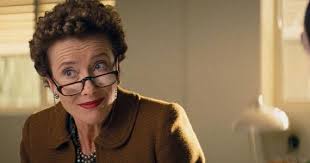
Mrs. Travers (Thompson) working on the film
The movie, though, belongs to Emma Thompson as Mrs. Travers. She creates a nuanced, complicated character from one who could be two-dimensional and tiresome. In Thompson’s rendition, Mrs. Travers keeps her standards high to ensure that no one can meet them—she can’t be disappointed again as she was as a girl. People don’t like her and she knows it, but she doesn’t care. She’s a starchy, vital, piercingly smart woman in 1961, when women were supposed to be pliable and sweet. Thompson gives her levels and depth, so that her eventual capitulation makes emotional, as well as financial, sense. When, at the end, she watches the completed film at the premiere, Thompson’s cathartic response is moving to witness, without compromising the exacting nature of Mrs. Travers’ inclinations.
Thompson’s lovely performance is well met by Hanks’ as Walt Disney. It’s lovely to see a film in which a man and a woman develop a relationship that isn’t romantic, but that’s based instead on commerce, creativity, and eventually, mutual respect. The film could mock the Disney machine much as Mrs. Travers does—but, of course, as many commentators have noted, it’s an inside job. Since Saving Mr. Banks was produced by Disney, the film is invested in hagiography and preserving his revered status as the benign patriarch of “imagineering.”
Walt (Hanks) and Mrs. Travers (Thompson) walk the park, their differences clear in their posture
Nonetheless, since he’s played as folksy and earnest by the lovable Hanks, the film makes it easy to admire Walt’s passion and commitment, and his real enjoyment in the pleasure his theme parks and films inspire. That unmediated delight is part of what Mrs. Travers comes to appreciate in him. Hanks’s final monologue, in which Walt travels to London with a real understanding of Mrs. Travers’s psychology, is a tour de force of empathy and persuasion, as he convinces her to give her father’s memory up to the power of imagination. Walt and Mrs. Travers are artists, whose stories transform their worlds. That they finally meet on an equal plane gives the film its arc.
Julie Andrews (who starred as Mary Poppins), Walt Disney, and P.L. Travers at the film’s premiere
Stay through the credits to hear the real P.L. Travers on tape, since she insisted that all her sessions with Mary Poppins’creative team be recorded. You’ll hear how much of her Thompson seems to capture, and marvel at how entitled Mrs. Travers felt to shape the adaptation of her creation at an historical moment when women just weren’t given that much heed. And enjoy the sentimental journey of watching a beloved Disney film fall into place, lyric by lyric, melody by melody, animation cell by cell, guided by a determined woman and her finally respectful, talented collaborators.
Receiving the award from Janelle at the banquet, in front of friends, colleagues, and family
Being acknowledged by your peers for a career’s worth of work is a wonderful thing. On November 9, at the American Society for Theatre Research (ASTR) conference in Dallas, I was honored with the 2013 Distinguished Scholar Award for “outstanding achievement in scholarship in the field of theatre studies.”
I was thrilled to be introduced by my friend and colleague, Janelle Reinelt, whose remarks I’ve posted below, followed by my own. Thanks to Janelle for her gracious intro, and thanks, too, to Iris Smith Fischer, chair of ASTR’s Awards Committee, Heather Nathans, ASTR’s president, and Nancy Erickson, ASTR’s administrator, for everything they did to make the award and the lovely banquet possible.
Because ASTR tradition dictates that the award is kept secret until the end of the award introduction, Janelle refers below to the “celebrant.”
Janelle Reinelt’s Tribute:
Bruce McConachie and David Mayer join me in presenting this year’s Distinguished Scholar Award to someone who has been a visible presence in every aspect of our profession for over thirty years. Her research and writing, teaching and editing, theatre criticism and organizational leadership have resulted in outstanding contributions to the field of theatre and performance studies.
Our scholar was one of the early voices of feminism, gender and sexuality studies. Her nine published volumes and well over 60 articles range widely over many topics, but most often embrace the concerns of gender, race, and sexuality as represented through performance. She came of age at the birth of performance studies, and was one of its first generation of luminary graduates, but her deep interest in and commitment to the theatre meant that she was always able to negotiate the early tensions in our field to produce her own creative vision out of mutually informed values from both sides of the discipline.
Before finishing her PhD, she had already been a founding editor of the journal Women and Performance, and over the years, she has continued her editorial work for various publications. At present she is one of the Consortium Editors for TDR, and book-series co-editor with David Román of “Triangulations: Lesbian/Gay/Queer Drama/Theatre/Performance,” for University of Michigan Press. They have published 16 titles in this on-going series. Their series description catches the major concerns of our scholar’s career as well: ‘Our intent is to be inclusive across disciplines, across practices, and across communities’.
Turning to her own scholarship, three major strands recur in her work. She wrote one of the first books on feminist theory in our field, originally published in 1988, which has recently been re-issued in a twenty-fifth anniversary edition with a new introduction. I’m speaking of the groundbreaking Feminist Spectator as Critic. Since the book first appeared, she has written extensively as a feminist and lesbian theorist and critic, from Presence and Desire: Essays on Gender, Sexuality, Performance (1993),to A Menopausal Gentleman: The Solo Performances of Peggy Shaw in 2011. Highlighting the performances of many women such as Deb Margolin and Holly Hughes, she is currently working on books on playwright Wendy Wasserstein and auteur/director Emily Mann.
The highlight of this strand of her scholarship is undoubtedly Utopia in Performance: Finding Hope at the Theatre from 2005. Looking in the face of a certain cynicism and fatigue that infected our field in the early years of the new century, she argued that often ‘live performances provide a place where people come together, embodied and passionate, to share experiences of meaning making and imagination that can describe or capture fleeting intimations of a better world’. Introducing the concept of utopian performatives, those unique moments in performance that break through to the affirmation of such intimations, she gave us ammunition for a variety of responses to nay-sayers. Widely cited and engaged, this book has become part of our critical canon.
The second strand of work concerns the public sphere and democratic dialogue. From her early experiences as a theatre critic, she has engaged the public, theorized its makeup and portent, and written stimulating and lively public discourse. For example, she is the author Theatre & Sexuality for Palgrave’s ‘Theatre &’ series, designed to reach a broad readership with significant short books on important topics. A significant section of her CV contains public writing in newspapers, magazines, alumni magazines, and various online sources. She was an early adaptor with respect to blogging, and since 2005 has maintained her own blog, “The Feminist Spectator,” to which she regularly posts commentary on film and TV, as well as Broadway, off-Broadway, regional, club and solo performances.
In 2011 she received the George Jean Nathan Award for Dramatic Criticism, for The Feminist Spectator blog, and earlier this year she published a new book entitled The Feminist Spectator in Action which collected a number of these writings as well as additional commentary on the nature of her project and a pedagogical section aimed at helping other women become critics and bloggers, enabling their public voices. The way this work engages the public can best be seen through her own words: ‘Feminist criticism. . .participates in an activist project of culture-making in which we’re collectively called to see what and who is stunningly, repeatedly evident and what and who is devastatingly obviously invisible in the art and popular culture we regularly consume for edification and entertainment’.
The third strand of her scholarship deals with the academy, the field of theatre and performance studies, and the role of the professoriate. She has been an incisive and articulate analyst of how higher education responded to the culture wars of the 80s and 90s, and how several fields have developed and changed in response to challenges from new positionalities. Drawing on her experiences at University of Wisconsin Madison and as Executive Director of the Center for Lesbian and Gay Studies at CUNY, she wrote Geographies of Learning in 2001, tackling the divisions between ideological camps of feminists and lesbians in forging Women’s Studies and Gender Studies programmes; and in theatre and performance studies, the theory/practice binary that still plagues and antagonizes some of our discourse up to the present time. This salient book makes excellent re-visiting, and is followed by many essays and lectures on similar topics all through our celebrant’s career.
She has written on colleague criticism and collegiality, mentoring junior colleagues, and many aspects of pedagogy, including essays in Theatre Topics in 2012 and 2013, the most recent, entitled “To Teach and to Mentor: Toward Our Collective Future.” Our award recipient speaks and writes on these topics from a history of positions at a number of important and varied institutions, including the University of Texas Austin in addition to CUNY and Wisconsin, as well as her present location at Princeton where she is Annan Professor of English, Professor of Theatre, and Director of the Program in Gender and Sexuality Studies. Along the way she led a significant disciplinary organization through her presidency of ATHE in the late ’90s. Her service record is massive: on boards of directors and editorial boards, committees and task forces, and all the other ways that she has been a force for support and development of the disciplines and areas of her expertise and commitment. In 2011, she received both the Outstanding Teacher Award from ATHE, and the Lifetime Achievement Award from the Women and Theatre Program.
The woman we honor today has been an inspiration to several generations of students, and speaking from personal experience, a trusted colleague and friend to many across our discipline. She is joined today by her partner and colleague Stacy Wolf, and by her father and sister. Please join me in acknowledging the 2013 recipient of the ASTR Distinguished Scholar Award for lifetime achievement, Jill Dolan.
Delivering my thanks
My remarks:
Thanks, Janelle, for those truly generous, lovely remarks.
I can’t begin to say how much this recognition means to me.
I started, as I think most of us do, as a theatre kid. I’m so grateful to my parents, Cyma and Jerry Dolan, for letting me spend so much time at the Pittsburgh Playhouse, which stirred my imagination beginning when I was only 10-years-old.
My dad, Jerry, and my sister, Randee (both of whom are here today), and the rest of my family, came to see me perform in all my Playhouse shows, always with flowers to celebrate. And now, more than 45 years later, my Dad reads my blog and asks me when I’ll post the next one, just as he used to ask me if my dissertation was done, every time we talked on the phone when I was a graduate student. We all need a cheerleader—thanks, Dad, for being mine.
I’ve been lucky enough, for these many years, to be surrounded by colleagues and students who really love what they do, and who refuse the distinction between theory and practice, or between artist and critic or scholar. I’ve been mentored by the best among us, including Bob Skloot and Phillip Zarrilli at Wisconsin; by Marvin Carlson at CUNY; and by the late Oscar Brockett at UT.
If I can pass on just a bit of what I’ve learned from them about doing this work, then I, too, will have contributed to the transmission of knowledge as they trained me to do.
At the beginning of my career, when being a lesbian feminist theatre and performance studies scholar seemed renegade and made us outlaws of a sort, having a posse made my work possible. Back in the early ‘80s, Janelle, and Sue-Ellen Case, and Elin Diamond, and Vicki Patraka, and I were sort of the Five Musketeers.
Along with Kate Davy, Susan Bennett, Peggy Phelan, David Roman, and the late Lynda Hart, as well as many other feminist theatre scholars (many of whom are in this room today), and the inimitable LeAnn Fields, our editor at Michigan, who was the earliest and most stalwart adapter of feminist and lesbian scholarship—these people had my back. They provoked me to think more deeply than I ever had before, and they inspired and nourished me with their ideas and their friendships.
Now, I don’t feel like such a renegade anymore, as I’ve been lucky enough to see feminist criticism and queer performance theory and critical race studies move into the center of our field. I’m so thankful for that. I come to conferences like ASTR eager to see what the next generations are doing, eager to learn from the new renegades and outlaws. I’m gratified to assume my elder stateswoman role, and to cede the front lines to the emerging and the newly tenured and promoted scholars, many of whom I’m proud to claim as my own former students and now, as my colleagues and my friends.
I’m lucky to have a partner who’s in our field, and I thank her for supporting and inspiring me every single day. Stacy and I always say, “Well, we forgot to have kids, but we do have students—and they better take care of us when we’re old!” That’s a joke (sort of!), but considering you all as my extended family doesn’t feel far-fetched.
When I sit down to write, you’re the ones I imagine as my readers. I thank each and every one of you for exchanging your words with me and for reading mine. You all sustain me.
In 1980, when I left Boston for graduate school at NYU, I took along the first edition of Linda Walsh Jenkins and Helen Krich Chinoy’s Women in American Theatre. That book armed me with key ideas as I went off to learn my trade, even as I quarreled with some of its presumptions.
I hope that my writing will inspire other young people to think and to quarrel, and teach them, as I learned, that there are lots of ways to be a theatre kid—and a feminist spectator, at that.
See you at the bar tonight, where I’ll be celebrating! Thank you so much for this honor.
And thank you for reading . . . The Feminist Spectator
It used to be that lesbian films—that peculiar underground brand made by and about and for lesbians, though not necessarily starring them—were sordid affairs. The subcultural economy for flicks like Claire of the Moon (1992) and Desert Hearts(1985) was small enough to keep production values low and distribution networks more a whispering project than a marketing strategy.
Now, with formats like Netflix regularly programming gay and lesbian fareand with delivery arms like Wolfe Video, an on-line source that sells DVDs and streams LGBT films, what were once poorly shot and haphazardly edited films with low-grade narratives and a lot of unconvincing-looking sex have bumped up more than a notch.
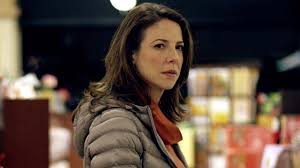
Concussion illustrates the new brand of lesbian films, a Sundance-acclaimed indie that follows in the heels of the more mainstream The Kids are All Right (2010) by casting lesser-known actors to tell a messier, less complacent domestic story. The wonderful, expressive Robin Weigert stars as Abby, a lesbian stay-at-home wife whose better half, Kate (Julie Fain Lawrence), is a lawyer without the energy or inclination to satisfy her spouse’s sexual desire. Drawn from desperation to pay for sex, Abby realizes that she’s as good at giving as she is at receiving, and decides to hire out as a same-sex escort.
Although the plot sounds prurient, part of what’s intriguing about writer-director Stacie Passon’s story is that Abby is smart and canny and sexually appealing, and that the story makes sober sense. At the film’s start, she’s clearly feeling stifled and hemmed in by her domestic responsibilities for two children—a 10-year-old boy who starts the film by hitting her in the head with a ball hard enough to send her to the emergency room, and a six-year-old girl whose anxieties tend toward memorizing a few lines about the Dominican Republic for her grade school social studies presentation. Abby loves her kids and Kate, but she’s bored by the routine and by how domesticity has tamped down her sexuality.
Renovating an apartment to flip
When she returns to work flipping apartments in New York, her renovation partner, Justin (Jonathan Tchaikovsky), turns her on to a female escort service run by his girlfriend, a character wittily called “The Girl” (Emily Kinney), who turns out to be a very young law student worried about getting caught trafficking in prostitutes and foreshortening her own legal career. That Justin connects Abby with The Girl on a lark becomes consternating for him when Abby turns out to like these hook-ups.
Abby's second experience paying for sex
Justin’s moralizing about her sex work becomes one of the many voices of an ethically hypocritical mainstream culture in which Abby puts little stock. From a young college girl who’s never had sex before to a middle-aged woman (Laila Robins, lovely as Woman #3) whose husband doesn’t satisfy her, Abby builds a client base of women she treats with sexual abandon and emotional precision, listening to their stories and becoming their therapist as much as their lady of the night. Passon engages the joy with which Abby listens, focusing in on Weigert’s open, attentive, empathic face as her clients talk, the two of them wrapped in sheets post-coitus with all the intimacy of lovers instead of those transacting business.
Part of Passon’s point, in fact, seems to be that women’s desire deserves to be met, in whatever ways make sense. In an interesting narrative choice, Abby and Kate’s friends are mostly straight couples. Abby works out at the gym with women in heterosexual marriages whose pleasures and frustrations aren’t very different from hers. They’re all “moms,” as she explains in a scene in a supermarket, women whose lots are thrown together by their children’s proximity, rather than by their own choice.
Passon seems to question whether a lesbian marriage is different from any other. While Lisa Cholodenko, director of the path-breaking The Kids are All Right, insisted on same-sex marriages’ similarity to heterosexual ones at a moment before gay marriage was even as widely accepted as it is today (which is to say not as much as it should be, but we’re getting there), Passon goes further by suggesting that lesbian marriages can be just as screwed up as any other. Aside from their children and their home, it’s never quite clear what keeps Abby and Kate together, given how constrained Abby feels by a life that seems so circumscribed and routine.
Kate (Lawrence) and Abby (Weigert) at home
Concussion proposes that fulfilling desire outside of marriage might do the trick, even if (or especially if) it’s satisfied in the vaguely illicit terms of affairs and sex-for-pay. When “Sam” (Maggie Siff), one of the neighborhood moms whose eye Abby has caught at the gym on more than one occasion, contrives to hire her services, their torrid if contracted affair threatens to spill over into their real lives. Abby has an orgasm when they have sex, surprising Sam, who thinks that’s against the rules.
Maggie Siff as "Sam," eyeing Abby at the gym
When Abby spots Sam in the local market flirting affectionately with her husband, from whom she’s supposed to be separated, she can’t resist approaching her to check out the terms of Sam’s heterosexual partnership. After Abby’s secret work life is inevitably and messily revealed, Sam walks her dog by Abby’s driveway and the two women intimate that they’ll keep seeing one another, surviving the banality of their daily domestic lives by continuing the intense, secretive sex that gives them both something to look forward to in between carpooling kids and scooping dog poop.
Weigert brings warm intelligence to her performance as Abby, and a lithe, lean sexual energy that’s unselfconscious and persuasive. Abby announces wryly at one point that she’s 43-years-old; indeed, part of the film’s poignancy is that it concerns a lesbian of a certain age, one who’s testing what she can and can’t give up to secure a family life that has its own pleasures and comforts. Concussion isn’t a story about coming out or being in your 20s and figuring out where your passions lie. It’s about being hit in the head and realizing that you have to lie down for a while to protect yourself, while your brain (and perhaps your heart) has a chance to heal. It’s about learning how to recover from the blow to the head that “real married life” sometimes represents and thriving in the aftermath.
Abby with her laundry, in an Akerman-like framed shot
Passon films Weigert with sympathy and respect, never indulging in what might be voyeurism. Some of her shots are framed like French feminist filmmaker Chantal Akerman’s in Jeanne Dielman (1975), her famous, nearly silent film about a woman who turns tricks with men in her home. Akerman’s film treads similar territory, but nearly 40 years ago, she could only see her prostitute heroine through the gauze of melancholy and domestic despair. Passon sees more pleasure and potential in Abby’s exploits. Akerman studies her character from a dispassionate distance, through doorways that frame her acts of quotidian domestic and professional preparation. Even the sex she has is clinical, as Akerman’s camera focuses on her suffering the men who mount her body. Passon might borrow some of Akerman’s framings, watching Abby through long or medium shots as she makes her own preparations for her home life and sex work, but Passon brings us closer to Abby’s physical and emotional feelings, as she experiments with the boundaries of where she’ll take her own passions.
Concussion also quotes Susan Glaspell’s classic feminist play, Trifles, in which two neighborhood women visit another’s home after she supposedly kills her husband, and can read off the surface of the scene the turbulent unhappiness of their friend’s life. In Concussion, when Kate visits the newly renovated New York flat where Abby has been entertaining her clients, she, too, understands by studying the space that her wife has been unfaithful there. Later, Kate follows her to the apartment and surprises Abby after a tryst, opening the door on Abby lying naked, luxuriously sprawled across the bed’s tangled white sheets. Kate stares at Abby with distaste, telling her to put something on, repulsed by how Abby has used her body, even though Kate no longer desires her.
The luxury of the post-coital body
In the short, artfully framed exchange, Passon captures the tension between sexuality and domesticity. How can women enjoy their sexuality and pick up their kids from school on time? What’s enough to fill out the outline of a life? Abby’s fellow moms seem more or less content with their lot. In the homosocial environment of the gyms and coffee shops they frequent, they prattle on wryly about banalities, which are, finally, the stuff that makes up a life. And they’re also wealthy suburban New Jersey women who don’t have to work.
Sam (Siff) and Abby (Weigert) finally meet up
But their apparently mundane lives don’t remove them from the complications of sex and power. When Sam meets Abby for their first encounter, she asks her to pull her hair and to treat her roughly. Siff and Weigert find all the nuances between two women who seem alike on the surface of their lives, both of whom need to acknowledge that their desire brings an edge that reminds them that so much more roils underneath. When Kate later reaches out physically to Abby, and Abby tries to show the same sexual intensity with her wife, Kate rejects her, unable or unwilling to plumb those depths.
Abby and Kate are Jewish, an added ethnic touch that helps to specify the kind of suburban life they lead. Abby is on the board of her synagogue; she’s a good citizen of her community, which as far as she’s concerned doesn’t preclude her extra-curricular activities. Passon doesn’t judge Abby; instead, she empathizes with her need to have more, to find value in herself in physical, as well as emotional and publicly responsible ways.
Abby (Weigert), a renovated version of the suburban Jewish housewife
Much ire has been expressed recently over Blue is the Warmest Color, Abdellatif Kechiche’s French film that won the Palme D’Or at Cannes and that apparently includes lots of explicit lesbian sex (I haven’t yet seen it). Julie Morah, the woman who wrote the graphic novel on which the film is based, said in The Guardian last May that the only thing missing in the film were real lesbians (the two young women who play the lead couple are straight).
Any lesbian or gay movie will continue to raise the “authenticity” question, perhaps until sexuality and gender are so truly diverse and fluid, no one will find it interesting to challenge who plays whom and how. Rose Troche, who produced Concussion, addressed those issues years ago with her work on The L Word, for which she and Ilene Chaiken brought lesbian sexpert Susie Bright to the set to instruct the cast in lesbian sexual practices. Authenticity issues could be raised about Concussion, but they would diminish another of Passon’s points: Most of Abby’s women clients aren’t lesbians, per se. They’ll try men (as her youngest, once virginal client plans to do) or they’ll return to their husbands at the end of the day (as Woman #3 and Sam will do). But they take a rich same-sex pleasure in Abby’s hands. It doesn’t matter what the characters (or the actors) “are” or how they identify. What they do is what counts.
In the end, Concussion is rueful, sobering, and sad, as it refuses to accord lesbian marriages any more potential for perfection than any other. And even in that, it seems progressive and right.
Adult Alison, Small Alison, and Medium Alison in FUN HOME
Two weeks ago, Slate ran a short piece called “Fun Home: Is America Ready for a Musical about a Butch Lesbian?” The article quotes collaborators Jeanine Tesori (Caroline, or Change) and Lisa Kron (Well) describing the importance of seeing characters we don’t usually find in musicals. Kron said,
[S]he has grown weary of a tiresome trope: In several recent musicals, “There was a moment where someone would say the word lesbian as a non sequitur because it was funny. I’d be so on board, and then I’d be slapped in the face by it. It was just like,This character’s a joke. This is not a person.”
If the preview performance of Fun Home I saw is any indication, enthusiastic audiences full of all kinds of people seemed at once moved, amused, and enthralled by the story of a lesbian who is indeed a person—and a full, complex one at that.
The new musical is adapted from cartoonist Alison Bechdel’s graphic novel, Fun Home (2006), a meta-memoir that muses on her own family history and especially, her father’s. A closeted gay man for his entire life, Bechdel’s father, Bruce (played with gorgeous voice and excruciating anguish by Michael Cerveris), throws his thwarted sexual energy into refurbishing old houses, including the one in which his family lives.
The “fun home” is actually a funeral home, a business left to Bruce by his father, in which he toils of economic necessity. He’s also an English teacher, well-known in the small Pennsylvania town in which Alison grows up. And he’s also an infamous cruiser of men and adolescents, who plies young guys with beer and sherry and leaves his three children alone in a New York apartment during a vacation while he slips out to pick up tricks.
But he’s also the only father Alison has. When she realizes as a student at Oberlin, after many years of boyish gender performances, that she’s a lesbian, she wants to connect with the father with whom she turns out to have something profound in common. But because he’s utterly unable to speak the truth of his life, he deflects Alison’s questions and disappoints her emotional need. Four months after she comes out to her parents, Bruce steps in front of a bus traveling down the street where he’s taken on a new house-remodeling project and kills himself.
Bruce plying a teenager with sherry as adult Alison remembers (Joan Marcus)
The graphic memoir and this lovely, surprisingly funny and aptly observed musical focus on Alison’s struggle to make sense of her father’s life and death. Kron, who wrote the pitch-perfect book and the literate and often hysterical lyrics, and composer Tesori and director Sam Gold (Picnic), create a capacious physical and narrative structure in which to let Alison’s story unfold.
Told in simultaneous time, the adult Alison (Beth Malone) narrates, standing behind her drawing table, pencil in hand, pondering captions for her cartoon frames, but also moving into and out of the rest of the action as a kind of unseen visitor from the future. She lurks on the edges of her own past life, watching “Small” (Sydney Lucas) and “Medium” (Alexandra Socha) versions of herself play out key scenes in her family history. She wonders, from the vantage of the present, if she can write a different treatment to capture what was really happening in her past.
Alison reads over her younger selves’ shoulders as they write in their diaries, groaning over their facile philosophizing or their tossed off observations about key moments. For example, Small Alison, after being unexpectedly summoned to her father’s side while he prepares a corpse for burial, notes in her journal that she saw her first dead body today. Then she comments, with the same emphasis and import, that she had an egg salad sandwich and watched The Partridge Family on TV. Large Alison can’t believe that her smaller self left so little record of such cataclysmic moments.
In some ways, grown Alison’s musing, spectral presence, while moving and elegiac, is the most elliptical part of this wonderful show. It’s difficult to capture someone thinking about their past, which makes Alison a powerful but static presence, the stand-in for the audience as we, too, watch history play out. But Fun Home’snarrative isn’t conventional; that is, it’s not motivated by plot or conflict so much as by moments, crafted to exemplify two lives that ran parallel but so infrequently truly touched.
The set design, too, by David Zinn (who also designed the costumes), moves the episodic scenes fluidly around on a revolve, that opens up onto various moments in Alison’s life. The always-moving scene let’s the story clip, and keeps Alison literally moving into and out of her own history.
Lucas is virtuosic as Small Alison, whom she plays as a prepubescent rebel with a cause. Already a tomboy, Small Alison plays out her boyishness with relish, especially in “Al for Short,” a show-stopping song in which, wearing a tough leather motorcycle jacket, she asks to be called “Al . . .” and then adds, with distaste, “. . . ison,” eager to crop off the remnant of girlishness that ends her name. Lucas’s charismatic, perfectly timed comic performance is thrilling. When Bruce appears to insist that she wear a barrette and a dress, Small Alison’s disgust is palpable, painful, and understandable.
The kids performing the fun home commercial in front of coffins (Joan Marcus)
Griffin Birney and Noah Hinsdale, as Alison’s put-upon brothers, are also terrific. The three kids stage a commercial for the fun home, in which they pop out of coffins to sing the praises of their father’s business. Later, as they pretend to emulate the normal, happy family life each of them understands is not, in fact, their own, the kids and their parents perform as The Partridge Family, under bubble-gum pop lights, with music and lyrics that echo that fabricated television band’s forcefully cheerful melodies and words.
The Partridge Family-style number . . . the musical creates presentational moments that leaven its inherent sadness (Joan Marcus)
For those of us who grew up as proto-lesbians in the 1960s and 70s (Bechdel was born in 1960), Fun Home strikes a deeply resonant chord. I know I wasn’t the only one in the audience at the Public that night whose eyes filled as she watched Medium Alison, struggling to understand her sexual and gender identity, approach the door of her college’s gay student union office, only to turn away in fear and shame before she could persuade herself to knock.
I doubt I was the only one who recognized the difficulty of writing a coming-out letter to your parents while at the same time, being over-the-moon with newly found but forbidden desire. Kron and Tesori and Socha (wonderfully awkward and earnest as Medium Alison) capture these emotions in “Changing My Major,” a song whose refrain is “I’m changing my major to Joan,” Alison’s first girlfriend (Roberta Colindrez). Joan wears an array of political buttons on her coat and backpack, and patiently, lovingly accompanies Alison as she discovers herself.
Medium Alison ponders the changes in her life once Joan appears (Joan Marcus)
Socha and Colindrez have great chemistry, capturing the excitement and daring of what it meant to be a “woman-loving-woman” on a college campus in the 1970s. As Joan, Colindrez is droll and understated, but warm and empathic. Joan manages to connect with Alison’s parents on a visit to the fun home, smoothing the way for Alison to be fully herself with them, even as Bruce continues to refuse his own truths.
Judy Kuhn, as Helen, Alison’s mother, has the thankless role of the wife who knows exactly who her husband is, but feels powerless to put into words what he denies. A character without agency is difficult to play. But Kuhn works up a good head of ire and rue in her one solo late in the show, bemoaning her own choice to stay with a man she knows prefers men.
Small Alison's brothers watch the 1970s style cabinet tv (Joan Marcus)
Fun Home evokes the 1970s, with its characters’ bell-bottomed costumes (perfectly designed by Zinn), the set’s bulky television cabinets playing blurry shows to which Alison and her brothers sit glued, and with its references to all the sexual intrigue of lives played out in the shadows of a culture in which LGBT people were still utterly invisible. That the musical makes that historical moment so detailed and palpable is part of its huge allure.
I was also surprised by the show’s humor, delighted to find its creators so willing to poke gentle, even loving fun at the foibles of this particular generation. To bring a comic touch to a personal story about a devastating life at a painful historical moment requires a real gift, which, happily, is everywhere evident here.
The terrific actors carry the warm, wry book. Alison (Malone) is constrained and regretful as she watches her father’s secrets play out, but affectionate and generous with her younger selves. Lucas, as Small Alison, is feisty and insistent, so willfully determined to be the something else she senses she is. (A friend who saw the show wondered how someone as young as Lucas could portray the emotions of an eight-year-old lesbian so well. And isn’t it something that such a character can be played on stage now? So many of us have truly never seen anything like our lives being embodied on stage in front of our eyes.)
Joan and Medium Alison (Joan Marcus)
Socha, as Medium Alison, nails what it feels like to be barely able to live in your skin until suddenly, you understand there’s a name for what you are and that there are others like you. She shrugs on her new identity like the army jacket Joan wears. It’s easy to see how this diffident young artist grew into the mature cartoonist who created Dykes to Watch Out For, the graphic serial that captured the mores of lesbian communities around the country.
In one of Fun Home’s most wrenching scenes, Bruce instructs Small Alison about her drawing. She wants to draw cartoons, and he wants her to draw high art, his elitism seeping into the imperious tone of his voice and the way he handles her work. As she resists his lesson about shading and tone, Bruce gets annoyed, returning her pencil with irritation and announcing that he doesn’t care if her work is crap or that she’ll embarrass herself in front of everyone.
Bruce gets ready for a court date that Small Alison doesn't quite understand (Joan Marcus)
The scene perfectly illustrates the father and daughter’s tragic relationship. He wanted, on some level, to live through her in the way he couldn’t live himself. Bruce wanted to be proud of Alison because he was ashamed of himself. But he didn’t reckon on a daughter who—even though that moment with Bruce hurts and scares her—knows that she’s right about her art and her sexuality. She knows that she’s a cartoonist and a lesbian; as Alison moves into self-possession and visibility, she realizes that Bruce will never be able to experience either one.
Fun Home charts a key turning point in a family and in a movement. And it does so largely with music (though the show is not quite sung through), always with humor, and consistently with a gentle, intelligent, compassionate tone that honors and ennobles its story.
Father and daughter (adult and small); how often have we seen them on stage? (Joan Marcus)
What a miracle to see this show performed last week. What a miracle to have same-sex marriage legalized in New Jersey this week, so LGBT people can marry if they wish. I left the theatre a week ago feeling strangely seen and not quite sure how to think about that; I’ve spent so many years watching for lesbian subtext and trying to read queerness underneath protestations of heterosexuality. To see lesbian desire as the text felt almost startling—and more wonderful than I can even begin to describe.
Go see Fun Home.
The Feminist Spectator
Fun Home, The Public Theatre, opens October 22, through November 17.
 In a World, actor Lake Bell’s debut as an indy writer/director, is a wonderful, witty, madcap exploration of voice-over talent inscribed with a feminist message. “In a world . . .” refers to the iconic phrase intoned by the most famous voice-over artist, Don LaFontaine, whose legacy other male artists are eager to track and supersede. Carol Solomon (Bell), a voice coach whose father, Sam (Fred Melamed), is the prime contender for LaFontaine’s spot in the pantheon of voice-over stars, winds up besting not just her pompous dad, but his sexist younger competitor, Gustav Warner (Ken Marino), for a coveted spot intoning “in a world” on a trailer for a new quartet of girl-power, futuristic fantasy films about Amazons taking over the universe.