Category Archives: Uncategorized

Wondering About Fiddler on the Roof at Arena Stage

Fiddler at Arena Stage, 2014

The 50th anniversary of Fiddler on the Roof has been celebrated amply this past year, including with a Princeton symposium Stacy Wolf (FS2) and I organized last fall.  Alisa Solomon’s marvelous book, Wonder of Wonders:  A Cultural History of Fiddler on the Roof, beautifully chronicles the musical’s origins and its evolution into a cultural touchstone for American Jews, one that often replaces or stands in for religious knowledge and practice.

I anticipated Molly Smith’s production of Fiddler at Arena Stage in Washington, DC, where she is the long-standing artistic director, because she’s done very well directing other classic Golden Age musicals.  Her production of Oklahoma! during Arena’s 2011-12 season was gorgeously re-imagined, with a multiracial cast that added thrilling new dimensions to the story about farmers and cowmen on the American prairie.  Using the challenging theatre-in-the-round architecture that gives Arena its name, Smith managed to bring vital new life and resonance to the show.

Smith's Oklahoma at Arena
Smith’s Oklahoma at Arena

Likewise, her production of My Fair Lady at the Shaw Festival at Niagara-on-the-Lake in 2011 made that show much more than an old chestnut.  She instilled in the musical a vivid sense of ironic humor, brisk pacing, and characters with a lot of feminist verve, making it, like her Oklahoma!, come alive with new meanings and colors, as well as a whole lot of pleasure.  That production, too, was cast with people of color in major and subsidiary roles, making the show look relevant and contemporary.


Smith's MY FAIR LADY at the Shaw Festival
Smith’s MY FAIR LADY at the Shaw Festival

Smith says in her program note for Fiddler, “Many of you know I often cast in a cross-cultural way because I believe this is the world we live in.”  What a shock, then, to see her production of this musical performed by only white actors.  She says that for Fiddler, “I was very interested in casting in a culturally specific way—through the Jewish and Russian point of view.  In this way we go from the individual to the universal.”

What a fascinating idea!  But, with respect, I’ll say I was hard pressed to find the “culturally specific casting” in the production, since very few of the actors seemed to be Jewish.  Okay, I know:  how can we tell?  And isn’t it essentialist to assume from a name or an actor’s photo in a program, or even from their appearance on stage, who’s Jewish?  Especially if “Jewishness” is more about culture and religion than it is about race?  (Although this is an on-going debate and point of discussion in Jewish studies.)  Or by “culturally specific,” did Smith mean Eastern European in origin?

I ask these questions as a Jewish woman whose name is “Dolan,” after all.  My grandfather’s family name was Dolinsky.  He was born in Poland, but when his family immigrated to the States and he was later drafted to serve in the First World War, the Army changed his name to Dolan.  My father tells me that my Zedie Jake was fond of his new name.  He enjoyed having an Irish name because he thought it made him sound more American (since, of course, the Irish became white before the Jews).

For me, the misrecognition of my name as Irish has meant a lifetime of trying to convey my Jewishness through identity performance.  I use my hands a lot, I raise my eyebrows, and I inflect my sentences in such a way that I hope will read as Jewish to my interlocutors. Being recognized as Jewish always seemed to me better than passing as gentile.  I was afraid of what people might say in front of me, if they assumed I wasn’t Jewish.  I was afraid that what I might hear would make me feel a traitor to my race or might scar my own sense of self.  Nonetheless, all that hand-waving wasn’t enough to keep me from overhearing anti-Semitic jokes when I was in high school theatre classes at the Pittsburgh Playhouse because my fellow actors thought there were no Jews present.  And despite the hand-waving, I still have to come out as Jewish whenever it seems important and necessary, or when I feel people dancing around that part of my identity, wondering.

Jonathan Haraday as Tevye
Jonathan Hadary as Tevye

So what does it mean for Smith to cast her Fiddler as “culturally specific,” with actors named Jonathan Hadary (Tevye), Ann Arvia (Golde), Dorea Schmidt (Tzeitel–could be Jewish?), Hannah Corneau (Hodel), Maria Rizzo (Chava), Shayna Blass (Shprintze—most likely Jewish!), and Maya Brettell (Bielke—maybe Jewish?)?  Any of them could be Jewish, for all I know.  But when Yente is played by Valerie Leonard, the cast member who most seemed to miss the musicality of the (contrived) Eastern European lilt Joseph Stein (book) and Sheldon Harnick (lyrics) wrote for their characters, what does this signal about cultural specificity?  Leonard could be Jewish and simply tone-deaf to the character’s Yiddishisms.  If the actor can’t play Jewish and/or is not “really” Jewish, why not have her played by an African American actor adept enough at acting to perform the authenticity required to make this musical succeed and make sense?  Because black skin isn’t culturally specific to the Russian shtetl?  But swarthy Italian complexions and curly black Italian hair can better “pass” as Jewish?

I really do mean to wonder (no pun intended) and not entirely to criticize.  I note that Jenna Weissman Joselit, a Jewish Studies scholar who runs the program at George Washington University and spoke (beautifully) at our Fiddler symposium at Princeton, receives special thanks in the program.  And Dr. Yohanan Petrovsky-Shtern (who is, I find via Google, a professor of Jewish Studies at Northwestern University and recently published a book called The Golden Age Shtetl) is also thanked.  Ariel Warmflash, an Arena Theatre teaching artist whose blog post on the Reconstructionist Rabbinical College web site leads me to believe she’s Jewish, is listed in the credits as a “cultural consultant.”  Perhaps she helped dialect and vocal coach Lynn Watson with the rolling r’s and intonations of the Russian accents the cast affects with greater or lesser success.  But does accent signal cultural specificity, especially when the songs that compose Fiddler’s soul aren’t written that way?

Does being Jewish even give you a special cultural purchase on the musical, when Solomon’s book and Harnick’s quote in Arena’s program insist that the point of the musical was to show that “Jews are just like everybody else”?  (See also Robert Brustein’s New Republic discussion of the show and Solomon’s book.)  Given Smith’s directing history and Arena’s location in a predominantly African American city, foregoing multiracial casting to be “true” to what seems to me a misbegotten sense of cultural authenticity represents a theatrical and political misstep.

Tevye and his cart
Tevye and his cart

But what does the production bring us in any case?  All the pleasure of Fiddler remains intact, from the pedagogical and rousing beauty of the opening song, “Tradition,” to the mournful resignation of “Anatevka,” when the shtetl-dwellers round up their belongings and leave their humble homes before the pogrom burns them down.  Hadary, a man slight of build and fairly short for a role typically cast with a rounder, more physically imposing type, underplays Tevye.  He’s casual with the glorious “If I were a Rich Man,” refusing to embody Zero Mostel’s iconic hands-above-his-head hip-shaking da-da-dee’s and deedle-dums, which makes the number feel tossed off instead of heart-felt.  He speaks in a Brooklyn accent, underlining perhaps, as Solomon argues in her book, that the musical was meant for those who had already assimilated to America and for whom it provided a nostalgic rereading of the shtetl from which many of the musical’s Jewish audiences’ ancestors might have come.

But Hadary’s New York-isms and his rather fey interpretation of Tevye aren’t fleshed out enough to be refreshing or original. Because he’s determined not to imitate Mostel (or Topol, the Israeli actor who played the role in Norman Jewison’s popular film adaptation), he throws away many of the character’s best lines and performs the patriarch as though he’s already cowed by his daughters’ impossible marriage requests.  If Tevye has no fire or fight, his debates with his daughters and with his god seem beside the point, pleading little performances whose endings are already known.

And of course, they are.  Most of the audience at Arena during the matinee I saw knew how Fiddler ends, except for perhaps a few of the children.  After all, it’s a classic.  The suspense isn’t in what happens; it’s in how the actors and director and designers get there.  Hadary missed opportunities to surprise us with his interpretation, and because of his size, Tevye often seemed the least, instead of the most, important person on stage.

Golde (Arvia) and Yente (Leonard)

Sometimes, that worked to the production’s benefit.  “Do You Love Me?,” the love song between Tevye and the dubious Golde, was sweetly understated.  Arvia’s Golde was the larger of the couple in Smith’s production.  Her ample heft softened Golde’s edges and she played the archetypal Jewish wife without the fatigued sarcasm many interpreters bring to the role.  Their duet allowed Tevye to truly wonder if his wife loves him, and let Golde acquiesce to what felt like the warm surprise of admitting it, after 25 years.

“Sabbath Prayer,” too, felt more familial than magisterial, as Tevye and Golde stood on opposite sides of their simple wooden table to offer their benediction, with their daughters and Perchik, the Kiev revolutionary, gathered around.  The set design and Smith’s use of the stage lent themselves to this more intimate, domestically focused interpretation, as scenes were decorated with few props and several benches that were moved easily around.  Red apples in a basket or clutched in a character’s hand supplied some color and texture against the muted tones of Paul Tazewell’s ragged shtetl costumes.  In “Sabbath Prayer” and in the wedding scene, actors carried candles that also warmed the space and provided flickering adornments to lighting designer Colin K. Bills’s sharply crafted spaces.  Smith amplified the sense of community by placing actors with lit candles above the audience around the back of the theatre, too.

“Anatevka” benefited from a similar warm under-playing, as Tevye and his neighbors slouched on the wooden floor boards and benches that comprised set designer Todd Rosenthal’s stage, underlining the resigned but somehow stalwart determination that the song implies. Lacking the revolve that typically moves Tevye and his family and their cart away from their home, Smith directed the cast to walk in an ever-expanding circle around the low ramps that encircled the stage, finally leaving the shtetl by stepping off the platform into the aisles of the audience and disappearing through the auditorium.  It’s a nice touch, representing the Jews of Anatevka dispersing around the globe.

The daughters
The daughters

But aside from the perhaps purposefully diminished Tevye and Smith’s attempt to render cultural specificity, this production doesn’t add anything very new to the canon of 50 years of Fiddler.  It all works; the daughters are especially good in “Matchmaker” and in their individual numbers, begging their father to let them marry whom they wish (and singing beautifully).  The women and girls who play them convey their affection for one another, and for their ambivalent father and warm mother, very well.  But they don’t add new notes to their characters, nor do they offer much in the way of the performance of Jewishness.

That said, I was struck in this production by how pedagogical the musical is, and by how much of it performs Jewish rituals.  Perhaps this is what Smith meant by cultural specificity, though I still don’t find those ethnic particularities in the performances so much as in how the scenes are constructed by Stein, Block, and Harnick and directed by Smith.  “Tradition” is such a good way to instruct the audience about ritual garments like tallit (prayer shawls), and in what it basically means to study Torah, and in the strict gender division of Orthodox Jewish life (although Anatevka’s residents always look more Orthodox than they really are, since the creative team was writing for assimilated, secular Jews).

The bottle dance
The Bottle Dance

The wedding scene, too, is pedagogical, as Tzeitel and Motel are lifted on chairs, the stage bisected by stanchions that keep the men from the women until Perchik insists on challenging tradition and dancing with Hodel.  The Bottle Dance, which Solomon explicates brilliantly in her book, is a tradition the original choreographer Jerome Robbins invented, through his ethnographic observation of Jewish weddings in preparation for the show.  Though fabricated, the muscular, masculine dance—which insists on the heteronormativity of Fiddler’s wedding scene even as it performs a lovely, queer homosociality—has been adopted as a Jewish ritual tradition that persists even now at weddings and bar and bat mitzvahs.

I had fun at Fiddler.  How can you not?  Talk about essentialism:  I cried through the whole thing, moved by the music, the dialogue, the predictable, inexorable situations, and by the man with the fiddle who haunts Tevye’s every decision and goes with him to America, carrying a bit of home and a continually diminishing sense of the shtetl along.  Is it my Jewishness that causes me to cry through Fiddler?  Is it my own nostalgia for singing the score around the piano with my family through the years?  Or my nostalgia for singing “Sabbath Prayer” with Stacy at the occasion of one of our nieces’ baby-naming ceremonies?  Or my memories of performing in our family living room as each of the characters when I was growing up, regardless of gender, and acting them all out the way I thought best?  Or my second-hand recall of Stacy’s stories about staging the Fruma Sarah dream-sequence with her sister, Allie, when they were kids?

(By the way, Smith stages that scene beautifully here.  The characters in Tevye’s dream wear surreal animal masks.  When the dead Fruma Sarah appears, she rises from the middle of the bed in a column of tulle as a monstrous, huge figure that towers over Tevye and Golde to proclaim her curse on Tzeitel’s marriage to Lazar Wolf.  Then she disappears back into the bedding the way she came.  This was the most brilliant interpretation of this number Stacy and I have ever seen.  It was terrifying and exhilarating all at once, even when you know exactly how the iconic number ends.)

In the theatre’s on line dramaturgical notes, Hadary claims,

“I grew up hearing the Tevye stories of Sholem Aleichem. In fact, my family members could well be characters in the play. So there was a lot of connection to the material.  This whole production, of Fiddler on the Roof, here, for me, brings together an awful lot of threads in my life—my ancestry, my whole life as an actor, my family, my Washington roots, plus it’s simply as good a role as has ever been written for a man in the theater.”

Okay, so he’s Jewish after all.  Does that secure something authentic about his performance?  I don’t really think so.

Fiddler, the fiddler
Fiddling on the roof

I can’t quite explain my “Jewish” nostalgia for Fiddler, or why exactly I care whether its characters are played by Jews.  There’s something about ethnic spectacle that Smith’s production both panders to and explicates, a bid for authenticity in which multiracial bodies might have gotten in her way and taken focus from the “real” Jewishness she thinks she’s invoking here.  But if Smith is going to attempt cultural specificity, then I suppose I can revert to ethnic form and say that most of these actors didn’t “feel” Jewish, that the production didn’t evoke anything particularly authentic in its rendering of shtetl life, cultural consultants and scholars aside.  But then, Solomon would say it was never meant to be authentic, but was crafted as an American memory of an unknowable past, one safely left behind with the Russians as Eastern European Jews immigrated to the new world and looked forward, never back.

The Feminist Spectator

Fiddler on the Roof, directed by Molly Smith at Arena Stage, November 23, 2014; closes January 11, 2015.


Olive Kitteridge on HBO

Olive, poster

Frances McDormand caused some chatter in October when she told Frank Bruni in the New York Times that she thinks “looking old . . . should be a boast about experiences accrued and insights acquired, a triumphant signal ‘that you are someone who, beneath that white hair, has a card catalog of valuable information.’”  In her gorgeous turn as the title character in HBO’s four-part miniseries, Olive Kitteridge, McDormand uses her 57-year-old expressive face to glorious advantage, registering with her eyes and mouth and the turn of a head all the complex emotions that move across this unhappy, reproving, unyielding woman’s countenance.

Director Lisa Cholodenko and screenwriter Jane Anderson adapted Elizabeth Strout’s Pulitzer Prize-winning novel, which I haven’t yet read, into this searing inquiry into the sad nuances of emotionally constrained and shuttered lives.  Olive and her long-suffering, sweet husband, Henry, played with warm, hapless vulnerability by the wonderful Richard Jenkins, have lived in an unremarkable small town in Maine all their lives.  He’s the local pharmacist, who runs the Main Street drugstore until he sells it to the “Aid-Rite” chain.  He knows everyone and dispenses kindly over-the-counter advice along with the pills he diligently counts out.  Olive teaches middle school math, subjecting generations of local children to her exacting standards and ruthless assessments.  Their poor only son, Christopher (John Gallagher, Jr. as an adult and Devin Druid at 13-years-old), doesn’t stand a chance as the other point on the triangle between his parents.  In his later years, he spends a lot of time in therapy, trying to shore up his battered ego.

McDormand as Olive, Kevin Druid as Christopher, and Richard Jenkins as Henry
McDormand as Olive, Kevin Druid as Christopher, and Richard Jenkins as Henry, at the family dinner table

The miniseries covers decades in the Kitteridge family’s lives, with each of its four chapters jumping in time and requiring McDormand and Jenkins to perform increasing frailties with thickening middles and wrinkling, spotted faces.  But more than an inquiry into aging—though it is that, too—Olive Kitteridge is a character study of a woman who fashions herself in a fire of her own making, not just as defense against a tragic past but as determination for blazing through an unknowable future.

We don’t know much about Olive.  Her father committed suicide, a violent act by which she’s clearly haunted, though she refers to it only obliquely.  When Kevin (Cory Michael Smith), a local boy who had a troubled mother, returns to Maine as an adult with his own psychological baggage, Olive dissuades him from suicide.  She describes the aftermath, which she’s clearly seen firsthand, in a way that shames Kevin out of his plan.  Olive and Kevin happen to witness Patty (Rachel Brosnahan, luminous in a tiny role), a local waitress, literally blown off a cliff in a strong wind.  Kevin jumps into the churning water below to save her, jump-starting his own second chance for life.

The miniseries, in fact, argues most often for second chances, suggesting that people are resilient enough to prevail in the face of what comes at them, unexpectedly, from all sides.  Some characters, though, in this panoply of emotional damage, simply succumb to the miasma of mental instability and sorrow that infuses their lives, which Cholodenko depicts with vivid imagery and effective empathy.

The story opens in the present, with an elderly Olive walking through the woods, laying a blanket over the leaves not for a picnic, but on which to lay a revolver that she carefully loads and prepares.  She turns her radio to a classical station, leaves an envelope addressed “To Whom it May Concern” beside her house keys, and looks up at the sky and the barren but strangely beautiful trees, resolute.  Part One then flashes back a few decades; Part Four returns to that prophetic moment.  In between, Olive’s story unfolds.

Cholodenko and her cinematographer, Frederick Elmes, make the most of the New England setting (shot in Massachusetts, though the story is set in Maine), evoking the details not just of small-town northeast life but of a couple who’ve lived together in the same modest house over their long, complicated marriage.  Olive rigorously tends her flower garden, which looks out over an expansive bay.  The scenery, though, always seems rugged and just a bit foreboding, rather than evoking a more comforting, soulful beauty.

Olive and Henry
Olive and Henry

Cholodenko and screenwriter Anderson pace the story in a stately manner (sometimes, the mournful score underlines the film’s tone and tempo too emphatically), moving it inexorably forward by a few weeks or months or years, while marking how little really changes.

Humor infuses the narrative at odd but appropriate moments.  Some of the subsidiary characters are played for laughs; there’s Angela (Martha Wainwright), a piano-playing lounge singer who’s crooning Top 40 favorites every time Olive and Henry go out to a local restaurant.  She also appears later, entertaining the residents of a nursing home.  Angela’s second-rate performing seems to be another mark of small town life.  But although her ubiquity is funny, it also feels a bit cheap.  As FS2 observed, it’s shtick in a different register from the rest of the film.

Olive and Henry couldn’t be more different—she the obdurate realist who can barely stand to be touched, he the sappy romantic who can’t help but love her anyway.  McDormand and Jenkins beautifully enact the complexities of loving another person as they age, marking each of moment of witting or inadvertent wounding, each flash of reluctant but deep love and admiration.

The characters who round out their journey are deftly drawn and indelibly played.  Zoe Kazan, as Denise—a lively young thing who comes to work in Henry’s pharmacy and draws his affections—captures the pathos and complexity of a character who could be rendered a two-dimensional stereotype of empty femininity.  John Gallagher, Jr., as the adult Christopher, nicely plays the frustration of a man whose emotional life has been shaped by the push and pull of parents who either love him too much or not at all.  Bill Murray, in a small but key role, is perfectly cast as Jack, a crusty old man with an outlook and affect that matches Olive’s.

Frances McDormand (photo, New York Times)

But it’s McDormand who makes Olive Kitteridge must-watch TV.  She’s fearless and feminist as a woman who could care less whether she’s beloved or despised, who sets her own moral compass, buries her wayward desires, and looks only forward, even as the past pulls at her and shapes her.  When, near the end of the story, Olive hears Rush Limbaugh’s voice on a car radio, she lambastes his destructive stupidity, explicitly aligning herself with feminism, against racism, and for the worthiness of queer lives.  It turns out that her world has been larger and more engaged than she’s let on, an exemplar for steely self-worth that refuses to suffer fools gladly.

Olive Kitteridge is an austere, sad story, uncompromising about the sacrifices and compromises long relationships require and about how we’re forged by family intimacies we don’t exactly choose.  Watch it to admire the direction, the story, the character, and McDormand’s own resolve, which mirrors her role so thoroughly (she executive produced the project).  We need more women in theatre and film like Frances McDormand, who resist the hegemony of youth culture and value what it means to age as a woman.

The Feminist Spectator

Olive Kitteridge, HBO.

Gone Girl

Gone Girl, poster

Oy vey, Gone Girl.  I read Gillian Flynn’s 2012 novel (and very much enjoyed the smart criticism she once wrote for Entertainment Weekly).  The book was good—a can’t-put-it-down, twisty-turny psychological thriller with a rather Grand Guignol finale that made very little sense.  Written in alternating voices—first Nick, the husband, then Amy, the wife—that provided opposing interpretations of the same events, the novel was a smart, he said/she said story about the souring of a very contemporary white upper-middle class marriage, one marred by the 2008 recession and the emotional hauntings and manipulations of the couple’s domestic past.

Then director David Fincher (he of The Social Network and Fight Club and The Girl with the Dragon Tattoo fame) gets ahold of the story.  Although Flynn adapted her novel for the screen (and made some changes in the still remarkably unbelievable ending), Fincher shifts the point of view and the film’s sympathy entirely to Nick (Ben Affleck, perfectly cast), and makes of Amy (Rosamund Pike) a stunningly cold psychopath.

Once again, in Fincher’s oeuvre (and let’s be frank, in so much of contemporary Hollywood cinema), the sexism is noxious and deep, while on the surface, the film looks progressive.  It also looks beautiful—Fincher is a stylist who conveys a lot of meaning by where he places the camera and how he uses his swooping establishing shots.

It’s clear from Gone Girl’s opening moments that Nick and Amy live bankrupt lives.  Nick lurks outside as dawn breaks, standing on the curb by the family garbage bin.  The street is empty, suburban in that anonymous, soulless way, and his presence seems to signal both his isolation and his strange heroism, the man’s man taking out the garbage (always prompted by the nagging wife, in the American popular imagination, even though Nick and Amy have promised never to become “that couple”), and surveying his terrain.

Too cool . . .
A production set-up shot of the Bar, with all its too cool self-referentiality . . .

After Nick slips away that morning, we see him later bantering at a bar with Margo (Carrie Coon), his smart-mouthed twin, who doesn’t seem to like his wife, Amy, very much.  Margo and Nick co-own the bar (which is called, in an attempt to be chic and pithy and self-ironic at once, The Bar).  When Nick gets a call from a next door neighbor, who tells him the family cat is wandering outside, he returns home to find his front door ajar, his living room overturned, his coffee table shattered, and his wife gone.  Where has Amy gone?  Who took her?  Did Nick kill her?

The house, just in case we don’t already get Fincher’s point, is set-decorated like a model apartment, the ones that someone else has furnished and accessorized.  Nothing personal (but one wedding photo significantly set on the living room mantle) gilds the large, free-flowing space.  It’s a house that a striving young couple might dream of, with an open kitchen, and interior French doors that set off bedrooms from large two-sink bathrooms.  It’s got a winding staircase and a foyer, and pretty white balustrades that later signal potential violence.  But it’s clear at a glance that no love softens the house’s edges or warms its trendy taupe paint.

I kept hoping, because of these signs, that Fincher’s Gone Girl would turn out to be a smart new critique of the emptiness of wanting what everyone else has.  But no, it turns out that Amy is quite wealthy, her parents the co-authors of a children’s book series that poached from her life to create a better, more accomplished doppelganger called “Amazing Amy.”  The Missouri suburban home to which Nick and Amy repair when his mother is dying of cancer and the recession ends their writing and reporting jobs in New York is a step down for this couple.  Although Nick grew up in this town, and now teaches creative writing at a local college, he and especially Amy seem to find the whole scene beneath contempt.

Noelle (Casey Wilson) and Amy (Rosamund Pike) . . . Amy singular as childless among the mothers
Noelle (Casey Wilson) and Amy (Rosamund Pike, both center) . . . Amy singular as childless among the mothers

Fincher and Flynn’s caricature of a female neighbor, who becomes important to the plot’s oppositions, is particularly mean-spirited.  A mother of triplets, whose husband is never seen, Noelle (Casey Wilson) is dumb and righteous and always has a baby at her breast.  She believes Nick killed Amy; she hounds the police investigating the case and speaks out at public vigils to reveal the dark secrets of the marriage to which Amy supposedly made her privy.  But the character sets up the toxic binary through which Fincher pathologizes Amy.  Noelle is a mother, who follows the sanctioned life-path that convention sets for many white, upper-middle class heterosexual women.  Amy, on the other hand, manipulates pregnancy to her own ends; it’s never clear whether or not she wants children or just the emotional power over Nick that having a child would confer.

The cat doesn't help humanize Amy.
The cat doesn’t help humanize Amy.

And that, finally, is what the film is about:  the take-down of a smart, beautiful woman who refuses to fulfill her proper wifely role.  Amy’s ambiguity and ambivalence about her reproductive capacities is only one of many strikes Fincher and Flynn place against her in the film’s inexorable misogynist slide toward her damnation.  Pike, as Amy, is beautiful and blonde, with porcelain skin, piercing dark eyes, and facial planes that make her angular and interesting to watch.  But her face is also strangely immobile—all her emotions come from her words, while her face and her body are always still (as FS2 points out, even her voice is very flat).  This, too, is how the film damns her.  Her lack of emotion makes her suspect, and the fact that she’s smart (the female detective, Rhonda Boney (Kim Dickens), investigating her disappearance comments on the prominently framed diplomas from Harvard and other Ivy League schools in her study) also works against Amy.  Smart, beautiful women who won’t reproduce—in Fincher’s cosmology—need to be punished.

Some commentators see Gone Girl as a critique of media exploitation, since so much of the film describes how CNN- and Fox News-style television “reporters” profit from American culture’s prurience.  The film’s two unctuous, sensationalist talk-show hosts are played by an elegant and remote Sela Ward as a fake-empathetic shark who scores an important live interview with Nick, and by Missi Pyle as a Fox News-style harridan who hammers away on-air at Nick’s presumed guilt.  That these grasping, insincere, and self-serving TV personalities are women lines up more support for the film’s empathy for Nick.

I’ve also heard people suggest that Fincher’s film could be seen to promote rape culture, since as Amy’s veracity becomes a key plot point, we find out she once ruined someone’s life by falsely accusing him of raping her.  Later, we see Amy penetrating herself with the mouth of a wine bottle to simulate rape wounds, which suggests that women “cry rape” for their own nefarious purposes.  That Amy does all this with an ever more frozen demeanor and with an increasingly Stepford Wives-style lack of affect is supposed to be chilling but actually becomes funny.  For a feminist spectator, Amy’s actions horrify mostly because Fincher and Flynn suggest that this super-smart woman, with all her social advantages, has to resort to manipulating her beauty and her body to get what she wants.

Margo (Carrie Coon), wearing "Protect your nuts."  Indeed.  Perhaps this film's moral . . .?
Margo (Carrie Coon), wearing a tee-shirt that reads, “Protect your nuts.” Indeed. Perhaps this film’s moral . . .?

As for the other women characters in the film, oy vey, again.  The film doesn’t even pass the Bechdel test.  Amy, Margo, and a subsidiary but important very young coed character, Andie (Emily Ratajkowski), don’t even actually talk to one another.  Coon plays Margo with intelligence and heart and, at first, wry humor.  In her first scene, she wears a tee-shirt on which a silhouetted squirrel warns, “Protect your nuts,” which seems a cautionary admonition for male viewers of Gone Girl.  But Margo’s only objective is to protect and save Nick.  Det. Boney is smart and can see through many of Amy’s manipulations, but ironically, she’s discredited because of her gender.  Andie, the very young coed, is all nubile body, her stupidity serving to represent the “anti-Amy” in a way that damns Amy again.

Gone Girl is one of those movies a feminist spectator can only leave feeling dirty.  The book gave Amy’s point of view weight, and refused to villainize her (despite controversies even then about whether the novel was misogynist).  The film takes it for granted that Nick is the hero, and Affleck’s hulking muscles and brooding good looks imply his character’s righteous John Wayne origins.  That Nick goes on television to protest that he’s not a good person, that he’s made mistakes, that he’s human, too, seals him as the film’s core.  Tanner Bolt, his lawyer (played wonderfully by Tyler Perry, the only actor and character who seems to see how ludicrous these proceedings are) suggests that he looks smug and remote, that his face doesn’t show enough emotion.  To prepare him for his television interview, Bolt throws Gummy Bears at Nick’s face every time he doesn’t look appropriately earnest or chagrined.

A close up from a weird cover of Entertainment Weekly about the film, in which Affleck and Pike pose together on what looks like a coroner's autopsy table.  Pike, in fact, looks dead, which underlines how the character works in Fincher's film.
A close up from a weird cover of Entertainment Weekly about the film, in which Affleck and Pike pose together on what looks like a coroner’s autopsy table. Pike, in fact, looks dead, which underlines the themes and gender complications in Fincher’s film.

Gone Girl suggests that we’re all playing for the cameras, that stories and relationships can be performed for maximum effect, and that the truth is finally beside the point.  But Nick’s smug affect can be fixed and shifted to his favor.  Amy’s vilifies her.  She’s too smart and pretty for her own good.  Her confidantes are ridiculed; her confessions to the audience through journal-writing voice-overs are unreliable; and her self-abuse makes her psychotic.  As FS2 suggests, Amy is cut from the same cloth as Alex, from Fatal Attraction (1987), and too many other smart, sexy, demonized women like them.

A longer shot of the EW cover . . .

I’m all for a good female villain, a rare breed for which Flynn argues in her own feminist defense.  But the way Amy is villainous here hews too closely to stereotypes circulated ad nauseum about smart women–that they’re self-serving and cold, ball-busters who refuse to settle down and have babies.  The blogsphere is having a good time debating the merits of the film’s representation of women (see Lauren Duca’s HuffPo round-up of much of this writing).  But I just can’t buy Gone Girl as feminist.  The truth of Amy and Nick’s relationship is never resolved, so the story refuses to tell us who the real villain is.  But the film’s cinematography, direction, and characterizations drain the audience’s empathy from Amy as the clock ticks on (the film is 149 minutes long). Amy is just another straight white female psychopathic character vilified and discarded on the trash heap of women in the Hollywood film history.

The Feminist Spectator

Gone Girl, dir. David Fincher, screenplay, Gillian Flynn, 2014.

And I and Silence

And I, WallaceI’ve been reading, teaching, and seeing Naomi Wallace’s plays for more than 25 years.  One Flea Spare is her most often produced, but Trestle at Post Lick Creek, Slaughter City, and In the Heart of America (among many more) are all beautifully, elliptically rendered stories.  The Liquid Plain, which premiered last year at the Oregon Shakespeare Festival in a production directed by Baltimore’s Center Stage artistic director Kwame Kwei-Armah, will open in New York at Signature Theatre this spring.

Wallace’s work just continues to deepen.  And I and Silence, which just closed at Signature, is a non-linear, episodic story, a sober drama about two young women, one African American and one white, who meet in prison and continue their lives together on their release in the 1950s.  The play moves back and forth in time as Dee and Jamie languish in prison as 17-year-olds for crimes of necessity, then try to manage their lives as adults nine years later on the outside.  Wallace sets the play in the ’50s to give it a gloss of distance and to heighten the stakes in making visible the oppressive social structures that inhibited young women and people of color, especially, in pre-Civil Rights, pre-women’s liberation America.

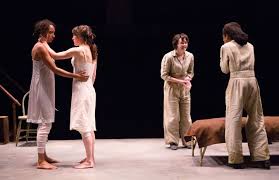
Simultaneous time, past and present, with Dee and Jamie doubled

Dee and Jamie are women before their time, full of desire and ambition and dreams that eventually are thwarted at every turn.  In prison, Dee approaches Jamie, determined to be her friend despite the African American girl’s wary suspicion.  One of the pleasures of the play is watching Jamie thaw and the two girls’ relationship warm and deepen.  To pass the time in prison, they dream about what they’ll do after, enacting ritual performances as the “servants” they decide they’ll become.  Jamie’s mother worked as a domestic; she schools Dee in how to hold her dust rag, and how to look graceful and pleasant and happy as she’s doing back-breaking cleaning work.  Wallace captures the performative posture of the subaltern, as Jamie teaches Dee the survival skills required to work under the policing gaze of the dominant class.

The materiality of the body and labor

But the flash-ahead scenes demonstrate how the two young women crack under the strain of such power arrangements.  Dee, who even in prison was willful and resistant, can’t hold her jobs because she won’t bend to her employers’ will.  And Jamie, too, finds the sexual compromises required to stay in her employer’s house impossible.  As the short play progresses, Jamie and Dee become desperate; their options run out as their food dwindles.

Wallace’s plays always focus on the intersections of class, race, and gender, and an underclass whose futures are formed by ideology they can’t quite see but can feel palpably, materially, in their daily lives.  In his New York Times review, Charles Isherwood found the play baggy, lacking tension and drama, and compared the ending somewhat dismissively to Thelma and Louise.  But in fact, like Susan Glaspell and so many women playwrights who capture the complexity of the quotidian, Wallace reads under the surface and sees the pain and power of daily decisions that compose a life.  And women’s lives, so fragile at that particular moment in the 50s, are full of tragedy and comedy and warmth and sorrow that Wallace captures elegantly.

The playing space, between two banks of audience seats

Director Caitlin McLeod (who directed a production of And I and Silence at London’s Finborough Theatre) makes good use of the long, narrow playing space, across which two banks of spectators face each other.  The set feels like a catwalk, hanging between worlds; it’s surrounded by metal stairs and bridges that weave and wonder to nowhere, like an Escher drawing.  The actors change the direction of the single, Army-style cot to signal moving from the prison cell to the room Dee and Jamie share when they get out.  Otherwise, it’s clear very little changes in their lives, as their entrapment continues. Likewise, McLeod captures the physicality of Wallace’s plays, in which the borders of bodies are often porous, or turned inside out, or show their interiors to mark the wound of ideology.

Nicks and Soule, thwarted desire

The four women who play Dee and Jamie convey the anger and affection, the hope and despair, the objectification and desire through which the characters cycle.  Samantha Soule and Rachel Nicks are especially lovely as the older pair, as they follow the thread of pride and possibility that winds around both women, linking their destinies together.  With a look and a gesture, Soule and Nicks convey the ample subtext in Wallace’s dialogue.  They carry their big tin wash bins with strength and purpose, and wash out the only dresses they own with determined pride.  Watching them work, hearing their stories, knowing their desires, is wrenching, moving, and illuminating.

Watch for Wallace’s The Liquid Plain at Signature this spring.  She’s one of our best playwrights.

The Feminist Spectator

And I and Silence, Signature Theatre, New York, September 13, 2014.

Three Acts, Two Dancers, One Radio Host

MBB, on knees, threesome
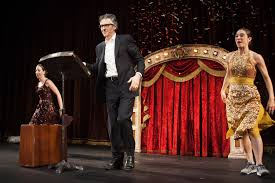
Anna Bass, Ira Glass, and Monica Bill Barnes

I have to admit that I rarely find that exuberant, affirming, utopian performative feeling I always hope for when I plan my theatre-going.  But the wish that I will keeps me buying tickets, and my desire to feel the electricity of common and hope-filled experience keeps me going to see live performance.  More often than not, I’m disappointed.

Not last week, when I caught the last performance of Monica Bill Barnes, Amy Bass, and Ira Glass’s whimsical, thoughtful, and thrilling performance at Town Hall.  The threesome—two dancers and a radio host—have toured this show on and off for the last year, and will continue to travel now that their hometown run has ended.  The evening, though, feels as spontaneous and extemporaneous as many of Glass’s radio hours, a casual but surprisingly profound and enormously satisfying tour through the ordinary in the most extraordinary way.

The two women, in sync
Barnes and Bass, in sync

Barnes choreographs the trio, embracing Glass into her long-standing duet with Bass.  The two women are terrific, athletic dancers, who enact their movement mostly in unison in a presentational, open, rhythmic style that makes them appealing—even riveting—to watch.  Their chemistry keeps you watching closely; Barnes and Bass are obviously in sync, but their facial expressions, their address to the audience, and their, well, acting, all contrast amusingly.  Their subtle on-stage competition is partly the subject of a hilarious interview Glass did with Bass about what she and Barnes think about when they’re dancing.  Their conversation is, of course, played during the show, as Bass and Barnes dance.

Monica Bill Barnes, dancer/choreographer

Of the two, Barnes is more muscular and angular.  Bass follows her step for step, but her performance style is just a bit softer, and that much more wry and sardonic.  As they move through the show’s various moods—it’s presented in three acts that more or less chart beginnings, middles, and ends of love and life—the range of their performance relationship becomes more and more impressive.

Note the mini-proscenium

Into their midst strides the very tall, thin, and physically awkward Ira Glass.  Part of the evening’s pleasure is witnessing his game and sometimes successful effort to switch idioms, to leave his head and his voice behind and perform with his loose and gangly limbs.  Despite his graying hair and stories from and about decades of his acclaimed radio show, This American Life, Glass seems like a teenager onstage.  He’s charming, diffident, and pleasantly unformed on the occasions when he follows Barnes and Bass through their routine with simplified movements.  But his willingness—to dance and to make a happy fool of himself—is heartfelt and thrilling and fun.

Glass’s fame and reach brings the audience to Town Hall.  This is where he first performed his show live, in the mid-90s, and the New York crowd adores him.  He begins the evening by carrying on an old, large, Samsonite suitcase (I think my parents had the same one in the 60s and 70s), from which he unpacks a modified music stand that he screws together while we watch.  The stand is heavy and solid; its heft gives Glass a podium from which to both mock his own presence in a live performance and to wield the whimsical authority that he plies on his show.

The Samonsite and the music stand

Throughout the performance, he reads from a text visible on the stand, but speaks in a way that feels improvised.  And he works the sound cues from a small tablet that he operates like an orchestra conductor.  The podium and his tech apparatus remind us that his stock in trade is speaking, pondering, and wondering, typically while sitting at a microphone playing stories and interviews with others.  (A very sweet moment in the piece describes how, as a very shy middle-school kid, Glass learned to deflect fearful intimacies by peppering people with questions that later became foundational to his career.)

Because Barnes and Bass use their movement vocabulary to illustrate, comment on, and contrast Glass’s stories and the music with which he underscores them, the performance offers a range of interpretive possibilities, languages, and experiences that happily, vividly collide all evening.  A post-modern meta-commentary frames the piece but doesn’t prevent it from being earnest and sincere.

The show, in fact, starts in the dark, as Barnes and Glass discuss for our amusement whether to begin with voices or bodies, with ideas or gestures.  Throughout, the “experiment,” as the artists call it, calls attention to its strategies, from the Brechtian/vaudevillian announcement of the three acts, paraded across the stage on poster-boards; to the frame-within-the-frame provided by the small, curtained proscenium through which the dancers appear in most of the first two acts; to Glass’s manipulation of the sound and stories and the interplay of his live voice and the dancers’ live bodies with their recorded voices and those of others throughout the narrative.

MMB, music stand

Those stories are sometimes poignant, often funny, and always moving examples of people’s foibles and fears.  Stories of a middle-school dance, for which Glass interviewed preteens, contrast with six adult audience volunteers who Barnes and Bass draw from their seats to perform the awkward slow dances most of us remember from the transformed gymnasiums of our youth.  A funny story about a corporate marketer who interacts with the wife he adores as though he’s a brand he’s trying to sell her contrasts with Glass’s interview with a poet laureate who writes about the death of his beloved wife.  Barnes and Bass accompany that interview and his poems by dancing precariously on a kitchen table set with dishes, supporting one another, catching one another as they each almost fall, holding one another as we learn that the poet’s wife can no longer speak, and as her eyes say her goodbyes.

The first story told and danced in the show is a hilarious, apt tale about a group of dancers performing in Riverdance who are certain they’re going to collectively win the lottery if they just have enough faith in their number.  Glass describes how the night of the drawing, they put on an electric performance, charged with their own determination to make their dream real.  They of course don’t win the lottery, and the next night, their performance, they think, drips with the sorrow of their bad luck.  But the audience, both nights, loves the show just the same.  The story demonstrates both the magic of a performance that works and the vast differences in experience between those laboring on stage and those consuming their work in the audience.  Listening to the story about dancers laboring and believing, while watching Barnes and Bass and Glass working hard in front of us, with such grace and faith, kicked me high into the moment’s utopian performativity.

I’m so glad I caught this evening (brilliantly lit by our Princeton colleague, Tony-nominated lighting designer Jane Cox, in a theatre that’s better used for public interviews and panel discussions than it is for real performance).  Listening to Glass’s This American Life is more often a singular experience; I catch it while I’m pulling weeds or driving, and I let his voice and the stories he curates transport me privately.  Being part of the enthralled audience at Town Hall, enjoying Glass but also Barnes and Bass’s vital and engaging presences, was just a delightful 90 minutes of community pleasure that confirmed the precarious, whimsical, sweet and sad, funny and poignant progress of our lives.  See this show wherever and however you can–touring dates are listed at the link below.

The Feminist Spectator

Three Acts, Two Dancers, One Radio Host, presented by Monica Bill Barnes & Co. and Ira Glass, Town Hall Theatre, New York, Friday, September 12, 2014.  See www.3Acts2Dancers1RadioHost.com for a list of upcoming performances around the country throughout 2014.