Category Archives: Uncategorized

Zero Dark Thirty

Bigelow, right, in sunglasses, directing Zero Dark Thirty

Although I hadn’t yet seen it when the Oscar nominations were recently announced, I was already miffed that Kathryn Bigelow wasn’t among those listed as Best Director contenders for her movie about the capture of Osama Bin Laden.  Here was the first woman director ever to win the award, in 2010, for The Hurt Locker, obviously being snubbed despite directing one of the most acclaimed, talked-about, Best Picture-nominated films of the year.

Now that I’ve seen Zero Dark Thirty, I’m even more perplexed by Bigelow’s absence from the list.  The film is a smart, richly nuanced, morally complicated cinematic version of a story from recent political history.  Bigelow’s vision, in concert with artistic partner Mark Boal’s eloquent script and Greig Fraser’s cinematography, makes the film the tense, suspenseful recitation of the events that culminated in Bin Laden’s assassination.  Zero Dark Thirty is also a fascinating, compelling glimpse into the workings of a government agency hell-bent on retribution with few resources with which to collect necessary information after the Obama administration ended the so-called enhanced interrogation techniques that were ubiquitous under Cheney and Bush.

Some speculate that the political backlash against Bigelow’s film might have robbed her of the Oscar nomination.  The New York Times noted that the heat from Congress and the media, in fact, has prompted screenwriter Boal to retain a lawyer.  Bigelow made a smart, articulate public statement in which she argues that “depiction isn’t endorsement” when it comes to the representations of torture to which some politicians and critics have objected.

I wonder, too, had a man directed Zero Dark Thirty, if the film’s exacting scenes of coercion would be so controversial.  Impossible, of course, to know, but I find myself disquieted along with others who’ve pointed out that even Oliver Stone’s inquiries into the Kennedy assassination and other political debacles weren’t targeted with quite this level of cross, chastising congressional venom.

Maya, at headquarters

Bigelow’s defense of her film almost mirrors the gendered polarities faced by Zero Dark Thirty’s heroine, Maya (Jessica Chastain), the CIA operative who tenaciously follows an intelligence lead to Bin Laden’s hiding place in a compound outside of Abbottabad, Pakistan.  Maya is often the only woman on the scene, whether in the “black sites” where the CIA tortures its detainees or in the headquarters in Washington where various men in suits ignore her presence unless she speaks up.

Gandolfini as the Director

In an amusing but telling scene in which Maya is among a group of agents meeting with the CIA director for the first time about their intel, when Maya asserts herself, the director asks, “Who the hell are you?”  She retorts, “I’m the motherfucker who found him.”  The director—played by James Gandolfini wearing amusing makeup and a hair piece to make him look like his character—chuckles, his admiration for Maya quickly won.

Maya is the hinge on which much of the film’s moral and ethical debate swings.  In the much discussed opening scenes, she and a seasoned colleague, Dan (in a terrifically vital performance by Jason Clarke), question a Muslim detainee who’s been in custody long enough to already be a bloody, soiled wreck.  Dan sweetly cajoles and then cruelly wounds the poor man, repeating and enacting his mantra, “If you lie to me, I’ll hurt you.”  The poor man, Ammar (Reda Kateb), is water-boarded, beaten, and encased in a box not much bigger than a standard issue Fed Ex package when he refuses to provide information.

Bigelow’s camera carefully observes Chastain’s Maya endure her first torture session, as her face subtly registers her horror at the behavior in which her presence makes her complicit.  But when Dan leaves and she’s left alone with Ammar, she refuses the empathy the prisoner solicits.  “Your friend is an animal,” he groans.  Maya doesn’t touch him—she never inflicts physical pain—but she sides with Dan when she tells Ammar that his treatment won’t improve until he provides the information they need.

Bigelow refuses, in other words, to burden her film with a righteous or essentialist feminist critique of violence as only masculine.  Her film doesn’t condone torture.  She documents it as a fact of history.  She represents it and honors the real female CIA operative on whom Maya’s character is based by giving her a steely resolve and an unshakable determination to follow her intelligence until it leads her to Bin Laden.

Maya works for 10 years, across the history told by Zero Dark Thirty, barely lifting her gaze from her computer screen and rarely leaving Pakistan and Afghanistan.  She sacrifices everything for her work.

Jennifer Ehle, as Jessica

As FS2 remarked, the film includes no romantic attachments for its leading character, and even her friendship with her one female colleague, Jessica (Jennifer Ehle), follows a more masculine model.  The two circle around one another warily at first, when Maya joins the team as an outsider/upstart.  But they grow to respect and admire one another, and Maya’s screensaver toward the film’s end depicts their finally warm relationship.  At one point, Jessica asks Maya if she has a boyfriend, but Maya demurs.

Maya’s focus on her job compromises her health and her happiness, but Bigelow and Boal paint her as a consummate professional with total devotion to her job and her mission.  In that, she becomes a 21st century feminist hero working in an agency still bound by 1950s gender assumptions.  But her intelligence and tenacity prevail.  Interesting, too, to see Chastain inhabit the lonely, isolated, singular hero shots typically reserved for men.

The lonely hero/ine

Chastain’s stark, pale white beauty helps make a character who could be remote—and in fact is, from many of her colleagues, though her camaraderie with others of them is nicely conveyed—interesting accessible and captivating.  Chastain’s cuts a willowy figure, and Bigelow and cinematographer Fraser often frame her curling red hair against swirling dun-colored desert dust.  But her beauty is slightly off-kilter; her eyes are round and large, and her lips are full and rectangular, which leaves the planes of her face to create a visual and emotional tension that makes Chastain more than a conventionally beautiful white woman.   And her emotional and intellectual acuity as a performer keeps you focused on her reactions.

Some of Bigelow’s choices seemed odd; for instance, I found it hard to believe that Maya would drive herself, alone, from her security-guarded domestic quarters to her work site, without even wearing a head-scarf in the semi-public space of her car.  In other public scenes, Maya wears an unexplained black wig or does cover her hair.  But the film never really clarifies the precarious place of a Western white woman in the patriarchal Middle Eastern culture in which Maya works for so long.

Always peering, searching

Maya has a close hold on her emotions, no doubt because of those agency gender politics.  When the Navy Seals who invade Bin Laden’s compound successfully assassinate him and bring his body back to their base in a bag, Bigelow and Boal allow the squad rather typical, macho male expressions of exultation.  Maya can’t afford such displays.  Her earlier delight in getting the green light for her long-awaited mission is subdued—Chastain portrays Maya’s excitement with a sharp intake of breath and by enlarging her already wide eyes.  Even as she watches the mission progress on her computer screen at the base, when she hears on her monitor that the Seals have got Bin Laden, Chastain plays Maya’s pleasure more as incredulity, mixed with a dawning, stunning realization that she’s achieved her goal.

The raid

When they return from their successful mission, Bigelow directs the Seals to park Bin Laden’s body bag on a cart at the back of the tent while they unpack the spoils they’ve retrieved from the compound.  She frames a shot of the cart left strangely by itself and unattended, considering the body it carries and the terror wreaked by the the man it once was.  When Maya approaches and unzips the bag, she looks at the corpse’s face and simply nods to a colleague, confirming its identity.

Bigelow and Boal downplay these moments of affirmation.  They never show Bin Laden’s face directly, making no attempt to have the actor and a make-up artist try to approximate his reality.  (Here’s terrific essay from the New York Times by the actor who played Bin Laden.)  The camera focuses on Maya and her reaction to the corpse—and on the Seals, when they invade his compound—keeping the focus on those who executed the raid, rather than inviting spectators to find prurient pleasure in what’s represented as an almost quotidian killing.

The Seals do their job, moving from floor to floor in the compound, killing two men and one of the women, corralling the many children in the house and falsely reassuring them that everything is okay.  When they reach the third floor and kill the third man, it’s only after he’s dead that the squad’s leader turns to the soldier who fired the shot and underlines the history he’s just made.

Picture of determination

No political celebration marks the film’s end.  Bigelow and Boal don’t cut to newspaper headlines or media reports or show scenes of gloating CIA operatives.  When the mission is over, Maya stands on an isolated runway alone, approaching a transport plane that arrives to retrieve her from Pakistan.  The eager young pilot says she must be very important, as she’s the only passenger on his manifest, giving her the whole, uncomfortable belly of the plane to herself.

As she buckles in and the plane takes off, Bigelow focuses in on her face, letting us watch, in one final take, as Maya lets her emotions well into choked sobs and tears that roll down her face.  In private, once she’s accomplished her mission, Bigelow implies that Maya can feel everything she’s repressed through the ten years of her quest.  In that final moment, Zero Dark Thirty shows its conscience, admitting that vengeance, too, has its costs.

A searing film like this, made by a woman about a woman’s single-minded quest to bring down one of history’s most reviled terrorists, deserves all the notice it gets.  And Kathryn Bigelow certainly deserved a Best Director nomination.

The Feminist Spectator

The Great God Pan

In another excellent Playwrights Horizons production, director Carolyn Cantor and playwright Amy Herzog create a beautiful mood piece about memory from Herzog’s latest play, The Great God Pan.  Though essentially a small domestic drama, Cantor and Herzog and an accomplished cast collaborate to make each intimate moment of emotional and historical ambiguity resonate with questions that extend way beyond the lives at stake on stage:  What do we remember and why?  What’s the difference between dementia and a “bad memory”?  How do the stories we tell ourselves about our lives become the fabric of who we actually are?  And can those stories be radically changed in middle age?

Jamie (Strong) and Paige (Goldberg)

Jamie is 32, living in New York with Paige, his girlfriend of six years, a former professional dancer working hard on a counseling degree that will fundamentally remake her life.  She specializes in advising young women with eating disorders.  Jamie’s parents, Cathy and Doug, whom he rarely sees, live in Highland Park, New Jersey—just an hour away but emotionally much more distant because for unclear reasons, Jamie holds them at arms-length.

These already precarious relationships unravel when Jamie is sought out by Frank, a childhood friend who brings stories about their past that Jamie can’t assimilate.  Frank comes to Jamie for evidence against Frank’s father, Dennis, whom he’s accusing of sexual abuse.  In fact, Frank reaches out to Jamie because in a mediation session with the family priest, Dennis has actually admitted that he touched Jamie.  But Jamie—horrified and obviously terrified—says he doesn’t remember.

Frank (Nobbs) and Jamie

Herzog hinges her play on this scene and this question.  Has Jamie built his adult life on a foundation of denial?  Does this uncovered history, a quarter-century old, explain Jamie’s problems with intimacy and his recent sexual dysfunction with Paige, whose just-announced pregnancy he can’t quite accept or celebrate?

Though each scene addresses a crucial piece of the puzzle Jamie’s life has become, the ambiguous, unsatisfying answers are less important than watching a now utterly tilted man try to fathom a new story of his life.  In small, jewel-like scenes, Herzog assigns dialogue to pairs of characters:  Jamie and Frank, Jamie and Paige, Jamie and Cathy, Jamie and Doug, Jamie and Polly, the woman who babysat Jamie and Frank when the abuse allegedly took place.  Though the scenes address the intimacies of a joint past or present, Jamie either constitutionally or emotionally isn’t capable of really digging into the facts or textures of what might have been the truth.  He can remember the alleged abuse as little as he can recall the poem Polly recited to Jamie and Frank when she took them to play by the creek.

The set (beautifully designed by Mark Wendland, with lighting by Japhy Weideman) is a flat wall that looms mostly downstage, decorated with paint and light reminiscent of green leaves in a woodsy setting.  As the scenes change, portions of this wall move in and out, offering square or rectangular boxes that serve as chairs or tables, or that evoke offices or family rooms.

The  lack of visual specificity lets you focus on the characters, whose three-dimensionality (and vulnerability) is palpable and sometimes breathtaking. Though they act simply, with clarity that often allows their characters’ quandaries challenge your own, each performer is understated but powerful.  Each character has a small but important emotional arc that underscores Jamie’s inability to make choices that will further his own adulthood.  Whether or not he was sexually abused, he seems caught, stuck and static as others move and change around him.  Has Frank’s story provided new reasons for Jamie’s stalled life?

Herzog writes with calculated indirection, so that a scene has often progressed for a bit before it’s clear what exactly is at stake.  She front-loads a scene’s emotional quotient before she gets to its narrative particulars, nicely evoking how much actually isn’t said in intimate relationships. But when the tension between Jamie and Paige prompts them to lash out at one another, in a scene that makes you cringe with its desperate cruelty, the play suggests that we don’t say things to protect one another from our own darkness, and that leaving our worst thoughts unsaid is perhaps the kindest gesture.  That Frank comes with so much to say threatens every fiber of Jamie’s existence.

Frank, whom the others suggest was always a difficult, anxious kid, remembers most distinctly Polly teaching him and Jamie to notice the signs of spring, which Jamie can’t recall at all.  And in fact, when Jamie reminds Polly about Frank’s memory, she shrugs it off, saying that she made everything up as she went along to keep the boys amused.  But through the course of the play, Jamie does come to remember that on their trips to the creek with Polly, she used to recite Elizabeth Barrett Browning’s poem about the Great God Pan, with its references to human-god-monster hybrids and horror hidden in the reeds. Jamie finally does remember a few ambiguous, portentous lines from the poem at the play’s end, which he and Frank recite in syncopated, halting recollection.

The Great God Pan is spare and concise, using its minimalism to address an ambiguous history too horrible to imagine.  Cantor nicely calibrates the production and does justice to an excellent cast.  Jeremy Strong plays Jamie with a moving mixture of incredulity and recognition.  Cantor often leaves him on stage between scenes, moving the oblique, suggestive set around him while other characters move on and off, and into and out of their scenes.  Jamie’s continual presence and near immobility illustrates his own peculiar lack of agency.

Strong’s vaguely feminine masculinity also helps evoke Jamie’s tentative relation to his own life.  His face is soft and his lips fleshy, his stature is small, and his hair just hints at gray, making him at once handsome and nondescript.  That Jamie is an investigative journalist implies he’s adept at detective work that allows him to fade into the background of his own quests, much as he does in this inquiry into his own history.

Peter Friedman as Doug, Becky Ann Baker as Cathy, and Strong as Jamie against the evocative set

Becky Ann Baker and Peter Friedman capture the desperation of parents suddenly terrified that they put their child in harm’s way and their eagerness to be prematurely reassured that Jamie is fine.  Their willingness to continue shirking their responsibility might explain Jamie’s distance from his family.  The emotional stuttering between him and his parents is beautifully captured in Baker, Friedman, and Strong’s rendition.

Keith Nobbs as Frank

Keith Nobbs brings to Frank, who’s now a gay massage therapist, a piercing bravery, as his excessively adorned “queer”-wear seems like armor meant to gird him against how stricken he remains.  (Kaye Voyce designed the costumes.)  The character could be played as obnoxious and self-righteous while he pursues his vengeance against his father.  Instead, Nobbs plays Frank as wounded and kind, tentative but determined, and insists on his humanity.

Likewise, Sarah Goldberg, as Paige, brings convincing concern to a woman who expected to rebuild her life with Jamie and can’t fathom his emotional recalcitrance.  She tries to help herself by helping others, but she’s stymied at every turn, by Jamie and by her patient, Joelle, a young anorexic (nicely played by Erin Wilhelmi), who’s terrified that Paige might actually be curing her.

The Great God Pan signals a queasy suspense throughout its taut 70 minutes without necessarily resolving anything about the characters’ pasts or their futures.  Herzog and Cantor pull us inexorably along, inviting us to take stock of the stories we tell ourselves about who we’ve been and how they add up to who we are.

The Feminist Spectator

The Great God Pan, Playwrights Horizons, New York.

Les Miz

Anne Hathaway as Fantine

I’m not a Les Miz person.  That is, I don’t know all the words to the show; I can’t keep the characters straight; and I didn’t see the Broadway production until well into its run, when the actors seemed tired and the audience was mostly comprised of people who didn’t speak English.  I wasn’t, in other words, waiting with baited breath for the film adaptation.

But since my girlfriend is a feminist musical theatre scholar, who happened to write a bang-up op-ed about the film’s gender politics for the Washington Post, I did of course see the film and can’t help but weigh in from my own non-specialist position.  Stacy (Wolf), of course, is right (despite all the horrible flaming and feminist-bashing on the Washington Post comment section under her essay)—the women do nothing but provide a passive romantic background for the central action of the male characters.

That said, Anne Hathaway, in her brief appearance as the doomed Fantine, really does put over that song.  As she sits up from her most recent degradation, shaking off the stench of the man who’s just raped her (throwing coins at her as he leaves), she convinces you that underneath her poverty-driven (and obviously make-up department produced) grime, she’s a golden-hearted woman who just fell on bad times.  Her voice is lovely, but mostly, she acts the song, and she’s a terrific actor—that’s what makes it so effective.

The first of too many inflicted indignities for Anne/Fantine, as her hair is shorn

But pauvre Anne!  To see her beautiful hair shorn off by the horrible, manipulative also-poor people to whom she has to turn to raise money to pay her debts; to see her fall into prostitution; to see her degraded at every turn as she tries to provide for her child . . . it’s probably a good thing she’s only in the film for 45 minutes.  How much more abject can you get?  And is one good song worth it?

Hugh Jackman is sweetly sincere and quite believably tuneful as Jean Valjean, the wronged ex-convict who has spent 19 years in hard labor because he stole a loaf of bread for his sister’s starving son.  His religious conversion, once he’s released on parole, persuades him to begin his life anew, using the silver he’s stolen from a kind-hearted priest to seed his new, righteous business and political ventures.

But what about all that religiosity?  What about all those close-ups of Jesus on the cross, and the two times Jackman/Valjean shoulders large heavy wooden objects highly reminiscent of Jesus’s burden?  Why make him so obviously a Christ figure?  And why play out this battle to the death between Valjean and Javert, his former jailer, on the basis of their separate but parallel beliefs that they alone are doing god’s work?

Religion . . . religion. And redemption.

I don’t know why I’m asking why—the narrative wants to redeem both men, as well as the abject Fantine, by giving them religious alibis.  All those songs about going home to god sound a bit too reminiscent of contemporary evangelicalism for my taste.  Why not comment on all that, or do something creative with it, instead of faithfully (if you will) pointing up and even emphasizing the musical’s religious undercurrents?

Likewise, what about that obsession Javert has with Valjean?  How homoerotic is that?  Is Javert so eternally preoccupied with his nemesis really just because Valjean skipped out on his lifelong parole and defied Javert’s power?  And hey, why don’t these guys have wives?  Why does Javert kill himself when he realizes that Valjean’s kindness means that his own quest for vengeance now has no meaning?  Sounds suspiciously like tortured love-that-dare-not-speak-its-name to me.

Javert’s obsession and Valjean’s continual flight from his vigilante justice becomes comical in the film, given that the even though we’re told that eight or nine years pass between various scenes, Javert keeps hovering about in Valjean’s life like gas from a bad meal.  And the film’s set—created on a sound-stage—is so claustrophobic and visually one-dimensional, it looks like none of the characters ever move house.  Instead, Les Miz seems like a French-inflected, music-accompanied, Hugo-inspired version of Groundhog Day—the characters wake up to repeat the same scenes over and over again, which makes it difficult to sustain any kind of narrative tension.

Eddie Redmayne (My Week with Marilyn) does a nice job as Marius, the would-be revolutionary who’s actually an aristocrat.  Redmayne’s fleshy lips and yearning countenance—on a face full of interesting planes that reminds me a bit of Willem Dafoe’s—let him play wounded, dreamy longing very well.  And Redmayne, too, turns out to have a decent enough voice to make it through Les Miz’s endlessly repetitive songs.

Cosette (Seyfried) and Marius (Redmayne), happily ever after

But the politics of his character go unremarked in the film.  Valjean saves him from the King’s men’s assault on the barricades by carrying the wounded younger man on his back through the sewers as Marius’s comrades die.  When the so-called revolution ends, however, Marius returns to the upper-crust family he’d foresworn (and course of gets the girl, the lovely, loyal Cosette, played with worried longing by Amanda Seyfried).  After one song where he mourns his fallen fellow fighters, he’s back in his grandfather’s estate throwing a grand old wedding party.

Although the film ends with the dead risen and returned to the barricades in a faux demonstration of revolutionary fervor for democracy, liberty, and equality, the film’s politics are only ever conservative.  The rich thrive, the poor die, the uprising fails, the guy gets the girl, the father dies so that his adopted daughter can marry (too Oedipal for my taste), and the credits role.

I guess I’m glad I saw Les Miz—one has to, given that it’s already a front-runner in the season’s awards derby.  But really—Best Picture?  I don’t think so.  The whole thing seemed so fake, without signaling that it intended to be so two-dimensionally theatrical.  The sound-stage effect make the narrative (and nearly every frame of every shot) feel claustrophobic, and director Tom Hooper’s legendary close-ups became disorienting and exhausting.  I felt like I’d spent nearly three hours sitting too close to my television.  (I finally agree with Charles Isherwood about something:  see his Arts Beat post about his reaction to the film in the New York Times.)

Samantha Barks delivers as Eponine

But awards predictions and buzz take on a life of their own.  Hathaway deserves a nomination for her performance.  And Samantha Barks, who plays the lovelorn Éponine is terrific.  She starred in the role in the West End stage production; her chops as a musical theatre performer, unlike most of the cast, shine from the screen.  The actors, though, are uniformly good, even Sacha Baron Cohen and Helena Bonham Carter, who step up gamely to play Eponine’s parents, the silly innkeepers who harbored Cosette reluctantly and then seek to profit from Valjean’s adoption of the girl.

Baron Cohen and Bonham Carter fall into easy sync as the film’s comic foils, picking pockets, stealing jewelry, and peeing in the liquor they serve with fluidly filmed, rhythmic choreography.  Would that Bonham Carter could stop repeating her turn as Mrs. Lovett, in Tim Burton’s film adaptation of Sweeney Todd.  But it was nice to see Baron Cohen performing a maniac in someone else’s script for a change, even if his singing was more Rex Harrison-style than Broadway.

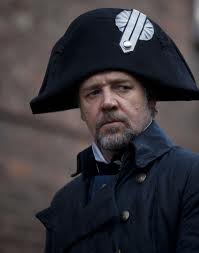
Crowe as Javert: Note that expression

Only Russell Crowe is disappointing as the villain, Javert, though Stacy tells me that the role is difficult in the best of circumstances.  Crowe seems stiff and embarrassed by this style of singing, even though he hits all the right notes.  His face is strangely devoid of emotion, or maybe, like the music itself, his performance is just one-note.  He looks uncomfortable, even constipated, even in the scenes when Javert prowls high above a (very inauthentic looking) Paris skyline, contemplating his faith and his fate.  Maybe it’s all that repressed homoeroticism upsetting his system.

. . . and that expression . . .

Les Miz is such an easy film on which to focus acclaim and approbation.  It announces its importance at every turn, from the grand opening scene where enchained men pull on thick ropes to bring a faltering ship into harbor under Javert’s cruel gaze, to the end of Act One, when the revolutionaries prepare their fight against the king, to the finale, when those now dead martyrs resurrect themselves to gild a much expanded barricade and deliver the rousing finale.

Valjean/Jackson, sentenced to hard labor before his release and remaking

But it’s not really about anything.  And the stories it does tell—about gender, especially, and about the futility of revolution, particularly—are tired and even offensive.

Films like Les Miz (and Django Unchained, which is next on my agenda) need to be seen.  But I regret spending nearly three hours on a movie that never persuaded me not to resist its insistent self-aggrandizement.  After Anne Hathaway left the screen, try as I might to give in and just go with it, there just didn’t seem to be any point.

The Feminist Spectator


Silver Linings Playbook

Jennifer Lawrence and Bradley Cooper in Silver Linings Playbook

There suddenly seem to be a number of recent films that boast a revised view of white male masculinity, from Your Sister’s Sister to Jeff, Who Lives at Home, to Liberal Arts.  I’m not referring to the awkward, insistently not queer stylings of the modern bromance, a category that seems formed to skirt the issues of homosociality and non-normative heterosexuality that their characters evoke but from which they shy resolutely away.  I’ve noticed instead more serious though often whimsical films in which the straight white male lead suffers an emotional crisis that lets him back away from more conventional social understandings of how men are supposed to act.  In an earlier era, these kinds of crises might have feminized their characters but now, they seem to authenticate a more thoughtful, even sensitive version of their straight masculinity.

Silver Linings Playbook proves another entry in this gender revision drama.  With Bradley Cooper proving his acting range, and Jennifer Lawrence continuing to impress with her terrifically nuanced, strong and quirky performance, the film sets their characters on a winding, carefully picked path toward one another through the minefields of their own damaged lives.

Pat (Cooper), his mother (Weaver), and his friend, Danny (Chris Tucker) returning from the hospital

Cooper plays Pat Solitano, an emotionally complicated, officially bipolar middle-class white guy who’s sprung from a psychiatric facility by his mother (Jacki Weaver) as the film begins.  He might not yet have completely come to terms with the violence he inflicted on the man he caught having an affair with his wife.  But he’s remorseful about the crime and earnest enough about his own rehabilitation to eagerly leave his Baltimore hospital and return home to the modest Philadelphia neighborhood where he moves in with his parents to reboot his life.

Jacki Weaver and Robert DeNiro as Pat's worried parents

Weaver is wonderful as the stereotypical, golden-hearted mother who adores her youngest son.  She serves mostly to keep the peace between Pat and his equally, if differently, psychologically afflicted father, Pat, Sr. (Robert DeNiro, in a lovely, understated performance as the OCD patriarch).  Weaver plays the mostly reactive wife/mother, who beams back and forth between her men proudly, just hoping that they’ll continue to get along.

Bradley and DeNiro as Pat Jr. and Sr., cut from the same cloth

When Pat barges into his parents’ bedroom in the middle of most nights with some cockamamie idea he needs to unload, Weaver’s sleep-blurred love and acceptance of her son’s odd quirks is moving and somehow true.  Weaver grounds Silver Linings as the missus determined to make the most of the new normal Pat’s diagnosis brings to their lives.

Chris Tucker co-stars as Danny, one of Pat’s fellow patients, who keeps giving his minders the slip.  He reappears often and unexpectedly in Pat’s post-hospitalization life to insist that he, too, is cured, even though his own idiosyncrasies indicate that psychiatric health is relative indeed.  Tucker’s unremarked race—though he plays Danny with an “urban” dialect and brio that underscore his difference from Pat and his Italian family—offers a strange backdrop against which to play out Pat’s chance to remake his life.

Chris Tucker as Danny, the zany friend who's also a patient at the hospital

Tucker often provides the film’s broader comedy in ways that come perilously close to stepping and fetching.  But the actor’s own bravado and his complex performance thankfully keep the role more real than director/screenwriter David O. Russell (who adapted the story from Matthew Quick’s novel) might have intended.

Likewise, Anumpar Kher plays Dr. Cliff Patel, the psychiatrist assigned to keep Pat on his meds and to help him ponder his mental health outside the safety of the hospital.  The compassionate, empathic doctor understands Pat’s illness and offers practical help.  But for this character of color, too, Russell devises a strange plot twist in which Patel and his friends bump into Pat and his family at an Eagles football tailgating party, where the South Asian men are harassed by a group of white Philly thugs.

Anumpar Kher as Dr. Patel giving Pat advice . . .
. . . then wearing green face paint after the debacle at the game

Pat and his father and brother battle the bullies, and Dr. Patel winds up tagging around with the family through the rest of the film, wearing the weird green face-paint that Eagles fans sport around game time.  That Pat accumulates this rather odd extended family through his disease seems part of Russell’s point. But the film’s racial overtones are oblique rather than illuminating.  Perhaps to represent a new white masculinity, Pat needs these men of color nearby to shore up his continued centrality.  I’m not sure . . .

Likewise, John Ortiz plays Pat’s best friend, Ronnie, in another racially inflected casting choice.  Ronnie and his wife, Veronica (an underused Julia Stiles), are Pat’s connection to his wife, Nikki (Brea Bee).  Pat mistakenly believes he can reconnect with Nikki, despite the physical and emotional damage his outburst over her infidelity caused.

In fact, that he nearly killed Nikki’s lover isn’t examined very closely here.  Cooper plays Pat with a manic energy, but without implying the threat that the beating he bestowed might imply.  We have to take on faith that Pat is truly recovered and that while he still seems emotionally wild, he’s got his physical brutality under control.  It’s a bit shifty that we’re asked to identify with and cheer on a cuckold whose violent outburst the film suggests is justified, if induced and intensified by his bipolar disease.

Lawrence as Tiffany

Ronnie and Veronica introduce Pat to Tiffany (Lawrence), Veronica’s widowed sister, hoping to distract him from the lost cause of his marriage.  Tiffany’s husband has been killed in a senseless car accident about which she feels guilty—he was off buying her lingerie to help reinvigorate their sex life when he died.  In response, she has sex with everyone in her office and develops a reputation as a mournful “slut” that she wears proudly.

Tiffany and Pat, first meeting

Lawrence plays single-minded, sad Tiffany as bothered not at all by what anyone might say about her behavior.  She wears black; she says what she wants; and when she decides she’s interested in Pat, she tracks him mercilessly, popping up unexpectedly beside him in her running clothes while he’s out for his daily jogs through their neighborhood.  She’s the aggressor in the relationship, courting him with the promise of nothing more than clear-sighted companionship and her shared understanding of his grief.

Pat wears a garbage bag over his clothes when he runs so that he’ll sweat more, since Nikki once insisted he lose weight.  Other characters comment regularly on the reformed Pat’s new body, and Cooper wears his own hunky physique lightly, with the pride of someone unaccustomed to having his appearance remarked.  Although he’s the romantic lead, Cooper performs like his is the character part, and for most of the film, it really is.

In its last moments, when the film shifts into romantic comedy mode, Cooper steps into a performance recycled from a more conventional genre so that he can “get the girl.”  But until then, the quirky comedy lets him shirk his beautiful person persona and play someone much more broken and layered.

All the right moves

Silver Linings Playbook comes together around a dance competition for which Tiffany insists Pat partner her.  She does their choreography and he gamely tries to follow along.  In a silly subplot, one of Pat, Sr.’s friends persuades him to bet all the money he’s been saving to start a restaurant on the outcome of an Eagles’ game.  He also throws in stakes for Pat and Tiffany; if they can score at least a five in their competition, he’ll forgive the bet.  The only thing the bet accomplishes is to bring Pat’s whole family (and his ex, Nikki) together to cheer on Pat and Tiffany when they compete.  The ensemble’s investment in the outcome of the dance contest is deep and their spirits are high.

I’m not giving away the story here, since the last third or so of Silver Linings is predictable.  But Cooper and Lawrence play Pat and Tiffany’s developing trust and understanding with sensitive clarity.  Their commitment to the make-shift moves of their competition choreography and their willingness to make fools of themselves as actors if not as their characters, makes the scene endearing and funny.  Naturally, after they score a five, and after she misunderstands a conversation he has with Nikki at the dance event, Pat confesses that he’s in love with Tiffany.

In a short epilogue, Tiffany joins the Solitanos in their cramped but cozy home, celebrating an Eagles win.  Lawrence crawls onto Cooper’s lap in an overstuffed chair and they cuddle happily.  Silver Linings Playbook might end on a slightly facile note, but the moment coaxes a smile from the typically poker-faced Tiffany that lights up the screen.  Her expression shows in an instant how in control of her performance Lawrence has been until that moment, as it’s the first in which she allows the character to crack her gruff, suspicious façade and show her heart.  Pat responds in kind while his mother watches proudly and it’s kind of impossible not to get behind the moment with them.  Pat has insisted throughout that he’ll get his silver lining; with Tiffany on his lap, how can you not believe he’s been successful?

Tailgating, with his shrink to the left

Russell also depicts the football fanaticism of middle-class Philly inner-city neighborhoods without condescension.  Pat wears an Eagles jersey to the dinner party where he meets Tiffany, embarrassed that Ronnie sports a tie and Veronica a dress.  His dad, Pat, Sr., is superstitious enough to believe that Pat’s presence in front of the television watching the game brings the team luck.  And when even his shrink turns out to be a gleeful fan, you realize that these men find their commitment not only to sports but to one another through their love of the game.  Pat’s playbook is just as important as his silver lining.  And in the end, he achieves them both.

The Feminist Spectator


Any Day Now

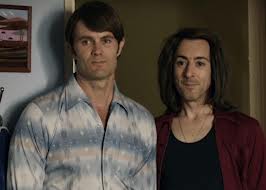
Paul (Dillahunt), Marco (Leyva), and Rudy (Cumming), would-be family

I came out as a lesbian in Boston in 1977, into a subculture of women’s bars, women’s music, women’s theatre, and feminist newspapers and political activism.  To my relief, I became part of a thoughtful, creative community that formed itself against the era’s dominant culture, which mostly sneered with dismissive antipathy at lesbians and gay men.

The most visible LGBT movement has at present turned its attention to assimilationist issues like marriage and the military. But a few decades ago,  when I came out and when Any Day Now is set, gay and lesbian politics had a utopian impulse and a radical commitment to change social relations.  In the 70s, the movement boasted more intersectional activism, in which gender, race, class, and sexuality were considered equally important in the struggle toward equality for all.  Activists theorized the rights of a diverse LGBT people to live in sexually, culturally, and domestically reimagined ways.

Travis Fine’s film Any Day Now parses the dismal political climate against which the movement dreamed its dreams, when to be out was impossible if you also wanted to hold on to your job and move through dominant culture unscathed.  The film evokes the stakes of what it meant to be white gay men from 1979 into the early 80s in West Hollywood by telling the story of a couple trying to adopt a child with Downs Syndrome who’s been abandoned by his drug-addicted, negligent mother.  The film is a sober, necessary reminder that not that long ago, the courts could discriminate against lesbians and gay men with utter (as opposed to relative) impunity.

Cumming as Rudy

Alan Cumming gives a bravura performance as Rudy, an arch but compassionate out gay man who lives down the hall from the drug addict, Marianna (Jamie Anne Allman, who played the morally corrupt sister, Terry, on The Killing).  Rudy notices her son, Marco (Isaac Leyva), wandering their building’s hallways with a long-haired blonde doll clutched in his arms when Marianna kicks the boy out of their apartment so that she can have sex with one of her drug-peddling johns.  After Marianna is arrested for possession, Rudy takes Marco in, determined he won’t get lost in the cold bureaucracy of Los Angeles’s social services.

Although he aspires to be a “real” cabaret singer, Rudy works as a female impersonator, lip-syncing to disco tunes at a gay bar.  Rudy’s act is lively and fun, but he’s really a torch singer.  Marco helps him mail demo tapes to LA cabarets, and one eventually bites, employing him to sing two nights a week.  By the film’s end, Rudy’s cabaret performance—with songs Cumming delivers beautifully—expresses all his longing, loss, and heartbreak.

At the start of his personal crusade to adopt Marco, Rudy meets Paul (Garret Dillahunt of television’s Raising Hope), a divorced man just coming out, on Paul’s first visit to the club.  Director Fine shows Paul sitting in his car, working up the courage to join the group of men wandering in and out of the bar.  When he finally manages to go in, Rudy spots him instantly and the two form a quick, loving bond.

Paul and Rudy get ready for court

Paul is a straight-acting assistant district attorney who Rudy enlists to advocate for his guardianship of Marco.  Their crusade becomes personal, as Paul’s affections for Rudy and Marco deepen quickly.  The two men move in together with the boy in tow and proceed to face a series of humiliating court and social battles in their effort to keep Marco and to protect their very fragile family.

The sad story moves predictably, with homophobic judges, lawyers, and district attorneys becoming ever more mercenary as they conspire to keep the two men from adopting Marco.  The poor boy is shuttled from foster homes to institutions, where he clutches his doll and cries himself to sleep.  Rudy’s promises that he and Paul will come for Marco turn out to be false, despite their best intentions, as the courts in the early 1980s—pre-HIV/AIDS but far before the civil rights victories of the 90s and 2000s—have no intention of letting the couple become Marco’s parents.

When the DA conspires to reduce Marianna’s jail time if she’ll reassert her parental rights, Paul and Rudy’s case is dismissed and Marco goes back to live in the apartment he insists isn’t his home.  Marianna returns to her drugs and her tricks and Marco is once again banished to the hallway.  In the film’s heart-breaking climax, he wanders out of the building, into the street, down to a bridge, and the camera watches him disappear, clutching his ubiquitous doll, never to be seen again.

Fine adapted the Any Day Now screenplay from a story inspired by true events, but the film advances in somewhat contrived ways.  Spectators might be as incredulous as the prosecuting attorney (played by Gregg Henry as resolutely unsympathetic) that Rudy and Paul decide to live together two days after they meet, or that Paul, after so recently coming out, would devote his life and sacrifice his career for his relationship with a drag performer and a stranger’s child.  But these believability issues pale in front of the cast’s empathetic performances.

Playing a 70s-style couple

Cumming can be a flamboyant actor, who sometimes mugs for the camera in ways that make him seem imperious.  (Though his performance as the aggressively ambitious but always disadvantaged Eli Gold on The Good Wife is smart and funny.)   In Any Day Now, Cumming jettisons such shtick for a restrained and effective performance as a gay man living an underground life who’s suddenly thrust into a public court system that judges him harshly.  Watching Rudy try not to be quite so gay in front of judges and lawyers who openly despise him is wrenching, and demonstrates Rudy’s determination to parent a child who no one else wants.

Marco (Leyva), happy with Rudy and Paul

Leyva is lovely as Marco, a placid, affectionate kid who loves dancing to disco and eating donuts and does his homework without complaint.  Cumming and Dillahunt are warm and kind with him, careful to treat the boy with respect and dignity.  The film, though, pities Marco just a bit, using him as the abject disabled kid through whom Rudy and Paul can prove their humanity.  Any Day Now, that is, might be an incisive portrait of gay life in the 70s, but it won’t win awards for how it portrays a disabled boy.

But at the same time, Fine doesn’t create a triumphal narrative at Marco’s expense.  Rudy and Paul aren’t exceptional parents; they’re quite ordinary, although more unobtrusive and discreet, given that they have to pretend to be cousins when they’re out in public with Marco.  The film simply suggests that their love is as good for Marco as that of any straight parents to whom he might be assigned.  The prosecuting attorney, however, insinuates that Rudy and Paul have already compromised Marco because he carries a doll.   The prosecutor relies on strict gender assumptions and overlooks Marco’s much longer term attachment to his companion-doll to press his case against the gay couple.

Rudy and Paul’s relationship is an open secret.  Even Paul’s boss, the district attorney (played as smug and cocky by Chris Mulkey) can read the signs of intimacy they try—to no avail—to hide, and he punishes them for it accordingly.  The tragedy of Marco’s loss is the cruelty of a system that wouldn’t let gay men parent him.  It’s the tragedy of history, when out gay men and lesbians were regularly torn from birth children they’d had in straight marriages, and when queer couples couldn’t dream of adopting kids.  Although laws have since become less stringent, gay adoption and custody continue as vexed, litigious issues.  Any Day Now reminds us that we can’t take our gains for granted.

Any Day Now is filmed in grainy stock meant to lend the story a documentary feel as it captures the grit of gay life in the 1970s.  The colors are muted and the apartment settings where Marianna and then Rudy live with Marco look washed out and tired.  Paul’s place is a step up, decorated in the brown earth tones popular in the 70s.

The white men wear long sideburns and the African American lawyer, Lonnie (Don Franklin), who’s the last to take Rudy and Paul’s case sports an Afro that looks unfortunately silly.  The one sympathetic woman in the film—Marco’s special ed teacher, Miss Flemming—is played as a liberal, peasant-dress-wearing Hippie by Kelli Williams.

The effort to recall that moment, with all its sartorial excess and earnest, urgent politics is commendable. Any Day Now reminds audiences that being counter-cultural in the 70s, after the heyday of the 60s, really wasn’t cool.  And being gay even less.

The Feminist Spectator