All posts by THEFEMINISTSPECTATOR

I’m Getting My Act Together and Taking it on the Road

Artistic Director Jeanine Tesori

City Center’s new summer “Encores! Off-Center” series was inaugurated this month with Jeanine Tesori as Artistic Director.  The program is an off-shoot of the wildly popular Encores! series, which presents historic Broadway musicals in “staged readings,” although over the years, the productions have become more and more star-studded and elaborate.  The new summer series features musicals that originally played Off Broadway.  I was sorry to miss the first two productions—Violet and The Cradle Will Rock—and delighted to see last night’s opening of I’m Getting My Act Together and Taking it on the Road.

The revival at City Center

This chamber-ish/rock-ish/folk-ish musical, first produced by Joe Papp at the Public Theatre in 1978, is a delightful proto-feminist tract with a book and lyrics by Gretchen Cryer (who played the lead in the original production) and music by Nancy Ford.  Both women joined the curtain call at last night’s opening.  Cryer and Ford were also present at a lobby conversation with Ted Chapin, head of the Rogers and Hammerstein Organization, who spoke about his book on Follies and loosely connected that Sondheim show to Cryer and Ford’s, which also opened in New York in the 1970s to mixed reviews.

At the end of Chapin’s informal reading and talk with Tesori—who proved a lovely host for the casual conversation—I saw a number of the women present approach Cryer to tell her how much her show had meant to them nearly forty years ago.

Nancy Ford, Renee Elise Goldsberry, and Gretchen Cryer, opening night

It’s easy to see why.  In a year when Broadway boasted openings like a revival of Hello, Dolly!, Deathtrap, Da, and The Best Little Whorehouse in Texas, and when Off-Broadway offered Sam Shepard’s Buried Child and Curse of the Starving Class, I’m Getting My Act Together must have seemed like a much-needed tonic for women who were trying out the precepts of second wave American feminism.

The musical wasn’t alone in plying gendered insights Off-Broadway in ’78.  Maria Irene Fornes’s foundational Fefu and Her Friends opened that year, along with Marsha Norman’s Getting Out and Tina Howe’s Museum, both important plays in the history of American women’s theatre.  Genet’s The Maids and Arthur Kopit’s Wings also offered interesting perspectives on women and gender roles Off-Broadway that year.

From a production of Merriam's THE CLUB

Eve Merriam’s The Club, which was produced at Circle in the Square in New York in 1976, might have been one of the first explicitly feminist small musicals.  That piece, for which Merriam wrote the book, lyrics, and music, cast a group of women as officious men at an all-male club, and used the gender drag to poke righteous fun at constraining gender roles.

But I’m Getting My Act Together feels more urgent and pointed in its feminist insights and demands.  The book is driven by 39-year-old Heather’s desire to take control of her own artistic and personal destiny, which she demonstrates through songs she writes and sings, along with two supportive women back-up singers and a five-piece male band.  The show’s narrative conceit is that Heather (with the sublime Renée Elise Goldsberry playing the role Cryer originated) has renovated her act as a singer-songwriter, moving away from the “stand by your man” folk ballad that established her reputation toward rock-inflected anthems about women’s empowerment that assert her own agency and her refusal to play the good girl role any longer. 

Sanchez and Goldsberry perform a song about the disappointments of marriage

Heather has to convince her long-time manager (and former flame), Joe, that the new act will sell.  He watches Heather and the band rehearse for that night’s opening, distressed by the feminist rhetoric in her new songs and her patter, and determined to turn the clock back on Heather’s style and message.  In the face of his Neanderthal attitudes (gamely enacted by Frederick Weller in his clueless Shane Mungitt mode from Take Me Out), Joe loses to Heather’s feminist determination.  On the occasion of her opening and, as it happens, her birthday (literally and, of course, metaphorically), she soldiers ahead with her artistic innovations and her political critique.

Thirty-five years after its first production, I’m Getting My Act Together shows the creakiness of time passing in some of its dialogue and lyrics.  Heather finds her feminist idealism as we watch, and declaims it in monologues meant to persuade the recalcitrant Joe of her now firm beliefs.  Her speeches sound at once naïve, because their rhetoric is now so familiar, but also really thrilling, because her critique of unequal gender roles and lowered expectations for women still, remarkably, pertains.

Goldsberry and Frederick Weller as Joe

We can laugh at Joe’s sideburns and his aviator frames and his patriarchal language and attitudes, all of which are overblown here for comic effect.  But it’s hard to deny that most women popular artists—singers and actors and otherwise—are still expected to be non-threatening and compliant, to not rock the gender and sexuality boat and to play to the crowd to enrich the box office.  Heather finally just refuses, and that makes her a hero not just for the ‘70s, but for now.

Cheryl, Alice, and Heather rock out

Directed and choreographed for speed and efficiency by Kathleen Marshall, the cast is wholly wonderful.  As the energetic and empathetic back-up singers, Alice and Cheryl, Christina Sajous and Jennifer Sanchez are lovely presences, singing and dancing their implicit support for Heather’s position.  One of the show’s running jokes is that Joe asks Cheryl to go get him drinks and things he could easily get himself.  She’s the “girl” who’s accustomed to serving the more powerful man and goes without question, although a dubious, poignant look clouds her face before she leaves the stage.  These are women unaccustomed to standing up for themselves, though Alice breaks out in a solo that demonstrates her nascent physical and vocal power.

Rabinowitz and the band

Jason Rabinowitz is Jake, the acoustic guitar player with a crush on Heather, even though she’s 15 years his senior.  Rabinowitz manages to be utterly sweet without sinking into sentiment, as he plays a folk version of Heather’s former hit song, “In a Simple Way I Love You,” that almost but doesn’t quite melt her heart.  (It certainly warmed the opening night audience’s.)  He’s tousle-haired and adorable as he offers himself for her companionship.

The other band members, several of whom have a line here or there, wear long-haired wigs and the accessories of late ‘70s fashion, and accompany Goldsberry, Sajous, and Sanchez with a folksy proto-rock rhythm that lets the women’s voices and charisma shine.

(See “Miss America,” a song from the production.)

Goldsberry is the real find here.  She played the remote suburban wife opposite Tate Donovan and Frances McDormand on Broadway in David Lindsay-Abaire’s Good People; she also performed in The Color Purple (as Nettie), Rent (as the final Mimi), and The Lion King.  In last season’s The Following, on Fox TV, she was cast as the unfortunate, doomed lawyer of the vicious escaped con, Joe Carroll (James Purefoy).  But this role lets her cut loose with her enormous talents and demonstrate her real star power.

Cryer, the original Heather, is a white woman; Goldsberry is African American.  The new casting isn’t underlined and the script doesn’t appear to have been adapted, but the choice does bring nuances to the role and the production that might not have been present in 1978.

Goldsberry shines

And Goldsberry is terrific as Heather.  She’s a bundle of energy and focus, vivid with her newly embraced agency and determination.  Goldsberry also manages to deliver Heather’s more earnest lines and monologues in all their radical feminist glory, without apology or hesitation.  Her performance is full of its own fervid belief, which persuades the audience to admire and appreciate her intervention into the misogyny of the music business, which was the tip of the sexist iceberg floating through American culture at the time.

Too bad I’m Getting My Act Together only plays for four performances; maybe they can take it on the road.

Opening night curtain call with Ford and Cryer

The Feminist Spectator

I’m Getting My Act Together and Taking it on the Road, Encores! Off-Center, through July 27, 2013.

The Heat and Melissa McCarthy

Good cop, mad cop indeed . . .

I’ve loved Melissa McCarthy ever since I saw her in Paul Feig’s wonderful Bridesmaids, where she stole the show with her performance as an over-sized, over-sexed-in-her-own-mind, straight-shooting, golf-shirt-wearing sister of the groom.  I admit to being a Sandra Bullock fan, too.  Her work in Miss Congeniality is an hysterical parody of conventional femininity, and her more serious roles (in The Blind Side, despite its dubious race politics, and Crash, likewise) show impressive range.  That McCarthy and Bullock would pair up for a female buddy cop movie had me gleefully anticipating The Heat’s release. 

Melissa Silverstein, in her “Women & Hollywood” blog, urged spectators to see the film opening weekend, so that we could be counted in the all-important box office numbers that record audiences’ initial enthusiasm.  She pointed out that given the continuing dearth of films starring women in leading roles—especially in summer blockbuster or comedy fare—it’s important to demonstrate support for a film with two female leads, directed by Feig, and written by a woman (Katie Dippold).

Happily, The Heat took in $40 million its opening weekend, which counts as a success by industry standards.  And according to IMDb, as of July 19, the film has grossed $129,271,224, well ahead of its estimated $43 million budget.

Advocacy for women in film aside, The Heat isn’t a perfect film.  Because the cop-buddy genre is already tired, even with two women playing the roles The Heat is predictable.  The movie doesn’t break ground the way Bridesmaids did, with its scatological humor, its surprising scenes, and its focus on a female friendship endangered by a woman’s marriage.  But The Heat offers enough laughs that it’s worth two hours and a bucket of popcorn for another view into McCarthy and Bullock’s talent.

The premise, of course, panders to the summer audience.  Bullock plays Sarah Ashburn, a character IMDb calls an “uptight” FBI agent, and McCarthy plays Shannon Mullins, a “testy” Boston cop, who are paired against their wishes to bring down a drug kingpin.  No surprises in this “opposites attract” narrative.

Bullock as Ashburn looks like a pro

Ashburn is neat and controlling, book smart but socially and professionally awkward, and has some misbegotten ideas about the etiquette of handling suspects.  (She tries to be solicitous and polite, which in this film never works.)

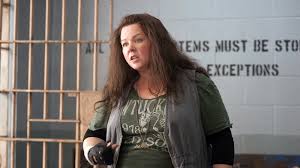
Mullins is messy, unkempt, and uncontained.  Her way of getting information is to throw a phone book at a suspect’s head or to threaten to shoot his balls off.  The women’s innate distaste for one another’s differences is established with by-the-book run-ins before they’re forced to team up.  And it’s no surprise that by the end, they’ve become friends and mutual admirers.  Why can Hollywood only imagine female friendships in this genre if the characters appear to overcome the odds of the radically different ways they perform their femininity? 

McCarthy's look is more down and dirty

Bullock and McCarthy are smart actors—you can see them working hard to rise above material that seems crafted for lowest common denominator audiences.  Dippold’s script does take some well-aimed shots at the position of women in a male-dominated workplace.  For different reasons, Ashburn and Mullins revolve outside the inner circle of white men with power in the FBI and in the Boston Police Department.  When Ashburn walks by the squad room and hears the men belittling Mullins, she doesn’t hesitate to stop and stand up for her partner.  They’re too singular in this landscape not to make common cause.

But because The Heat has to be funny, it can’t dwell on feminist insights about women and work.  Most of the humor comes from the unlikely ways that both Ashburn and Mullins negotiate not just the FBI and the police force, but their femininity, which neither of them “do” very well in conventional terms.  Bullock began her career playing capable tomboys whose preoccupation with their work makes them misfits among conventional women.  Miss Congeniality cleverly satirizes expectations generated by the beauty pageant industry, with its desperately constrained performances of conventional white femininity.  When her sweat-shirt- and jeans-wearing character has to go undercover in a pageant, the film illustrates how femininity is in fact just a construct.  Bullock plays her character’s bumbling attempts to look “natural” in outfits and make-up she never wears with real comic confidence. 

Even in THE HEAT, still something of a tomboy . . .

In The Heat, Bullock’s physical comedy talents are mostly wasted, as she becomes the “straight woman” to McCarthy’s more comic foil.  The pairing requires Bullock’s Ashburn to look “professional” in sexy but conservative pants and blazers that contrast with McCarthy’s slovenly cargo pants, t-shirts, and canvas vests.  (One visual joke is that McCarthy always wears dirty white wristbands, a costuming choice carried over from Bridesmaids, in which the bands were mostly black.)

Without more conventionally performed femininity to stand as a contrast, Bullock becomes the more or less “good girl” against whom McCarthy plays the unruly female whose dress style, language, and mannerisms put her much farther outside the acceptable realm of gendered propriety.  The choice leaves Bullock little to do, and consigns McCarthy to another version of a character I hope won’t stick with her throughout her career—the trash-talking, zaftig woman who makes up for what the film already considers her “unattractiveness” by taking charge with a “fuck-you” attitude and being good at whatever she does.

One of the jokes about Mullins (as with all of McCarthy’s characters, including the common criminal she plays in Identity Thief) is that she’s a sexual virago.  Throughout The Heat, a running bit  has her bumping into various men who make moony-eyes at her and ask her why she didn’t call them for a second date.  Mullins prefers the one-night-stand, love-‘em-and-leave-‘em lifestyle, which is supposed to represent not her fear of commitment, but her dedication to her job.

I want to see this as Feig and Dippold’s choice to quote and mock the conventions of male buddy pictures, in which toughened guys sleep with women because they have to (to reassure audiences that they’re not queer) but who live for their work (or their saddles or their cattle or whatever it is that makes them “manly” in a given film).  McCarthy pulls off the comedy, as one man after another is brushed off with a gesture, a casual remark, and a turned back.  But I worry that part of what seems “funny” here is that a woman who looks like Mullins could ever really be sexually attractive.  The film invites a laughing at even as it proposes that we laugh with Mullins’s indifferent romantic life.

Likewise, Ashburn admits that she was married once, but couldn’t juggle a relationship with her own workaholic style.  These women like their jobs and they’re good at them—the conflict here isn’t about whether they should give up their professions for marriage or relationships.  That’s a good thing.  But that Ashburn has already been married secures her ability to procure a man, which moves her farther along the “normal” continuum than The Heat suggests Mullins can ever travel. 

Shaking down a perp

The melancholy of The Heat comes from the two women’s innate loneliness and isolation in the professions they love.  Neither has a female friend, and the men with whom they work deride them, if for different reasons.  Ashburn is too smart for her own good.  She finds drugs and guns where her male colleagues overlook them, which makes them feel jealous and humiliated.  But when she expects a promotion based on her good work, her superior (Demian Birchir) tells her that no one likes her and she has to prove she can get along with people before he’ll take her seriously.  Learning to get along with Mullins is the sorry joke she has to suffer through to prove her obvious talent for her job.  Men in films are rarely told they have to learn to get along with people.  Men are allowed to be unlikable, as characters and as co-workers (and as actors).  But Ashburn has to do penance for her proficiency and her inability to win her colleagues with conventional feminine wiles.

Mullins, too, is good at what she does and is ostracized for her “unconventional” methods (ones celebrated in other films—look at Denzel Washington’s character in Training Day).  Her working class, stereotypically drawn Boston family hates her because she was responsible for putting her brother in jail, even though he was dealing drugs and working with unsavory characters.  The scene in which Mullins takes Ashburn home to see her family ricochets between hysterical and utterly distasteful.  Jane Curtin is wasted as Mullins’s cranky, hostile mother Mullins’s brothers and their girlfriends are portrayed as Southie stereotypes.  But their inability to “read” Ashburn is consternating for her and funny for us, as they ask her, “Are you a guy?  Or a girl?”  And don’t believe her answer.  And ask her how she hides her facial hair.  The Heat needs more of these off-kilter, less obvious, situation- and character-driven moments, instead of hanging all of its humor on a plot that barely makes sense and is really beside the point. 

Opposites always attract

Despite their different styles, Ashburn and Mullins are kind of made for each other.  And happily, they do form a friendship by the end, a sisterhood signaled when Mullins signs Ashburn’s woefully under-populated high school yearbook by calling her “family.”  The grand emotional finale is saccharine and expected.  The conclusion to their professional stories is less predictable:  Mullins gets a honor for her police work, which her contrite and now proud family attends and at which they cheer (too) enthusiastically.  But Ashburn gives up her bid for an FBI promotion at her home office to stay in Boston.  Maybe she’ll finally date Levy (Marlon Wayans), the lovely African American colleague in her new office who’s been subtly flirting with her throughout the film.  Wayans is wasted, too, in a role only meant to secure the women’s heterosexuality.

McCarthy’s two major release films this year demonstrate Hollywood’s discomfort with a woman whose body size scales up from the tall, thin white women who remain the industry’s physical standard.  The Heat and the truly odious Identity Thief from earlier this year equate her weight with a kind of crass white-trashy-ness, and mostly evince their producers’ uneasiness with her body size (see my guest blog post on Symposium, “Hollywood has a Weight Problem,” which is expanded on here).  The characters these films create for McCarthy move outside the bounds of conventional white femininity in ways that their narratives judge harshly.  In Identity Thief, she is the criminal, a disobedient, loudly dressed woman who steals the button-downed Jason Bateman character’s identity. 

Planning to steal Jason Bateman's identity in IDENTITY THIEF

In both cases, the films’ comedy comes from the distastefulness with which the conventionally-sized and conventionally-attractive leads face their co-star’s adversarial character.  And although in both cases, the leading characters grudgingly learn to respect and even like one another by the film’s end, these reconciliations are always at McCarthy’s expense.  In Identity Thief, Bateman’s wife is played by Amanda Peet, casting that further underlines McCarthy’s character’s intractable and criminal inappropriateness.  The film uses McCarthy to represent all the ways in which the “world” (that is, women and alpha men) oppress well-meant but nondescript guys like Bateman’s character, who has to prove his salt (that is, his masculinity) and save his job by taking McCarthy down.

McCarthy tries hard, in both films, not to be the butt of the jokes.  Her comic timing is impeccable and smart; apparently, in The Heat, she and Bullock improvised much of the script.  (McCarthy did time with the Groundlings, a well-regarded improv troupe in LA, earlier in her career.)  She’s known for her on-set professionalism, and in interviews, she demurs when asked about being a “role model” for fat (or even normal-sized) women.

But numerous feature stories about McCarthy can’t help but see her as exceptional, as a heavy-set woman garnering starring comic roles.  In a recent People Magazine interview (see excerpt here), McCarthy says she hopes that she’s cast for her talent, not for her size.

Would that Hollywood could produce scripts worthy of her skill and potential.  Meanwhile, I’m glad The Heat is doing well at the box office—maybe it’ll encourage better scripts with better characters for McCarthy and for Bullock.

The Feminist Spectator

Addendum:  In response to this post, several people wrote to tell me they found The Heat racist, sexist, and transphobic.  Here are two pertinent essays on the film supporting that perspective, one by Joan Walsh, on Salon.com and another by Megan Kearns, on Btchflcks.com. Another review, by Briony Kidd, on an ABC affiliate site in Australia, lauds the film’s comedy and its leads.  If nothing else,  I’m glad the film is inspiring debate and attention.