Yearly Archives: 2013

The 2013 Tony Awards Show

Can’t Neil Patrick Harris (NPH) be hired to host all of the televised award shows?  Good thing he’s already lined up to do the 2013 Emmy Awards in June.  If the producers of the Oscars were smart, they’d hammer out a contract and sign him on.  Compared to the puerile, offensive humor of Seth MacFarlane as the host of last year’s Academy Awards, NPH’s PhD in hosting easily trumps McFarlane’s nursery school rendition.

NPH, of course, is openly gay, which I have to think lands him closer to the center of the hosting bulls eye from the start.  He somehow understands the fine line between satire and parody and sincerity that these shows demand, as they both honor and send-up the nominated work.  If awards shows are really just long commercials for the product they’re touting, and a chance to see adorned celebrities read from Teleprompters or improvise and show their “real” selves, a good host has to strike the balance between toast- and roast-master.


NPH singing and dancing his heart out in the opening

NPH most often trades snark for sweet, with self-deprecating charm that brings the whole audience along instead of aiming only for the lowest common denominator (take note, MacFarlane).  And he sings, dances, and patters with the best of them, willing to aim both high and low.  Shouting out to the kid watching somewhere and yearning to be part of what was all night honored as “the Broadway community,” NPH noted, “We were all that kid” (one of the show’s early highs).

French-kissing Sandy the Annie dog, as they sat companionably on the side of the stage at Radio City, might have been lowbrow, but I found it hysterical.  NPH doesn’t take himself too seriously, and he positions himself squarely inside the crowd he’s addressing.  He creates a “we” that invites the television audience in, too, and lets us feel proud of and involved in a field of culture in which most of us are just consumers. That’s a gift.

The production numbers last night exemplified the best of any awards show in recent memory.  Medleys or pastiches from nominated musicals (or from previous winners, like Once, which was cheated out of a full scene when the show ran late) were filmed and edited with kinetic verve and visual detail, offering movement, fluidity, and energy that nicely translated the three-dimensional song-and-dance numbers into television’s two.


Kinky Boots

Projections and set pieces offered the flavor of each show’s style and design, providing the numbers with color and texture, excitement and flare.  Even the choice to announce the awards in front of a marquee-style posting of each category, with warm wood doorways coloring the television frame, helped give the show warmth and immediacy, eschewing the more formal pomp and circumstance that often bogs down the Oscars, for instance, in more remote glamour.

In fact, the 2013 Tony Awards show underlined beautifully that Broadway is all about real bodies laboring in real time to create a magical, meaningful experience for spectators.  I loved how the television camera captured NPH sweating and panting after his terrific opening production number.

And you could see all of the performers actually singing (no lip-syncing here, even, I’m pretty sure, for the Phantom of the Opera number, one of the evening’s more gratuitous scenes, which only served to honor the staying power of one of Broadway’s money cows).  The labor of those Broadway artists was palpable and impressive all evening.

Was it my imagination that the show also seemed politically and socially progressive and might point to a hopeful moment in Broadway theatre?  Each of the musical numbers seemed strikingly multiracial, from the cheerleaders of Bring it On to the fearful but feisty students of Matilda, and from the factory workers of Kinky Boots to the singers of Motown, in which the one or two white people in the chorus nicely reversed the typical demographic balance.  Even Annie’s orphans included African- and Asian-American girls.

Four people of color won major awards for acting:  Courtney B. Vance for Lucky Guy (sorry for leaving him out in my first posting of this blog!); Patina Miller for Pippin (whose gown, when she accepted, showed off her gorgeous, strong arms); Billy Porter for Kinky Boots (who thanked his mother for her graceful acceptance of things she doesn’t understand which, he suggested, could be a model for us all); and the elegant elder stateswoman, Cicely Tyson for Trip to Bountiful (who deserved more than the 30 seconds of speaking time she received).


Miller, Tyson, and Porter, winners all

Women, queer people, and drag queens stood out in the winners’ category all evening.  Diana Paulus won early for directing Pippin, eloquently urging people watching to “do what you love.”  Pam McKinnon won shortly after for directing Who’s Afraid of Virginia Woolf.  She, too, spoke beautifully and sincerely about her long relationship with Edward Albee and the importance of the arts.  My Facebook feed exploded with shock and delight that two women took home this year’s directing honors, but Playwrights Horizon’s Beth Nathanson’s remark—“It’s about fucking time!”—seemed most astute.


Stark Sands and Porter, out of drag

Drag roles abounded in the nominated musicals.  Although Billy Porter performed the televised Kinky Boots number in civilian clothes, all the show’s press focuses on his high-heeled drag glory.  Bertie Carvel (Matilda), who lost to Porter, performed his misshapen villain turn as the hideous Miss Trunchbull.  And the less-noticed but equally adept Gregory Haney was on hand as La Cienega, the trans-cheerleader in the scene from Bring it On.

Though no one in Cinderella played in drag, even that musical hints at the old English pantomime tradition of dame roles in which men played women.  The numbers’ fluid gender performativity, along with NPH’s out-ness and the several gay male winners who acknowledged their husbands from the stage, gave the evening a happy queer vibe.  Even Jane Lynch, singing Annie’s “Little Girls,” brought a cool lesbian affect to the drunken, child-hating Miss Hannigan.

Most of the skits and patter worked beautifully all evening.  Andrew Rannells (The New Normal), Megan Hilty (Smash), and Laura Benanti (Go On) joined NPH for a funny number about Broadway stars whose television series were cancelled.  The skit wittily underscored the economics of the arts and the differences between LA and NY, while letting all four demonstrate the acting, singing, and comedy chops that their televised experiences only flattened.


Lauper accepts for Kinky Boots

Sigourney Weaver deserved a better presenting partner than NY Mayor Michael Bloomberg (who should never, ever wear a red bow tie), and a few of those reading from Teleprompters sounded stilted and wooden.  But for the most part, the show’s writing was superior and the stars’ delivery smooth and warm or appropriately funny.  Steve van Zandt’s rambling introduction to The Rascal’s “Good Lovin’” struck a sour note, even though he’d earned the moment by producing the Broadway musical, The Rascals:  Once Upon a Dream.  The band’s number, played live over a montage of scenes from this year’s plays and musicals in which people kissed one another (wtf?), seemed to have wandered in from “The People’s Choice Awards” circa 1966.  Cyndi Lauper, who was sincerely moved as she accepted her Tony for Kinky Boots, did a much better job performing “True Colors” live in front of the “In Memoriam” slides.


Vanya and Sonia and Masha and Spike

Finally, the evening demonstrated the synergy between universities and regional theatres, as Diana Paulus thanked Harvard’s president, Drew Gilpin Faust, for supporting ART and Emily Mann, accepting the Best Play award for Christopher Durang’s Vanya and Sonia and Masha and Spike as McCarter Theatre’s artistic director (where the show was first produced before it moved to Lincoln Center and its Broadway run), thanked Princeton University, which hosts the theatre on its campus.  The presence of Paulus, Mann, and Martha Lavey, who accepted the Tony for Best Revival of a Play on behalf of Who’s Afraid of Virginia Woolf, which originated at Steppenwolf Theatre, where Lavey is Artistic Director, illustrated the power of women who head significant regional theatres.

The 2013 Tony Awards made me surprisingly proud to be part of the “Broadway community” honored throughout the night—as a critic, a spectator, and a fan.  The queer-, women-, and people of color-friendly show and the work its awards honored just rocked.

The Feminist Spectator


Frances Ha

Greta Gerwig as Frances

Noah Baumbach’s films are typically quirky and off-beat.  Rather than detailing extensive narratives of modern life and relationships, he focuses on the smaller, episodic moments of interaction and reflection that become the essential stuff of our lives.  Baumbach delivers exposition by accretion, typically dropping the viewer into a situation and a set of relationships illustrated by dialogue, reactions, and interactions on to which he builds in a series of scenes that meander in various directions simultaneously.

The Squid and The Whale (2005) and Greenberg (2010) both offer portraits of families and relationships neither heroic nor exceptionally eccentric; Margot at the Wedding (2007) is darker and rougher in its treatment of family politics.  But in many ways, his goal as a filmmaker seems to engage us with stories about people who are in most ways ordinary—not exceedingly beautiful or handsome, not necessarily paradigms of morality or values, but people who skew intellectual and artistic and relatively class-privileged, who muddle along trying to do the least amount of damage to themselves and others.

In his latest, Frances Ha, co-written with Greta Gerwig, who stars, Baumbach offers a character study in black-and-white (and beautiful shades of detailed gray, which thematizes the film’s narrative of ambivalence and uncertainty).  Similar at first to Lena Dunham’s now iconic television series, Girls, Frances Ha focuses on the post-college graduation relationship of best friends Frances (Gerwig) and Sophie (Mickey Sumner) as they suffer through that indeterminate phase of their lives when possibilities loom large, while at the same time, prescribing a dose of reality and its limitations. 

Frances (Gerwig) and Sophie (Sumner)

Frances and Sophie, as they agree, are like a long-term lesbian couple that’s stopped having sex.  As roommates in a small apartment in Brooklyn, they’re physically intimate, sleeping together chastely and conveniently, sharing a bathroom and their ablutions, and talking about sex with men with the off-hand frank detail of women for whom heterosexuality seems given, but not necessarily interesting or compelling.  In fact, when Frances’s boyfriend, Dan (Michael Esper), invites her to move in with him (ostensibly to help raise the odd hairless cats he plans to adopt), Frances demurs, explaining that she’s more committed to Sophie and couldn’t possibly walk out on their lease together.  Dan and Frances break up shortly after.  With little fuss or bother, they agree that their relationship hasn’t been working for a while, and step back from the precipice of commitment to foreclose their future together.  This is how relationships play out for Millenials, I guess.

Likewise, despite Frances’s willingness to throw over a boyfriend to hang on to Sophie, Sophie has her eye on a Tribeca apartment that she’s willing to share with a woman she doesn’t even like, all for the geographic cachet.  She asks her parents for help with the brokers’ fees, and leaves Frances in the lurch, prompting her best friend’s peripatetic peregrinations parking with a host of other acquaintances until the film’s surprisingly redemptive ending.  Frances couch-surfs with Lev (Adam Driver, as quirky as ever but with his out-sized sexual appetites less graphically represented than with the character he plays on Girls) and Benji (Michael Zegen, sweet as the more benign, self-deprecating of the two male friends with whom Frances temporarily lives).


Frances and the boys (Gerwig, Zegen, and Driver)

She moves on to stay with Rachel (Grace Gummer, supercilious and aloof, whether as the character or as an actor, it’s difficult to discern), a fellow dancer in a local company who reluctantly and very temporarily lets Frances into her life.  Using a credit card she’s sent in the mail, Frances also takes a misbegotten trip to Paris for a weekend, sleeping through half of it in the cushy apartment of Rachel’s aunt and uncle, whom Frances has at once charmed, bemused, and repelled at a dinner party at which she’s clearly the odd girl out.  The awkward dinner table scene is a wonderful illustration of Frances’s erratic social skills; sometimes she’s engaged and articulate, but among these more established grown-ups, Frances seems incoherent and painfully unformed.

Rachel (Gummer) and Frances (Gerwig)

Gerwig plays Frances as a captivating mix of hopeful and abject, the perfect Baumbach heroic foil.  She wants to be an artist, but it’s clear her talents as a dancer, exuberant as they are, are small.  The dance company to which she apprentices, led by Colleen (Charlotte d’Amboise as the empathetic but straight-talking older woman who influences Frances’s choices), can’t make a place for Frances, but does save her in the end, pointing her life in a better-suited, more sensible and artistically plausible direction.  Frances’s sophistication is nascent, too.  In the way of many young women who graduate from prestigious liberal arts colleges (in this case, Vassar, obvious but unnamed until the credits), Frances thinks on her feet, sorting through the value of the great books she’s read and the expectation that’s been fed to her that she’s destined for greatness herself.

That Frances could be in fact ordinary is the horror that passes over her face frequently in Baumbach’s close examination, tempered only by the equally terrifying notion that she could also be lonely and alone.  Sophie’s blithe rejection devastates Frances.  And that Sophie leaves her for a man who’s beneath Frances’s contempt makes her friend’s departure that much harder to bear.

As Sophie, Sumner is all gawky elbows and knees, the sharp planes of her long face contrasting beautifully with Gerwig’s more ample features.  Sophie wears over-sized round glasses that only emphasize her face’s length and angularity, giving her a look both pseudo-sophisticated and strangely like a 10-year-old trying on her older sister’s accessories.  Sumner nicely plays Sophie’s mercurial temperament, her unintentional cruelty to her best friend presented not as emotional but only logistical.

Though she seems the one who has-it-all (that horrible, once again topical yardstick of success for some American women), Sophie’s unhappiness slowly dawns on Frances.  Sophie leaves her job at Random House to follow her fiancée, Patch (Patrick Heusinger), to Japan, where he’s been appointed to a powerful job with Goldman Sachs.  She’s bored and dissatisfied, but can’t seem to shake the obligatory marriage to the successful WASP-y man that comes with her pedigree, despite the fact that she’s Jewish.  When Frances realizes that Sophie won’t revise her fatal choices, Frances goes about saving herself instead. 

Couch surfing

Frances Ha is a sweet and often sad investigation of young female friendships, a coming-of-age story in which Frances accepts the compromises necessary to accommodate the unpredictability of those you love and the disappointments you find in yourself.  Frances isn’t particularly flawed—that is, she comes from a secure and loving family, though they can’t provide the financial safety net that her Bohemian friends seem to expect and accept.   She’s smart and talented enough, if often socially awkward in the self-centered way of those who’ve drunk the Kool-Aid of undergraduate experiences that spoon-feed them their own exceptionalism.  But watching her find her own agency and become the artistic and emotional heroine of her own very reasonable life is a real pleasure.

Gerwig herself is an unconventional and appealing leading lady.  She’s not wraith-like or svelte in the way of typical 20-something white romantic-lead actresses (even comic ones), and her face is pretty in an off-center, much more interesting way.  One of the film’s most exhilarating moments comes when Gerwig as Frances is filmed in a long, high tracking shot running and dancing down the streets of New York, pirouetting through crosswalks and artfully avoiding other pedestrians as she moves to her own drummer. 

Dancing through New York

Those moments of happy unselfconsciousness and revealing grace predict where Frances ends up in Frances Ha.  Bathed in the warm, white light of confidence and hope, she becomes an unusual and lovely heroine.  And as Feminist Spectator 2 notes, Frances Ha is also a wonderful New York City film—it’s almost as though it switches the focus from Woody Allen’s typical New York schlemiel to the young, impressionable, non-Jewish girlfriends he always dated in those movies, and sees the city from her perspective.  Thanks to Baumbach and Gerwig’s empathetic, sweet script, that’s a real gift.

The Feminist Spectator

New on The Feminist Spectator

Hello Friends, I’m finally returning to this blog, after too many months of other obligations that took me too far away.

As I begin posting again, I also want to call your attention to a few new additions on the rest of the site.

Under “books,” you’ll find the link to The Feminist Spectator in Action:  Feminist Criticism for the Stage and Screen, which will be out in July 2013 from Palgrave Macmillan.

Under “articles,” you’ll find my recent Theatre Topics piece on teaching and mentoring, as well as my Journal of Dramatic Theory and Criticism essay on women’s music and affect.

Under “lectures,” you’ll (soon) find the keynote I presented with Stacy Wolf at the Mid-America Theatre Conference in St. Louis in March 2013.

Under “interviews,” you’ll find a discussion I moderated at the Center for Lesbian and Gay Studies in May 2013 with Holly Hughes, Erin Markey, and Joseph Keckler on queer institutionalization, and an interview with Prof. Anne Basting at the University of Wisconsin-Milwaukee on Jewish identity and performance, also from May 2013.

Under teaching, you’ll (soon) find syllabi from my most recent classes, including Fall 2012’s “Women in American Theatre” and “Theatre and Society,” and Spring 2013’s “For Your Viewing Pleasure:  Gender, Sexuality, and Popular Culture.”

I hope all these are useful to you one way or another as resources.

Good to be back, all best,

The Feminist Spectator

Picnic

Sitting on the porch where life takes place . . .

Watching this William Inge play, which won the Pulitzer Prize in 1953, through the lens of 21st century America offers some interesting frisson between past and present.  All the sexual repressions of the 1950s radiate palpably from the stage, but the overlay of a 2013 sensibility lets you see how gender performances and roles have become a bit more elastic for men and for women.  Looking back on the 50s through Inge’s story allows for almost Brechtian historicization, a reminder that social relations do change, even if the pathos of the constrained options Inge outlined continue to resonate, if differently, in a contemporary landscape.

In a small Kansas town, a community of yearning women and inadequate men muddle through their lives, trying to make the most of the few raw materials they can marshal as middle-class white people with stunted dreams.

Into their midst walks the charismatic Hal Carter, a drifter with a questionable past and a dubious future who boasts a stunning set of tanned and oiled six-pack abs.  His sexual heat undoes the women and the men with whom he comes in contact, highlighting all their thwarted desires and their narrow, prosaic lives.  Although a few things change after Carter breezes into and out of town, Inge underlines how most things stay the same for his characters, as most of them return to the drudging conventionality of the lives they live rather than the ones of which they dream.

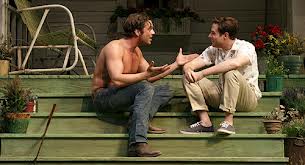
One of the production’s early pleasures is how director Sam Gold instructs his female cast members to stare nearly dumbfounded at the brawny newcomer’s bared torso, turning Sebastian Stan’s Carter into the beefcake object of our collective gaze.  In the subdued mid-West of the 1950s, a man who paraded around the yard with his shirt off was cause for some scandal.

Hal and his abs turning the women's heads

But in Gold’s sensitive and even humorous interpretation, Carter’s flaunted body becomes the nexus for the women’s frustrated longings, the physical manifestation of all they haven’t been able to achieve and every disappointment they’ve suffered instead.  It’s also just fun to see a man made so blatantly the object to be looked at.  With his shirt either opened to his waist or off completely, Stan’s abs and biceps are lit and displayed for maximum effect.

Which is a good thing, because Stan’s performance never clicks as the magnetic drifter to whom every other character compares him or herself and comes up lacking.  With his broad shoulders and tall stature, Stan gets some of Carter’s physical presence right.  But he’s not enough in control of his performance to really generate the brute force of sexuality that turns the women’s heads and tugs at their hearts, or that makes men feel jealous and intimidated.  Stan constantly runs his fingers through his lank, slightly long hair, and looks dark and handsome.

Sebastian Stan as Hal

But his portrait never develops Carter into someone with whom you can sympathize as he struggles to throw off his white-trash, Arkansas past and achieve his own version of the American Dream.  He can’t become more than his body.  His erotic power doesn’t get him the jobs he wants, and his big talk can’t secure him a real place in a stable community. Instead, he’s a pretty, negligent boy, whose hold on the neighborhood’s imagination only makes sense as a fantasy of freedom and flight.

When Mrs. Helen Potts (Ellen Burstyn) hires Hal to do odd jobs around her house, she’s delighted to have the attention of a man filling the empty spaces in a life otherwise spent tending to her querulous, aging mother (played as a whining, shouting, off-stage presence by Lizbeth Mackay).  Helen had a quick and disastrous marriage as a young woman, which her mother quickly had annulled.  But Helen holds on to her would-be husband’s name, never again trying to escape from the help-mate role to which her mother keeps her chained.  Played by the venerable Burstyn as a forcefully cheerful if a bit ditzy elderly woman, Mrs. Potts manages to generate some sympathy as she enjoys Hal’s happy disruption of her dull household routine.

Her close neighbor, Flo Owens (Mare Winningham), has her own history of unlucky love, referring to a ne’er-do-well and now absent husband who turned to other women and to drink soon after her two daughters were born.  But the stoic Flo (beautifully performed by Winningham) determines that her daughters will redeem her by marrying up and distinguishing the family.  Her eldest, the beautiful, willowy Madge (Maggie Grace, of Lost television fame), has been dating Alan Seymour (Ben Rappaport), son of a local business scion whose inherited wealth and place in his father’s empire makes him a worthy catch.  But it’s immediately clear that Madge feels little for Alan, an ambivalence clarified when she first sets eyes on Hal and their initial hello carries all the weight of their instant, searing attraction.

Hopeful attraction, Hal and Madge

Or at least it’s supposed to.  Grace is lovely as Madge, sweet and ingenuous, her dissatisfaction with a life that’s already threatening to entrap her inchoate but palpable.  In Hal, she recognizes an answer to the nagging question of her dawning desire, as well as a way out of a town that objectifies her without really seeing her.  Madge is confined by everyone’s gaze and their projections, since in this town at this time, being a pretty girl is the best commodity to be and to have.  In Hal’s embrace, she finally feels seen for herself instead of as the local prize.  But because Stan’s Hal is emotionally stiff, their great attraction doesn’t register.  Their lack of chemistry hampers Grace’s ability to soar.

Despite a rather hollow central performance, the production still carries the sting of Inge’s critique of masculinity and conventional heterosexuality.  As a gay man in the 1950s, he funneled his desire through the emotions of his female characters, turning them into a collection of repressed and yearning middle-aged women approaching a resigned spinsterhood.  The supporting cast here rises way past the occasions that Inge establishes for them, particularizing each of their personalities and the sexuality they’ve subdued into other preoccupations.

Marvel as Rosemary and Birney as Howard, courting

Elizabeth Marvel, as Rosemary, the Owen’s reluctant, unmarried boarder, gives a heart-breaking but often funny performance as a woman who can’t stand her life as a reputable school-teacher one minute longer.  She chafes at the propriety that’s long hampered her, and rails at Howard (Reid Birney), the ambivalent, rather happy bachelor who courts her on the weekends with a healthy dose of moonshine under his belt but would rather not marry her.  That Rosemary gets her way in the end, much to Howard’s dismay, moving out of Flo’s house into his, is a Pyrrhic victory.  It’s already clear that this marriage won’t be a full-hearted partnership, but a union of convenience that will allow Rosemary to say that she hasn’t wasted her life.

That’s the saddest note Picnic sounds.  In this cosmology, all of these women need a man to save them from single lives of what for women here can only be seen as desolation.  The youngest are determined to get out, Madge by running off with the dissolute Hal, and her younger sister, Millie, the “smart” one, by imagining New York City as her escape.  Millie, played with verve and heart by Madeleine Martin, sees herself into a future in which she can have a career, alone in the city, peddling her brain instead of her body; it’s easy to imagine her becoming Peggy Olson in Mad Men.  Millie’s intelligence, of course, has to be signaled by her masculinity, but in this world, only a kid who looked like a tomboy could imagine a life outside the proper performances of femininity that channeled girls into heterosexual, home-bound futures.

Hal (Stan) and Alan (Rappaport)

The men in Picnic are unhappy too, which makes Inge’s play and its gender implications so resonant.  Even the Adonis-like Hal isn’t really a god; he’s a man who can’t whip himself into shape well enough to pull off the pretense that he’s who he wants to be.  Howard is something of a flibbertigibbet, going on about his store and his responsibilities, creating noise around himself so that he can enjoy having illicit sex with Rosemary but not saddle himself with domestic responsibilities he clearly abhors.  Alan Seymour, whose wealth can buy him any girl he’d like—Madge is a prize for an ordinary physical specimen like him—is jealous of the physical prowess Hal displays so casually.  Alan might be smarter, privileged by class and position, but in Rappaport’s empathetic performance, you can tell he’d trade places with Hal instantly, if he could adopt his easy manner and sexual charisma.  Though Howard and Alan have more social power than the irresponsible Hal, they measure themselves against his erotic power and his physical ease and find themselves woefully lacking.

Flo (Winningham) and Madge (Grace) on the household porch

What does it mean, then, to be a man in a world so firmly delimited by class, gender, and sexual expectation?  What does it mean to be a woman?  Gold uses the occasion of Inge’s play to pose these questions, letting us take the measure of Inge’s moment and ours through his elegant production.  Ably realized by set designer Andrew Lieberman, lighting designer Jane Cox, and costume designer David Zinn, Gold places the homestead nearly center stage, as a corner of the Owen’s kitchen looms out into the central playing space.  Characters go in and out the front door onto a porch, slamming the screen door, and we see them working at the sink or the stove in the kitchen beyond.  They move around the interior space, gliding in and out of sight, in ways that made FS2 think about how the fourth-wall realism from which Picnic is made always promises more access to its characters than it actually gives.

While the scenic choice creates some difficult sight lines and some awkward moments for actors forced to say their lines out over window sills, the design makes an agile metaphorical point.  The house confines all of them.  When Madge climbs to her room on the third floor to prepare for her date, she dreamily leaves her curtains open, letting the audience and Howard and Hal outside in the yard watch her brush her hair and ritualistically apply her make-up.  Gold invites us to watch the men watching Madge watch herself in the mirror, establishing a circuit of gazes that exemplify the yearning not just for sexual contact but for the unsullied, still-expectant life that Madge represents.  The moment is piercing and poignant, demonstrating as it does that no one in this little neighborhood will get what they want, that they’ve all missed out on a happiness that was chimerical to begin with.

Because after all, there’s no redemption in Madge’s fast and no doubt fatal connection with Hal.  After her public hook-up with Hal, Bomber (Chris Perfetti), the young paperboy who openly lusts after Madge, taunts her about her suddenly “bad” reputation, suggesting he wants to be next.  One small step away from sexual decorum means that Madge is already risking a fall from the grace of an upright middle-class life, however deadening.  But Inge suggests that staying within those bounds predicts a straitened life of homosociality, of living in groups of single, divorced, or otherwise abandoned women entertaining one another over cards at downtown hotels, showing off new dresses that adorn the untouched bodies on which they hang, making nervous jokes and laughing to stave off their own loneliness.

Madge follows Hal out of town, hoping she can write a new story from a very old tale.  But on her mother’s face, worn so ably by Winningham, Flo’s wrenching disappointment, concern, and deep knowledge of how history inevitably repeats itself signals everything she knows about what the end is going to be.  And that, of course, is no picnic.

The Feminist Spectator

Picnic, Roundabout Theatre Company at the American Airlines Theatre.

Bethany

Tobias Segal and America Ferrera

Laura Marks’ incisive new play, given a lovely, spare production by the Women’s Project, in residence at City Center, considers the stakes in a faltering economy for those middle-class workers who never imagined they’d somehow lose everything.  Set in 2009, in the darkest days of the recent recession, Bethany tracks the failing fortunes of a woman who’s lost her home, and through a quirk of administrative fascism, temporarily lost custody of her daughter, whose name also names the play.

Played by the talented America Ferrera as intelligent, wily, and deeply humane, Crystal works at a Saturn dealer selling cars that boast their American manufacturing pedigree and foist a cheerily forced sense of industrial family on prospective buyers.  Through carefully structured, cross-cut scenes, we see Crystal attempting to close a sale with Charlie, an oily motivational speaker who visits the dealership multiple times to consider the appropriate model.  The stakes for Crystal are high—she needs her seven percent commission to furnish a foreclosed home in which she’s squatting, so that she can persuade her social worker that she’s reestablished a secure domestic environment for her five-year-old, Bethany.

Marks forgoes conventional exposition, dropping us into Crystal’s plight as the play opens and we see her using a credit card to break into a house she presumes is empty.  After she leafs through mail that’s clearly not her own and looks in empty cabinets, trying the electricity to see if the refrigerator works, she’s startled by the appearance of Gary, a scruffy, bare-foot, slow-talking homeless man who’s already laid claim to the house.  The two circle warily, until they’ve reassured themselves and one another that they can make common cause by sharing the space.

[Spoiler alert!]

In one of Marks’s best moves, however, the play charts how Gary quickly becomes less of an ally, finally aligning with the other ideological forces against which Crystal has to struggle alone.  The economy threatens her already precarious livelihood; the state has taken her daughter and requires her to jump through ever-higher hoops to get the child back; and Charlie, the potential Saturn buyer, sees Crystal only through gender presumptions that allow him to expect sexual favors in return for a deposit on his car.

Gary, whose hold on reality is tenuous at best, fast presumes that Crystal will be part of his paranoid, anti-government scheme to live off the land and re-engineer DNA so that only the best specimens will be left to procreate and recreate the world.  When, in a bargain with the devil, Crystal succumbs to Charlie’s insistence that she have sex with him before he hands over his check, Gary is infuriated.  He destroys the kitchen, writes “whore” across the freezer door in his own excrement, and leaves a dead squirrel in the refrigerator for Crystal to find.  His conservative notions of gender become as oppressive to Crystal as the economic and social environment in which she’s forced to operate.

Gary really isn’t any worse than the other difficult personalities Crystal confronts as she tries to survive.  Charlie might be a snake, but we learn that he, too, is out of a job, and tries to rely on the magical realism of too-optimistic motivational pabulum to convince himself and others that people can get what they want just by willing it to be true.

Ferrera and Emily Ackerman, as Shannon

Shannon, Crystal’s boss at the dealership, is equally squeezed by corporate offices who suddenly announce that they’re closing this franchise.  Her sardonic, hard-shelled personality hides a basic resignation and doubt over whether she can pull herself through her life.  And when Patricia, Charlie’s unexpected wife, tracks Crystal down, only her insistent denial holds her together.  She confronts Crystal about her affair with Charlie, but pretends that her husband remains the hero she wants him to be, instead of a serial philanderer who can’t keep a job.

Taylor and Ferrera, as Crystal navigates the laws that Toni enforces

Toni, the supercilious, insidiously threatening social worker who wields the state-derived power to return Bethany to Crystal’s custody, enjoys her power over her client and has no problem holding Crystal to the letter of the law.  Crystal’s economic circumstances caused her to lose Bethany in the first place; when Crystal tried to find a place for them in a shelter, the authorities took Bethany away from her mother because they were sleeping in their car.  But despite her knowledge of Crystal’s straitened circumstances, Toni insists that Crystal pay to buy Bethany her own bed and to install expensive window guards, as the law requires.  Marks draws keenly the cruel absurdity of social systems supposedly established to advocate for poor people.  The unctuous, self-satisfied Toni becomes the perfect agent of the state, happy to exercise its power over people below her.

Bethany takes a surprising turn three-quarters of the way through that I won’t reveal here.  But although Crystal’s actions are shocking, they remain believable for a woman determined to hold on to the little she has.  Crystal becomes an admirable if melancholy heroine, whose quick thinking, physical daring, and willingness to compromise morals that are only a luxury, given her circumstances, help her survive.  She becomes a model of shrewd self-reliance, determined and courageous given the unresolvable conflict between an economy that makes subsistence nearly impossible and a social system that refuses to offer a safety net, instead only making it harder to keep families together and do what needs to be done.

The kitchen set is backed by a Levittown-like backdrop, evoking the "exurbs" of the small, unnamed American city in which the play takes place

Designer Lauren Helpern’s set evokes the sterile, echoing hollowness of an abandoned home as well as the absent presence of the elderly man whose house was foreclosed and is left empty for Crystal and Gary to squat in.  The production somehow signals that there’s always a third party present whose own loss enables Crystal and Gary to survive in the shelter of his shadow until the power company gets around to turning off the electricity.

Gaye Taylor Upchurch directs Bethany with swift assurance, keeping the short play moving and lean.  Ferrera’s focused, raw performance is complemented by a superb supporting cast.  Tobias Segal is convincing and strangely sweet (until he’s not) as Gary, finding various truths in a character who could be played as a caricature of a paranoid schizophrenic.  With his arrhythmic diction and his odd physical stance, Segal plays the man’s oddities but refuses to let the audience or the other characters to write Gary off as a maniac. His strangeness becomes increasingly unsettling instead of comic.

Ken Marks, too, as the would-be motivational speaker, Charlie, offers a character whose flawed masculinity seems social rather than personal.  That is, Charlie is a fake and a snake, but Marks clarifies that he’s also grasping to retain what he thinks should be his birthright as a man—to have sexual and social power that he can exercise at his whim.  That Charlie isn’t entirely successful makes the character pathetic but also reveals a social system in which economic strife upends gender as well as class presumptions.

Ackerman, Ferrera, and Griffith

The three supporting women are also superb.  Myra Lucretia Taylor, as Toni, the oppressive social worker, hits all the right notes, with the fake cheerfulness and fabricated warmth typical of a social system functionary who does her job for all the wrong reasons.  Emily Ackerman, as Shannon, Crystal’s boss, is comic but poignant as a woman who sees the end coming and can’t do a thing to save herself or her employees.  And Kristin Griffith, as Charlie’s deluded wife, Patricia, captures the fragility of a woman trying to pretend that her life isn’t falling apart at the seams.

Marks has a written a play that reminds me of Caryl Churchill’s ability to intertwine issues of gender and class and the economy.  Marks uses a stylized realism, while Churchill’s strategies tend to be Brechtian.  Bethany also reminds me of Suzan-Lori Parks’s Fucking A and In the Blood, in which her heroine, too (based on Hawthorne’s Hester Prynne), is prey to faceless ideological systems over which she can’t triumph.  Crystal seems her way through a desperate situation but Marks implies that another will surely follow. Her critique is vital and insightful, theatrical and resonant.

The Feminist Spectator

Bethany, New York City Center Stage II, February 2, 2013.