Yearly Archives: 2013

Mr. Burns, a Post-Electric Play

Anne Washburn’s terrific new play, in an elegant, understated production directed by Steve Cosson at Playwrights Horizons, addresses a near-future dystopia in which American civilization has been laid to waste by some sort of nuclear disaster.  The details are less important than their impact; in the play’s moving, compelling first scene, we learn only by accretion what has happened, and why this ragtag group of survivors is assembled in this place and in this way, without ever receiving a full account of the world-changing cataclysm that’s left the tiny community to rebuild itself without electricity.

On a set (perfectly designed by Neil Patel) that evokes an outdoor space whose borders are warily guarded but that can be permeated at any time from any direction, a few men and women pass their time reminiscing not about the families or friends they’ve lost (that comes later, only briefly), but about the elaborate plot points of an episode of The Simpsons called “Cape Feare.”  In Washburn’s elegiac vision, community is rebuilt by remembering together a cartoon series in which the episode being reviewed is itself a multi-layered, post-modern reference to older movies and their newer re-makings, loaded with in-jokes and obscure allusions.  By recalling the rich episode together and jointly acting parts of it out, these folks begin to re-knit themselves once more into something that might be called a society.

That popular culture—and a televised cartoon, no less—would become the common reference point through which to rebuild sociality is a deft philosophical and political suggestion.  Washburn proposes that rather than discreet ethnic, racial, sexual, or gender identities or nationalities (though everyone here seems to be nominally “American”), people will find their way back into a re-imagined social fabric through the memory of a popular culture that called on their hermeneutic insights to make it meaningful and pleasurable.

By setting the play in the future, Washburn points back to the now, in which, indeed, popular culture like The Simpsons is already working to form communities across what were once more rigidly defined identity positions.  The playwright suggests, in fact, that popular culture is already—and perhaps will become even more so in a straitened future—our cultural capital, and will gain more and more exchange value as other forms of currency and commerce becoming meaningless in a post-nuclear disaster world.  The pleasure of remembering narrative—as arcane and irrelevant as The Simpsons episode at first seems—becomes as valuable and luxurious as listening to jazz or classical musical, as watching Shakespeare or seeing a film is now.

Post-apocalypse remembering in the first scene

Part of the play’s pleasure is how it foils your narrative expectations while the characters enjoy reveling in their narrative reconstructions.  That is, the dystopian genre would suggest at least a stab at new political theorizing, at declamations about how society might reorder itself and its remaining people.  Instead, the outside world impinges on this new community only rarely, and only to stake its claims on the currency of memory.  The new borders have less to do with political theory than they do with shoring up the ensembles that spring up to perform their own memories of The Simpsons episode.  Remembered lines become closely guarded and fought for across these performance troupes, as survivors protect their repertoire of recalled dialogue and scenes and character attributes and inhabit their memories through performance.  Over its three acts (but only one intermission), the play crescendos into economically poor but affectively rich theatricality.  The play’s final performance-within-the-performance implies that the new society has become a simulacrum of the memories it’s reconstructed to constitute its present.

That might sound heady.  There is indeed something philosophical about Washburn’s take on the future and her proposal about how the world might be rebuilt.  But her intensely theatrical vision translates beautifully in Cosson’s production.  The actors, to a person, play from intense naturalism; the play was in fact first improvised with The Civilians, the troupe to which Washburn, Cosson, and many of the performers belong.  Their attempts to recall The Simpsons episode evince the kind of memory-making in which a sudden flash is gleefully announced and happily built upon by the assembled.  Their recollections begin to take shape as a collective image of an imagined past that only ever lived in their individual minds’ eyes.

But those detailed reminiscences become affecting and infectious.  I never watched The Simpsons (although I did screen the “Cape Feare” episode in preparation for Mr. Burns) but even I felt a great deal of pleasure in the cast’s recitations.  Because none of these people knew one another before the apocalypse, but are wanderers thrown together when they escape from towns incinerated by nuclear fallout, they have little in common but their love for popular culture.  That it becomes enough to rejoin them into a semblance of human community—through theatre and performance, no less—is conceptually moving.

The one interaction that actualizes the devastation happens when Gibson (Gibson Frazier; all the actors are called by their real names, and then assume rotating roles from The Simpsons episode) falls across the little group on his way south from Boston.  These chance meetings, it seems, require a ritual.  The new arrival is asked if he’s seen friends or loved ones, whose names the group recalls from notebooks in which they’ve written their names.  Gibson, too, has a book, where he’s listed names of survivors he’s passed along the way.  The rules, though, require that each person share only ten names—someone in fact suggests they heard the sharing has been limited to eight.

As the group runs through their lists, Gibson thinks hard, believes he recognizes one or two, and then shakes his head negatively.  In that simple, sad scene, we see the history of old forms of human fellowship constrained and then dissolving, as we understand that none of these people will be reunited with those they lost.  The hope, in Washburn’s hands, comes from how they re-make communities through memory—and through theatre.

Rehearsing, in costume

In the first act, the actors’ recall of the episode is narrated, as we watch especially Matt (Matthew Maher, as terrific here as he was in Annie Baker’s The Flick in Playwrights’ last season) throw himself into dazzling feats of remembrance.  By the second act, a make-shift theatre is constructed, as their much reduced living place now has corrugated walls within which a jerry-rigged proscenium has been erected.  The second act is pure rehearsal, as stagehands and costumers work with the actors to prepare their performances and the community is threatened by marauders who want to steal their lines.  In the third act, the performances are so intact there’s very little outside of them—the enactment of a memory of popular culture has become the day’s lingua franca, the way in which they inhabit their lives.

Washburn’s insight into the pull of memory, of popular culture, and of the embodiments of theatre and the necessity of performance is elegant and persuasive.  Somehow, she and Cosson and the cast (aided by Michael Friedman’s wonderful score and especially Nedra McClyde’s gorgeous third-act singing) avoid the imperious irony that might undermine how affecting the play and production turn out to be.  That is, The Simpsons, as I understand the show, often plays with political and postmodernist irony that would keep audiences at an emotional remove.

Playing the Simpsons

But in Mr. Burns, audiences are invited to empathize with the situation and the commitment of a band of players arrayed to communicate with one another through memory and pleasure and a strange, inarticulate but present kind of love.  We know little about any of the “characters”—in fact, in the first act, one of the women is withdrawn and tense, and although the others seem worried about her, the audience never learns what’s wrong.  In the second act, she’s become the troupe’s director—she’s articulate, strong, and present.  No backstory explains this transformation; social rules, as well as theatrical and narrative rules, are rewritten in Washburn’s talented hands.

The cast is uniformly excellent.  Along with the enormously affecting Maher, the sober Frazier, and the musical McClyde, Quincy Tyler Bernstein, Susannah Flood, Jennifer R. Morris, Colleen Werthmann, and Sam Breslin Wright work beautifully together, creating a very specifically real emotional and physical world without any of the tricks of conventional theatre.  You see them working together as actors—the actors in this play–Mr. Burns–and as the actors they play in The Simpson episodes they reconstruct.  That labor, Washburn suggests, and that commitment to embodiment, reenactment, and memory, creates a common future, one in which the audience is emotionally invited to take part.

The production and the play are a tour-de-force, an original, smart, moving illustration of possibility, a hopeful reading of a dystopia that could be a nightmare and which, in Washburn’s hands, turns out instead to be life as a dream.

The Feminist Spectator

Mr. Burns, a Post-Electric Play, at Playwrights Horizons through October 20th.

Women or Nothing


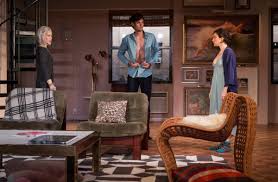
Feiffer as Gretchen and Pourfar as Laura on the gorgeous set

What’s irksome about this play by filmmaker Ethan Coen (No Country for Old Men) at the Atlantic Theatre Company is that it’s so clearly a rough draft.  While most American playwrights see their scripts workshopped endlessly—sometimes for years, and often to the detriment of the work and their creativity—here’s a famous (albeit talented) writer whose name recognition and cultural capital entitles him to a full, beautifully designed and well-cast production of the play that doesn’t quite yet know what it wants to be when it grows up.

Laura and Gretchen are a lesbian couple “desperate” (according to press materials) to have a child.  Gretchen contrives for her office-mate Chuck to visit her at home, where she’s conveniently absent, so that Laura can seduce him, all with the convoluted intent to use what appears to be Chuck’s first-rate sperm to conceive their child.  Through a series of coincidences, the plan goes awry, as they tend to do, even in would-be sex farces like this one.

But Coen’s uncooked play isn’t quite yet a sex farce; it also has ambitions towards a darker, more philosophical comedy about ethics and identity, while at the same time borrowing a page from Oscar Wilde and appearing an absurd comedy of manners.  Any one of these genres and styles might have been enough.  As a mash-up, the play keeps missing its mark, as the actors and their characters wave to one another from the decks of stylistic ships heading in quite different directions.

The talented Susan Pourfar (Tribes and a role on TV’s Scandal as Huck’s murderous paramour) plays Laura, a famous classical pianist with a rather vicious notion of her own success.  Pourfar affects a snobby, ponderously cultured accent to represent Laura’s affectations, which becomes funny once you understand that Pourfar wants us to join her in poking fun at the character.  Halley Feiffer, on the other hand, goes for sitcom cute and sassy as Gretchen in the evening’s least tonally convincing performance.


Beitzel as the unwitting sperm donor, Chuck

Robert Beitzel, as Chuck, seems to have wandered in from a Pinter play, pausing often as he tries to understand what’s happening to him as the evening’s machinations ensnare him.  Debra Rush is wonderful as Laura’s mother, who plays the Lady Bracknell of the affair with imperious affront.  She’s a sexual adventurer in her own right, but even she can’t quite keep up with the intrigue set in motion by her daughter and her partner.  Rush is wonderful, and she and Pourfar prove terrific comic partners, as their scenes work best so far.


Rush, Beitzel, and Pourfar in an awkward post-coital confrontation

I saw a preview of this production, which opens on September 16 and has already been extended by a week, into October.  Director David Cromer, known for his coup de theatre with his terrific production of Our Town, and more recently revered for his direction of Tribes, stays out of the actors’ way, understating their blocking and allowing lots of realist silence and room for business that sets up the play’s final reveal.  But what Women or Nothing really needs is a dramaturg to help Coen decide which path through this plot and its issues he really wants to take, and to help him prune off the tangents.

As is, the play seems most invested in plot points that consider the difference between nature and nurture.  Gretchen is particularly committed to the idea of a sperm-donor whose “product” is tested, assuming that children are as eggs and semen do.  But Coen’s twist implies that we can’t really control our destinies, that genetic material both does and doesn’t predict its own outcomes.  Even his argument wants to have it both ways, and some of the plot stretches each side of the point.


Laura reasons it out for Chuck

Chuck and Laura have the most interesting and literate dialogue in their seduction scene, as Laura reveals herself to be aware of her own carefully constructed public persona, even as she bemoans her own inability to insist on the more private self she suspect exists.  But ultimately, it’s difficult to care one way or another, as the dialogue swings between slightly amusing and simply serviceable.

And why, really, did Coen need a lesbian couple to tell this story?  Clearly, his inquiry into nature and genetics needed a non-reproductive couple to set his plot in motion.  But we know nothing of Laura and Gretchen’s relationship, including why they so desperately want a child.  Pourfar and Feiffer demonstrate not a spark of chemistry; even their casual affection seems awkward and unpracticed.  The lesbian relationship seems shoehorned into a plot that wants to be about many other things, few of them developed.


Feiffer and Pourfar, not a lot of chemistry there yet

Perhaps with more previews before opening, Coen and Cromer can pull the production together.  For now, it’s a shame to see the Atlantic’s budget and the designers’ skills wasted on a gorgeous two-level interior set (a spiral staircase leads up to a loft in which a baby grand piano sits, spot-lit, but never visited or played by the characters), a talented cast, and a play that doesn’t really do service to either.

The Feminist Spectator


Elysium

Matt Damon as Max saves the world in ELYSIUM

Neill Blomkamps’ commitment to the plight of the global 99% seems radical for a filmmaker given a block-buster budget and a chance to work with superstar Matt Damon.  The South African filmmaker’s District 9 (2009), his lower-budget break-out hit, used keen allegories, metaphors, and evocative sci-fi visuals to deliver a parable about barely post-apartheid social justice.  Elysium, as many reviewers have noted, vastly increases his budget and gives him too many toys.  As a result, what could have been an effective story about the haves and the have-nots, and a struggle for real democracy, gets buried under movie conventions that obscure the film’s more progressive heart.

Devastated LA in 2154

In Blomkamp’s tale—which he wrote and directed—it’s 2154 in a desiccated, devastated Los Angeles.  Our hero, Max (a very appealing Damon), is now a man, though Blomkamp flashes back to his childhood as an orphan raised by nuns alongside a girl named Frey (Alice Braga, as an adult) who remains his love-interest throughout his life.  Max has a checkered past—he’s a reformed thief, trying to scratch out a living among the rest of his poor peers on Earth.  They live in the shadow of Elysium, a utopian, wealthy and privileged world, devoid of illness, that shimmers in the sky like beacon, always visible but impossible to reach.

Elysium in the sky like a Mercedes Benz medallion

Gangs of resisters try to penetrate its airspace in souped-up space shuttles full of illegal immigrants.  While the metaphor might be heavy-handed and obvious, it’s cheering to see immigration taken up as a theme in a sci-fi film with a political critique on its agenda.  Groups of desperate brown people leave the crashed shuttles when they reach Elysium, fleeing for the pods that will cure their diseases or looking for a life superior to the ones they left behind on Earth.  (Those pods look like present-day, cancer-promoting tanning booths, as it happens, a nice ironic touch.)

In the future LA, everyone speaks Spanish, as Blomkamp’s cast embodies the prediction that Latino/as will soon be the U.S. majority population.  On Elysium, most—though not all—of the rich and powerful people are white.  In a newly global space society populated mostly by Anglo-Europeans—signified by the fact that they speak French or British-accented English—President Patel is of South Asian extraction, but Delacourt, the villain (played stiffly by Jodi Foster, though her white, white hair and ice-blue eyes are wonderful), is a white woman determined to seize his power for herself.

Foster as the white, pan-Anglo/European ice queen, Delacourt

The plot doesn’t matter much, but it’s fun to track Blomkamp’s analogies and allegories through his visuals and his casting choices.  The film’s racial politics dictate that the social justice gangs on Earth are comprised of men across race, including Mexican actor Diego Juna, who plays Max’s friend, Julio, and the Brazilian actor Wagner Moura, who plays Spider, the head of the resistance.  Much of the dialogue is in Spanish with English sub-titles; the English is often spoken with an array of accents.

Copley as Kruger, the predatory villain

The film’s other villains are white men, most notably Sharlto Copley, who played the hero in District 9 and here is cast as Delacourt’s henchman, Kruger, a coldly vicious specimen who betrays her in his own bid for power.  Max, the “good” white man, is destined to become a martyr, supremely sacrificing himself to rewrite Elysium’s computer programming to ensure that his fellow dispossessed earthlings will become full citizens.

Damon's abs signal that he's the hero

I can applaud a film that ends with democracy and health care for all, especially one in which the politics of racial difference are addressed so explicitly.  But as I watched Elysium, I couldn’t help but notice its terrible gender representations.  The lovely, compassionate Frey has grown up to be a doctor, whose path crosses once again with Max when he turns to her for medical attention.  Frey is a (single) mother with a child dying of leukemia; Frey’s only hope to save Mathilda (Emma Tremblay) is to get her to Elysium, where she can be treated by their magic, death-defying machines.  Through a set of plot contrivances, Frey and her daughter wind up with Max and Kruger in a shuttle rocketing toward the utopian planet.

Saving the mother and her dying child

But Frey’s presence is only useful to secure a typically virtuous, threatened womanhood in a film otherwise about male heroism.  Frey is beautiful and silent; on the shuttle, Kruger threatens her with rape, running his knife across her face (metaphorically if not literally) while Max/Damon watches in impotent horror (he’s tied up at the time).  Once they arrive on Elysium, Frey is burdened with her sick daughter’s body, racing through Elysium’s Get Smart-esque series of doors and passageways and richly green neighborhoods looking for a machine that will cure her.  The kid has more interesting dialogue than she does.  Of course, by the end, Max and the other men save both mother and child.  All Braga can do is sigh with grateful maternal relief and look gorgeous.

Foster’s Delacourt has little to do.  She’s just a whiter-than-white ice queen with a pan-Anglo/European accent that sounds ridiculous.  Her dirty dealings and illegal maneuverings—and her anti-immigrant racism—require her to die.  Her throat is cut, staining her gorgeous gray suit, and she bleeds out right in front of Frey, who can neither save her nor establish common gender-cause.

As an allegory, Elysium is fun, even smart, and visually compelling. Blomkamp has a sense of humor; those intimidating sliding doors that close on the villains while the heroes run through them all boast signs that say, “Caution:  Heavy Doors.”  Blomkamp conceives of 2154 LA as a mash-up of Johannesburg shanty-towns, Pennsylvania’s old steel towns, and a kind of Appalachian outpost, while Elysium is the ultimate in gated suburban communities.  Blomkamp creates a future Earth with gritty realism.  That his hero is a mortal man who’s filthy and bloody and sweaty even before he’s assigned to save the world makes Max empathetic and appealing.

But too many “car” chases (here, retrofitted space vehicles) and too much hand-to-armor combat between Max and Kruger detract from Blomkamp’s central theme.  And the film’s gender politics imply that even 150 years from now, women will still be prey to sexual violence and require good white men to save them.  Can’t we imagine something more progressive than that?

The Feminist Spectator

Blue Jasmine

Blanche DuBois is an iconic character of the white male American imaginary, a damaged, even pathological figure, whose sexual and emotional pathos drives Tennessee Williams’s A Streetcar Named Desire.  The canonical play has been revived on Broadway several times in the last few years, once with Cate Blanchett in a production originally mounted with her Sydney-based theatre company, and once by director Emily Mann with an all-African American cast.  Now, Woody Allen enters the Williams arena with his own film adaptation of the play, also starring Blanchett, in Blue Jasmine.

Reconceived as a cross between Streetcar and the Bernie Madoff story, the film chronicles the downfall of “Jasmine” (born Jeanette, the Blanche character), a comfortably clueless member of the 1% whose life begins to unravel when her husband, Hal (Alex Baldwin), is indicted for financial fraud of the Madoff magnitude.  Fleeing New York, where former friends now only pity her reduced circumstances, she settles in with her working-class sister, Ginger (Sally Hawkins), in San Francisco.  By Jasmine’s standards, Ginger’s apartment on Van Ness is tiny and cramped, but Jasmine proceeds to crowd it even more with her out-sized personality and expectations, disrupting numerous people’s lives with her illusions and narcissism.

Living the life of the one percent

Allen uses flashbacks to measure the distance Jasmine has fallen, and to gradually implicate her in her own misfortune.  From a millionaire’s life in New York to a one-bedroom flat in San Francisco; from cavorting with the rich to working as a receptionist for a lecherous dentist; from presuming she deserves the luxury she’s been handed to maintaining those illusions, even when she’s precipitated the crisis that dissolves her thoughtless privilege, Allen creates a compelling portrait of a ruined woman.

His adaptation—which uses much of Williams’s plot and some of the play’s dialogue, even as it expands the narrative to include a Madoff-like scheme and a revised story for Ginger (the Stella character)—also emphasizes that Jasmine is nothing but a performance of herself.  Where Williams hinted that Blanche had a soul that was corrupted by circumstances both emotional and economic, Allen denies Jasmine a heart.  As Stacy, Feminist Spectator 2, remarked, she’s only a series of screens, projecting an image of herself crafted to fit what “white woman” and “wealth” mean on the Upper East Side of contemporary New York.

Blanchett, unvarnished as Jasmine/Blanche unravels

As a result, where those recent Broadway theatre revivals managed to cook up some empathy for the deluded Blanche, Allen makes it difficult to feel anything but contempt for Jasmine.  Blanchett’s completely unvarnished performance is marvelous; it’s rare to see a woman so exposed on screen, and an actor so unconcerned with how she looks.  That Blanchett plays against Jasmine’s utter concern with her own surface creates a tension that makes her performance fascinating.

Taking selfies: Max Casella, Blanchett, Hawkins, Cannavale

The rest of the cast, too, is excellent.  Hawkins plays Ginger/Stella with confused guilelessness, one moment persuaded by Jasmine’s pretentions that Ginger deserves more from her life, and the next settling in rather happily with the rough-hewn mechanic, Chili (Bobby Cannavale), who adores her.  Hawkins captures Ginger’s confusion about how much striving is enough, given that she’s actually content with what she has.  Ironically, Hawkins—who’s British—and Blanchett—who’s Australian—play these quintessential American characters with real insight into what they represent about contemporary white American femininity.

Dwight/Mitch (Sarsgaard) and the potential for "redemption"

Chili serves as the film’s Stanley, the working-class, physically magnetic hero, given a much more lovable, humanized reading by the sweetly sexy Cannavale.  Peter Sarsgaard’s Dwight is the upper-middle-class Mitch stand-in with the potential to save Jasmine from herself.  With a conveniently deceased wife and a ton of money, Dwight seems the perfect white man on a white horse riding to Jasmine’s rescue.  But she can’t stop herself from lying to him about her past, finally, once again, undoing any possibility of future redemption.

Blanchett makes these plot machinations believable, and the combination of Williams’s dialogue with Allen’s (and exchanges that seem improvised, they sound so natural and spontaneous) keeps the film moving along in a literate and compelling way.  But as my former colleague, the famed, late theatre historian Oscar Brockett, used to say, “Why this play [read film]?  Why now?”  The perennial interest in the madwoman (as Sondra Gilbert and Susan Gubar wrote years ago) who’s somehow the exemplar of white femininity; the woman whose agency is warped by a deluded sense of social propriety; the woman with no desire of her own, except for maintaining her own fantasy of herself, from the outside, for others . . . isn’t stereotype shopworn by now?

Blanchett (for whom Oscar buzz has already begun) is terrific and makes the film worth seeing, along with Hawkins, Cannavale, Sarsgaard, and Baldwin as the Madoff figure, Louis C.K., as a man who seduces Ginger without telling her that he’s married, and even Andrew Dice Clay as Ginger’s first husband, Augie, all of whom bring nuance to characters that could be two-dimensional.  But it’s too bad we get to see all this good work in such a tired tale.

The Feminist Spectator


The Fosters, on ABC Family


The Fosters, under one roof

Teaching my course on gender, sexuality, and pop culture last spring, I encountered some of the progressive, queer-friendly narratives of the ABC Family network’s line up for the first time.  I’d stopped watching Pretty Little Liars before one of its four teenage heroines came out as a lesbian.  And I knew nothing of the queer vampire (or is it werewolf?) on Teen Wolf.  Who knew that ABC Family programmed stories that would be equally at home on Logo, if that LGBT channel had the money for higher production values?


Stef (Teri Polo) and Lena (Sherri Saum) at home

The Fosters premiered on ABC Family this summer, and multiplies exponentially the gender-, race- and sexuality-related content of its sister shows.  Stef (Teri Polo) and Lena (Sherri Saum) are an inter-racial lesbian couple called the Fosters who also happen to be foster parents.  The musically talented Brandon (David Lambert) is Stef’s biological son from a prior heterosexual marriage; Jesus (Jake T. Austin) and Mariana (Cierra Ramirez) are teenage Latino twins the couple fostered and then adopted when they were children.

Stef is a cop; Lena is the vice principal at an ocean-side, progressive charter school all their children attend.  In the first episode, Lena impulsively agrees to foster Callie (Maia Mitchell), a teenage white girl just released from juvenile detention.  It turns out she was sent away for smashing up her step-father’s car, but only after he beat up her little brother, Jude (Hayden Byerly), for wearing a dress.

I didn’t see the whole season, which ended this week with Stef and Lena’s wedding.  But I’ll watch again when it resumes, as I’m curious which themes the show will take up next season and how its characters will grow.  And if I have to look to ABC Family for representations of multi-racial queer characters, count me in.

The “Family” designation of this ABC network perhaps explains the “after-school special” tone of some—though not all—of the writing on The Fosters.  Issue after social issue is packed into each episode in ways that sometimes feel didactic.  When Jesus and Mariana find their birth mother, for example, and proceed to see her without telling Stef and Lena, the woman turns out to be a junkie with a murderous boyfriend.  She takes money from the twins, but can’t straighten out her life enough to really be of use in theirs.


Navigating the kitchen

After Jesus and Mariana learn this hard lesson, Lena comforts Mariana by acknowledging that it must be hard to have a birth mother who chose not to have her children in her life.  But Lena explains that she and Stef did choose to parent Mariana and Jesus, and that families of choice often make more sense and provide more support than those bound by biology.  Can’t argue with that.  And I registered my surprise and pleasure at hearing a character on television explain families of choice so eloquently. 

Lena and Stef at their wedding

Stef and Lena, who’ve been together for ten years, cap the series’ first season with their wedding.  Stef is reluctant, sabotaging the upcoming nuptials with sarcastic remarks and casual indifference until she realizes that she’s internalized her father’s homophobia.  When she accepts that the doubting voice in her head is not hers, but her father’s, she uninvites him from the wedding and moves forward with her commitment to Lena.

The wedding ceremony scene is nicely subdued.  Lena’s father, who officiates, announces how pleased he is that the Supreme Court finally did the right thing by realizing that all people are entitled to equal protection under the law.  Again, I found myself delighted to hear a television character expressing such an opinion. 

Nucci as Mike, Stef's ex, with Saum as Lena

Danny Nucci plays Mike Foster, Stef’s ex-husband, who also happens to be an alcoholic cop (they once were partners on the police force).  His addiction is the least persuasive plot line in the first season, too easily resolved when we see him attending an AA meeting in the last episode.  Even though ABC Family’s network tag-line is “A New Kind of Family,” it seems a show like this can’t get away without some sort of heterosexual adult male presence.  Nucci doesn’t have much to do as Mike, except be the standard-bearer for a straight guy trying to be mindful of his privilege and his masculine presumptions.  But I suppose even that contributes a useful, if mostly pedagogical, point of view. 

Not much heat, but nice affectionate chemistry

The actors carry the show with earnest performances that soft-pedal the dialogue’s frequent preaching.  Although they’re not quite convincing as a romantic couple—despite frequent bedroom scenes with a generous amount of bare skin and physical intimacy—Polo (as Stef) and Saum (as Lena) manage an affectionate chemistry that makes them plausible as a couple with five kids who manage a household and two full-time jobs.

Brandon (Lambert) and Callie (Mitchell) make beautiful music

The young cast is excellent.  Austin and Ramirez have a lovely rapport as Jesus and Mariana, the Latino twins; that they look out for one another, even as they begin to meld with the rest of the family, provides some sweet sibling moments.  Mitchell and Lambert, as Callie and Brandon, the two oldest teens, try to avoid their growing erotic attraction all season, especially once Stef and Lena decide to formally adopt Callie and Jude.  When Callie and Brandon finally hook at up their moms’ wedding, the moment precipitates a cliff-hanger crisis in preparation for Season Two.  Mitchell is terrific as Callie—she’s an appealing, smart young actor who reacts with nuance in a role that could be cloyingly overplayed.

Domestic arrangements, with their trials and tribulations, are the stuff of television sit-coms and melodramas.  The Fosters falls into predictable patterns, exploring high school traumas, the complications of a blended family, and the complexity of people across generations helping one another through their lives.  That the parents here are lesbians, that the family is multi-racial, and that four of the five kids are adopted from a disorganized and uncaring foster system makes The Fosters worth a look.

The Feminist Spectator